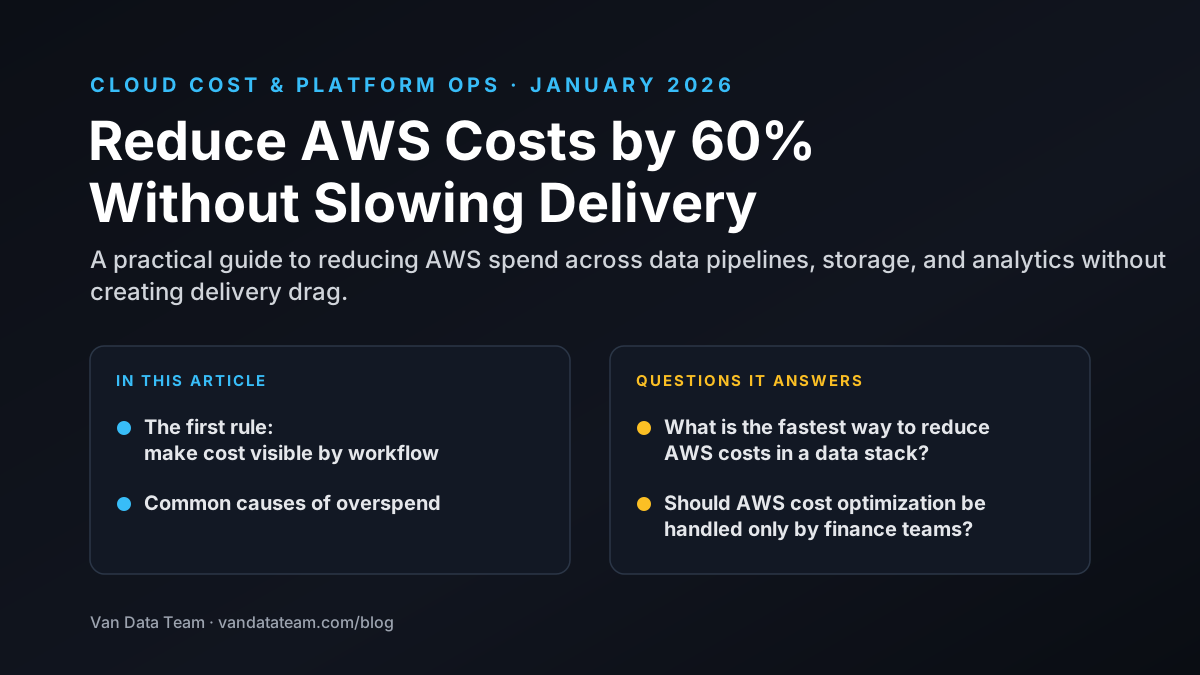
How Data Teams Reduce AWS Costs by 60% Without Slowing Delivery
A practical guide to reducing AWS spend across data pipelines, storage, and analytics without creating delivery drag.
Reducing AWS spend by 60% usually does not come from one heroic infrastructure trick. It comes from a series of architectural decisions that remove waste, simplify the path data takes, and make usage visible to the team that owns it.
The first rule: make cost visible by workflow
Cost reports are noisy when they are only grouped by service. Teams make better decisions when spend is mapped to a workflow such as:
- ingestion
- storage
- transformation
- analytics delivery
- experimentation
That framing changes the question from “why is S3 expensive?” to “which workflow is creating the storage and compute bill?”
Common causes of overspend
Over-provisioned compute
Many teams size for peak load and forget to revisit it. Batch windows end, workloads change, and the oversized cluster keeps running.
Redundant storage copies
Raw, cleaned, transformed, and analytics-ready copies can all be useful. But many stacks keep too many copies for too long with no lifecycle policy.
Query patterns nobody revisited
Expensive warehouse and Athena usage often reflects old dashboards, broad scans, or weak partition strategy more than actual business value.
The optimization playbook
1. Right-size compute around real workload shape
Look at when the workload actually spikes. Many pipelines can move from always-on capacity to scheduled or autoscaled capacity with no delivery penalty.
2. Tighten retention and lifecycle rules
Not every dataset deserves the same storage class or retention period. Lifecycle transitions are one of the cleanest ways to reduce cost without reducing capability.
3. Remove duplicate movement
Teams often pay twice: once to move data and again to store multiple slightly different copies. A better contract between raw, staged, and modeled data reduces both complexity and spend.
4. Make dashboards earn their keep
If a dashboard or report is not driving decisions, it should not be generating heavy scheduled queries every hour.
5. Pair cost reviews with architecture reviews
Pure finance-led cost optimization often misses the engineering reason the waste exists. The strongest savings show up when cost review and architecture review happen together.
A simple decision framework
When evaluating any AWS optimization, ask:
- does it reduce spend visibly
- does it keep or improve reliability
- does it simplify operator understanding
- does it create new delivery drag
If the answer to the last question is yes, the change may be false efficiency.
The takeaway
The best AWS cost optimization work is operational, not cosmetic. It removes waste by improving architecture discipline, not by making the team tiptoe around the platform.
That is why the most durable savings tend to come from data workflow design, not one-off discount hunting.

Founder of Van Data Team. Builds Vanaxity, the AI agent system for SEO, GEO, and AEO, and leads data engineering delivery for B2B teams.
About the authorArticle FAQ
Questions readers usually ask next.
These short answers clarify the practical follow-up questions that often come after the main article.
Need a similar system?
If this article maps to a workflow your team already operates, the next step is usually a scoped review of the system, constraints, and rollout path.
Consultation
Scope your next AI workflow.
Share the system and blockers. We will map fit, gaps, and the next step.