May 18, 2026
GPT 5.5 vs Claude Opus 4.7: practical comparison for production teams
GPT 5.5 vs Claude Opus 4.7 depends on workflow fit, risk, review cost, and guardrails. Use this guide to compare models before production.
Article focus
Teams comparing GPT 5.5 vs Claude Opus 4.7 should start with the workflow, not the model name. A useful comparison tests both models against real tasks, scores the outputs, tracks review effort, and identifies where guardrails or human escalation are required before...
Section guide
Teams comparing GPT 5.5 vs Claude Opus 4.7 should start with the workflow, not the model name. A useful comparison tests both models against real tasks, scores the outputs, tracks review effort, and identifies where guardrails or human escalation are required before production use.
The risky move is treating one public benchmark, one viral screenshot, or one impressive demo as a buying decision. Senior teams need a clearer answer: which model performs better inside the job they need to run every week?
This GPT 5.5 vs Claude Opus 4.7 guide gives you a practical evaluation framework for AI agents, reporting workflows, data operations, and internal automation. It uses official documentation where current specs matter, but the main recommendation is operational: test against your own inputs before you decide. For prior context, see our deeper take on Claude Opus 4.7 benchmarks for production AI agents and the earlier GPT 5.4 vs Claude Opus 4.7 comparison to track how the model gap has shifted.
Key Takeaways
- GPT 5.5 vs Claude Opus 4.7 is not a universal winner question. It is a workflow-fit, review-cost, and risk-control question.
- As of May 18, 2026, official docs list both models with frontier-scale context windows and premium pricing, so cost per successful task matters more than token price alone.
- The best GPT 5.5 vs Claude Opus 4.7 framework uses real prompts, expected outputs, scoring rubrics, failure logs, and human review metrics.
- Production teams should compare escalation rate, retry rate, factual error patterns, tool-call reliability, and reviewer time.
- If the model will touch customer answers, financial analysis, code changes, or executive reporting, guardrails are part of the build, not a later cleanup task.
GPT 5.5 vs Claude Opus 4.7 at a glance
Use this battlecard to keep documented specs separate from production evidence:
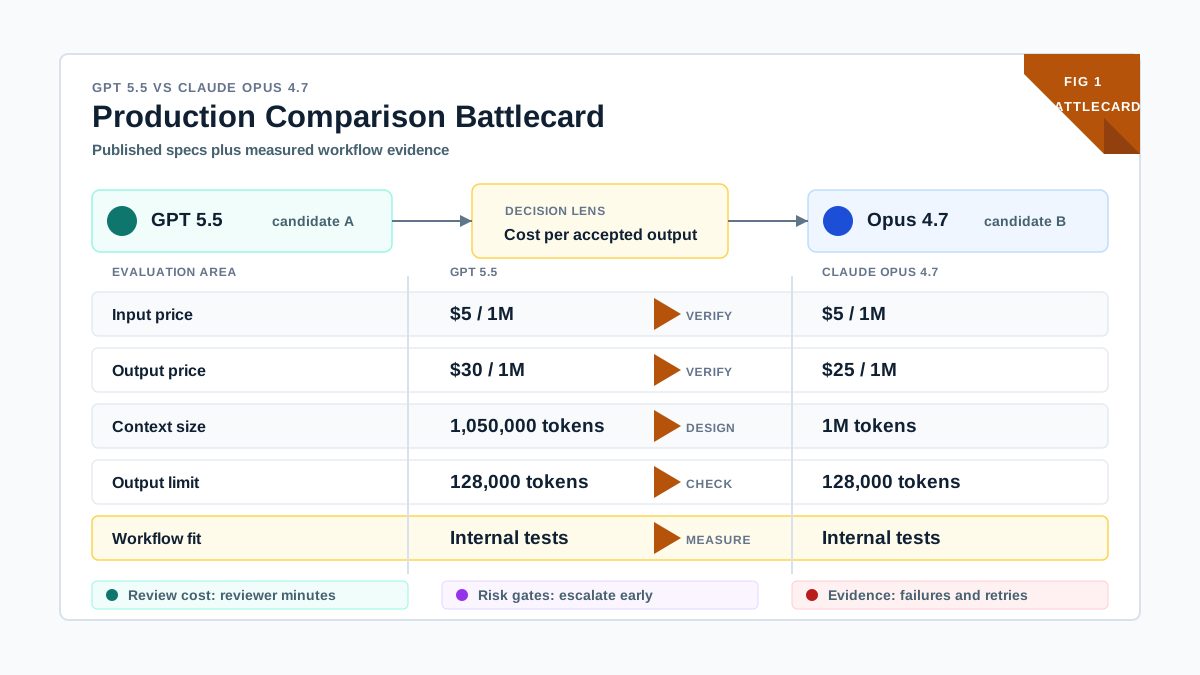
A fair GPT 5.5 vs Claude Opus 4.7 comparison separates documented specs from workflow evidence. Official docs can tell you pricing, context limits, output limits, and platform availability. They cannot tell you how either model will behave inside your support queue, warehouse incident workflow, or board reporting process.
As of May 18, 2026, OpenAI's GPT-5.5 model documentation lists a 1,050,000 token context window, 128,000 max output tokens, and pricing of $5 per 1M input tokens and $30 per 1M output tokens. Anthropic's model overview lists Opus 4.7 with a 1M token context window, 128,000 max output tokens, and pricing of $5 per 1M input tokens and $25 per 1M output tokens.
Those numbers are useful, but they are not the decision.
| Evaluation area | GPT 5.5 | Opus 4.7 | Production note | |---|---:|---:|---| | Input price | $5 / 1M tokens | $5 / 1M tokens | Verify before buying capacity | | Output price | $30 / 1M tokens | $25 / 1M tokens | Compare cost per accepted output | | Context window | 1,050,000 tokens | 1M tokens | Large context does not remove retrieval design | | Max output | 128,000 tokens | 128,000 tokens | Long output still needs structure checks | | Best evidence | Internal task tests | Internal task tests | Vendor claims are not enough | | Review requirement | Use risk-based gates | Use risk-based gates | Human escalation belongs in both workflows |
If you are building production AI agent workflows, connect model choice to runtime design. Van Data Team's work on AI agent development starts by mapping the decisions, tools, handoffs, and failure modes before selecting the model.
What is GPT 5.5 vs Claude Opus 4.7?
GPT 5.5 vs Claude Opus 4.7 is a commercial investigation query. The reader is not looking for a generic model definition. They are deciding which frontier model belongs in a real workflow.
That workflow might be an internal research agent, a support triage assistant, a coding agent, a reporting analyst, or a data pipeline incident summarizer. In each case, the right comparison changes. A model that drafts polished analysis may still fail if it calls the wrong tool, misses a policy exception, or hides uncertainty from the reviewer.
The practical meaning of GPT 5.5 vs Claude Opus 4.7 is this: compare both systems against the job, not against each other in the abstract.
A better first question is:
What output must this workflow produce, what evidence must support it, and who is accountable if it is wrong?
That question keeps the team away from model fandom. It also prevents a common failure mode: selecting a model because it looks strong on a sample task, then discovering that production inputs are messier, longer, more ambiguous, or more sensitive than the demo.
Maya, a head of support at a SaaS company, learned this during a support triage pilot. Her team tested 40 clean tickets and got strong results from both models. Then they added 200 real tickets with missing context, angry customer language, duplicate issues, and stale CRM fields. The ranking changed. The model that looked better in the demo created more escalation cleanup. The final decision came from reviewer minutes per ticket, not from first-impression answer quality.
Why GPT 5.5 vs Claude Opus 4.7 matters in production
GPT 5.5 vs Claude Opus 4.7 matters because production systems pay for errors in time, trust, and workflow drag. The model does not operate in a vacuum. It sits inside prompts, tools, permissions, data contracts, logs, and human review.
For an AI agent, the important question is not only "did the answer sound right?" It is also:
- Did the model retrieve the right source?
- Did it call the right tool with valid arguments?
- Did it stop when confidence was low?
- Did it explain uncertainty clearly?
- Did it create extra work for the reviewer?
- Did the workflow produce an auditable trail?
This is why model choice and workflow design should move together. If the use case depends on data freshness, your model evaluation should include the pipeline underneath it. A reporting agent that summarizes stale warehouse tables is still wrong, even if the prose is excellent. Teams building around warehouse inputs should treat data pipeline engineering as part of the model decision.
The same logic applies to automated reporting. A leadership summary that misses an anomaly can create the wrong operating conversation. For that type of workflow, model comparison should include metric definitions, anomaly thresholds, source lineage, and sign-off rules. This is where agentic BI and reporting needs a scoring rubric, not a beauty contest.
A GPT 5.5 vs Claude Opus 4.7 framework for evaluation
The evaluation process should move through five measurable steps:
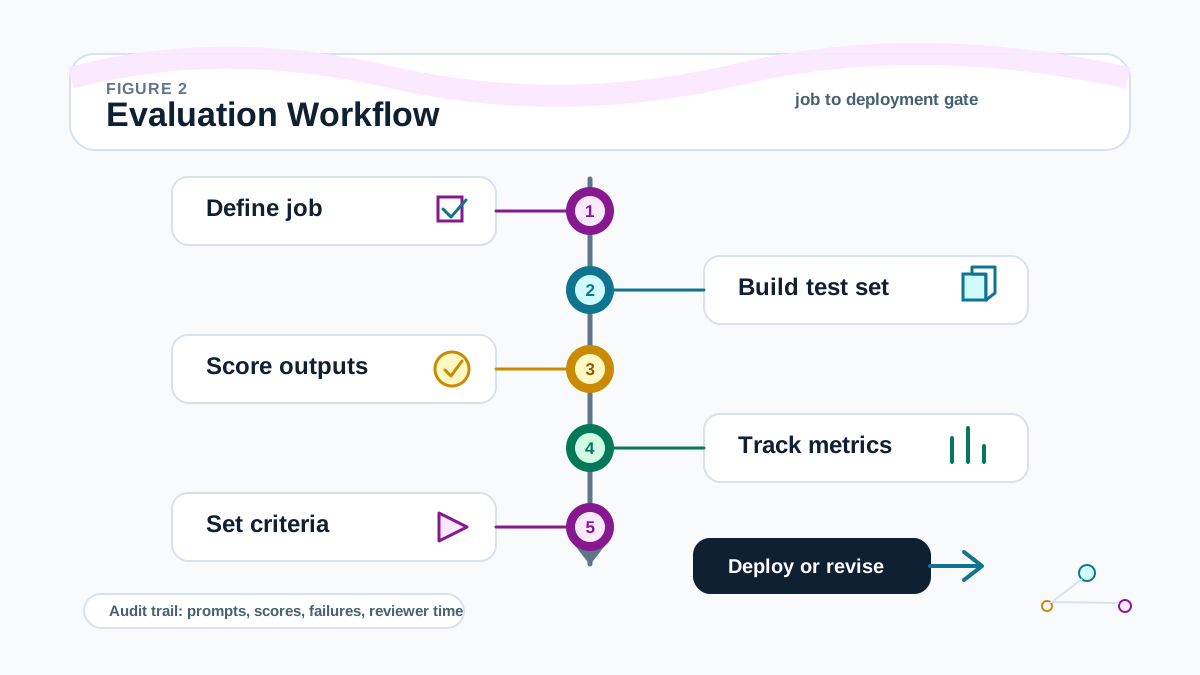
A strong GPT 5.5 vs Claude Opus 4.7 framework has five parts: task design, input set, scoring rubric, review measurement, and deployment criteria.
1. Define the job before the prompts
Start with the business workflow. Write one paragraph that describes what the model must do, where the input comes from, what output is accepted, and what happens next.
For example:
"Summarize failed data pipeline runs every morning, group failures by owner, identify likely root cause, suggest next action, and route high-severity incidents to Slack with links to logs."
That sentence is more useful than "test both models for reasoning." It gives the team something to measure.
2. Build a representative test set
A useful GPT 5.5 vs Claude Opus 4.7 workflow needs real inputs. Include clean cases, messy cases, long-context cases, missing-data cases, adversarial instructions, and cases where the right answer is "escalate."
For a support agent, include refund requests, angry customers, product bugs, duplicate tickets, policy exceptions, and account-specific context. For a reporting assistant, include normal weeks, anomaly weeks, late-arriving data, schema changes, and contradictory metric definitions.
3. Score outputs with a rubric
Do not rely on general preference. Score each output across the dimensions that matter.
| Scoring dimension | What to check | |---|---| | Correctness | The answer matches source data and expected reasoning | | Evidence use | The model cites or references the right input | | Instruction following | The model respects format, policy, and role limits | | Tool behavior | Tool calls are valid, necessary, and sequenced correctly | | Uncertainty handling | The model escalates instead of inventing missing facts | | Reviewer effort | A human can approve or fix the output quickly | | Production fit | The output can move to the next system without cleanup |
This is the difference between GPT 5.5 vs Claude Opus 4.7 examples that entertain and examples that help you ship.
4. Track operational metrics
The best model is often the one that reduces total workflow cost, not the one with the lowest token price. Track these metrics during the pilot:
- Accepted output rate
- Reviewer minutes per accepted output
- Retry rate
- Escalation rate
- Tool-call error rate
- Factual correction rate
- Cost per accepted output
- Time from input to approved result
OpenAI's API pricing page and Anthropic's docs help estimate token cost, but internal measurement tells you cost per successful task. That is the number operators should trust.
5. Decide with deployment criteria
Before testing, define what "good enough" means. For low-risk internal drafting, an 80% accepted output rate may be acceptable. For customer-facing support, finance analysis, legal review, or code deployment, the threshold should be higher and the escalation rules should be explicit.
A production decision might look like this:
- Use the higher-scoring model for first-pass analysis
- Route low-confidence outputs to human review
- Send policy exceptions to a specialist queue
- Log every prompt, source, tool call, and final output
- Review failures weekly for prompt, retrieval, or model changes
For deeper agent operations patterns, see Van Data Team's guide to AI agents with human review.
GPT 5.5 vs Claude Opus 4.7 examples for real workflows
This matrix shows how model choice changes by workflow risk:
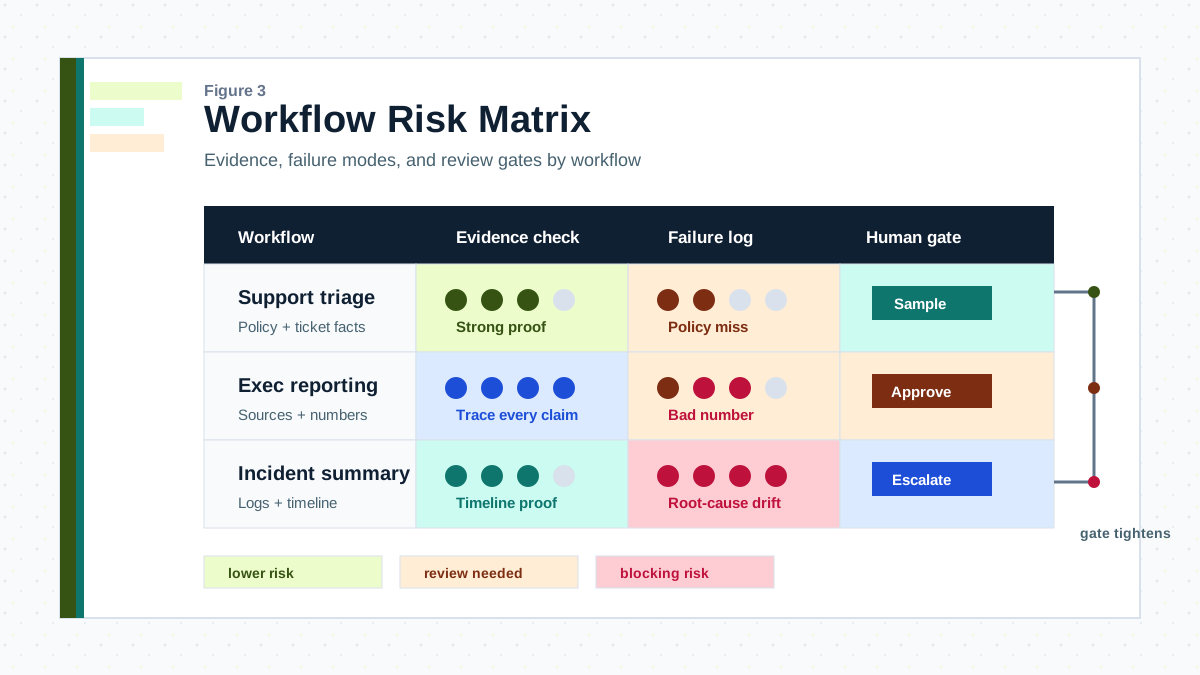
Practical GPT 5.5 vs Claude Opus 4.7 examples should mirror the work your team actually performs. Here are three patterns.
Example 1: support triage agent
The model receives a ticket, customer plan data, previous interactions, product status, and policy rules. It must classify the issue, draft a reply, recommend an action, and decide whether to escalate.
The evaluation should include:
- Tickets with incomplete customer context
- Policy edge cases
- Refund and security-sensitive requests
- Duplicate issues
- Escalation-worthy failures
The winning model is the one that reduces first-response time without increasing policy mistakes.
Example 2: executive reporting assistant
Ravi's operations team used a reporting assistant to draft Monday updates from warehouse tables. The first pilot looked strong: both models wrote clear summaries. The issue appeared when finance restated a metric on the 12th of the month. One model confidently used the old number. The other flagged the mismatch and asked for review. Ravi chose the second model for that workflow, even though its prose needed more editing, because the failure mode was safer.
This is how to use GPT 5.5 vs Claude Opus 4.7 in reporting: test the uncomfortable cases, not only the clean weeks.
Example 3: data pipeline incident summarizer
A data platform team wants an agent to read Airflow logs, warehouse freshness checks, schema changes, and alert history. The output should identify likely root cause and recommend the next operator action.
The GPT 5.5 vs Claude Opus 4.7 implementation should test:
- Source outage versus transformation bug
- Schema drift versus delayed ingestion
- False positive alerts
- Backfill instructions
- Ownership routing
- Links to logs and runbooks
If the model cannot distinguish "wait for source recovery" from "start a backfill," it is not ready for production action.
GPT 5.5 vs Claude Opus 4.7 best practices
GPT 5.5 vs Claude Opus 4.7 best practices are mostly workflow practices. The model matters, but the operating wrapper matters just as much.
Separate model selection from workflow design. Choose the workflow contract first: inputs, tools, permissions, memory boundaries, output format, review gates, and logs.
Use structured prompts and outputs. Ask for JSON, tables, labels, confidence levels, and source references where the next system needs structure. Free-form prose is harder to validate.
Keep an evaluation changelog. Record model version, prompt version, test set, scoring method, and known failure modes. Model comparison is not permanent. It changes as vendors update models and your workflow changes.
Measure review cost. A model that sounds better but takes longer to verify may be worse for the business. Reviewer time belongs in the score.
Design escalation paths early. High-risk outputs should not rely on reviewer instinct. Create explicit thresholds for missing evidence, conflicting sources, policy exceptions, customer impact, and financial exposure.
Verify vendor specs before deployment. Official docs and system cards change. Before publishing benchmark, pricing, context, or safety claims, check the latest vendor pages and safety materials, including Anthropic's system card index.
If you want a structured way to scope the pilot before a larger build, a Strategy Sprint can turn the model comparison into a test plan, rubric, and production architecture direction.
Common mistakes to avoid
The fastest way to get GPT 5.5 vs Claude Opus 4.7 wrong is to compare models in a setting that does not resemble production.
Avoid these mistakes:
-
Choosing from one demo. A single prompt says little about reliability across messy inputs.
-
Ignoring human review. If reviewers spend 10 minutes fixing every output, the model is not saving the workflow.
-
Using generic benchmarks as the final answer. Benchmarks can guide hypotheses, but internal workflow tests decide production fit.
-
Skipping failure logs. Without failure categories, the team cannot tell whether the issue is prompt design, retrieval, tool access, source data, or model behavior.
-
Comparing token price instead of accepted-output cost. Lower per-token cost can still lose if retries, long outputs, and review time increase.
-
Treating the comparison as permanent. Model behavior, pricing, availability, and platform features change. Retest before major workflow changes.
-
Letting the model act without permissions. Tool access should be explicit, narrow, logged, and reversible.
Elena, a COO at a B2B services firm, nearly approved a customer-facing agent after a strong two-day pilot. The blocker came from the failure log. The model handled normal requests well but mishandled contract exceptions for enterprise customers. The team delayed launch by one week, added an escalation rule for contract language, and avoided sending incorrect answers to their largest accounts. The model did not change. The guardrail did.
Conclusion: make GPT 5.5 vs Claude Opus 4.7 a production decision
GPT 5.5 vs Claude Opus 4.7 should not be decided by hype, screenshots, or isolated examples. The right model is the one that performs inside your workflow with acceptable accuracy, review cost, escalation behavior, and operational risk.
Start with the task. Build a representative test set. Score outputs. Measure reviewer effort. Check vendor docs before making pricing or availability claims. Then design the workflow so the model can succeed without hiding failures.
For low-risk drafting, the decision may be simple. For AI agents, reporting workflows, data pipeline operations, and customer-facing automation, the evaluation needs guardrails from the first pilot.
Van Data Team helps teams connect model evaluation with production architecture, data pipelines, and agent operations. To turn a GPT 5.5 vs Claude Opus 4.7 comparison into a scoped build plan, book a scoping call and bring the workflow you need to test.
Article FAQ
Questions readers usually ask next.
These short answers clarify the practical follow-up questions that often come after the main article.
Need a similar system?
If this article maps to a workflow your team already operates, the next step is usually a scoped review of the system, constraints, and rollout path.
Book your free workflow review here.
Related articles
View all
Grok 4.7: Same Price as Grok 4.6, but Check Cost per Task
China AI Slowdown: Why Beijing and Trump Both Said No
Grok 4.6 and Persistent VM Agents