 Client projectLive
Small business operations · AI Agents
alice/ai Multi-Agent Operating System for Small Business
Built by Van Data Team for alice/ai
An AI operating system for small business: a LangGraph Supervisor routes each request to specialised sub-agents across more than 70 MCP tool integrations, shipped from one React codebase to the web, a PWA and native iOS and Android apps.
- MCP tool integrations under one supervisor
- 70+
- specialist agents in the product, per goalice.ai
- 6
Measured outcomes
Outcome 01
70+ MCP tool integrations under one LangGraph Supervisor
Outcome 02
51 specialised backend controllers on FastAPI and AWS ECS Fargate
Outcome 03
One React 19 codebase shipping web, PWA, iOS and Android
Challenge pressure
Small-business owners lose their week to admin and operations spread across the tools they run the business on, and an assistant that can only answer questions cannot do any of that work.
The situation
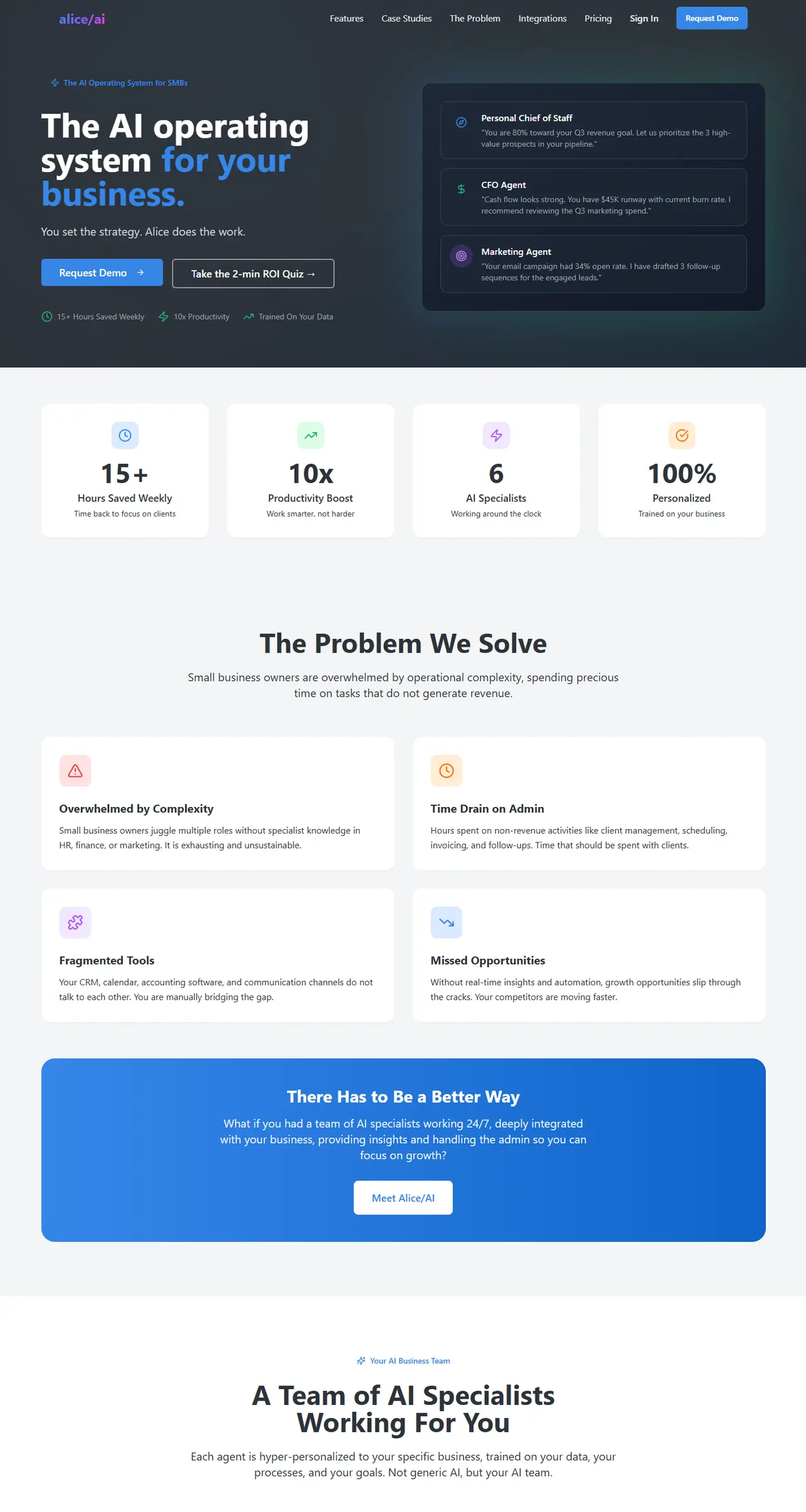
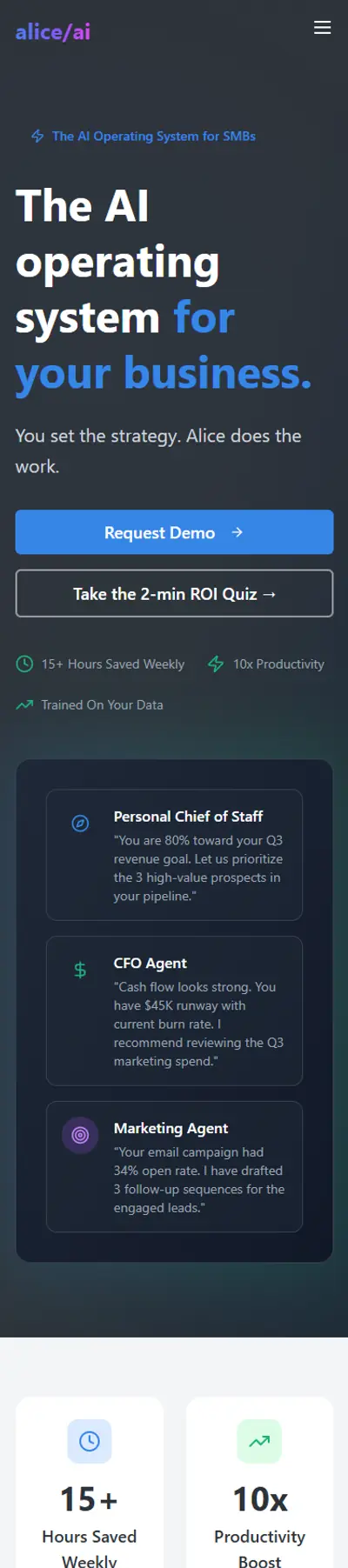
alice/ai, formerly PraxisAI, sells an AI operating system to small businesses: the owner sets the direction and specialist agents do the work, from a personal chief of staff to finance and marketing agents. That promise only holds if the agents can act inside the tools the business already uses, and if the product reaches owners on whichever device they work from.
What we built
A FastAPI backend of 51 specialised controllers on AWS ECS Fargate, with a LangGraph Supervisor orchestrating sub-agents over more than 70 MCP tool integrations, retrieval on Pinecone and FAISS, tracing in LangSmith, and GPT-4 and Gemini behind the agents. The React 19 and Vite frontend, on Material-UI v7, Redux Toolkit and React Router 7, streams answers over server-sent events and ships as a PWA and, through Capacitor 7, as native iOS and Android apps. AWS Cognito via Amplify handles multi-tenant sign-in, Stripe handles billing, and 14 DynamoDB tables hold the data. MCP connections to Cliniko and Nookal bring healthcare practice-management records and scheduling into the same assistant.
What changed
Owners work with one supervisor that can act across more than 70 connected tools instead of switching between them, on the web or in the native apps, and the team maintains a single codebase for every platform.
Constraints and decisions
The supervisor routes to specialised sub-agents instead of handing one agent every tool, so each agent chooses from a short, relevant toolset even as integrations pass 70. Native apps come from the same React code through Capacitor, which keeps web, iOS and Android on one release cycle. CI/CD runs on GitHub Actions with OIDC-based AWS access and separate DEV and PROD pipelines, so no long-lived cloud keys sit in the pipeline.
Technology stack
 Gemini
 FastAPIAWS ECS FargateReact 19CapacitorAWS CognitoDynamoDBStripe
Need a similar system?
If this case study maps to your current workflow, the next useful step is a scoped project conversation with constraints, timeline, and integration needs.
Related case studies
More work like this

 Client projectLive
Education
RAG tutoring that lifted answer accuracy from about 80% to 95%+
95%+
RAG answer accuracy, from about 80%
Five memory-backed agents
Enterprise SaaS
Five memory-backed agents running a multi-tenant enterprise suite
94.7%
platform health score in production