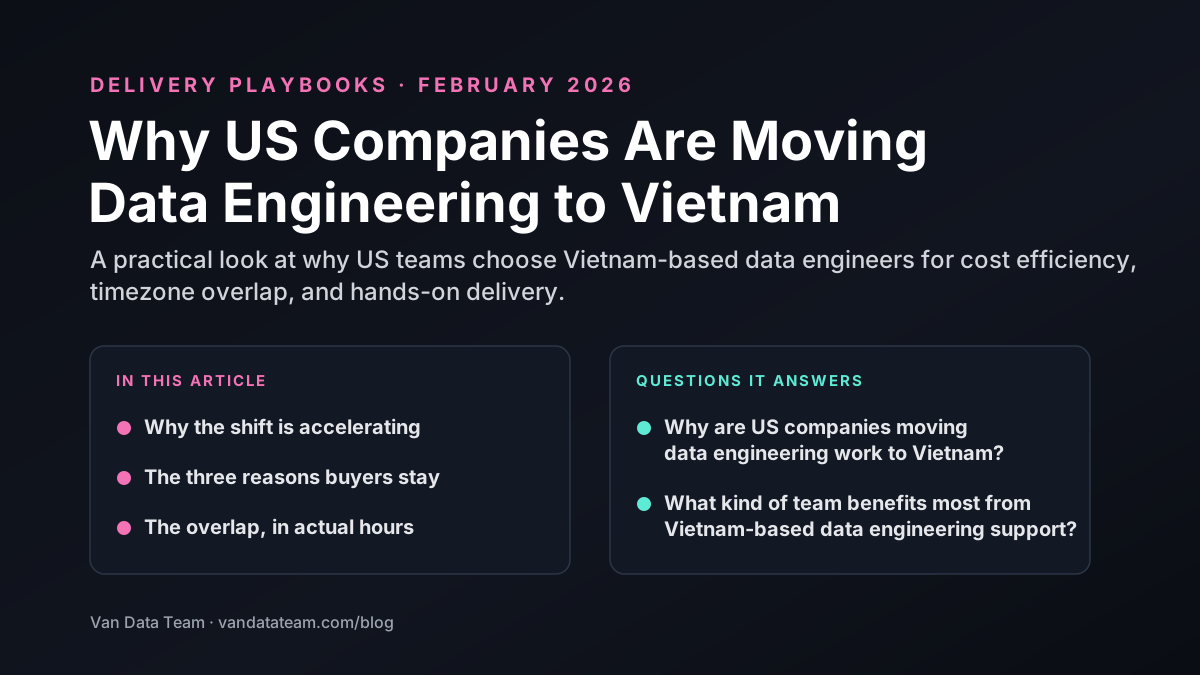
Why US Companies Are Moving Data Engineering to Vietnam
A practical look at why US teams choose Vietnam-based data engineers for cost efficiency, timezone overlap, and hands-on delivery.
US companies are not moving data engineering work to Vietnam only because labor is cheaper. They are moving because the work can be senior, fast, and operationally easier to manage than a fragmented agency model.
Why the shift is accelerating
The last two years changed what buyers expect from a data engineering partner. They no longer want a team that can only build a pipeline. They want a partner who can:
- understand the business workflow behind the data movement
- connect warehouse decisions to reporting and AI use cases
- ship production-ready automation without long architecture delays
Vietnam-based delivery fits that model well when the partner is senior enough to own architecture and implementation in the same loop.
The three reasons buyers stay
1. Better cost-to-seniority ratio
The biggest advantage is not "cheap talent." The advantage is being able to hire a more senior builder for the same budget that would only cover a mid-level hire in many US markets.
That means companies can spend their budget on:
- architecture review
- implementation
- deployment hardening
- documentation and handoff
instead of spending most of the budget just staffing the work.
2. Reliable timezone overlap
Strong Vietnam-based teams usually build a delivery rhythm around async artifacts and clear overlap windows. That creates a healthy pattern:
- US team reviews in the morning
- implementation continues while the US team is offline
- next-day progress is already waiting
For operators, this reduces idle time between decisions and execution.
3. Broader technical ownership
Modern data work touches more than ETL. Buyers now expect one partner to handle:
- ingestion and transformation
- cloud deployment
- dashboard enablement
- AI-ready data modeling
- observability and failure recovery
That broader ownership is where independent senior partners consistently outperform generic outsourcing.
The overlap, in actual hours
"Timezone overlap" is easy to claim and easy to check. Vietnam runs on UTC+7 all year and does not observe daylight saving time, so the gap to the US moves by an hour twice a year.
| Vietnam time | US Eastern (EDT, summer) | US Pacific (PDT, summer) | | --- | --- | --- | | 8:00 pm | 9:00 am | 6:00 am | | 9:00 pm | 10:00 am | 7:00 am | | 10:00 pm | 11:00 am | 8:00 am | | 7:00 am (next day) | 8:00 pm | 5:00 pm |
In US winter (EST and PST) every US time in the table is one hour earlier, which gives Eastern teams a slightly easier morning call and Pacific teams an earlier one.
In practice that means one to two hours of live overlap a day, usually the US morning, and the rest of the day running on written handoffs. The teams that make this work treat the overlap as a decision window, not a status meeting:
- Before the call, the Vietnam side posts what changed, what is blocked and what needs a decision.
- During the call, only decisions and open questions; everything else is already written down.
- After the call, the US side has a full working day of async review, and implementation picks up again overnight.
A pipeline change reviewed on Tuesday morning in New York can be implemented, tested and waiting for sign-off by Wednesday morning, which is the "follow the sun" benefit people describe. Without written handoffs, the same gap turns every question into a one-day delay.
Choosing an engagement model
How the work is structured matters as much as where it is done. The three common models fail in different ways.
| Model | Works well when | Watch out for | | --- | --- | --- | | Staff augmentation (individual engineers join your team) | You already have strong technical leadership and clear tickets | You carry all the architecture, review and management load | | Managed team (a vendor runs a team on your backlog) | You need steady capacity over many months | Seniority drifts, and knowledge stays with the vendor | | Fixed-scope project (a defined outcome, delivered and handed off) | The goal is clear: a pipeline, a migration, a platform upgrade | Scope has to be written down well before work starts |
For most mid-market data work, such as a new ingestion pipeline, a warehouse migration or a reporting rebuild, a fixed-scope project with a written handoff is the lowest-risk start. It forces both sides to agree on what "done" means, and it ends with something your own team can run.
A due-diligence checklist
Before signing with any offshore partner, Vietnam-based or not, get clear written answers on these points.
Access and security
- How production access is granted, scoped and revoked, ideally through your SSO with least-privilege roles
- That no credentials are shared between people and nothing is stored outside your secret manager
- How access is removed on the last day of the engagement
Ownership and contracts
- Code, pipelines and documentation belong to you once paid for
- A data processing agreement if personal data passes through the systems being built
- Who is named on the work: the people you interviewed should be the people doing it
Delivery and handoff
- How changes are reviewed and deployed, and how a bad deploy is rolled back
- What monitoring, alerting and runbooks you receive at the end
- What support looks like after launch, and for how long
A partner who answers these quickly and specifically has done this before. Vague answers about process usually mean the process is improvised.
Risks worth planning for
None of these are reasons to avoid offshore delivery. They are reasons to plan for it.
- Knowledge concentrated in one person. Require written architecture notes and a handoff session as part of the scope, not as a favor at the end.
- Misunderstandings in async work. Written specs with examples of correct output prevent more rework than extra meetings do.
- Tết, the Lunar New Year. Vietnam's main holiday falls in late January or February and usually takes about a week out of the calendar. Plan releases around it the way you would around year-end freezes.
- Overnight production incidents. Decide up front who responds when a pipeline fails during US night, and what the escalation path is.
When Vietnam is the right choice
Vietnam-based data engineering is a strong fit when:
- the team wants senior delivery without building a large in-house bench
- the backlog includes both data infrastructure and business automation
- the company values speed, async communication, and clear ownership
It is especially strong for startups and mid-market teams that need leverage, not staffing theater. It is a weaker fit when the work needs someone on site, when every decision needs a live meeting, or when no one on your side can own requirements and review.
How we run engagements at Van Data Team
We are a founder-led team in Ho Chi Minh City. Engagements are fixed-scope and fixed-price: most production pipelines cost $8,000 to $30,000 and a platform migration slice $20,000 to $80,000, with a 30-day support window after launch. Most of our work is data pipeline development and data platform modernization, and our case studies show what was delivered and measured.
If you are weighing a partner against hiring, our comparison of a data engineering partner vs an in-house team walks through the trade-offs, and choosing batch vs streaming pipelines covers one of the first architecture decisions in most projects.
The takeaway
The real reason US companies move data engineering work to Vietnam is simple: they get more execution per dollar, faster iteration loops, and partners who can own both the architecture and the delivery.
When the engagement is scoped well, with real overlap hours, written handoffs, clear access rules and a defined end state, Vietnam is not a compromise. It is a strategic advantage.

Founder of Van Data Team. Builds Vanaxity, the AI agent system for SEO, GEO, and AEO, and leads data engineering delivery for B2B teams.
About the authorArticle FAQ
Questions readers usually ask next.
These short answers clarify the practical follow-up questions that often come after the main article.
Need a similar system?
If this article maps to a workflow your team already operates, the next step is usually a scoped review of the system, constraints, and rollout path.
Consultation
Scope your next AI workflow.
Share the system and blockers. We will map fit, gaps, and the next step.