Claude Fable 5 vs GPT 5.5 vs Gemini 3.5 Flash Thinking
Claude Fable 5 vs GPT 5.5 vs Gemini 3.5 Flash Thinking compared with current pricing, context limits, benchmark signals, and production routing guidance.

Claude Fable 5 vs GPT 5.5 vs Gemini 3.5 Flash Thinking is a comparison article, so the first decision should be based on numbers before narrative: API price, context window, output limit, benchmark signal, availability, latency profile, and the risk of each workload.
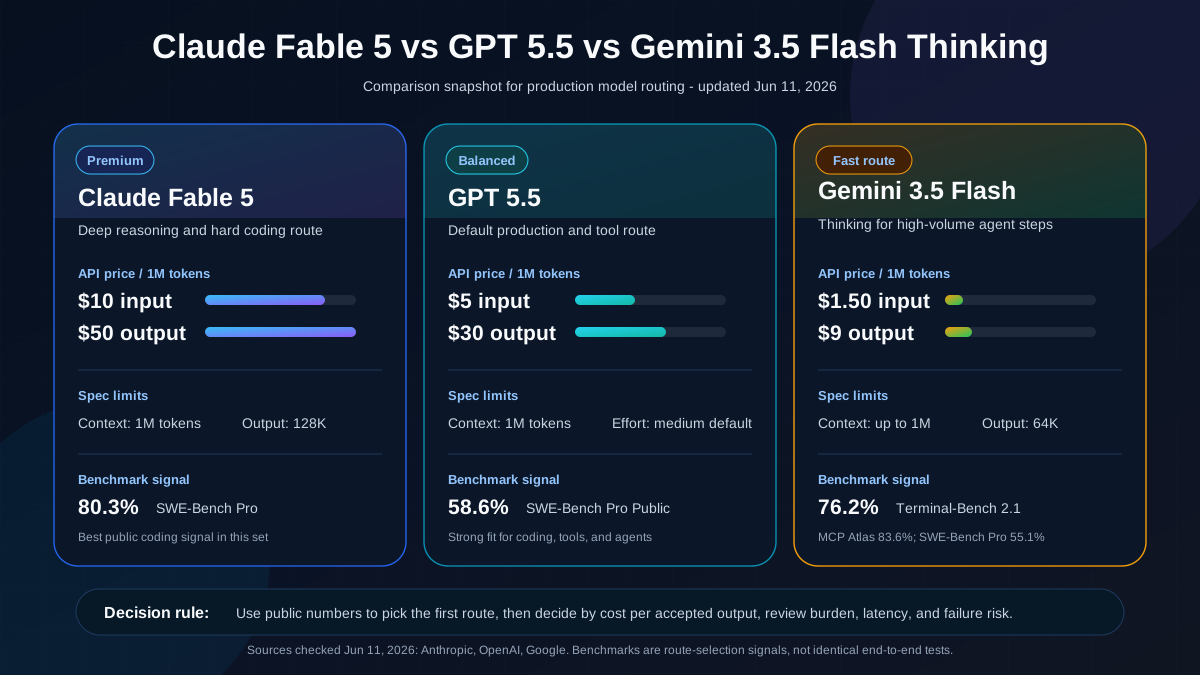
As of June 11, 2026, the headline pricing is clear: Claude Fable 5 is $10 per 1M input tokens and $50 per 1M output tokens, GPT 5.5 is $5 / $30, and Gemini 3.5 Flash is $1.50 / $9. The benchmark picture is also more specific than a generic "best model" debate: Fable has the strongest public signal on deep coding, GPT 5.5 is a high-context general production model with strong tool behavior, and Gemini 3.5 Flash is the speed and cost route with a strong agentic benchmark profile.
A founder, CTO, data lead, or ops owner still should not choose only from vendor charts. The practical answer is to compare measurable constraints first, then route each workload by reasoning depth, latency, cost per accepted output, review burden, and failure risk.
At Van Data Team, that is how we evaluate AI agent development projects: we define the task type, required evidence, tool permissions, validation rules, model route, fallback route, and human review gate before putting production traffic behind a model choice.
This guide gives you a source-backed comparison table, a comparison visual, practical routing examples, implementation workflow, common failure modes, and a decision artifact you can adapt for production planning.
Key Takeaways
- Claude Fable 5 is the premium capability route: $10 input / $50 output per 1M tokens, 1M context, 128K max output, and Anthropic-reported SWE-Bench Pro signal of 80.3%.
- GPT 5.5 is the balanced production route: $5 input / $30 output per 1M tokens, 1M context, medium default reasoning effort, strong tool-use positioning, and OpenAI-reported SWE-Bench Pro Public signal of 58.6%.
- Gemini 3.5 Flash Thinking is the speed and cost route: $1.50 input / $9 output per 1M tokens, 1M context, 64K output, Terminal-Bench 2.1 at 76.2%, MCP Atlas at 83.6%, and much lower token price.
- The benchmark rows are not perfectly apples-to-apples. Use them to decide what to test first, not to skip your own evaluation.
- For production, the useful answer is not "one winner." It is a routing policy that sends high-risk reasoning to the strongest route, normal tool work to the balanced route, and high-volume low-risk work to the fastest route.
Real spec snapshot: price, context, and benchmark signals
Use this as a current decision snapshot, not a permanent procurement answer. Pricing, model access, benchmark methodology, and reasoning controls can change, so verify the vendor pages again before signing off a production route.
| Metric | Claude Fable 5 | GPT 5.5 | Gemini 3.5 Flash Thinking | What it means |
|---|---|---|---|---|
| API price | $10 input / $50 output per 1M tokens | $5 input / $30 output per 1M tokens | $1.50 input / $9 output per 1M tokens | Gemini is cheapest on list price; Fable must earn its premium through acceptance rate and lower rework. |
| Context window | 1M tokens | 1M tokens | Up to 1M tokens | All three can support long-context workflows; retrieval quality still matters more than dumping all context into the prompt. |
| Max output | 128K tokens | Verify in the API model metadata before rollout | 64K tokens | Large output limits help research synthesis and code generation, but they also increase review burden. |
| Reasoning control | Adaptive thinking, always on | Reasoning effort defaults to medium; raise only when evals justify it | Thinking levels tune quality, cost, and latency | Reasoning effort is an operating knob, not a quality guarantee. |
| Coding benchmark signal | SWE-Bench Pro: 80.3% | SWE-Bench Pro Public: 58.6% | SWE-Bench Pro Public: 55.1%; Terminal-Bench 2.1: 76.2% | Fable has the strongest public coding signal, but your codebase still needs its own acceptance tests. |
| Agentic/tool benchmark signal | Anthropic positions it for demanding long-horizon agentic work | OpenAI positions it for tool-heavy agents and grounded assistants | MCP Atlas: 83.6%; Toolathlon: 56.5% | Tool-call reliability and recovery behavior should be measured with your tools, not copied from public benchmarks. |
| Best first route to test | High-risk reasoning, architecture, deep coding, executive synthesis | Default coding, product workflows, tool-heavy agents, grounded assistants | High-volume triage, fast summaries, first-pass agent steps, cost-sensitive operations | The right winner depends on task risk, not only benchmark rank. |
Source note: the Fable figures come from Anthropic's launch and model documentation, GPT 5.5 pricing and behavior come from OpenAI's launch, pricing, and GPT 5.5 guide, and Gemini 3.5 Flash figures come from Google's model card, Google AI pricing, and Google launch notes. Benchmark methodology is not identical across every row, so treat public numbers as route-selection signals.
The mistake we see is teams treating model selection as a one-time architecture decision. It is closer to routing design. A support triage workflow, a weekly revenue report, and a schema-mapping assistant should not necessarily share the same model route, even if one model wins a headline benchmark.
What Claude Fable 5 vs GPT 5.5 vs Gemini 3.5 Flash Thinking means in practice
This comparison is a framework for deciding how to use three frontier model families inside real workflows. The word "Thinking" matters because it changes the question. You are not only asking which model can answer well. You are asking when the workflow should spend more reasoning effort and when it should choose a faster route.
A practical implementation usually separates work into four lanes:
- Intake and classification
- Model route selection
- Validation and review
- Delivery, monitoring, and fallback
Consider a data operations team building an AI assistant for pipeline incidents. A routine freshness warning might route to the fastest model for a short summary. A suspected schema break might route to GPT 5.5 for code-aware diagnosis. A cross-system incident with customer impact might route to Fable for deeper reasoning, then stop for human review before any remediation plan is sent.
That pattern is more reliable than declaring one model the winner. It also makes cost easier to control because expensive reasoning is reserved for tasks that need it.
For data-heavy workflows, model routing should sit beside data pipeline engineering, not above it. If the warehouse tables, event contracts, or freshness checks are unreliable, a stronger model will still produce unreliable operational advice.
Source-backed notes before choosing a winner
The safest way to write this comparison is to separate official specs from interpretation. Anthropic's Claude Fable 5 launch note and Anthropic's model overview provide the Fable price, availability, 1M context window, 128K max output, and adaptive thinking status.
For GPT 5.5, OpenAI's launch article gives the $5 / $30 API pricing, 1M context window, and published evaluation table, while OpenAI's pricing page confirms current API price and the GPT 5.5 guide explains the default medium reasoning effort and tool-heavy workflow positioning.
For Gemini 3.5 Flash Thinking, Google's Gemini 3.5 announcement gives the Terminal-Bench 2.1, GDPval-AA, MCP Atlas, and CharXiv signals; Google DeepMind's model card gives the 1M context, 64K output, and evaluation table; and Google AI pricing gives the $1.50 / $9 paid API price.
The comparison still needs caution. Fable's strongest public number is an Anthropic-reported SWE-Bench Pro result, GPT 5.5's comparison table is from OpenAI, and Gemini's strongest numbers include Terminal-Bench and MCP Atlas from Google. These are useful signals, but they are not a substitute for a controlled evaluation on your own prompts, data, tools, and failure modes.
Comparison visual: what the numbers imply
The comparison should be visual, not only prose. A reader should be able to see the tradeoff in one pass: Fable is the premium deep-reasoning route, GPT 5.5 is the balanced production route, and Gemini 3.5 Flash Thinking is the lower-cost speed route.
After the comparison, start with the task, not the model. A good evaluation asks what the workflow needs to produce, what can go wrong, and how expensive each failure is.
Use these dimensions before testing:
| Dimension | What to ask | Why it matters |
|---|---|---|
| Accuracy | Does the output match the expected answer or decision? | Prevents attractive but wrong responses |
| Reasoning depth | Does the task require multi-step planning or synthesis? | Decides whether a thinking route is worth the cost |
| Latency | How long can the user or downstream system wait? | Shapes UX, queue design, and timeout rules |
| Token budget | How much context is needed for a useful answer? | Controls retrieval, summarization, and long-context cost |
| Tool use | Does the model need to call APIs, query data, or edit files? | Exposes permission and recovery risks |
| Review burden | How much human inspection is required before output ships? | Changes the real cost of the workflow |
| Failure recovery | What happens when the model is wrong, slow, or unavailable? | Determines fallback, retry, and escalation design |
The practical route usually looks like this in prose: an input enters the workflow, a classifier labels the task type and risk level, a routing policy selects the model, validation checks the result, human review catches high-risk outputs, and monitoring records cost, latency, retries, and acceptance rate.
For agentic BI and reporting, that might mean Gemini handles quick dashboard explanations, GPT handles SQL-aware analysis drafts, and Fable handles executive-level synthesis when an anomaly affects revenue, churn, or capacity planning.
Here is a short routing policy artifact a team could adapt:
model_routes:
 quick_summary:
 default_model: gemini-3.5-flash-thinking
 max_risk: low
 validation: factuality_check
 fallback_model: gpt-5.5

 code_review:
 default_model: gpt-5.5
 max_risk: medium
 validation: test_diff_and_static_review
 fallback_model: claude-fable-5

 strategic_analysis:
 default_model: claude-fable-5
 max_risk: high
 validation: source_trace_and_assumption_check
 human_review: required

 dashboard_narrative:
 default_model: gemini-3.5-flash-thinking
 max_risk: medium
 validation: metric_contract_check
 fallback_model: gpt-5.5
This is not meant to be copied blindly. It shows the shape of the decision: each route has a task, a model, a validation method, a fallback, and a review rule.
Strengths, limitations, and when to test each model
Claude Fable 5
Test Claude Fable 5 first when the task depends on deep reasoning, careful synthesis, long-horizon planning, high-context analysis, or expensive codebase work. The public spec makes it a premium route: $10 / $50 per 1M input/output tokens, 1M context, 128K max output, and the strongest public SWE-Bench Pro signal in this comparison at 80.3%.
Its limitation is operational cost and speed uncertainty until you measure it. If the task is low-risk, repetitive, and latency-sensitive, routing everything to the deepest reasoning model can waste budget and slow the user experience. Fable should earn its premium by reducing retries, reviewer corrections, and downstream rework.
Choose or test Fable when:
- The output shapes a strategy, incident response, or executive recommendation
- The model must reconcile conflicting evidence
- The cost of a wrong answer is higher than the cost of review
- You can afford human approval before action
GPT 5.5
Test GPT 5.5 first when you need a balanced production model for coding, tool orchestration, agent steps, evaluation drafts, grounded assistants, and general workflow automation. Its current public price is $5 / $30 per 1M input/output tokens with a 1M context window, and OpenAI positions GPT 5.5 around coding, tool-heavy agents, and long-context retrieval.
Its limitation is that "balanced" does not mean best for every route. It may be too expensive for simple batch classification and not always the strongest candidate for the hardest reasoning cases. Treat it as the default route to beat, then specialize around measured failures.
Choose or test GPT 5.5 when:
- The workflow includes coding, structured tool use, or multi-step agent behavior
- You need strong general capability across many task types
- You want one default route before adding specialized fallbacks
- You are building evaluation and observability into the rollout
Gemini 3.5 Flash Thinking
Test Gemini 3.5 Flash Thinking first when speed, throughput, and cost discipline matter. Its current paid API price is $1.50 / $9 per 1M input/output tokens, with up to 1M context and 64K output. Google's public signals are strongest around fast agentic work: Terminal-Bench 2.1 at 76.2%, MCP Atlas at 83.6%, and a Flash-style latency profile.
Its limitation is risk tolerance. If a task needs deep source reconciliation, long planning, or high-stakes judgment, it should either escalate or stop for review.
Choose or test Gemini Flash Thinking when:
- The workflow is high-volume and low-to-medium risk
- Latency affects user adoption
- The output can be validated mechanically
- A stronger fallback route catches uncertain or failed outputs
Implementation workflow for production teams
The implementation should be small enough to finish, but serious enough to reveal failure modes.
- Inventory workflows by task type
List the workflows where models will produce output: code review, customer triage, schema mapping, KPI explanation, anomaly investigation, research synthesis, or internal report drafting. For each one, define the user, input, output, data dependency, and failure impact.
- Build an evaluation set
Create realistic test cases from your own work. Include easy cases, normal cases, edge cases, and known failures. Do not rely only on vendor demos or public prompts.
For coding, score bug fixes, refactors, test generation, and review comments separately. For reporting, score metric accuracy, narrative quality, cited evidence, and escalation judgment. For pipeline work, score schema awareness, transformation reasoning, and ability to explain backfill risk.
- Run the same tasks across models
Keep prompts, retrieved context, tools, and scoring rules consistent. If one model gets better context than another, you are testing the retrieval layer, not the model.
- Measure completed task cost
Cost per completed task includes token cost, failed attempts, retries, human review, latency impact, and recovery work. A cheaper model that needs three attempts and a reviewer may be more expensive than a stronger model that passes once.
- Add monitoring before launch
Log model route, task type, prompt version, retrieved sources, output status, validation result, latency, token use, fallback use, reviewer decision, and final acceptance. Without this, you cannot improve the route after launch.
- Set review and fallback rules
High-risk tasks should not auto-ship. That is where human review, escalation queues, and audit trails matter. Our related guide on AI agents with human review walks through this pattern in more detail.
A practical Van Data Team engagement for this topic would produce a scoped workflow review, route map, evaluation scorecard, guardrail plan, dashboard gap review, and implementation scope. If you need those artifacts before committing to a build, review the available engagement options and scope the decision around your actual workflows.
Common mistakes to avoid
The first mistake is choosing one model for every task. That creates hidden waste because simple tasks pay for complex reasoning, while hard tasks may still lack review.
The second mistake is trusting benchmark summaries without checking methodology. Benchmarks can help prioritize what to test, but they rarely match your prompts, data quality, tool contracts, or failure costs.
The third mistake is comparing list prices instead of completed task cost. A fast model with weak acceptance rates may create more retries. A strong model with slow latency may hurt interactive workflows.
The fourth mistake is ignoring observability. If you do not log route selection, validation results, reviewer decisions, and fallback behavior, you will not know why the workflow improved or failed.
The fifth mistake is skipping recovery design. A production model route needs timeouts, retries, fallback models, human escalation, and a rollback path when quality drops.
The sixth mistake is publishing unsupported claims. Pricing, latency, model availability, and benchmark scores change quickly. Keep vendor claims, public comparison claims, and internal test results clearly separated.
Practical examples
A platform team wants to automate pull request review. Gemini Flash Thinking handles quick summaries of changed files. GPT 5.5 reviews the diff for logic, tests, and maintainability. Fable reviews high-risk architectural changes or ambiguous failures. The final output does not merge code. It creates a reviewer brief with evidence, confidence, and unresolved questions.
A revenue operations team wants weekly pipeline commentary. Gemini drafts low-risk KPI summaries. GPT checks metric definitions and joins. Fable handles board-facing analysis when pipeline movement conflicts with sales activity. Human review is required before the executive summary goes out.
A data engineering team wants schema drift triage. Gemini summarizes the alert. GPT inspects the transformation and likely downstream tables. Fable is reserved for incidents where a backfill, customer-facing metric, or financial report may be affected. The routing rule protects both cost and trust.
Conclusion
For teams evaluating Claude Fable 5 vs GPT 5.5 vs Gemini 3.5 Flash Thinking, the useful decision starts with real constraints: Fable is the premium high-reasoning route, GPT 5.5 is the balanced production route, and Gemini 3.5 Flash Thinking is the cost-and-speed route. The final choice should come from measured acceptance rate, retry rate, latency, review burden, and failure cost.
Start with the workflow. Separate low-risk speed tasks from deep reasoning tasks. Build an evaluation set from real prompts and real data. Measure cost per accepted output. Log route decisions, retries, latency, review outcomes, and fallback behavior. Then keep the routing policy adjustable as model specs and pricing change.
Van Data Team can help turn that comparison into an implementation scope: workflow review, signal map, model routing design, evaluation scorecard, guardrail plan, reporting dashboard, and production rollout path. The model choice matters, but the operating system around it is what makes the work reliable.

Founder of Van Data Team. Builds Vanaxity, the AI agent system for SEO, GEO, and AEO, and leads data engineering delivery for B2B teams.
About the authorAI model benchmarks
Models in this article
Current pricing, context window and independent scores for each model.
Article FAQ
Questions readers usually ask next.
These short answers clarify the practical follow-up questions that often come after the main article.
Need a similar system?
If this article maps to a workflow your team already operates, the next step is usually a scoped review of the system, constraints, and rollout path.
Free routing review
Route Fable, GPT, Gemini
Review your Claude Fable 5 vs GPT 5.5 vs Gemini 3.5 Flash Thinking decision and leave with a routing, evaluation, and rollout plan.
- Workload routing matrix for Claude Fable 5, GPT 5.5, and Gemini 3.5 Flash Thinking
- Evaluation set outline for reasoning, coding, extraction, review, and escalation tasks
- Cost, latency, and retry metrics to track before rollout
- Human review checkpoints and guardrail recommendations
- Next-step implementation plan for your highest-risk agent workflow
Consultation
Scope your next AI workflow.
Share the system and blockers. We will map fit, gaps, and the next step.