July 4, 2026
Grok 4.5 and the SpaceX Cursor Acquisition: What It Means for AI-assisted Software Engineering
Grok 4.5 And The SpaceX Cursor Acquisition: What It Means For AI-assisted Software Engineering guide for production teams: compare workflow fit, risk, cost.
Article focus
Summary: "Grok 4.5 and the SpaceX Cursor acquisition mean AI-assisted software engineering tools are moving from simple editors to governed feedback systems.
Section guide
Summary: "Grok 4.5 and the SpaceX Cursor acquisition mean AI-assisted software engineering tools are moving from simple editors to governed feedback systems. Engineering leaders should control source-code exposure, review gates, test evidence, model updates, and rollout risk before adopting them broadly."
Grok 4.5 and the reported SpaceX Cursor acquisition: what it means for AI-assisted software engineering is that AI coding tools are becoming feedback systems, not just developer editors.
- According to Investing.com, Grok 4.5 entered private beta at SpaceX and Tesla on June 28, 2026.
- According to Forbes, SpaceX agreed to acquire Anysphere, Cursor's parent company, on June 16, 2026 in a $60 billion all-stock deal.
Reported fact: Investing.com reports that Grok 4.5 entered private beta at SpaceX and Tesla on June 28, 2026.
Reported fact: Forbes reports that SpaceX agreed to acquire Anysphere, Cursor's parent company, in a $60 billion all-stock deal.
For CTOs, AI leads, platform teams, and data leaders, the buyer problem is not whether the newest model sounds impressive. The problem is whether your software delivery system can tolerate these risks without turning production engineering into a black box:
- AI-generated changes.
- Model refreshes.
- Prompt-data exposure.
- Review drift.
- Production rollout gaps.
At Van Data Team, we would make this operational by mapping the engineering workflow first:
- Repository access.
- Prompt boundaries.
- Test evidence.
- Reviewer responsibility.
- Deployment gates.
- Incident recovery.
- Metrics that show whether AI assistance is improving delivery or just moving risk downstream.
Key Takeaways
The practical takeaway from Grok 4.5 and the reported SpaceX Cursor acquisition is that engineering leaders should respond by building stronger operating systems for AI-assisted software engineering and delivery, not by rushing a tool swap.
- Grok 4.5 matters because, according to Investing.com, it combines a frontier model with internal engineering feedback, not because public teams can use it today.
- The reported Cursor acquisition matters because IDE activity can become high-value training and evaluation signal when paired with a model lab.
- The correct response is not to standardize on a tool immediately. It is to build a governance layer around source-code privacy, generated-code review, regression testing, and model update monitoring.
- Private beta performance should be treated as directional until public access and independent benchmarks exist.
- Teams that measure only speed will miss the real risk. The better scorecard includes defect rate, rollback rate, review burden, security findings, latency, cost, and developer trust.
| Signal | Verified fact | What engineering leaders should do |
|---|---|---|
| Grok 4.5 private beta | Investing.com reports that Grok 4.5 entered private beta at SpaceX and Tesla on June 28, 2026. | Treat it as a reported internal deployment signal, not a public vendor benchmark. |
| Model scale | Investing.com reports that Grok 4.5 is built on xAI's V9 foundation model with 1.5 trillion parameters. | Evaluate workflow outcomes instead of assuming parameter count equals production reliability. |
| Cursor transaction | Forbes reports that SpaceX agreed to acquire Anysphere in a $60 billion all-stock deal. | Review vendor dependence, data commitments, and portability before broad rollout. |
| Cursor business scale | Forbes reports Cursor reached roughly $4 billion in annualized revenue in under four years, including about $2.6 billion from enterprise B2B customers. | Assume enterprise adoption pressure will increase, then prepare policy and evaluation before usage spreads informally. |
| Public validation | TechTimes reports no public access and no independent benchmark results. | Separate reported internal claims from your own acceptance criteria. |
What Happened: Grok 4.5, Cursor, and SpaceX's AI Coding Stack
The reported event is a stack-level move: SpaceX would connect a model, an AI coding environment, and internal engineering evaluation loops.
- Grok 4.5 is not only a chatbot update.
- Cursor is not only an editor.
- Together, the reports point toward a closed-loop system where real coding activity can shape model behavior.
- Model behavior can shape developer workflows.
- Engineering outcomes can feed the next training or reinforcement cycle.
Investing.com reports that Grok 4.5 entered private beta testing at SpaceX and Tesla. - Investing.com
Investing.com also reports that V9 training completed on May 26, 2026, and that Cursor data was incorporated during supplemental training. That detail is the operating story.
A coding assistant used inside real workflows can create signals that ordinary benchmark suites miss - the same gap we found when comparing Claude Fable 5, GPT-5.5, and Gemini 3.5 Flash Thinking on real tasks:
- Accepted edits.
- Rejected completions.
- Failed patches.
- Test fixes.
- Review comments.
- Refactoring patterns.
- Dependency choices.
- Architecture violations.
Reported fact: Tech Funding News reports that the deal followed an option agreement signed on April 21, 2026, with an approximately $10 billion walk-away fee.
The reported transaction mechanics reinforce the same point. Tech Funding News reports that the deal followed an option agreement signed on April 21, 2026 with an approximately $10 billion walk-away fee. That is not normal tooling spend. It is strategic infrastructure spend around developer workflow data.
The mistake we see in AI adoption is treating the editor as the system boundary. The real boundary includes:
- The model.
- IDE.
- Repository.
- Tickets.
- Logs.
- Test runner.
- CI pipeline.
- Security scanner.
- Code review process.
- Deployment gate.
- Incident trail.
Why This Matters for AI-assisted Software Engineering
The main implication is that AI-assisted software engineering is shifting from individual productivity toward governed engineering infrastructure.
- An autocomplete tool can be adopted team by team.
- A feedback system touches data policy, engineering metrics, architecture review, and vendor strategy.
- The risk is not only whether the tool writes useful code. The risk is whether the organization can govern how that code was produced.
Consider a platform lead named Maya at a mid-market SaaS company. Her developers already use multiple AI coding tools, but no one can answer basic questions:
- Which repositories are allowed?
- Are prompts logged?
- Which generated changes caused production defects?
- Did model updates change code style or dependency choices?
The team feels faster. The risk is unmeasured.
The reported Grok-Cursor combination makes that gap harder to ignore. If IDE behavior becomes useful training and evaluation data, then every enterprise has to decide what its code, prompts, diffs, tests, and review comments are allowed to become. That is a governance question before it is a productivity question.
There are several practical shifts.
- Model quality may depend less on isolated benchmark tasks and more on dense workflow feedback. Real engineering work contains messy context: legacy modules, partial tests, unclear tickets, reviewer preferences, compliance constraints, and incident history.
- Human review changes shape. Reviewers are no longer only checking a teammate's code. They are checking a teammate plus a probabilistic system that may have generated plausible but poorly scoped changes.
- Model refresh cadence becomes a production variable. Investing.com reports that SpaceX plans to release completely new models trained from scratch each month throughout 2026. Frequent refreshes can improve capability, but they can also change behavior faster than your policies, tests, and reviewers adapt.
The Coding-data Flywheel Is the Strategic Shift
The strategic shift is the coding-data flywheel: IDE usage creates engineering signals, those signals improve model evaluation, and better model behavior can drive more IDE usage. This is why Cursor matters in the story. The IDE sits where intent becomes code.
Figure caption: Diagram/concept: Coding-data Flywheel - developer task, repository context, AI suggestion, accepted or rejected edit, test result, review comment, deployment result, model evaluation, model update, and return to the developer through control gates.
A useful flywheel diagram for this article would show the loop in plain operational terms:
- Developer task.
- Repository context.
- AI suggestion.
- Accepted or rejected edit.
- Test result.
- Review comment.
- Deployment result.
- Model evaluation.
- Model update.
- Back to the developer.
The important visual detail is that the loop has control gates, not just arrows.
For enterprise teams, the high-value signals are not "a developer asked for code." They are more specific:
- The generated patch passed tests but failed architecture review.
- The assistant selected a dependency that security later blocked.
- The model fixed a failing SQL transformation but increased query cost.
- The tool produced correct code only after the developer supplied private schema context.
- The reviewer accepted the code but added maintainability comments.
That kind of signal can improve a coding model, but it can also expose sensitive context. The same data that makes a system smarter may include:
- Product logic.
- Customer workflows.
- Internal APIs.
- Access patterns.
- Incident names.
- Architectural constraints.
At Van Data Team, we start by separating workflow signal from confidential payload. For AI agent development, that means defining:
- What an agent may retrieve.
- What it may write.
- What evidence it must store.
- Where it must stop for human review.
The same approach applies to coding assistants: useful automation needs permissions, logs, escalation, and rollback paths.
A Practical Workflow for Adoption Without Losing Control
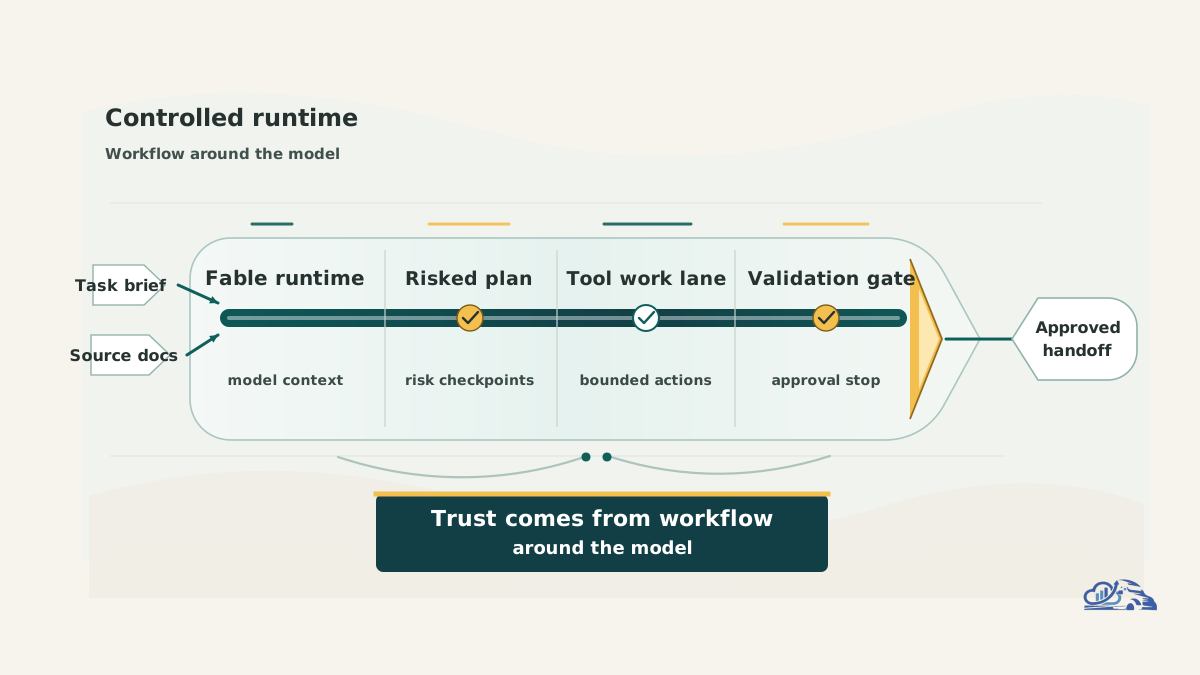
A safe adoption workflow starts with approved use cases, narrow repository access, measurable gates, and a review loop that treats AI output as untrusted until verified. The tool can be powerful. The workflow has to remain accountable.
Start with low-risk internal workflows:
- Test generation.
- Documentation updates.
- Migration scripts.
- Lint fixes.
- Data quality checks.
- Non-production SQL.
- Internal tooling.
Then graduate to production-adjacent changes only when the team has evidence about:
- Quality.
- Latency.
- Cost.
- Review burden.
A practical implementation architecture should include these layers:
- Developer IDE with approved AI settings.
- Repository access policy by project and sensitivity.
- Prompt and context logging rules.
- Test harness for generated changes.
- Static analysis and dependency scanning.
- Human review gate for production paths.
- Deployment evidence captured in CI.
- Post-merge monitoring for rollback and defect signals.
A lightweight policy artifact can make the workflow concrete:
1. Define the Grok 4.5 and the SpaceX Cursor acquisition: what it means for AI-assisted software engineering decision.
2. List required inputs, owner, and stop conditions.
3. Run the smallest safe workflow.
4. Validate output quality before publishing or deployment.
5. Escalate unresolved risk to a human reviewer.
This is not bureaucracy for its own sake. It is how the team prevents the model from becoming an unobserved contributor with broad permissions.
A concrete offer: Van Data Team can run a scoped AI-assisted engineering workflow review that produces:
- A repository risk map.
- An approved-use-case matrix.
- Evidence requirements.
- A dashboard gap review.
- An implementation scope for review gates.
That fits naturally with our broader AI and data engineering services, especially when coding assistants touch data pipelines, orchestration, analytics, or platform automation.
Evaluation Criteria and Failure Modes
Engineering teams should evaluate AI coding assistants by production behavior, not demo speed. The fastest assistant is not useful if it increases hidden review work, security exceptions, or rollback frequency.
A strong evaluation harness includes representative tasks from your actual workflow. Use tickets that include:
- Legacy context.
- Weak tests.
- Real style constraints.
- Normal ambiguity.
Then compare the assistant's output against your standards.
| Evaluation area | What to measure | Failure mode to watch |
|---|---|---|
| Code quality | Test pass rate, maintainability comments, architecture fit | The model writes code that passes locally but violates system design. |
| Security | Dependency risk, secret exposure, unsafe patterns | The model introduces libraries, logging, or permissions reviewers miss. |
| Cost | Token usage, review time, CI minutes, cloud impact | The tool reduces typing while increasing compute or review load. |
| Latency | Time from task start to reviewed merge | The model is fast but creates long review queues. |
| Drift | Behavior after model updates | The same prompt produces different patterns without notice. |
| Recovery | Rollback clarity and incident evidence | Generated changes ship without enough context to debug. |
Keep exact numbers as sourced facts only when cited nearby; otherwise treat the number as a measurement to collect in the reader's own workflow.
A common failure mode is measuring developer velocity while ignoring reviewer load. Suppose Ravi's data platform team uses an AI assistant to create dbt models and orchestration code.
- Pull requests arrive faster.
- Reviewers spend more time checking column lineage.
- Reviewers also check warehouse cost, idempotency, and data freshness.
- If the team tracks only merge count, AI looks successful.
- If it tracks escaped defects and review minutes, the picture may change.
Another failure mode is silent model drift. If a vendor ships frequent updates, the team needs regression prompts and golden tasks.
- The goal is not to freeze innovation.
- The goal is to know when a model update changes behavior in production-sensitive workflows.
When to Choose or Test Each AI Coding Pattern
The right pattern depends on repository risk, team maturity, and the amount of workflow evidence you can capture. A small internal script does not need the same controls as a payment service, data warehouse migration, or platform deployment tool.
| Pattern | Best fit | Strength | Limitation | Choose or test when |
|---|---|---|---|---|
| Assistant-only coding | Individual developer acceleration on low-risk work | Easy adoption and low process overhead | Weak visibility into data use and quality drift | The work is internal, reversible, and reviewed like normal code. |
| Agentic coding workflow | Multi-step tasks with tests, files, and tool calls | Can complete broader changes with less manual coordination | Needs stricter permissions and better recovery paths | The team has CI, clear ownership, and review gates. |
| Model-IDE feedback loop | Large engineering organizations with heavy coding signal | Can improve model behavior from real workflow data | Raises data governance, vendor lock-in, and portability questions | The organization can negotiate data terms and run independent evaluation. |
| Internal coding agent | Sensitive codebases or regulated workflows | More control over context, logging, and permissions | Higher build and maintenance burden | Source privacy and auditability matter more than plug-and-play speed. |
For most teams, the near-term answer is controlled adoption, not tool maximalism.
- Use assistants where the blast radius is low.
- Use agents where the task can be tested and rolled back.
- Use feedback-heavy platforms only after data commitments, export options, and audit trails are clear.
Use current official pricing pages before modeling cost; compare accepted-output cost after retries, caching, review minutes, fallback behavior, and priority or batch choices.
What CTOs, AI Leads, and Data Teams Should Do Next
The next move is to build an AI-assisted engineering operating model before informal tool usage becomes standard practice - the same discipline we outlined in governing agentic AI at scale. That model should define:
- What developers can do.
- What agents can touch.
- What reviewers must verify.
- What evidence must be stored.
Start with a simple governance map:
- Which repositories are approved for AI assistance?
- Which data, schemas, credentials, and customer examples are blocked?
- Which generated changes require senior review?
- Which tasks are good candidates for automation?
- Which model or tool changes require retesting?
- Which metrics decide whether adoption expands or pauses?
Then build the reporting layer. Engineering leaders need a dashboard that shows:
- Where AI is used.
- What types of changes it affects.
- How review burden changes.
- How defects move.
- Whether rollout risk is increasing.
This is where data teams should be involved early. Coding assistants touch:
- SQL.
- Orchestration.
- Analytics models.
- Internal dashboards.
- API clients.
- Data contracts.
- Cloud infrastructure.
A model that writes plausible transformation code can still break freshness, lineage, or warehouse cost controls.
The founder-led stance is simple: do not let the vendor roadmap become your operating model.
- Vendors will ship faster models.
- Vendors will deepen IDE integration.
- Vendors will push more agentic behavior.
- Your team still owns production risk.
Conclusion
The practical answer to the reported Grok 4.5 and SpaceX Cursor acquisition story: what it means for AI-assisted software engineering is that coding tools are becoming governed engineering systems.
- The model matters.
- The editor matters.
- The operating layer around them matters more.
The strongest teams will not be the ones that give every developer unrestricted access to the newest assistant. They will be the teams that:
- Define safe use cases.
- Protect source and prompt data.
- Measure quality as well as speed.
- Review generated changes with clear ownership.
- Retest workflows when models change.
For CTOs and AI leads, the next step is concrete: build a risk-reviewed adoption plan before AI coding becomes invisible infrastructure. Van Data Team can help produce the workflow map, signal dashboard, review-gate design, and implementation scope needed to move from experimentation to controlled production use.
Article FAQ
Questions readers usually ask next.
These short answers clarify the practical follow-up questions that often come after the main article.
Need a similar system?
If this article maps to a workflow your team already operates, the next step is usually a scoped review of the system, constraints, and rollout path.
Book your free workflow review here.
Related articles
View all
AI Governance Lessons from NVIDIA's Board Appointment
Djinn Stealer and ChocoPoC: the new attacks on AI coding assistants and the Zero Trust DevSecOps response
Claude Fable 5: A Practical Guide for Production AI Workflows