July 13, 2026
AI Governance Lessons from NVIDIA's Board Appointment
NVIDIA's board appointment shows how AI governance depends on audit trails, risk controls, model oversight, and clear production accountability safely.
Article focus
The lesson of NVIDIA's board change for AI teams is that production AI governance should be treated as an operating control system, not a policy document.
Section guide
TL;DR
- The lesson of NVIDIA's board change for AI teams is that production AI governance should be treated as an operating control system, not a policy document.
- AI teams need named owners, audit trails, model and prompt change records, scoped tool permissions, human review checkpoints, monitoring, and recovery paths.
- NVIDIA did not state that the appointment was an AI regulation response, but the Audit Committee detail is a useful lens for how technical teams should think about AI governance in production.
High-Level Statistics Summary
- NVIDIA announced Suzanne Nora Johnson's board appointment in early May 2026, with the appointment effective July 13, 2026.
- According to NVIDIA Investor Relations, the appointment expands NVIDIA's board to 11 members.
- Johnson's background includes two decades at Goldman Sachs and an expected Audit Committee role on the effective date.
- The sources cited in this article do not report quantified AI governance performance gains, so this analysis does not claim incident-resolution, cost-reduction, or productivity percentages.
AI governance is the operating discipline that defines who owns an AI system, what data and models it can use, how changes are approved, what evidence is logged, and who is accountable when the workflow fails. For engineering, data, and operations teams, the practical output is not a policy deck. It is a production control system.
NVIDIA announced in early May 2026 that Suzanne Nora Johnson would join its board of directors effective July 13, 2026. According to NVIDIA Investor Relations, the appointment expands NVIDIA's board to 11 members, and Johnson joins the Audit Committee on the effective date.
NVIDIA did not state that this appointment was a response to AI regulation or AI policy pressure. That boundary matters. The useful lesson for technical teams is broader: as AI systems become production infrastructure, the discipline that surrounds them has to look more like audit, controls, ownership, and evidence.
At Van Data Team, we start by mapping the workflow before we choose the tool. For teams building production AI agent workflows, reporting assistants, or governed data pipelines, the work is to identify where a model retrieves context, calls tools, changes business state, stops for human review, or leaves an audit trail.
How Van Data Team Makes This Operational
At Van Data Team, we treat AI governance as an operating workflow, not a theory section. We start by mapping the current handoff, source systems, decisions, review gates, dashboards, and recovery paths. The useful output is a scoped delivery plan: which signals to collect, which workflow gaps to close, which automation belongs behind a human review gate, and which dashboard or runbook lets the team act next.
What NVIDIA Actually Announced
NVIDIA announced that Suzanne Nora Johnson would join its board and Audit Committee, with the appointment becoming effective on the stated July date. The company described Johnson as the former Vice Chairman of The Goldman Sachs Group, where she spent two decades in leadership roles including Chair of the Global Markets Institute, Head of Global Research, and Head of Global Healthcare.
According to the NVIDIA Newsroom announcement, Johnson will join NVIDIA's board and Audit Committee effective on the appointment date. The same NVIDIA Newsroom announcement also notes her Pfizer board role and prior service as Board Chair of Intuit.
"She is expected to join the board's Audit Committee on the effective date of her appointment."
That line is the governance signal worth examining. Not because NVIDIA said this was about AI oversight. It did not. The signal is that audit discipline, finance discipline, healthcare exposure, and board governance experience are increasingly relevant in companies where technical systems carry business-critical risk.
Here is the factual boundary:
NVIDIA Board Appointment Facts And Governance Relevance
| Topic | Reported fact | Why it matters for this article |
|---|---|---|
| Appointment | NVIDIA announced Johnson's board appointment in early May | This is the news hook, not proof of an AI compliance motive |
| Effective date | The appointment is effective on the July date stated by NVIDIA | Today is the effective date of an earlier announcement |
| Board size | NVIDIA said the board expands to the new size | The change is a formal board governance action |
| Committee role | Johnson joins the Audit Committee | Audit discipline is the lens for production oversight |
| Background | Johnson held senior Goldman Sachs roles and other board roles | Her profile is governance, finance, healthcare, and corporate oversight |
The rest of this article is Van Data Team's analysis for engineering, data, and operations teams. It is not NVIDIA's stated rationale.
Why Audit Discipline Matters In The AI Era
Audit discipline matters for AI systems because production risk is not only about whether a model can generate a useful answer; it is about whether the organization can explain, reproduce, review, and recover from that answer. A model that works in a demo can still fail governance in production if no one knows which data it used, which prompt changed, which tool it called, or who approved the workflow.
For technical teams, this is the bridge between corporate governance and system design. A board committee asks whether the company has controls, evidence, risk visibility, and accountable owners. A production team should ask the same questions at the workflow level.
A reporting assistant, for example, should not only generate an answer. It should log the source tables, generated SQL, semantic layer version, model version, reviewer approval, and final recipient. If it produces a financial metric, the team should be able to inspect the path from raw source to dashboard output. That is where agentic BI and reporting needs the same seriousness as conventional analytics governance.
The mistake we see is treating governance as something added after launch. A team writes a policy, stores it in a wiki, and assumes the risk is covered. Then the first incident arrives: the agent used stale customer data, routed an exception to the wrong queue, or triggered a tool call that no longer matched the business process. At that point, a policy is not enough. The team needs logs, ownership, rollback behavior, and a known escalation path.
A practical governance model should answer operational questions:
- What system made the recommendation?
- What data sources were available at the time?
- What model, prompt, retrieval configuration, and tool permissions were active?
- What checks ran before release?
- What human review occurred, and who had authority to override?
- What happens when the workflow is wrong?
These are engineering questions before they are compliance questions.
What AI Governance Means For Production Teams
AI governance means the roles, controls, records, review gates, and monitoring practices that determine how AI systems are approved, deployed, observed, changed, and held accountable in production. For a technical audience, the simplest definition is this: governance is the operating wrapper around model behavior.
That wrapper has several layers.
Data governance defines which source systems an AI workflow can access, how freshness is measured, which fields are restricted, and how lineage is recorded. If a customer support agent can retrieve account history, it should not silently retrieve payroll data because both live in the same warehouse.
Model governance covers model selection, versioning, release criteria, evaluation datasets, known limitations, and fallback behavior. The team should know what changed between releases and which tests passed before a model was promoted.
Prompt and agent governance tracks system prompts, retrieval instructions, tool permissions, memory behavior, and action boundaries. This matters when an agent can send messages, update records, open tickets, trigger workflows, or query internal systems.
Access governance defines who can configure, approve, deploy, or override the system. Prototype credentials should not drift into production. Tool access should be scoped to the workflow, not granted broadly because development was easier that way.
Human review and escalation define when the system must stop. Low confidence, sensitive data, high-value transactions, policy exceptions, and unclear intent should route to a person with authority to decide.
Observability and incident response define what the team watches after release. Cost, latency, quality, drift, exception rates, user corrections, refusals, and tool-call failures all matter. Teams that already invest in data pipeline engineering will recognize the pattern: production quality depends on visibility, not hope.
Consider a hypothetical operations team deploying an AI triage workflow for inbound vendor requests. The model classifies the request, extracts fields, checks policy documents, and routes the case. Without governance, the workflow looks efficient until it misclassifies a sensitive contract exception as routine. With governance, the system detects sensitive terms, records the source text, stops automation, escalates to the right owner, and preserves a review trail.
That is the difference between automation and accountable automation.
The Production Oversight Checklist
A production AI workflow needs named owners, scoped permissions, recorded evidence, and release gates before it becomes business-critical. The following checklist is the practical version of board-level control thinking translated into engineering work.
Production AI Governance Control Checklist
| Governance area | Production control | Evidence to keep | Accountable owner |
|---|---|---|---|
| Ownership | Assign business owner, technical owner, and escalation owner | Workflow register and approval record | Product or operations lead |
| Data | Document sources, lineage, retention, quality checks, and restricted fields | Data catalog entry and lineage log | Data engineering lead |
| Model | Track model version, known limits, release criteria, and fallback behavior | Model card or release note | ML or platform lead |
| Prompt and retrieval | Version prompts, retrieval rules, embeddings configuration, and source filters | Change log and evaluation result | AI engineering lead |
| Tool access | Scope tool permissions by workflow and environment | Permission matrix and tool-call logs | Platform owner |
| Human review | Define approval thresholds and escalation authority | Review queue records and overrides | Operations owner |
| Monitoring | Track drift, latency, cost, quality, exceptions, and feedback | Dashboard and incident log | SRE or analytics owner |
| Recovery | Define pause, rollback, notification, and replay procedures | Runbook and post-incident review | Incident commander |
This artifact should live close to the system, not in a forgotten folder. It should be reviewed when the workflow changes, when a model changes, when a source system changes, or when the business process changes.
A governed reporting assistant is a useful example. The team should log the user's question, retrieved semantic definitions, generated query, warehouse tables touched, execution status, reviewer decision, and final answer. It should also show the report owner where cost and latency are increasing. AI cost governance is not separate from platform governance; the same operating discipline that helps teams reduce AWS costs without slowing delivery applies to AI workflows that consume compute, tokens, storage, and human review time.
The goal is not to collect logs for their own sake. The goal is to create enough evidence to answer the important questions quickly.
How Board Governance Maps To Engineering Governance
The following illustration summarizes from oversight questions to production controls:
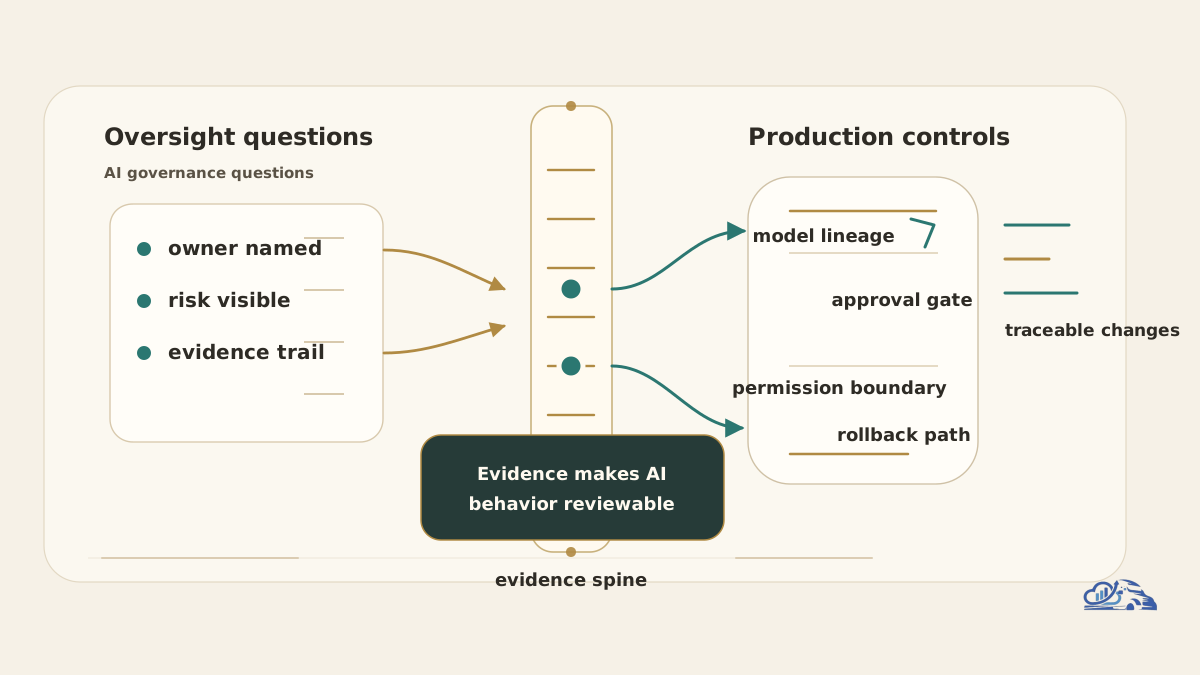
Board governance asks who is accountable, what controls exist, what risks are visible, and what evidence supports the decision. Engineering governance asks the same questions, but at the level of systems, releases, workflows, and incidents.
The mapping is direct:
Board Governance Questions Mapped To Production AI Controls
| Board-level question | Production AI question |
|---|---|
| Who is accountable for this risk? | Who owns this workflow in production? |
| What controls prevent failure? | What gates, tests, permissions, and fallback paths exist? |
| What evidence supports the report? | What logs prove the data, model, prompt, and tool behavior? |
| What changed since the last review? | What model, prompt, data, or tool configuration changed? |
| What happens when controls fail? | Who pauses the workflow, rolls it back, and notifies users? |
This is why audit committee thinking is useful even when the article is not about securities law or formal compliance. Audit discipline forces a team to move from belief to evidence.
Imagine an engineering team shipping an internal procurement agent. The agent reads policy, checks vendor status, drafts a recommendation, and can open an approval ticket. In prototype, the team allows broad document access and a flexible tool set. In production, that is too loose. The production design should limit retrieval sources, restrict ticket actions, log policy references, require review for exceptions, and reject requests outside its scope.
The governance question is not "Can the agent do the work?" The better question is "Can we prove what the agent did, why it did it, and who had authority over the outcome?"
At Van Data Team, this is where implementation starts to look like architecture. We define workflow boundaries, permissions, review gates, and reporting surfaces before treating the agent as production-ready. For teams that need a scoped path, we can deliver a workflow review that produces a signal map, control checklist, dashboard gap review, and implementation scope for the first governed release.
Common Mistakes That Break Oversight
Most AI oversight failures come from weak system boundaries, missing evidence, and unclear ownership. These failures are preventable, but only if teams treat governance as production design instead of documentation.
The common mistakes are specific.
Treating policy as the control. A policy can describe intent, but the system still needs permissions, logs, gates, and recovery behavior. If the workflow can bypass the policy in practice, the control does not exist.
Logging outputs without context. Saving the final answer is not enough. Teams also need model version, prompt version, retrieval sources, tool calls, user input, approvals, overrides, and error states where appropriate.
Letting prototype access survive launch. Early experiments often use broad credentials, relaxed prompts, open tools, and loose review. Those choices should be reset before production.
Assigning ownership to a group instead of an accountable function. "The data team owns it" is too vague during an incident. The workflow needs a business owner, technical owner, and escalation path.
Reviewing once and ignoring drift. AI systems can degrade when source data changes, user behavior changes, model behavior changes, or business rules change. Post-release monitoring is part of governance.
Adding human review without authority. A reviewer who can only rubber-stamp is not a control. The workflow must define what the reviewer can approve, reject, edit, escalate, or pause.
Ignoring operational cost. Governance should include budget visibility. Token usage, warehouse queries, orchestration retries, vector search, and review queues can become hidden operating costs.
A late-stage failure often looks boring from the outside. A dashboard number is wrong. A route is misclassified. A workflow takes too long. A human reviewer does not know whether to override. The real problem is usually upstream: the system did not preserve enough context for anyone to understand or correct the behavior quickly.
Practical Implementation Architecture
A governed AI production architecture should separate intake, retrieval, model execution, tool action, review, logging, monitoring, and recovery. This keeps the system inspectable when something goes wrong.
A practical architecture usually includes these components:
- Intake layer for user requests, metadata, identity, and business context.
- Policy layer for permissions, data boundaries, and workflow rules.
- Retrieval layer for approved knowledge sources, lineage, and freshness checks.
- Model layer for prompt templates, model versions, evaluations, and fallback behavior.
- Tool layer for scoped actions with explicit permissions and environment separation.
- Review layer for human approval, escalation, override, and exception handling.
- Evidence layer for input, output, prompt, model, data, tool-call, and approval logs.
- Monitoring layer for quality, latency, cost, exceptions, drift, and user feedback.
- Recovery layer for pause, rollback, replay, notification, and post-incident review.
A workflow diagram for this article should show control points, not just data flow. The useful visual is a path from request to retrieval to model to tool action to human review to monitoring, with evidence captured at each step. That is the operating model teams need when an AI system moves from experiment to production.
For a data team, this architecture may sit beside existing warehouse and orchestration systems. For an operations team, it may sit inside ticketing, CRM, or approval workflows. For an AI platform team, it may become a reusable control layer for multiple agents.
The implementation does not have to be heavy. The mistake is making it invisible.
A small team can start with a workflow register, versioned prompts, scoped service accounts, a release checklist, a review queue, and a dashboard for quality, cost, latency, and exceptions. A larger team may need formal model review records, data catalogs, incident management integration, and executive reporting.
The right level depends on the risk of the workflow. An internal drafting assistant does not need the same controls as an agent that updates customer records or produces finance-facing metrics. The governance burden should match the blast radius.
Evaluation Criteria Before Release
An AI workflow is ready for production only when the team can test behavior, observe failure, assign accountability, and recover without improvising. Before launch, evaluate the workflow across operating dimensions.
Accuracy and quality: Does the system answer correctly on known examples, edge cases, ambiguous inputs, and negative cases?
Data boundaries: Does it retrieve only approved sources? Does it avoid restricted fields? Can the team inspect which source influenced the answer?
Prompt and model change control: Are prompts, model choices, retrieval settings, and tool permissions versioned?
Latency and cost: Can the workflow meet the user's operational tolerance? Are token usage, warehouse cost, retries, and manual review time visible?
Human review burden: Does review happen only where it adds value, or does the system create a queue no one can manage?
Failure recovery: Can the team pause, roll back, replay, notify, and correct the workflow without rebuilding it under pressure?
Auditability: Can an owner reconstruct what happened after a disputed output, wrong action, or policy exception?
A hypothetical reporting assistant makes this concrete. Before release, the team tests known dashboard questions, intentionally ambiguous metric requests, stale data scenarios, restricted-field attempts, and malformed user prompts. The assistant passes only if it produces accurate answers, stops where it should, routes exceptions to a reviewer, and logs enough evidence for post-release inspection.
That is governance as engineering discipline.
Conclusion
NVIDIA's appointment of Suzanne Nora Johnson is a corporate governance event with clear reported facts from NVIDIA: the company announced the appointment in early May, said it expands the board, and stated that Johnson joins the Audit Committee on the effective date. NVIDIA did not state an AI regulation motive, and the analysis should not invent one.
The operational lesson is still useful. Production AI systems need audit-level discipline before they become business-critical. Teams need to know what system made a decision, what data it used, what changed, who approved it, what evidence exists, and how the workflow can be stopped or corrected.
That is the practical meaning of AI governance for engineering, data, and operations teams. It is not a layer of paperwork on top of delivery. It is the control structure that lets delivery survive contact with production.
Van Data Team helps teams turn this into working systems: governed agents, resilient data pipelines, review gates, reporting dashboards, and implementation plans that match the workflow's real risk. For globally distributed teams, that operating model also depends on clear async delivery, which is why our view of Vietnam-based data engineering is grounded in ownership, documentation, and production accountability.
Article FAQ
Questions readers usually ask next.
These short answers clarify the practical follow-up questions that often come after the main article.
Need a similar system?
If this article maps to a workflow your team already operates, the next step is usually a scoped review of the system, constraints, and rollout path.
Book your free workflow review here.
Related articles
View all
Djinn Stealer and ChocoPoC: the new attacks on AI coding assistants and the Zero Trust DevSecOps response
Claude Fable 5 vs GPT 5.5 vs Gemini 3.5 Flash Thinking
Optimizing Docker Image Build Times: A Practical Guide for Production Teams