July 8, 2026
DataRobot Unifies AI Governance Beyond the Cloud: Practical Guide for Production Teams
DataRobot Unifies AI Governance Beyond The Cloud guide for production teams: compare workflow fit, risk, cost, review burden, and deployment guardrails.
Article focus
DataRobot unifies AI Governance beyond the Cloud breaks down when source systems are scattered, reviews stay manual, handoffs are unclear, and risk is hard to prove.
Section guide
DataRobot unifies AI Governance beyond the Cloud breaks down when source systems are scattered, reviews stay manual, handoffs are unclear, and risk is hard to prove. This guide is for operators who need a practical map, workflow, dashboard signal, review gate, and implementation plan. At Van Data Team, we start by tracing source systems, ownership, automation boundaries, and escalation paths before turning the review into production work.
DataRobot unifies AI Governance beyond the Cloud means DataRobot is positioning AI governance as a cross-environment control layer for models, agents, and applications that run outside a single managed public cloud. The buyer problem is simple: AI systems now touch cloud services, private networks, edge devices, internal tools, and regulated data stores, but governance often stops at the platform boundary.
For product, data, security, and operations leaders, the practical output is a governance operating model: inventory the AI estate, map policy gaps, define approval gates, track lineage, monitor runtime behavior, and preserve evidence for audit. At Van Data Team, we treat this as implementation work, not vendor news. Our AI and data engineering services focus on the pipelines, reporting layers, agent guardrails, and review gates that make governance usable when the workflow is already in production.
According to the DataRobot newsroom announcement, the July 2, 2026 release targets governance beyond the public cloud, including on-premises, edge, air-gapped, sovereign, private cloud, and hybrid environments. The point is not that every team should adopt the same platform. The point is that cloud-only governance is no longer enough for teams shipping agentic AI into real business systems.
How Van Data Team Makes This Operational
At Van Data Team, we treat DataRobot unifies AI Governance beyond the Cloud as an operating workflow, not a theory section. We start by mapping the current handoff, source systems, decisions, review gates, dashboards, and recovery paths. The useful output is a scoped delivery plan: which signals to collect, which workflow gaps to close, which automation belongs behind a human review gate, and which dashboard or runbook lets the team act next.
Key Takeaways
- DataRobot frames the governance problem around fragmentation: public cloud, platform, and application controls often stop when an agent crosses environment boundaries.
- The announcement describes three governance layers: AI and agentic governance, IT governance, and infrastructure governance.
- The strongest implementation pattern is a central registry with role-based access, approval workflows, versioning, lineage, runtime monitoring, moderation, and compliance documentation.
- Teams should evaluate governance by environment coverage, evidence quality, escalation paths, cost controls, latency impact, token budget visibility, and failure recovery.
- Unified governance is an operating model before it is a tool purchase; the mistake we see is starting with dashboards before the team has mapped owners, systems touched, and release gates.
By the Numbers
- The DataRobot newsroom announcement describes governance across six non-public-cloud or mixed-environment categories: on-premises, edge, air-gapped, sovereign, private cloud, and hybrid environments.
- The DataRobot AI Governance product page describes a central hub covering six AI asset categories: models, LLMs, agents, tools, apps, and vector databases.
- NIST's AI Risk Management Framework, released January 26, 2023, organizes AI risk work into four functions: Govern, Map, Measure, and Manage.
- The European Commission says the AI Act defines four AI risk levels and lists obligations for high-risk systems, including logging, documentation, human oversight, robustness, cybersecurity, and accuracy.
Cloud-Only Governance vs Cross-Environment Governance
Cloud-only AI governance works when the AI workload stays inside one provider boundary; cross-environment governance is needed when models, agents, tools, data, and approvals span mixed infrastructure.
| Decision area | Cloud-only governance | Cross-environment governance |
|---|---|---|
| Environment coverage | Public cloud controls inside one provider | Public cloud, private cloud, hybrid, on-premises, edge, air-gapped, and sovereign environments |
| Asset scope | Often model or service centric | Models, LLMs, agents, tools, applications, vector databases, and workflows |
| Release control | Platform-specific deployment approval | Central registry, role-based access, approval workflows, and versioning |
| Runtime control | Monitoring inside one cloud boundary | Input/output moderation, lineage, system-touchpoint tracking, and escalation across environments |
| Audit evidence | Cloud logs and platform documentation | Compliance documentation tied to policy, lineage, approvals, identities, and deployment history |
| Operational risk | Gaps appear when workloads leave the cloud | Gaps appear when owners, policies, or evidence are inconsistent |
The DataRobot AI Governance product page describes a central hub for models, LLMs, agents, tools, apps, and vector databases. That six-part asset scope matters because production AI risk no longer sits only in the model artifact. It sits in the retrieval path, the prompt chain, the tool call, the identity used to call an API, and the business action that follows.
What the Announcement Actually Means
The announcement means DataRobot is making governance portable across environments where public-cloud-native controls may not be available or complete.
DataRobot's own framing is sharp enough to quote:
"Governance can't be an afterthought bolted onto a platform."
The full implementation message is broader than that line. DataRobot says governance should include consistent policy enforcement, end-to-end lineage, and compliance documentation wherever agents run, whatever systems they touch, and whoever built them. It also describes three layers: AI and agentic governance, IT governance, and infrastructure governance.
That three-layer model is useful for buyers because it separates the controls that often get blurred together.
AI and agentic governance covers pre-production review, policy checks, registry status, versioning, moderation, and runtime behavior. IT governance covers identity, permissions, entitlements, and who can access which data or APIs. Infrastructure governance covers hosting, gateways, fair-use rules, cost controls, and deployment across public cloud, private cloud, hybrid, edge, air-gapped, and sovereign environments.
A practical example: Maya leads analytics engineering at a regulated lender. Her team uses one model in the cloud for credit pre-screening, a private deployment for sensitive customer data, and an internal agent that prepares exception-review packets for underwriters. If governance only watches the cloud model endpoint, it misses the agent's retrieval path, internal system access, prompt changes, approval history, and the evidence the compliance team needs later. Cross-environment governance closes that gap only if the workflow itself is mapped.
Why Governance Beyond One Cloud Boundary Matters
Governance beyond one cloud boundary matters because AI agents create risk through actions, not just outputs.
A traditional model governance process often asks: What model is deployed? What data trained it? Who approved it? How is performance monitored? Those questions still matter, but they are incomplete for agentic systems. An agent may retrieve a contract, call a CRM, update a ticket, write to a database, send an email, or pass a recommendation into a downstream approval flow.
According to NIST, the AI Risk Management Framework was released on January 26, 2023 and organizes AI risk activity through four core functions: Govern, Map, Measure, and Manage. That structure fits this problem well. You cannot manage what you have not mapped, and you cannot prove governance if the control evidence lives in separate tools with different owners.
The EU regulatory context points in the same direction. The European Commission says the AI Act defines four levels of AI risk and lists strict obligations for high-risk systems, including risk assessment, traceability through logging, detailed documentation, human oversight, robustness, cybersecurity, and accuracy. For teams operating in or serving the EU, those are not abstract ethics terms. They become release criteria, monitoring criteria, and evidence criteria.
The mistake we see is treating governance as a compliance dashboard. A dashboard is useful only after the workflow emits reliable signals. If the agent has no stable identity, no versioned prompt or tool configuration, no approval record, and no system-touchpoint map, the dashboard becomes a polished view of missing evidence.
This is where production AI agent workflows need engineering discipline. The agent should know when to act, when to stop, when to ask for review, and how to leave a trail that another human can inspect six months later.
A Practical Implementation Framework
A workable implementation framework starts with the AI estate, not the governance tool.
At Van Data Team, we start by mapping the intake, decisions, tools, data stores, owners, and handoffs that already shape the work today. Then we decide where an agent should retrieve context, call tools, write outputs, or stop for review. The governance layer follows that workflow map.
1. Inventory the governed assets
Create a live inventory of models, LLMs, agents, applications, vector databases, tools, datasets, prompts, pipelines, dashboards, and deployment locations. For each asset, capture the owner, business purpose, environment, data sensitivity, downstream systems, and release status.
This inventory should include shadow automation. The highest-risk automation is often not the flagship model. It is the small internal script or agent that quietly writes to production systems without versioning.
2. Map environment coverage
List where each asset runs: public cloud, private cloud, hybrid, on-premises, edge, air-gapped, or sovereign infrastructure. Then mark which governance controls exist in each environment.
The important question is not "Do we have governance?" It is "Where does governance stop?" If cloud logs cover one endpoint but the edge deployment stores only local traces, the evidence model is split. If sovereign infrastructure has stricter access controls but weaker observability, the review process needs a different operating path.
3. Define approval gates before production
Approval should not be a meeting at the end of a project. It should be a state transition in the workflow.
A governed release path should include build, test, security review, policy review, business-owner approval, deployment approval, runtime monitoring, incident handling, and rollback. Each step needs a named owner and evidence artifact.
4. Version every operational component
For agentic AI, versioning needs to cover more than the base model. Track the prompt, tool manifest, retrieval configuration, data source list, guardrail settings, evaluation set, approval record, and deployment target.
If a response changes, the team needs to know whether the change came from the model, prompt, retrieval corpus, tool permission, policy threshold, or data pipeline. Without that detail, root cause analysis becomes guesswork.
5. Connect monitoring to action
Monitoring should capture quality, cost, latency, token budget, policy violations, failed tool calls, escalation volume, and user overrides. But monitoring is not complete until it triggers an action.
For example, a policy violation should create an incident or review task. A latency increase should point to the retrieval, model, or tool-call segment responsible. A token budget overrun should show whether the agent is carrying too much context, calling the model too often, or retrieving low-value documents.
Teams that need governed reporting should connect AI governance signals into agentic BI and reporting, so business stakeholders can see what changed, what failed, and what needs review without reading raw logs.
6. Preserve compliance evidence as part of the workflow
Documentation should be generated by the operating process, not reconstructed during audit season. Approval records, lineage maps, evaluation results, incident reports, prompt versions, tool permissions, and deployment history should all be part of the normal release path.
That is the difference between governance theater and operational governance.
Governance Checklist
- Inventory models, LLMs, agents, applications, vector databases, tools, datasets, prompts, pipelines, dashboards, and deployment locations.
- Map environment coverage across public cloud, private cloud, hybrid, on-premises, edge, air-gapped, and sovereign infrastructure.
- Define approval gates for build, test, security review, policy review, business-owner approval, deployment approval, runtime monitoring, incident handling, and rollback.
- Version the model, prompt, tool manifest, retrieval configuration, data source list, guardrail settings, evaluation set, approval record, and deployment target.
- Monitor quality, cost, latency, token budget, policy violations, failed tool calls, escalation volume, and user overrides.
- Preserve approval records, lineage maps, evaluation results, incident reports, prompt versions, tool permissions, and deployment history as normal workflow evidence.
A Lightweight Governance Control Map
The following illustration summarizes cross-environment governance control map:
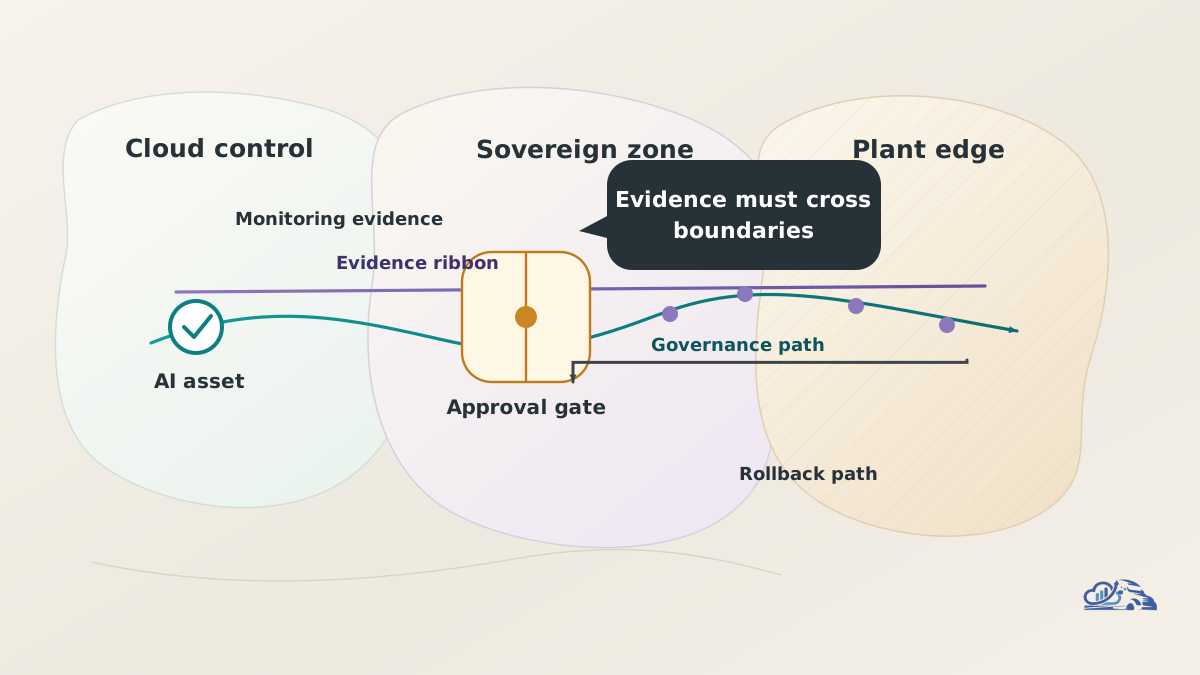
A governance control map gives teams one artifact that connects environment, owner, release gate, monitoring signal, and recovery path.
1. Define the DataRobot unifies AI Governance beyond the Cloud decision.
2. List required inputs, owner, and stop conditions.
3. Run the smallest safe workflow.
4. Validate output quality before publishing or deployment.
5. Escalate unresolved risk to a human reviewer.
This is not a replacement for a governance platform. It is a practical bridge between workflow reality and platform configuration. A central registry becomes useful when every asset has this level of operating context.
Consider a second scenario. Omar manages AI enablement for a manufacturing group with edge deployments in plants where connectivity is intermittent. A cloud dashboard shows model status, but the plant agent uses local context and delayed sync. When a policy threshold changes, headquarters assumes the edge deployment updated immediately. It did not. The fix is not a better slide. The fix is a release gate that confirms policy propagation, local version status, deferred logs, and fallback behavior when sync fails.
That kind of issue is common in hybrid infrastructure. It is also where governance work overlaps with cloud cost optimization, because fair-use policies, model hosting choices, gateway design, and token budgets affect both risk and spend.
Best Practices for Production Teams
The best practice is to make governance consistent across environments while allowing environment-specific controls where infrastructure constraints differ.
Start with one policy vocabulary. If "approved for production" means one thing in the public cloud and another thing on-premises, audit evidence will drift. Use consistent labels for draft, approved, deployed, deprecated, quarantined, and retired assets.
Treat agents as production systems. Do not govern them as prompts. An agent has identity, permissions, tools, memory, retrieval, policy checks, monitoring, and escalation behavior. Each of those parts can fail independently.
Separate build, approve, deploy, and monitor permissions. Role-based access is not bureaucracy when an agent can touch customer records, financial systems, or regulated decisions. The same person should not be able to silently change a tool permission, approve the change, and deploy it into production without review.
Use pre-deployment red-team and evaluation checks. The DataRobot product page mentions pre-deployment testing for jailbreaks, bias, inaccuracies, toxicity, and compliance issues. Whether a team uses DataRobot or another stack, those checks should be tied to release criteria, not left as exploratory testing.
Monitor inputs, outputs, and tool calls. Output moderation alone misses the action path. A compliant answer can still come from an improper data source or trigger an improper downstream action.
Design recovery before launch. Define rollback targets, fallback modes, manual review queues, and incident ownership. Production readiness comes from knowing what happens after the control fires.
Common Failure Modes to Avoid
The common failure mode is assuming a governance feature will compensate for an unmapped workflow.
One failure is partial inventory. Teams register models but forget agents, retrieval stores, prompt chains, dashboards, and internal tools. The governance view looks complete until an incident reveals the missing dependency.
Another failure is environment optimism. A policy works in the cloud, so the team assumes the same enforcement exists on-premises or at the edge. It may not. Air-gapped and sovereign environments may have different deployment cadence, logging access, identity controls, and update paths.
A third failure is manual compliance reconstruction. If the audit packet depends on someone gathering screenshots, Slack approvals, spreadsheet notes, and old deployment tickets, the governance process is already weak. Evidence should be produced during the normal workflow.
A fourth failure is monitoring without ownership. Alert volume rises, but nobody knows who decides whether to pause the agent, adjust the policy, roll back a version, or escalate to legal or compliance.
A fifth failure is ignoring cost and latency. Agent governance can add moderation calls, retrieval checks, logging overhead, and policy evaluation steps. These controls are often necessary, but they still need latency budgets, cost visibility, and service-level expectations. The right target is not zero overhead. The right target is measured overhead with clear value.
For teams that want a structured starting point, Van Data Team can run a scoped governance workflow review through our founder-led delivery model. The output is a signal map, asset inventory template, release-gate proposal, dashboard gap review, and implementation scope for the highest-risk AI workflows first.
How to Evaluate DataRobot or Any Governance Platform
Evaluation should test whether the platform can prove control across the actual environments where your AI systems run.
Use a real workflow, not a demo workflow. Pick one agent or model that touches sensitive data, crosses at least two systems, and has a business owner outside the data team. Then test the platform against the work it must actually govern.
Evaluate these dimensions:
- Environment coverage: Can the platform govern the environments you actually use, including private, hybrid, on-premises, edge, air-gapped, or sovereign deployments?
- Asset coverage: Does it cover models, LLMs, agents, tools, applications, vector databases, prompts, and data pipelines?
- Access control: Can build, approve, deploy, and monitor permissions be separated?
- Lineage: Can the team trace model, prompt, retrieval, tool, data, and application dependencies?
- Runtime monitoring: Are inputs, outputs, policy violations, tool calls, latency, cost, and token usage visible?
- Moderation and guardrails: Can unsafe responses be blocked before they reach business users or downstream systems?
- Evidence quality: Can audit documentation be generated from system records instead of manual reconstruction?
- Recovery: Can the team pause, roll back, fall back to human review, and preserve incident evidence?
- Operating burden: How much review work does the governance process add, and which roles absorb it?
The verdict is usually use-case specific. A cloud-native-only control plane may be enough for a contained internal assistant with low-risk data and one deployment environment. A cross-environment governance approach is a stronger fit when agents touch regulated workflows, multiple clouds, internal systems, edge infrastructure, or sovereign data constraints.
Conclusion
DataRobot unifies AI Governance beyond the Cloud because AI governance now has to follow models, agents, applications, tools, and data across the places where work actually happens. The useful lesson is not only about DataRobot. It is that governance fails when it is trapped inside one cloud, one platform, or one reporting layer.
Production teams should start with the operating model: inventory assets, map environments, assign owners, define approval gates, version the whole agent stack, monitor runtime behavior, preserve evidence, and design fallback paths before launch. Then a governance platform has something concrete to enforce.
At Van Data Team, our stance is direct: do not buy governance before you understand the workflow it must govern. Start with the highest-risk AI workflow, map the systems touched, define what must be approved, and build the reporting and escalation path around that reality. DataRobot unifies AI Governance beyond the Cloud is ultimately a practical reminder that AI governance works only when policy, lineage, monitoring, approvals, and recovery paths follow the full production workflow across every environment where the AI system acts.
Article FAQ
Questions readers usually ask next.
These short answers clarify the practical follow-up questions that often come after the main article.
Need a similar system?
If this article maps to a workflow your team already operates, the next step is usually a scoped review of the system, constraints, and rollout path.
Free governance review
DataRobot Governance Beyond Cloud
Map DataRobot-style governance beyond cloud boundaries and leave with review gates, lineage checks, monitoring signals, and implementation next steps.
- AI estate map across cloud, private, edge, and hybrid systems
- Approval checkpoints for agents, models, tools, and data access
- Lineage and evidence gaps to close before audit
- Runtime monitoring signals for agent behavior and policy drift
- Prioritized implementation plan with owners and next steps
Related articles
View all
AI Agent Web Scraping: Lessons From OpenAI's Rogue Agents
Defensive AI Agents and the Defender's Window
How Data Teams Reduce AWS Costs by 60% Without Slowing Delivery