July 7, 2026
DeepMind's Running Guide agent and the A24 partnership: what real-time spatial and creative AI agents mean for engineers
DeepMind's Running Guide Agent And The A24 Partnership: What Real-time Spatial And Creative AI Agents Mean For Engineers guide for production teams: compare.
Article focus
Engineering teams trying to move AI agents from demos into production should treat the Running Guide and A24 partnership announcements as a systems-design signal: agents are moving into workflows where timing, context, and human control matter.
Section guide
Engineering teams trying to move AI agents from demos into production should treat the Running Guide and A24 partnership announcements as a systems-design signal: agents are moving into workflows where timing, context, and human control matter. This article explains DeepMind's Running Guide agent and the A24 partnership: what real-time spatial and creative AI agents mean for engineers, then turns the news into a practical framework for bounded autonomy, review gates, observability, and recovery.
At Van Data Team, we start AI agent work by mapping the workflow before choosing the model: what the system observes, what it can decide, what it can change, where a human must review, and how failure is recovered. That same operating lens applies here. Running Guide is about real-time physical guidance. The A24 collaboration is about creative workflow tooling. Both point to the same engineering lesson: production agents need narrow permissions, explicit feedback loops, and measurable safeguards. For teams building similar systems, that is the bridge from AI research headline to production AI agent workflows.
Tooling And Landscape Fit
Do not evaluate the topic in isolation. Compare the main approach against adjacent frameworks, orchestration choices, and runtime controls so the reader can see when each option fits.
Review adjacent options such as LangGraph, LangChain, CrewAI, native function calling, MCP before choosing the implementation path.
Key Takeaways
- Running Guide and the A24 collaboration show AI systems leaving chat-only interfaces and entering workflow environments where timing, trust, and user authority shape product safety.
- According to Google DeepMind, Running Guide helps blind and low-vision runners navigate independently using real-time computer vision and spatial audio cues on a chest-mounted Pixel 10 Pro.
- According to Variety's June 22, 2026 report, Google invested $75 million in A24, with AI filmmaking tools and an AI storyboard generator discussed as part of the collaboration.
- The practical engineering pattern is bounded autonomy: define inputs, allowed actions, review states, fallback behavior, logs, and escalation before the agent reaches users.
- Creative backlash is not just a communications issue. For engineers, it is a product signal about consent, provenance, attribution, reversibility, and human approval.
What DeepMind Actually Announced
DeepMind announced two different AI-workflow efforts that belong in the same engineering conversation because both place AI inside bounded human workflows.
| Signal | Official scope | Engineering lesson |
|---|---|---|
| Running Guide | Google DeepMind describes Running Guide as an accessibility AI agent for blind and low-vision runners that uses real-time computer vision and spatial audio cues on a chest-mounted Pixel 10 Pro | Real-time agents need low-friction feedback, confidence handling, and clear fallback behavior |
| A24 collaboration | Google DeepMind describes the A24 work as a research and development collaboration focused on AI workflows and techniques for filmmakers | Creative agents need editability, provenance, permissions, and approval gates |
| Investment context | Variety reports a $75 million Google investment in A24 and says an AI storyboard generator is under discussion | Workflow selection matters: start with bounded pre-production tasks before deeper automation |
| Governance context | The Hollywood Reporter covered creative-community backlash, including boycott calls, after the A24 and Google DeepMind partnership | Trust, consent, and user control become engineering requirements, not soft launch details |
According to Google DeepMind, Running Guide builds on Project Guideline and is designed to help blind and low-vision runners move without a human guide or tether. The important point is not that it is a general autonomous navigation product. It is a focused accessibility agent with a specific environment, user, device posture, signal path, and feedback channel.
"A step towards running unbounded"
- Google DeepMind, Running Guide announcement
The A24 collaboration is different. According to Google DeepMind's official announcement, it is a research partnership to explore AI workflows and techniques for filmmakers while helping A24 and its filmmakers shape new technology in service of their vision. Variety adds that an AI storyboard generator is under discussion and reports that Google does not gain access to A24's existing film library.
Those details matter. A storyboard assistant is a bounded workflow. It can support ideation, shot exploration, scene composition, and iteration without becoming the author of the film. That boundary is the product.
Why Spatial and Creative Agents Belong Together
Spatial and creative agents belong together because both force engineers to design for context, timing, and human authority instead of simple answer generation.
A chatbot can be wrong and still leave the user time to inspect the answer. A running guide agent has to communicate while the user is moving. A creative workflow agent can generate plausible output, but the filmmaker still owns the judgment, taste, and final approval. In both cases, the agent does not merely respond. It participates in an active workflow.
The mistake we see is treating "agent" as a single architecture. It is not. A spatial agent, a creative co-pilot, a reporting agent, and a research automation stack can all use models, tools, memory, and orchestration, but their risk surfaces are different.
A practical classification helps:
| Agent pattern | Typical output | Main risk | Required control |
|---|---|---|---|
| Chat assistant | Text answer or recommendation | Incorrect guidance | Source grounding and user verification |
| Spatial guide | Timed cue in a changing environment | Unsafe or confusing feedback | Confidence thresholds, fallback cues, and human override |
| Creative co-pilot | Draft, storyboard, image, edit, or variation | Loss of authorship, consent, or provenance | Approval gates, attribution, and reversible edits |
| Business workflow agent | Report, decision support, task update, or tool call | Silent process failure | Logs, dashboards, escalation, and rollback |
This is where Van Data Team's operating model becomes relevant for engineering leaders. In agent design with human review, the core question is not "Can the model do the task?" The better question is "Where does the model stop, and what happens next?"
That question applies cleanly to Running Guide and A24. The spatial agent should stop when confidence is low, signals conflict, or conditions fall outside the tested envelope. The creative agent should stop when output needs rights review, brand review, director approval, or human taste.
What Real-Time Spatial Agents Mean for Engineers
Real-time spatial agents make latency, perception quality, feedback clarity, and fallback behavior part of product safety.
Running Guide is useful because it shows an agent operating around continuous physical-world variables. The environment changes second by second. Lighting shifts. The path changes. People and objects move. The runner is also moving, which means feedback has to be timely, clear, and low effort to interpret.
In a spatial product, latency is not just a performance metric. It changes user trust. If an audio cue arrives late, the cue can become confusing even when the underlying model prediction was reasonable. If cues are too frequent, the system can create cognitive fatigue. If cues are too vague, the user may not know whether to slow down, continue, or stop.
Engineers should treat spatial AI as a loop, not a prompt:
- Observe the environment through camera, sensor, route, or device context.
- Estimate confidence and uncertainty.
- Decide whether guidance is safe to provide.
- Communicate through a channel the user can process immediately.
- Listen for user correction, override, or changed conditions.
- Escalate to a fallback state when the system is unsure.
For a running assistant, the fallback might be a conservative audio cue such as slow down, stop, or request human help. For a warehouse navigation tool, it might be a lockout state. For an inspection agent, it might be a handoff to a supervisor.
A useful evaluation table for spatial agents looks like this:
| Dimension | Production question |
|---|---|
| Perception | What signals does the agent use, and what conditions reduce quality? |
| Confidence | What threshold changes the system from guidance to fallback? |
| Latency | How is end-to-end cue timing measured under real device conditions? |
| Feedback | Can the user understand the cue while moving or under load? |
| Recovery | What does the system do after a missed cue, blocked route, or uncertain scene? |
| Observability | What events are logged without exposing sensitive user data? |
A hypothetical example makes this concrete. A runner approaches a temporary obstacle on a familiar route. The model detects a path change, but confidence drops because lighting is poor and the obstacle edge is unclear. A production-grade agent should not improvise a precise instruction beyond its certainty. It should move into conservative guidance, reduce ambiguity, and make the safest next action clear.
That same pattern applies outside accessibility. If an internal operations agent sees conflicting numbers in a dashboard, it should not quietly publish a recommendation. It should flag the conflict, show evidence, and escalate. The domain changes. The control logic remains.
What Creative AI Agents Mean for Engineers
Creative AI agents make human control, provenance, reversibility, and consent core system requirements.
The DeepMind and A24 partnership is not just a story about generative media. It is a story about workflow boundaries. According to Google DeepMind, A24 and its filmmakers can help shape new technology in service of their vision. Engineers should read that as a product specification.
Creative control has to be implemented. It cannot live only in a launch statement.
In practice, creative workflow agents need:
- Permission controls that define who can generate, edit, approve, export, and archive.
- Provenance records that show which model, prompt, source asset, or user action shaped an output.
- Reversible edits so a human can compare, reject, or restore prior states.
- Approval gates before generated work moves into production, publishing, or client review.
- Review logs that capture who approved what and when.
Storyboarding is a sensible workflow because it is bounded. A storyboard generator can help a filmmaker explore camera angles, mood, pacing, scene blocking, or visual alternatives during pre-production. It can accelerate exploration without owning the final creative decision.
The backlash covered by The Hollywood Reporter is also part of the engineering brief. If a user group worries that AI systems may erode authorship, consent, or labor value, those concerns become product requirements. Explainability, attribution, opt-out boundaries, auditability, and review gates are not public relations extras. They are part of the system design.
A practical creative-agent workflow might look like this in prose: the filmmaker creates a scene brief, the agent generates storyboard options, the director selects or rejects frames, the system records the generation context, a reviewer checks rights and style alignment, and only approved outputs move into the production workspace. The diagram for this workflow should show draft, review, revision, approval, archive, and rejection states, with human authority visible at each transition.
This is also where production AI agent operations matter. Logs are not only for debugging. They are how teams reconstruct decisions when a creative, legal, brand, or operational question appears later.
A Production Framework for Agent Engineering
The following illustration summarizes bounded autonomy loop:
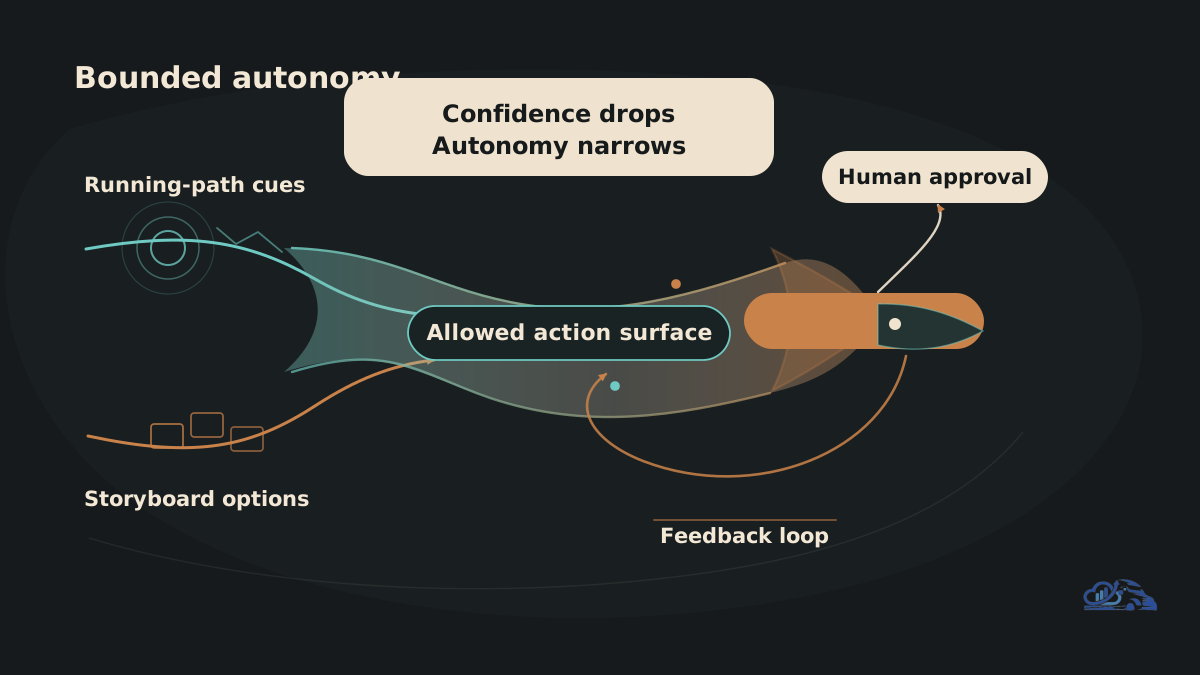
A production agent framework starts by defining the environment, action surface, feedback loop, failure handling, and review model before model capability is evaluated.
At Van Data Team, we usually begin with a signal map. The map identifies what the agent can observe, which signals are trusted, which signals are weak, and where a human decision is still required. This avoids the common mistake of building a clever model wrapper around an unclear workflow.
Use this framework for spatial, creative, or business agents.
Define the environment
The environment is the operating context the agent must understand. For Running Guide, that context includes the runner, path, obstacles, movement, device posture, and audio channel. For a creative agent, it includes the script, visual intent, production constraints, review rules, and asset permissions. For a business agent, it may include CRM data, warehouse tables, dashboards, documents, tickets, and approval policies.
The environment definition should answer:
- What inputs are available?
- Which inputs are reliable?
- Which conditions make inputs unreliable?
- What user intent is the agent supporting?
- What does the agent never get to decide?
Define the action surface
The action surface is what the agent can do. Guidance is different from suggestion. Suggestion is different from generation. Generation is different from tool execution. Tool execution is different from irreversible automation.
A spatial guide may provide cues but not physically control the runner. A storyboard agent may generate options but not approve a final cut. A reporting agent may draft commentary but not send an executive alert until a human approves it.
For teams implementing internal AI systems, this is where Agentic BI and reporting needs guardrails. A reporting agent that can summarize revenue movement is useful. A reporting agent that silently changes a board metric without review is a risk.
Define the feedback loop
The feedback loop is how the agent learns whether its output worked. In Running Guide, feedback is immediate: the runner follows, slows, corrects, or stops. In filmmaking, feedback is editorial: a human accepts, revises, rejects, or asks for variation. In business workflows, feedback may come through review status, dashboard corrections, ticket outcomes, or decision logs.
Good feedback loops are measurable. Track acceptance, rejection, override, escalation, low-confidence states, and time to recovery. These metrics matter more than demo screenshots because they show how the agent behaves under real workflow pressure.
Define failure handling
Failure handling should be designed before launch. The main question is simple: what should the agent do when it is unsure?
For a spatial agent, uncertainty should usually reduce autonomy. For a creative agent, uncertainty should increase human review. For a reporting agent, uncertainty should show sources, mark assumptions, and block automated distribution until someone checks the output.
This runbook checklist is a useful artifact for implementation planning:
| Check | What to document |
|---|---|
| Inputs | Data sources, sensors, files, tools, or user context |
| Permissions | Actions allowed, actions blocked, and actions requiring approval |
| Confidence | Thresholds for normal action, cautious action, and fallback |
| Human review | Roles, review states, approval criteria, and rejection paths |
| Observability | Logs, traces, dashboards, and incident review fields |
| Recovery | Retry rules, rollback options, escalation paths, and user notification |
| Evaluation | Test scenarios, acceptance criteria, adversarial cases, and regression checks |
For teams that want a concrete implementation scope, Van Data Team can turn this into a scoped workflow review: a signal map, action-permission matrix, dashboard gap review, review-gate design, and delivery plan for the first production agent. The output is not a generic strategy document. It is an implementation scope that defines what to build, what to monitor, and where the system must stop.
Common Mistakes to Avoid
The most common mistake is treating spatial, creative, and business agents as the same product pattern because all of them use AI.
The second mistake is overstating the maturity or scope of the announcement. Running Guide should be framed as a focused accessibility application, not a general-purpose autonomous physical agent. The A24 partnership should be framed as a research collaboration around filmmaker workflows, not a film-library training deal or an IP transfer.
Other mistakes are more operational:
- Ignoring latency until late testing.
- Treating model confidence as an internal detail instead of a product state.
- Designing creative tools without provenance and approval history.
- Letting generated output move directly into publishing or production.
- Measuring only answer quality instead of recovery behavior.
- Building agents without dashboards for rejection, override, and escalation.
- Treating backlash as noise instead of requirement discovery.
A business example makes the point. Suppose a data team builds an agent that drafts weekly operating commentary from warehouse metrics. The first version produces fluent summaries, but it misses a late-arriving data correction and sends the old conclusion to leadership. The fix is not only a better prompt. The fix is workflow design: freshness checks, source citations, anomaly detection, reviewer approval, and a rollback path for published commentary.
That is why bounded systems outperform broad demos in production. They have fewer permissions, clearer accountability, and better recovery behavior.
A related implementation example is a research agent that gathers sources, validates claims, drafts summaries, and leaves uncertain findings for human review. Van Data Team's autonomous research agent stack is relevant because the same pattern applies: constrain the workflow, log the evidence, and separate automated drafting from final judgment.
Evaluation Criteria for Engineering Teams
Engineering teams should evaluate real-time and creative agents by how they behave under uncertainty, not by how impressive the best-case demo looks.
Use these criteria before committing to a production roadmap:
| Criterion | Spatial agent question | Creative agent question | Business agent question |
|---|---|---|---|
| Cost | What device, inference, monitoring, and support costs scale with use? | What generation, storage, review, and rights-checking costs scale with output? | What model, orchestration, data, and reviewer costs scale with workflow volume? |
| Latency | Can the cue arrive while it is still useful? | Can iteration stay fast without bypassing review? | Can the workflow meet reporting or decision deadlines? |
| Token budget | Is context compact enough for reliable reasoning? | Are prompts and assets scoped to the creative task? | Are source excerpts, tables, and history bounded? |
| Observability | Can incidents be reconstructed? | Can generated assets be traced? | Can decisions be audited from source to output? |
| Review burden | Does human review improve safety without blocking normal use? | Are approvals clear and reversible? | Are escalations routed to the right owner? |
| Recovery | What happens after a bad cue, rejected draft, or wrong recommendation? | Can the team restore prior versions? | Can the system retract, correct, and notify? |
This is where adjacent implementation patterns matter. A chatbot is useful when the primary risk is answer quality. Robotic process automation is useful when deterministic rules dominate. Batch data pipelines are useful when timing is scheduled and repeatable. Agentic workflows are useful when the system must interpret context, call tools, make bounded recommendations, and stop for review.
The right pattern depends on the workflow. If the task is deterministic, do not force an agent into it. If the task requires judgment, context, and escalation, do not hide it inside an unobservable script.
Conclusion
DeepMind's Running Guide agent and the A24 partnership: what real-time spatial and creative AI agents mean for engineers is not a narrow news story. It is a signal that agents are entering workflows where a wrong output can affect movement, authorship, trust, or operational decisions.
The practical response is not to chase broad autonomy. It is to build bounded systems. Define the environment. Limit the action surface. Make confidence visible. Keep humans in charge where judgment matters. Log the workflow. Design recovery before launch.
For engineering teams, the opportunity is real, but the work is operational. The teams that benefit from this shift will be the ones that treat agents as production systems with permissions, observability, review gates, and escalation. Van Data Team helps teams turn that into scoped delivery across AI agents, data workflows, and reporting systems, with the controls needed to ship something that survives contact with real users.
Article FAQ
Questions readers usually ask next.
These short answers clarify the practical follow-up questions that often come after the main article.
Need a similar system?
If this article maps to a workflow your team already operates, the next step is usually a scoped review of the system, constraints, and rollout path.
Free agent review
Scope spatial and creative agents
Map how Running Guide-style spatial agents and A24-style creative workflows would need permissions, checkpoints, observability, and recovery before production.
- Agent boundary map: observations, decisions, actions, and blocked changes
- Human review gates for spatial guidance and creative asset workflows
- Observability checklist for timing, tool calls, context drift, and handoffs
- Recovery plan for bad guidance, failed tools, and creative misalignment
- Prioritized build/no-build next steps for your first production agent
Related articles
View all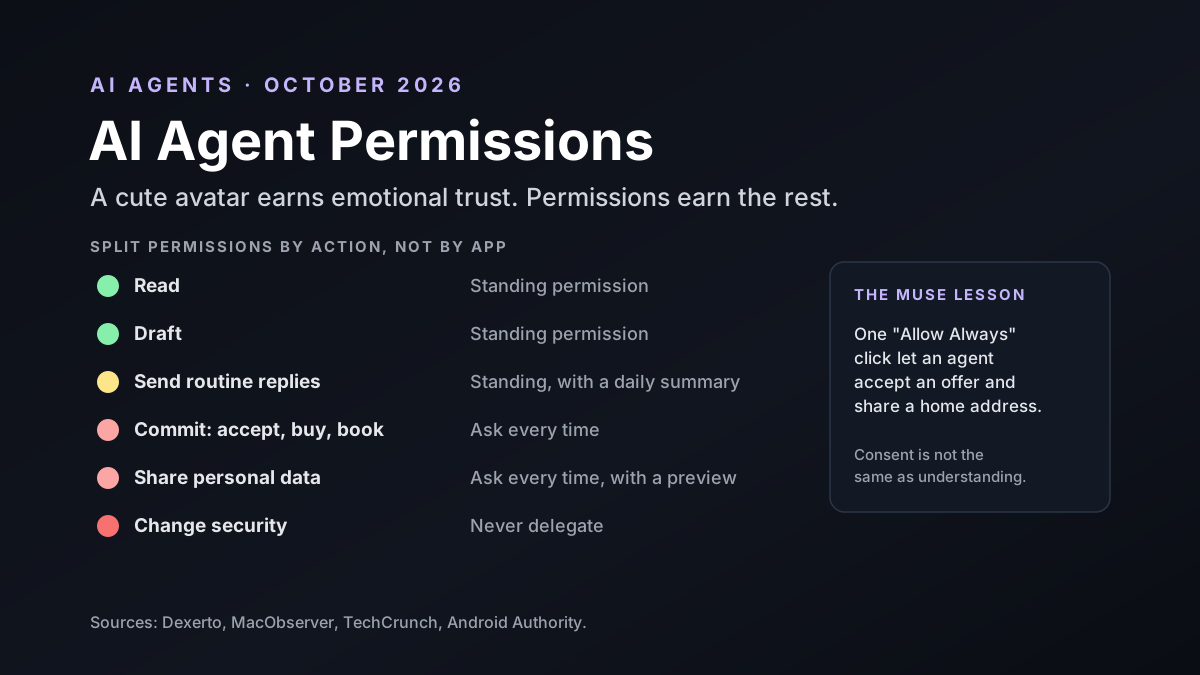
AI Agent Permissions: Lessons From Meta Muse and OpenAI Dots
Jev and System One Models: Fast Classifiers for AI Agents
AI Slowdown Stocks: Chipmakers Sink, Hyperscalers Gain