August 11, 2026
Agentic Incident Response for GPU Clusters
Agentic Incident Response guide for production teams: compare workflow fit, risk, cost, review burden, and deployment guardrails before shipping safely.
Article focus
Agentic incident response for GPU clusters combines continuous fault detection with evidence-backed diagnosis, so MLOps and infrastructure engineers can shorten the path from a failed node to safe recovery—cutting costly training stalls and slow, round-the-clock log analysis.
Section guide
Categories: MLOps; AI Agents and Multi-Agent Systems
Agentic incident response for GPU clusters combines continuous fault detection with evidence-backed diagnosis, so MLOps and infrastructure engineers can shorten the path from a failed node to safe recovery—cutting costly training stalls and slow, round-the-clock log analysis. Amazon SageMaker HyperPod documents health monitoring and automatic node recovery, while AWS DevOps Agent separately describes automated triage and root-cause analysis (RCA); the cited sources don't establish a native link between them. This Van Data Team guide turns those pieces into a staged adoption and governance framework, using our delivery model.
Key Takeaways
The separately documented capabilities support a split operating model: HyperPod detects and recovers node health, while DevOps Agent investigates operational incidents.
- AWS separately documents HyperPod health monitoring and AWS DevOps Agent incident triage; no cited source confirms a native HyperPod-to-DevOps Agent integration or related launch date.
- The Health Monitoring Agent (HMA) detects unhealthy nodes and performs supported mechanical recovery. Separately, AWS DevOps Agent investigates wider operational incidents through supported inputs.
- Mean time to recovery (MTTR) spans detection, triage, diagnosis, decision, remediation, and workload resume. Faster alerts only shorten part of that path.
- Van Data Team recommends starting with agent-proposed RCA and human-approved remediation.
- Expand autonomy only after evidence quality, false positives, permissions, rollback, and auditability meet team-defined thresholds.
What AWS documents for agentic incident response
AWS separately documents HyperPod's cluster health loop and DevOps Agent's investigation loop. The cited materials do not establish that HyperPod events or HMA telemetry are sent directly into DevOps Agent.
Reported by AWS. SageMaker HyperPod is AWS's resilient environment for large-scale model training. The HyperPod health-monitoring documentation says HMA publishes detected GPU or Trainium health events to CloudWatch. Separately, the AWS DevOps Agent incident-response documentation describes investigations started through supported integrations, webhooks, or manual input. It says those investigations can provide key findings, RCA, and mitigation plans. Neither cited source documents a direct HyperPod-to-DevOps Agent telemetry integration.
HMA supplies the detection and mechanical recovery layer. According to AWS's HMA support announcement for Slurm, the agent runs continuously on GPU- and Trainium-based nodes. It watches for hardware conditions such as unresponsive GPUs and NVLink error counters. When it detects a fault, it marks the node unhealthy and can reboot or replace it. With Slurm auto-resume enabled, the job continues from its last saved checkpoint after replacement.
That mechanical loop is clear in the SageMaker HyperPod health-monitoring documentation:
"The health monitoring system will monitor the node health status continuously ... and then take actions automatically when fault is detected."
DevOps Agent supplies a separately documented investigation layer. AWS describes it as an autonomous incident-response agent that can automatically triage incoming events. It performs deep, multi-phase RCA with parallel hypothesis generation and counter-evidence validation. AWS previewed it at re:Invent 2025 and made it generally available on March 31, 2026.
Before rollout, verify current region availability, supported cluster configurations, permissions, and exact feature scope in the current AWS documentation. Those details can change after a release.
Van Data Team analysis. Large training systems should treat hardware failure as an operating condition, not an exceptional case. The cost of an incident includes idle accelerator time, work lost since the last checkpoint, engineering investigation, and delayed downstream work.
MTTR isn't one timer. It contains detection, triage, diagnosis, decision, remediation, and workload resume. HMA can shorten detection and supported mechanical recovery. DevOps Agent targets triage and diagnosis. Neither removes the need for checkpoint policy, approval rules, rollback, and ownership.
Detection latency is only the opening interval. A slow diagnosis can leave replacement capacity idle, trigger the wrong restart, or let the same fault return after resume. Checkpoint policy also affects how much work must be repeated. Teams should measure time from fault to signal, validated cause, approved action, and successful resume. That event and job data is the basis for any credible business case.
At Van Data Team, we start by mapping the incident workflow: which signal fires, what context is required, who decides, and how the workload resumes. That map drives pipelines, dashboards, review gates, and escalation paths. Our MLOps and AI agent articles cover the same production discipline across adjacent workflows.
How Do You Separate Detection From Diagnosis?
The following illustration summarizes detect, diagnose, govern:
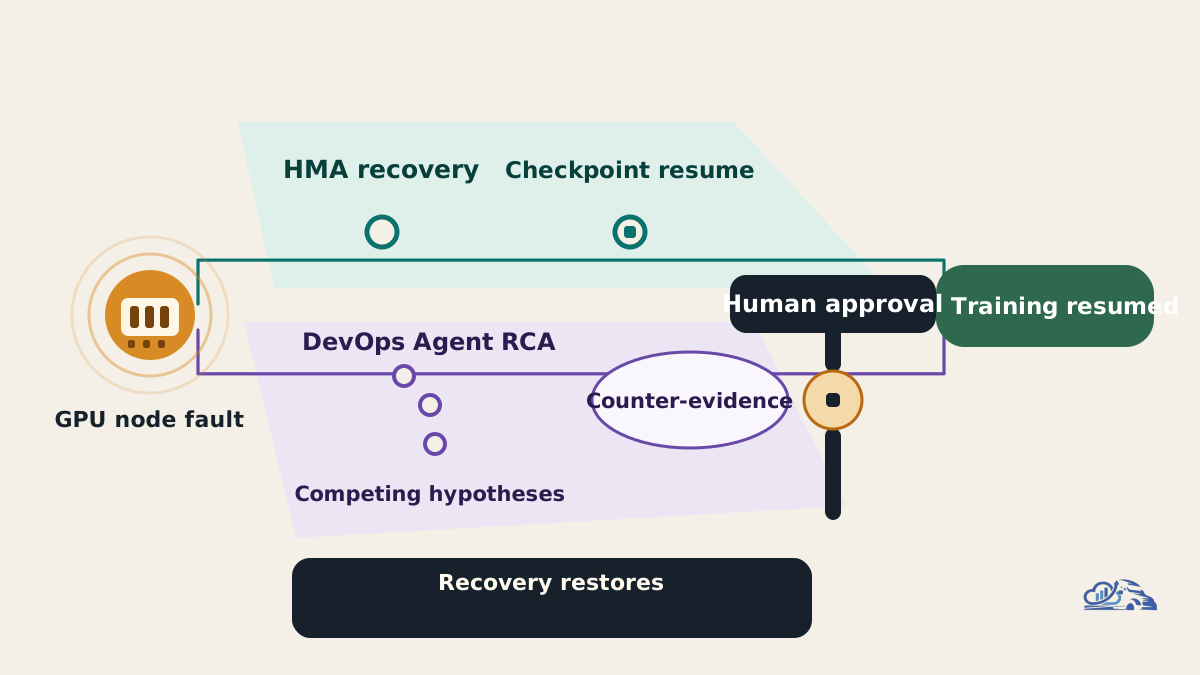
A safe operating model keeps node-health recovery, causal diagnosis, and consequential approval as distinct responsibilities.
| Layer | Responsibility | Evidence or input | Output or action | Governance boundary | Evaluation focus |
|---|---|---|---|---|---|
| HMA and cluster health | Detect node and hardware conditions; perform supported mechanical recovery | GPU and Trainium health, unresponsive GPU signals, NVLink counters | Mark unhealthy, reboot or replace, support checkpoint resume | Stay within the documented health-recovery policy | Detection coverage, signal quality, recovery result, successful resume |
| DevOps Agent and RCA | Correlate events and test root-cause hypotheses | Supported alerts, observability, code, CI/CD | Evidence-backed RCA and a proposed next action | Start read-only; require approval for consequential remediation | Accuracy, evidence completeness, confidence, false positives, cost, latency, token budget |
| Human control | Own permissions, approval, rollback, and incident closure | Agent evidence, runbooks, business impact, cluster state | Approve, reject, modify, stop, or roll back | Gate node drains, job restarts, configuration changes, and broad-impact actions | Audit completeness, safe recovery, escalation quality, policy compliance |
An unhealthy-node signal is not always the full root cause. It may identify the component that failed without explaining why. A driver rollout, scheduler change, bad configuration, upstream storage issue, or dependency failure may have created the condition.
This split also makes ownership clearer. The health layer can follow a documented service policy. The investigation layer can read broader evidence. The human control layer owns actions that can change workload state or widen the blast radius. Each layer gets its own permissions, telemetry, success criteria, and rollback path.
Illustrative driver-crash scenario
This is a hypothetical operating example, not a customer case. During a long training run, Mina, the on-call SRE, sees HMA report a node-level GPU condition after a driver crash. HMA marks the node unhealthy and starts its supported recovery path. The training job enters its configured checkpoint-aware recovery path.
In the proposed workflow, DevOps Agent would then correlate HMA telemetry, HyperPod events, driver signals, and recent system context. It would propose that a recent driver change caused the incident and show the supporting and contradictory evidence. Mina reviews the causal chain. She approves any wider action, such as restarting the job or changing cluster configuration.
The decision rule is simple: mechanical health recovery may follow its configured policy. RCA should not inherit broad write access merely because it produced a plausible diagnosis.
When Can You Trust Multi-Agent RCA?
A root cause is trustworthy only when the agent exposes its evidence, survives counter-evidence, and performs well against incidents with known answers.
Reported by AWS. The documented investigation pattern uses parallel hypothesis generation and counter-evidence validation. The agent gathers telemetry and architectural context, then develops competing explanations. It tests each theory against supporting and contradictory signals before converging on a cause.
For a training-cluster incident, plausible hypotheses may include a component failure, recent system change, anomalous input, resource limit, or dependency problem. Parallel work can reduce tunnel vision. It doesn't guarantee truth. Several weak hypotheses can still produce a polished but wrong conclusion.
Van Data Team analysis. Trust starts with an evidence trail. The investigation should show which metrics, logs, events, code changes, deployment records, and cluster states supported each theory. It should also show what contradicted a theory and why that theory was rejected.
Replay resolved incidents before live use. Compare the agent's diagnosis with ground truth adjudicated by engineers. Score root-cause accuracy and evidence completeness separately. Then examine confidence calibration, false-positive rate, time to useful diagnosis, and repeatability across similar incidents. A confident answer with missing decisive telemetry should fail the gate.
Production evaluation also needs operating limits. Track investigation cost, latency, token budget, and human review burden. A fast agent that floods operators with weak hypotheses can still increase MTTR. Observability should expose agent steps, tool calls, evidence access, retries, budget use, and termination reasons.
Stop the run when required evidence is missing, signals remain contradictory, a budget is exceeded, or the agent requests an unsupported tool. These stop conditions should produce a clear escalation, not a silent failure or another uncontrolled retry.
The adjacent agent landscape includes LangGraph and LangChain for orchestration, CrewAI for role-based agent teams, native function calling for tool use, Model Context Protocol (MCP) for standardized context and tool access, and Plan-and-Execute for explicit planning. These are different orchestration, protocol, and reasoning options. They aren't claims of feature parity with AWS DevOps Agent.
The same evaluation contract should govern AWS DevOps Agent, a custom multi-agent system, or another AIOps incident agent. The framework choice matters less than the operating contract. A production RCA workflow needs bounded tools, observable reasoning, reproducible evaluation, and a safe handoff to humans. That is also how Van Data Team approaches production AI agent workflows.
How Should You Govern Autonomous Triage?
Teams should move from offline evidence gathering to bounded autonomy only after evaluation and controls remain reliable under live conditions.
-
Historical replay. Run the agent against resolved incidents without production access. Build ground truth from the final incident review, not the first on-call guess. Use failures to improve signal coverage, prompts, tools, and stop conditions.
-
Live decision support. Let the agent collect evidence and propose RCA while a human decides. Keep infrastructure access read-only. Record whether the engineer accepted the diagnosis, needed to steer it, or found a different cause.
-
Bounded automation. Permit reversible actions with a small blast radius only after replay and live results are dependable. Define exact resources, preconditions, validation checks, retry limits, and rollback steps for every allowed action.
-
Conditional autonomy. Expand action scope only when accuracy, evidence quality, permissions, and recovery results remain stable in production. Revoke access when telemetry changes, evaluation degrades, or a new failure mode invalidates prior assumptions.
Least privilege is the baseline. Early access should cover only the telemetry, code, deployment records, and cluster metadata required for diagnosis. Keep investigation permissions separate from remediation permissions. AWS DevOps Agent's documented scope covers triage and RCA; feeding platform signals into it and connecting its output to wider automation are separate architecture and governance decisions.
Require human approval before draining nodes, restarting jobs, changing configuration, or taking any action with broad cluster impact. Give each investigation explicit ceilings for elapsed time, cost, latency, and token budget. Stop and escalate when evidence is incomplete, signals conflict, the cluster state is ambiguous, or a tool call falls outside policy.
Audit logs should preserve the trigger, evidence, hypotheses, counter-evidence, confidence, tool calls, approvals, actions, and observed result. Runbooks should state preconditions, validation checks, recovery steps, and rollback. A named engineer still owns incident closure. Periodic replay against new failure modes keeps evaluation tied to the system that exists now.
The mistake we see is treating a fluent RCA narrative as a verified cause. Other failure modes include merged but unrelated alerts, stale topology, missing telemetry, repeated investigation loops, and permissions that widen over time. An AI agent ops and human escalation playbook helps make these boundaries explicit.
At Van Data Team, we start with the workflow, then define permissions, observable decisions, review gates, and rollback before expanding autonomy. This is the same reliability discipline we apply to our own data and agent pipelines. A scoped workflow review should return a signal map, dashboard gap review, permission model, evaluation plan, and implementation scope.
The operating takeaway
Hardware failure is a normal operating condition in large training systems, so recovery speed matters more than pretending every run will stay clean.
The value of agentic incident response comes from shortening the full path from detection to dependable workload resume. HyperPod and HMA cover node-health detection and supported mechanical recovery. Separately, AWS documents DevOps Agent as a layer for continuous triage and evidence-based diagnosis. A combined workflow still needs approval boundaries, audit trails, runbooks, rollback, and accountable incident ownership.
Start with decision support. Test known incidents, measure evidence quality and false positives, and keep consequential actions behind a human gate. Expand autonomy only when the system proves reliable under real operating pressure.
At Van Data Team, discovery, architecture, and implementation stay in one accountable loop. Book a scoping call to receive a workflow review, signal map, dashboard gap assessment, governance design, evaluation plan, and phased delivery scope for your training-cluster incident workflow.
Article FAQ
Questions readers usually ask next.
These short answers clarify the practical follow-up questions that often come after the main article.
Need a similar system?
If this article maps to a workflow your team already operates, the next step is usually a scoped review of the system, constraints, and rollout path.
Book your free workflow review here.
Related articles
View all
What Happened to OpenAI Operator?
Serverless Voice Agents on AWS: A Production Guide
Unverified GPT-5.6 soft launch reports and what they mean for AI-assisted software engineering: what is confirmed?