August 7, 2026
Serverless Voice Agents on AWS: A Production Guide
Learn how Nova Sonic, AppSync Events, and Bedrock AgentCore shape serverless voice agents, including cost, latency, orchestration, and production checks.
Article focus
Serverless voice agents on AWS combine Amazon Nova Sonic, a speech-to-speech model on Amazon Bedrock, AWS's managed foundation-model platform; AWS AppSync Events, a managed real-time event layer; and Amazon Bedrock AgentCore Runtime, a serverless agent host.
Section guide
Serverless voice agents on AWS combine Amazon Nova Sonic, a speech-to-speech model on Amazon Bedrock, AWS's managed foundation-model platform; AWS AppSync Events, a managed real-time event layer; and Amazon Bedrock AgentCore Runtime, a serverless agent host. AWS documents this event-driven composition. It helps engineering and platform teams avoid costly always-on compute, difficult scaling, and latency stalls under concurrent sessions. This guide maps the architecture, cost and latency path, and production evaluation checks.
At Van Data Team, we start by mapping the live workflow: audio transport, agent decisions, retrieval, tools, review gates, and recovery. Our AI agent development service turns that map into a scoped session flow, permission model, and evaluation plan before the team commits to an orchestration framework.
Enterprise sales coaching is a useful illustrative application. The agent can identify an objection, retrieve approved material, and suggest a response during a live conversation. AWS presents the architecture for automotive and manufacturing assistance, not as a dedicated sales-coaching reference. The same operating pattern can support customer service, field assistance, and other real-time voice workloads.
Key Takeaways
The pattern works when teams treat serverless infrastructure as an operating model, not a shortcut around production engineering.
- AWS separates real-time transport, speech processing, agent hosting, retrieval, and tool execution into observable components.
- The serverless cost model shifts spending toward active sessions, but model, streaming, retrieval, logging, and tool costs remain.
- The coordinator-and-specialist pattern supports focused agents, but every synchronous hop consumes latency and token budget.
- Production approval requires session isolation, grounded responses, voice-data controls, traceable decisions, failure recovery, and human escalation.
How serverless voice agents fit together
The documented AWS pattern separates transport, speech reasoning, agent hosting, and grounded actions so each layer can scale and fail independently.
| Component | Role in the documented pattern | Van Data Team production check |
|---|---|---|
| AWS AppSync Events and AWS Lambda | AppSync Events carries real-time audio events while Lambda manages streaming and session lifecycle. Lambda is AWS's event-driven function service. | Trace connection, reconnection, event delivery, interruption cancellation, session cleanup, and streaming cost. |
| Amazon Nova Sonic | Handles listening, understanding, reasoning, and responding through real-time bidirectional speech streaming. | Measure session startup, first audio response, turn completion, interruption behavior, grounding, and model usage. |
| Amazon Bedrock AgentCore Runtime | Hosts containerized agents with serverless scaling, session isolation, and usage billing. | Verify isolation under concurrent sessions, runtime attribution, startup behavior, fallback, and recovery. |
| Coordinator and specialist agents | Route work across agents, retrieval, and tools while segmenting concurrent sessions. | Evaluate routing accuracy, hop latency, token budget, duplicated work, cancellation, and fallback behavior. |
| Retrieval and tools | Supply current context and external capabilities to the live voice flow. | Test source freshness, permissions, grounding, tool errors, PII exposure, action boundaries, and per-call cost. |
Amazon Nova Sonic handles the conversational loop within a unified model. It streams through the InvokeModelWithBidirectionalStream API rather than waiting for a complete recording and a later text response. That removes separate speech recognition and speech synthesis services from the core voice path.
AWS states the runtime contract plainly in its scalable voice agent design:
"Amazon Bedrock AgentCore Runtime is a serverless hosting environment for AI agents."
AppSync Events carries audio and session events between the client and backend. Lambda manages the live connection and Nova Sonic stream in the AWS reference. AgentCore hosts containerized coordinator or specialist agents. The AWS Samples reference implementation adds a practical path for WebSocket communication, authentication, tool use, and deployment.
In an illustrative sales-coaching flow, a seller starts a live session and speaks normally. Nova Sonic manages the speech interaction. A coordinator identifies the current objection, while retrieval supplies approved product or policy context. An objection-handling specialist prepares guidance, and Nova Sonic returns it as speech. Every lookup, response, and tool call remains attached to that seller's session.
The important boundary is responsibility. AppSync Events transports events. Nova Sonic runs the voice loop. AgentCore hosts agents. Retrieval grounds responses. Tools perform approved actions. Mixing these responsibilities makes latency, cost, and failure analysis much harder.
Why the zero-idle model changes voice agent cost
Serverless architecture changes voice economics by removing the need to reserve dedicated voice compute for traffic that isn't present.
An always-on design pays for provisioned processes, connection capacity, and scaling headroom even when conversations are quiet. A serverless design shifts more spending toward active sessions and actual work. That is the useful meaning of "zero idle" here. It doesn't mean every account-level charge disappears when nobody is speaking.
Serverless Land reports an illustrative cost of about $0.007 for a five-minute interactive session. This is not an independently verified AWS benchmark or a universal production rate. Region, model usage, session behavior, retrieval, logging, and external tools can materially change the result.
An honest voice agent cost model includes:
- Nova Sonic input and output usage.
- AppSync event and connection traffic.
- Lambda and AgentCore runtime usage.
- Retrieval queries, embeddings, and storage.
- Specialist model calls and their token consumption.
- Tool APIs, logs, traces, data transfer, and retained audio or transcripts.
Traffic shape matters as much as nominal service pricing. Measure session duration, active speech, silence, interruption frequency, concurrent demand, retrieval calls, specialist calls, and retained data. Then compare the observed active-session profile with the team's existing always-on baseline.
Cost attribution should reach the session and workflow level. A platform total cannot show whether objection handling, retrieval, or a slow tool is driving spend. The same discipline used to reduce AWS costs without slowing delivery applies here: map spend to the work that created it.
Where latency accumulates in real-time voice AI
The following illustration summarizes the latency-critical voice path:
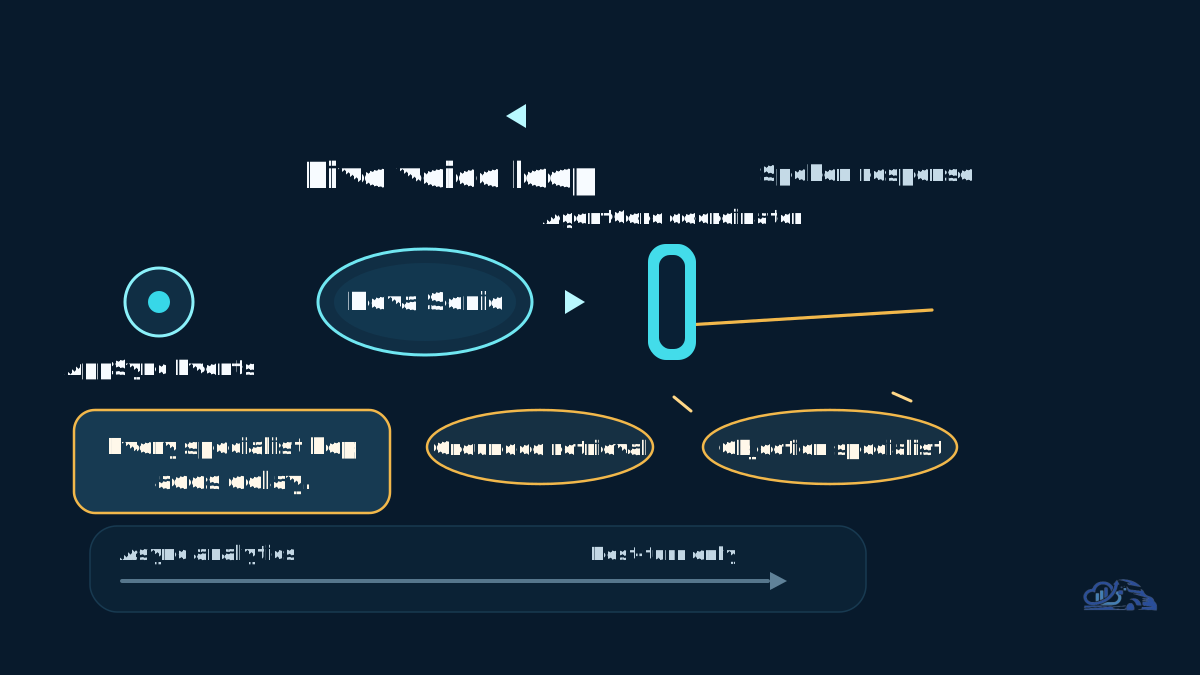
Low latency comes from bidirectional streaming and a short synchronous path, not from the serverless label alone.
Nova Sonic can begin processing and returning audio through its bidirectional stream while the conversation is active. Yet model time is only part of the path. Audio ingress, event delivery, coordinator routing, retrieval, specialist reasoning, tool execution, and output buffering all affect the user's experience.
Keep only user-blocking work inside the live turn. Reporting, transcript enrichment, long-running analytics, and nonessential writes should happen asynchronously. A specialist agent belongs in the synchronous path only when it improves the answer enough to justify another network and model hop.
Barge-in also needs explicit engineering. When a user interrupts, the system should mark the previous turn as stale, cancel safe-to-cancel work, discard buffered output, and preserve the valid session state. Otherwise, the agent may keep speaking from an obsolete tool result while the user has already changed direction.
Consider an illustrative coaching session. A buyer corrects the seller's assumption while a recommendation specialist is still working. The coordinator must cancel that recommendation and route the new intent. Returning the old advice quickly is still a failure.
Trace connection setup, inbound audio, model response, routing, retrieval, tools, specialist calls, and outbound audio separately. Test these stages under overlapping sessions, reconnects, interruptions, and traffic bursts. Don't adopt a published latency claim as your production target without traces from your own region, clients, knowledge layer, and tool stack.
How to orchestrate and evaluate multi-agent voice
A production multi-agent voice system should use the fewest agent boundaries needed to improve routing, grounding, or control.
AWS documents a coordinator that delegates work to specialist agents, retrieval, and tools. For sales coaching, useful roles might include retrieval, recommendation, objection handling, policy checking, and human escalation. The coordinator should keep the conversation state and invoke a specialist only when its narrow capability is required.
The adjacent framework landscape offers different control models:
- Native function calling fits a narrow workflow where the voice model selects from a small set of approved tools.
- LangGraph fits explicit state transitions, branching, retries, and resumable workflows.
- LangChain helps teams compose models, retrievers, tools, and supporting integrations.
- CrewAI frames orchestration around collaborating roles and delegated tasks.
- Model Context Protocol, or MCP, standardizes access to tools and context. It doesn't replace routing, state, or authorization policy.
- Plan-and-Execute can separate complex planning from action, but extra planning turns can add delay.
Evaluate each option on the same dimensions: cost, latency, token budget, observability, evaluation support, state control, and failure recovery. The framework with the most features isn't automatically the safest fit for a live conversation.
The mistake we see is turning every domain concept into another agent. More specialists can duplicate retrieval, repeat context, consume tokens, and make cancellation unclear. Don't add one unless held-out tests show a measurable quality or control benefit.
Give each session a shared trace identifier. Create a span for every model, agent, retrieval, and tool call. Record why the coordinator selected a route, which grounded sources were used, what was cancelled, and which fallback ran. Sensitive arguments and transcripts should be redacted before they reach logs.
Evaluation must cover route selection, grounding, tool correctness, interruption recovery, unsupported claims, and escalation. Review cost and token use beside conversation quality. Our AI agent operations and escalation playbook explains how to connect those signals to review ownership and recovery actions.
Production governance and evaluation gates
Production approval requires evidence that the voice workflow stays isolated, grounded, recoverable, and accountable under realistic pressure.
Start with session boundaries. AgentCore provides managed session isolation, but application state can still cross boundaries through a bad cache key, retrieval filter, log record, or tool request. Test concurrent users with intentionally similar prompts and verify that audio, transcripts, retrieved records, memory, and tool results never cross sessions.
Voice data needs its own operating policy. Define consent and disclosure, what audio is retained, whether transcripts are required, who can retrieve them, and when they are deleted. Redact sensitive content from traces. Retrieval and tool permissions should follow the user's identity and business role, not only the agent's service identity.
Guardrails should match the consequence of the response. A sales-coaching agent may suggest grounded wording, but it shouldn't invent pricing, promise contract terms, or act on the seller's behalf. Safety, policy, contractual, and customer-facing commitments need narrow tool permissions and explicit review gates. Use human-in-the-loop agent design when a recommendation could create material business impact.
Failure behavior must be designed before rollout. If retrieval times out, the agent should not fill the gap from unsupported memory. If a specialist fails, the coordinator needs a safe fallback or an escalation path. If a tool's result arrives after an interruption, that result must not leak into the next turn.
Build held-out conversations representing routine, ambiguous, adversarial, and interrupted sessions. Evaluate route accuracy, source grounding, tool arguments, claim safety, barge-in recovery, escalation, token use, and session cost. Keep this set separate from prompts used during development.
If the architecture fits but the scope is unclear, Van Data Team can turn representative conversations into a workflow review, latency-hop map, usage-based cost model, evaluation-set outline, permissions matrix, and delivery plan. Our guide to turning an operations brief into an executable automation scope shows the level of detail that plan should contain.
The production decision
Serverless voice agents are a strong fit when demand varies and the team can measure every active-session hop. The AWS pattern removes dedicated idle voice compute, provides managed scaling, and isolates hosted agent sessions. It doesn't remove the cost or latency created by models, transport, retrieval, tools, and specialist agents.
Start with a representative session profile, a short synchronous path, and a held-out evaluation set. Prove interruption recovery and cross-session isolation before adding autonomy. Then tag cost, tokens, latency, sources, and tool outcomes to the same trace.
If you need a production decision rather than another voice demo, work with Van Data Team on the agent architecture. The useful output is a scoped workflow, measurable acceptance gates, an operating cost model, and a recovery plan your team can own after launch.
Article FAQ
Questions readers usually ask next.
These short answers clarify the practical follow-up questions that often come after the main article.
Need a similar system?
If this article maps to a workflow your team already operates, the next step is usually a scoped review of the system, constraints, and rollout path.
Free architecture review
Pressure-Test Your Serverless Voice Architecture
Review your Nova Sonic, AppSync Events, and AgentCore pattern, then leave with a practical cost, latency, orchestration, and production-readiness plan.
- A component map for audio streaming, session state, AgentCore agents, retrieval, tools, and human review
- A per-session cost model covering model usage, streaming, runtime, retrieval, logging, and concurrency assumptions
- A latency budget for turn-taking, barge-in, retrieval, tool calls, and multi-agent handoffs
- An orchestration recommendation across LangGraph, LangChain, CrewAI, native function calling, and MCP
- A production checklist for isolation, PII, consent, guardrails, observability, and held-out evaluations
Related articles
View all
Jev and System One Models: Fast Classifiers for AI Agents
GPT-5.6 In Microsoft 365 Copilot: What Production Teams Should Know
Building AI agents with Model Context Protocol (MCP): A Practical Guide for Production Teams