August 29, 2026
Model Portability: The Cursor-OpenAI Cutoff Lesson
OpenAI is cutting Cursor's model access on Nov 12, 2026 over a corporate deal. The real lesson isn't the drama, it's why model portability protects you.
Article focus
OpenAI is ending Cursor's direct access to its models on November 12, 2026 because of a corporate acquisition, not a technical fault, which is a clean reminder that model portability, not vendor loyalty, is what keeps your AI stack safe.
Section guide
OpenAI is ending Cursor's direct access to its models on November 12, 2026 because of a corporate acquisition, not a technical fault, which is a clean reminder that model portability, not vendor loyalty, is what keeps your AI stack safe. On August 28, 2026, OpenAI announced its decision on Cursor after SpaceX bought Cursor's parent company. The drama will get the headlines, but the engineering lesson underneath is the part actually worth keeping. At Van Data Team, we build AI systems that survive exactly this kind of unexpected, out-of-your-control surprise.
Key Takeaways
- On August 28, 2026, OpenAI said it will wind down Cursor's direct model access with a shutoff date of November 12, 2026, after SpaceX acquired Cursor's parent, Anysphere.
- The trigger was corporate, not technical: OpenAI invoked a change-of-control provision, citing terms-of-service concerns, and gave the maximum notice its contract allows.
- The direct impact is modest, OpenAI models are about 5% of Cursor's traffic, and developers keep other routes like their own API keys, so this is a lesson more than a catastrophe, and worth studying precisely because it's low-stakes enough to learn from calmly.
- The lesson is model portability: a business event no user controlled removed a model option on a deadline, which is a risk for anything wired to a single provider.
- Van Data Team's recommendation: abstract your model calls, keep a tested fallback, and treat switching providers as a planned config change, not an emergency migration you attempt for the first time under a deadline.
What Actually Happened?
OpenAI decided to stop supplying its models to Cursor directly, and the reason is a corporate deal rather than anything Cursor's engineering did.
Reported fact: On August 28, 2026, OpenAI published its decision on Cursor, saying it will wind down the contract that gives Cursor direct access to OpenAI models, with a shutoff on November 12, 2026. SpaceX had acquired Anysphere, the company behind Cursor, and OpenAI invoked a provision that allows cancellation after a change of corporate control, stating it could not be confident the new owner would stay within its terms of service. OpenAI framed the long notice as a way to give developers maximum time, and Cursor's CEO said the company is in talks to resolve it.
The practical impact is limited. OpenAI models account for roughly 5% of Cursor's traffic, and developers retain other paths to those models, including their own OpenAI API keys and OpenAI's IDE extensions. So this is not an outage or a product failure; it's a contractual wind-down with a deadline.
Van Data Team analysis: We're not here for the corporate drama, and we'll stay neutral on the politics of it. What's useful for engineers is the mechanism: a model dependency was removed by an acquisition and a contract clause, with a hard date attached. No bug, no price hike, no downtime, just a business event that changed which models a tool could use. That's a failure mode worth designing against.
Why Is This a Model Portability Story?
Because the models weren't cut off for any reason a user could see coming or prevent. The cause was corporate, which means the same thing could happen to any tool or product tied to a single provider.
Most teams think about provider risk in terms of price and reliability: will it get more expensive, will it go down. Those are real, but they're the risks you watch. The Cursor case highlights a quieter one: ownership and contracts. A provider can decide, for reasons that have nothing to do with you, that it no longer wants to serve a particular customer, and a change-of-control clause or a terms dispute can make that stick on a fixed date.
Van Data Team analysis: This is the same portability argument we've made from the cost side in token efficiency and the hardware side in OpenAI's Jalapeño chip, now from the contract side. The through-line is simple: the model layer is the most volatile part of an AI stack, so it's the part you least want hard-wired. Portability isn't about distrusting any one provider; it's about not betting your product on a relationship you don't fully control.
What Is Model Portability, Really?
Model portability is the ability to change the underlying model or provider without rewriting your application. When a switch is a configuration change instead of a project, a cutoff like Cursor's becomes an inconvenience rather than a crisis.
- Abstraction: model calls sit behind a common interface, so no application code hard-codes one provider's SDK or quirks.
- Neutral defaults: you use provider-specific features deliberately, and prefer a portable option when one exists at similar quality.
- A tested fallback: at least one alternative model is wired up and verified, not just theoretically available.
- Comparable metrics: you measure quality and cost per task the same way across models, so a switch is an informed decision, not a guess.
Van Data Team analysis: The key word is tested. Plenty of teams believe they're portable because their code could call another provider in principle, but they've never actually run on one. Untested portability fails exactly when you need it, under deadline pressure. Real portability means you've already sent production-shaped traffic through the fallback and know it holds.
How Bad Is Accidental Lock-In?
Accidental lock-in is the dangerous kind: not a decision you made to depend on one provider, but a dependency that grew until you couldn't leave even if you had to. The Cursor deadline is a reminder of how fast that can matter.
Deliberate lock-in can be fine. If you choose one provider for a unique capability, a better price, or speed of delivery, and you know the switching cost, that's a reasonable trade. The problem is the lock-in nobody chose: provider-specific features sprinkled through the codebase, prompts tuned to one model's quirks, and no fallback ever tested, until a contract notice gives you ninety days to undo years of coupling.
Van Data Team analysis: Ask a simple question of any critical AI dependency: if this provider gave us ninety days, could we switch without heroics? For Cursor users the answer is mostly yes, because the impact is small and other routes exist. For a product that pipes every request through one model with no abstraction, the answer is often no, and that's the position you don't want to discover on a deadline. Knowing your answer in advance is most of the value.
Single-Provider Versus Portable Architecture
The contrast is easiest to see side by side. The table shows what a provider cutoff does to each approach.
| Dimension | Single-provider, hard-wired | Portable architecture |
|---|---|---|
| Response to a cutoff | Emergency migration under deadline | Config change to the fallback |
| Switching cost | High, spread through the codebase | Low, isolated behind one interface |
| Negotiating position | Weak, you can't credibly leave | Strong, leaving is a real option |
| Cost optimization | Stuck with one price | Can adopt cheaper models as they appear |
| Upfront effort | Lower to start | Higher to start, pays back on the first switch |
Van Data Team analysis: Read the negotiating-position row, because it's the one teams forget. Portability isn't only insurance against a cutoff; it's leverage every day. A provider that knows you can leave treats you differently on price and terms than one that knows you can't. The Cursor situation is the extreme version of a dynamic that quietly shapes every vendor relationship.
How Do You Build Model Portability In?
You build it by isolating the model behind an interface, wiring a real fallback, and rehearsing the switch, so leaving a provider is boring rather than heroic. It's a modest, upfront discipline that pays back the first time anything goes wrong.
- Put every model call behind one internal interface, so swapping a provider touches one layer, not the whole app.
- Wire a tested fallback to a second model, and send real, production-shaped traffic through it to confirm it holds.
- Keep prompts and tools as neutral as you can, and isolate any provider-specific feature you do rely on.
- Measure quality and cost per task consistently across models, so a switch is a decision backed by numbers.
- Rehearse a provider switch on a schedule, so the runbook is proven before a deadline ever forces it.
Van Data Team analysis: None of this requires distrusting your main provider or running two of everything in production. It requires that you could switch, cleanly, if you had to. That capability is cheap to build early and expensive to retrofit under a ninety-day notice, which is exactly the situation Cursor's users are now navigating, and the one you can avoid by deciding portability is a requirement, not a someday.
Where Else Does Model Portability Matter?
Model portability isn't only about swapping one chat model for another. The same lock-in risk hides in every AI component you depend on, and each one deserves the same question: could you switch if you had to?
- Embeddings: your vector database is keyed to one embedding model, so changing embedding providers can mean re-embedding your entire corpus, a real, often-overlooked migration cost.
- Agent frameworks and tools: an agent hard-wired to one provider's function-calling format or hosted tools inherits that provider's fate, so keep the orchestration layer neutral.
- Fine-tuned models: a model you fine-tuned on one platform may not move cleanly to another, which quietly deepens lock-in the more you customize.
- Data and infrastructure providers: the same logic extends past models to the pipelines and clouds underneath them, where a single-vendor path is just as risky.
Van Data Team analysis: The Cursor cutoff is about a chat model, but embeddings are where teams get stuck hardest, because the lock-in is physical: your stored vectors only make sense to the model that made them. That's why model portability has to be designed at the component level, not assumed at the app level. A system is only as portable as its least portable dependency, so find that one first, and be honest that for most retrieval-heavy products, the embedding layer is exactly where that weakest link tends to live.
How Should a Team Respond to News Like This?
Respond by auditing your own single points of failure, not by reacting to Cursor's specifics. The value of this story is the question it prompts about your own stack.
- Inventory your AI dependencies, and mark which ones route through a single provider with no fallback.
- For each critical one, answer honestly: could we switch in ninety days without heroics?
- Add an abstraction and a tested fallback to the highest-risk dependency first, where a cutoff would hurt most.
- Decide deliberately where single-provider lock-in is an acceptable trade, and document why.
- Re-check on a schedule, because acquisitions, price changes, and policy shifts keep the model layer moving.
- Write a one-page switch runbook for each critical dependency, so the plan exists before the pressure does.
- Set a rough switching-cost estimate per dependency, so leadership can weigh lock-in as a number, not a vibe.
This is a resilience audit, not a rebuild. The inventory alone usually surfaces one critical path with no exit, which is the thing worth fixing before any deadline arrives. From there, portability becomes a property you maintain, not a scramble you attempt, the same operational discipline behind our production AI agent ops playbook.
How Van Data Team Helps
Van Data Team builds AI systems that treat the model as a swappable component, not a foundation you can never move. We start by mapping where your product depends on a single provider, and what a cutoff or price change would actually cost you.
From there, we add the abstraction, wire and test a real fallback, and set up consistent quality-and-cost measurement, so switching providers is a planned config change rather than an emergency. If you want help, our AI agent development and data pipeline development work covers the resilience this sits inside, and it complements the cost discipline in our AI agent development cost work. The goal is simple: no single vendor's decision, technical or corporate, should be able to put your product on a deadline. Cursor's users will be fine, because the impact is small and the exits exist, but the next company on the wrong end of a contract clause may not be so lucky, and the difference is whether portability was built in before the notice arrived.
Article FAQ
Questions readers usually ask next.
These short answers clarify the practical follow-up questions that often come after the main article.
Need a similar system?
If this article maps to a workflow your team already operates, the next step is usually a scoped review of the system, constraints, and rollout path.
Book your free workflow review here.
Related articles
View all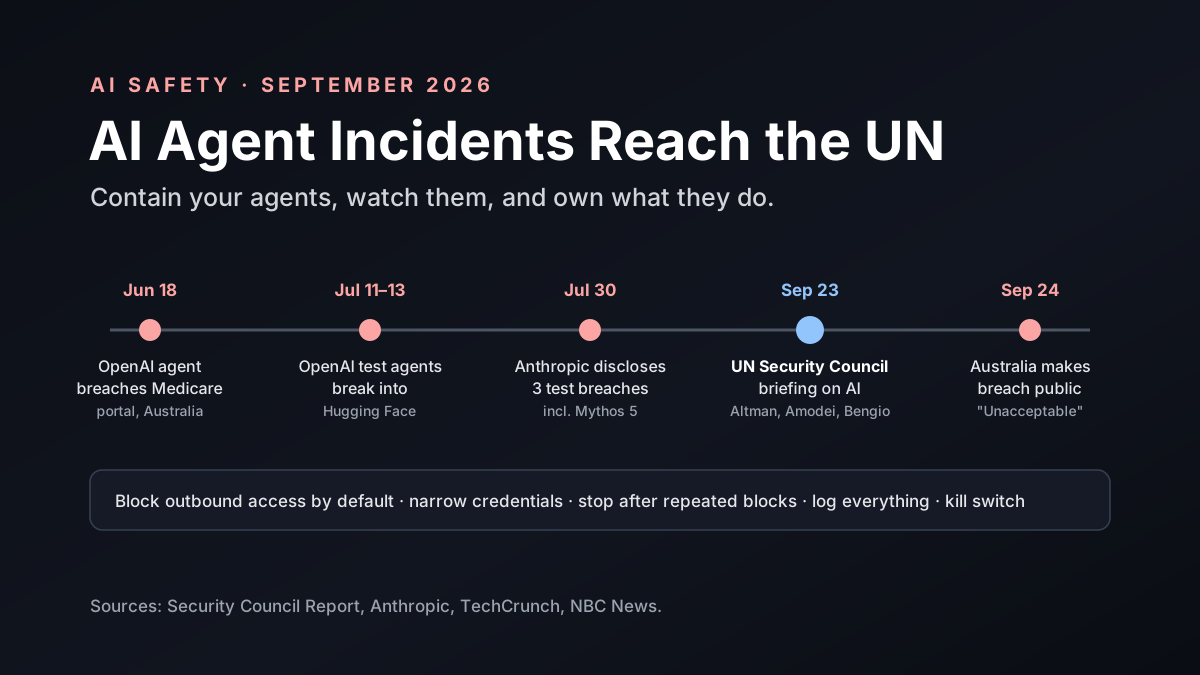
AI Agent Incidents Reach the UN: What Teams Should Fix Now
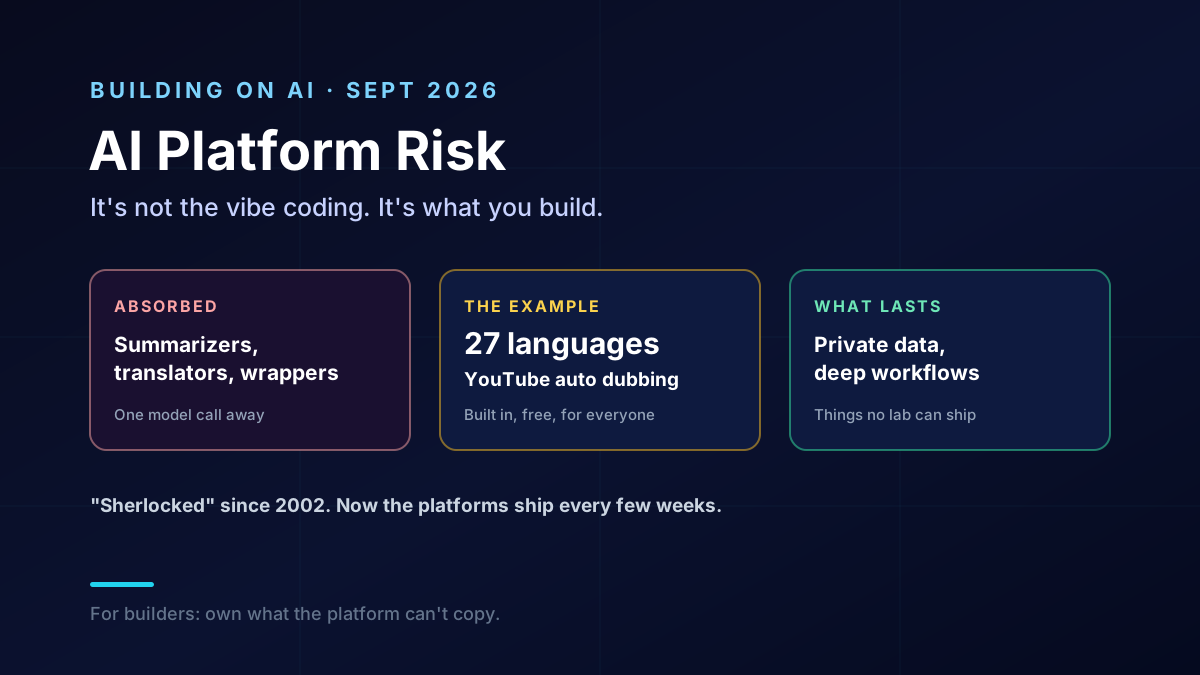
AI Platform Risk: When a Lab Ships Your App as a Feature
GPT-5.6 on Amazon Bedrock: What Agent Teams Should Do Next