GPT-5.6 on Amazon Bedrock: What Agent Teams Should Do Next
GPT-5.6 Sol, Terra and Luna on Amazon Bedrock: which fits each agent step, how cache breakpoints earn a 90% discount, and what really drives workflow cost.
According to the AWS Weekly Roundup for July 20, 2026, GPT-5.6 on Amazon Bedrock is generally available in the Sol, Terra, and Luna tiers through the Responses API. In a separate item, AWS published a copy-paste Lambda agent setup prompt that configures supported coding agents with AWS Serverless skills and the Serverless MCP server. The roundup also showed MCP, A2A, UTCP, AG-UI, and x402 working together through the Strands Agents SDK as an example implementation.
For engineering, platform, and MLOps teams, the buyer problem is not simply gaining model access. It is deciding which model handles which task, where repeated context belongs, what tools an agent may call, and where a person must approve a change. At Van Data Team, we start by mapping those operating decisions before selecting the stack. That is how we turn announcements into production AI agent workflows with explicit permissions, evaluations, review gates, telemetry, and recovery paths.
Key Takeaways
AWS's roundup creates separate operating decisions for model governance, coding-agent setup, and interface portability.
- Sol, Terra, and Luna are distinct Bedrock options, not a reason to choose a single model for every agent step.
- AWS positions Sol for flagship reasoning, Terra for balanced performance, and Luna for fast, cost-efficient inference.
- Explicit cache breakpoints can make repeated context eligible for a 90% billing discount, but total workflow cost still depends on agent behavior.
- The Lambda setup aid is a prompt that configures skills and an MCP server. It does not approve, deploy, or harden a production system.
- Open protocols can reduce framework coupling only when teams govern their schemas, permissions, versions, errors, and audit data.
What AWS Actually Announced
AWS reported distinct model, setup, and interoperability developments in the same weekly roundup; it did not announce a bundled agent product.
| Roundup item | AWS-reported specification | Production boundary |
|---|---|---|
| Bedrock model availability | Sol, Terra, and Luna are generally available through the Responses API | Model access does not define routing, evaluation, fallback, or human escalation |
| Lambda coding-agent setup | A copy-paste prompt configures AWS Serverless skills and the Serverless MCP server | The prompt is a starting scaffold, not an automatic production pipeline |
| Open protocol demonstration | MCP, A2A, UTCP, AG-UI, and x402 work together in a Strands Agents SDK example | Strands is an example SDK, and the pattern is not limited to a single framework |
AWS describes Sol as its flagship reasoning tier, Terra as the balanced option, and Luna as the fast, cost-efficient option. AWS also says pricing matches OpenAI first-party rates and that usage counts toward AWS commitments. These are procurement and access facts. They do not tell a platform team which tier will meet its own quality, latency, or operating-cost targets.
The Lambda item belongs to a different delivery lane. A developer copies the prompt from the Lambda console or retrieves it from AWS documentation, then pastes it into a supported coding agent. AWS summarizes the intent plainly:
That wording matters. The prompt gives the coding agent AWS Serverless guidance and connects the Serverless MCP server. It does not prove that generated infrastructure is least-privileged, that retry behavior matches the workload, or that a proposed change is safe to merge.
The protocol demonstration is separate again. AWS used Strands Agents SDK to show the named protocols together and said the patterns apply to any agent framework. The practical signal is composability, not a mandate to adopt Strands.
Why GPT-5.6 on Amazon Bedrock Matters for Governed Agent Work
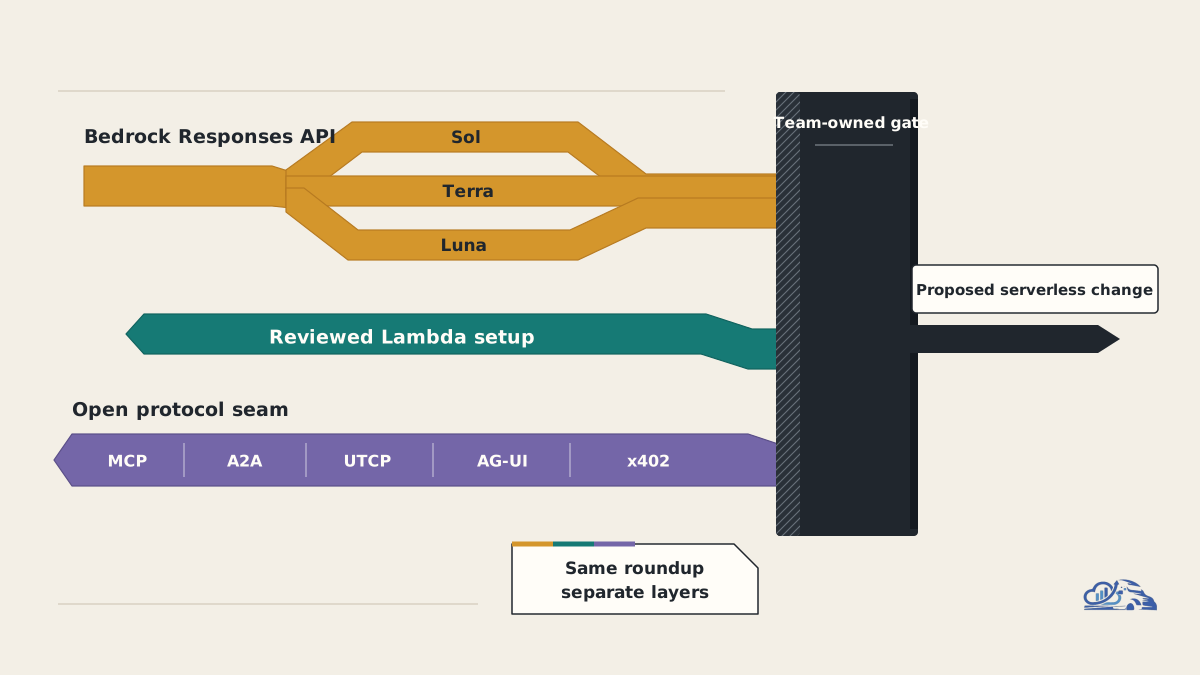
GPT-5.6 on Amazon Bedrock gives AWS-centered teams another governed model-access path, while the separate Lambda prompt can standardize how coding agents begin serverless work.
The benefit is strongest when a company already routes model usage, cloud identity, spending, and operational evidence through AWS. Bedrock can become the model access boundary for these GPT-5.6 tiers. The Lambda setup prompt remains a coding-agent configuration mechanism outside Bedrock. Keeping that distinction visible prevents architecture diagrams, ownership, and controls from collapsing into a vague "AWS agent stack."
The operating architecture should keep Bedrock model access, coding-agent configuration, MCP and tool permissions, serverless code, and review and telemetry as separately owned layers.
Turn the model tiers into a routing policy
The AWS tier labels are useful inputs, but production routing should be based on representative evaluations.
| Candidate tier | AWS positioning | Van Data Team recommendation |
|---|---|---|
| Sol | Flagship reasoning | Evaluate for complex planning, ambiguous remediation, and high-consequence decisions |
| Terra | Balanced performance | Use as the general evaluation baseline when quality and operating cost both matter |
| Luna | Fast, cost-efficient inference | Evaluate for simpler, frequent, or latency-sensitive steps |
The final column is Van Data Team analysis, not an AWS prescription. A team should test every candidate on the same task set and record task success, unsupported output, tool-argument validity, latency, token consumption, retries, escalation frequency, and recovery behavior. Price and latency are measurement inputs, not permanent assumptions.
A practical routing policy should answer these questions:
- What task class is the agent handling?
- Which tier is the default candidate for that class?
- What evidence triggers a fallback or escalation?
- Which actions require human approval regardless of model output?
- How will the team detect that workload drift has invalidated the policy?
Consider a hypothetical platform team that is building an internal Lambda-backed tool. It may evaluate Sol for ambiguous failure analysis, Terra as the baseline for general implementation work, and Luna for simpler repeated steps. The team does not promote any route because its label sounds right. It promotes the route only after the same evaluation harness exercises all candidates.
Treat prompt caching as an economics policy
Prompt caching matters when an agent repeatedly receives stable context, not merely when a prompt is long. Suitable candidates may include system instructions, tool policies, approved schemas, repository conventions, security constraints, and evaluation rubrics. Request-specific data, changing deployment state, temporary credentials, and user input belong in the dynamic portion.
Explicit breakpoints should follow ownership boundaries. If a policy changes, the team needs to know which cached segment became stale, which runs used it, and how the new version was verified. Cache telemetry should sit beside model, task, token budget, retry, tool-call, and outcome data so savings are evaluated at workflow level.
The mistake we see is treating the documented discount as a forecast for the entire agent run. A cache benefit can be diluted by excessive dynamic context, repeated retries, unnecessary tool calls, or routing every task to the heaviest tier. Teams already examining AWS cost optimization across data workloads should apply the same discipline here: map spend to a workflow, not only to a service or model name.
How to Apply the Lambda Setup Prompt Safely
The safe workflow is to fetch the current AWS prompt, inspect it, paste it into the chosen coding agent, and review every resulting configuration or code change before merging.
AWS documents setup paths for Claude Code, Kiro, Cursor, GitHub Copilot, Codex, Devin Desktop, and OpenCode. The following PowerShell artifact retrieves the supplied Markdown and places its contents on the clipboard:
$setupPromptUrl = "https://docs.aws.amazon.com/lambda/latest/dg/samples/aws-lambda-agent-setup.md"

Invoke-WebRequest -Uri $setupPromptUrl -OutFile ".\aws-lambda-agent-setup.md"

Get-Content -Raw ".\aws-lambda-agent-setup.md" | Set-Clipboard
This command downloads and copies a prompt. It does not create Lambda resources, deploy infrastructure, or produce a production-ready agent system.
Before pasting, inspect aws-lambda-agent-setup.md for the current instructions and expected changes. After the agent processes it, review:
- The skills, configuration files, commands, and dependencies added or changed
- The Serverless MCP server command, arguments, environment, and access boundary
- Tool permissions and AWS identity permissions against the actual workflow
- Generated application or infrastructure code, including environment assumptions
- Logging, error handling, retries, timeout behavior, and rollback implications
- Tests, security checks, deployment plans, and the complete version-control diff
Do not approve a broad cloud permission because the setup was supplied by AWS. The prompt can configure an agent correctly while the agent's later implementation request is still over-scoped. The same principle applies to generated code: review the proposed behavior, not just the syntax. Our guide to designing AI agents with human review loops shows how to place approval at consequential boundaries without forcing a person to inspect every harmless step.
In a hypothetical rollout, a platform lead first applies the setup prompt in a disposable branch. The team reviews the new skills and MCP configuration, asks the agent to scaffold a Lambda-backed tool, and runs its normal infrastructure, security, and application checks. Only then does an owner approve the merge. The prompt accelerates setup; the existing engineering system remains accountable for the result.
Why Open Protocol Boundaries Matter More Than an SDK Choice
Open protocol boundaries can reduce agent lock-in when workflow logic depends on testable contracts instead of framework-specific calls scattered through the codebase.
AWS's example includes the complete set named in the roundup: MCP, A2A, UTCP, AG-UI, and x402. MCP is not the whole interoperability story, and Strands Agents SDK is not the only implementation option. The useful architecture decision is to make each protocol boundary explicit and replaceable.
| Integration pattern | Strength | Limitation | When to choose or test it |
|---|---|---|---|
| Framework-native integration | Fast path inside a single SDK | Workflow logic can become coupled to framework objects and lifecycle rules | Test for a contained workflow with low replacement pressure |
| Open protocol boundary | Clearer contract and adapter replacement path | Requires version, authentication, schema, and error governance | Prefer when components may evolve independently |
| Custom point-to-point adapter | Precise fit for a narrow integration | Maintenance and behavior drift grow with every connection | Reserve for gaps that a standard boundary cannot meet |
For each boundary, record the protocol, interface owner, schema version, authentication method, allowed actions, timeout and retry policy, error contract, audit fields, and compatibility tests. Keep business decisions such as routing, approval, and recovery outside the SDK adapter where practical.
Observability also needs to cross boundaries. A trace should let an operator connect an agent request to model selection, tool use, downstream responses, policy decisions, human review, and final outcome. If a component fails, the runbook should state whether to retry, switch an adapter, fall back to another route, pause for review, or stop safely.
A Practical Production Readiness Checklist
A production-ready agent workflow needs explicit policy, evidence, and recovery around the AWS capabilities, because model availability and generated scaffolding are only inputs.
- Model policy: Assign candidate tiers by task class and name the owner of each routing decision.
- Evaluation: Test representative work, tool arguments, refusal behavior, failure modes, latency, token use, and total operating cost.
- Fallbacks: Define when to retry, change route, request human review, or stop without taking action.
- Caching: Separate stable and dynamic context, version cached policy, and monitor cache behavior with workflow outcomes.
- Prompt provenance: Store the AWS setup prompt version, review its changes, and rerun checks when the source changes.
- Permissions: Restrict coding-agent, MCP, cloud, repository, and deployment access to the minimum required workflow.
- Observability: Correlate prompts, model routes, tool calls, errors, approvals, and final state without exposing sensitive content.
- Protocol contracts: Document interfaces independently of Strands or any other SDK and maintain adapter-level tests.
- Release control: Use normal code review, infrastructure review, security checks, staged deployment, and rollback procedures.
- Operator ownership: Assign who responds when routing, caching, tools, or downstream services behave unexpectedly.
The common failure modes are predictable: using the flagship tier everywhere, caching mutable context, accepting generated permissions without review, hiding protocol behavior inside a single SDK, and shipping without a tested stop path. The production AI agent operations playbook covers the monitoring, fallback, and escalation layer that should surround this setup.
For teams that want an implementation scope rather than another architecture slide, Van Data Team can provide a task-to-model matrix, repeated-context map, tool and permission inventory, protocol boundary map, evaluation plan, and rollout and rollback checklist. Scope the model and agent workflow around those deliverables.
Operational Budget
AWS reports that GPT-5.6 on Amazon Bedrock uses OpenAI first-party pricing, counts toward AWS commitments, and supports explicit cache breakpoints that discount repeated context. Those facts establish procurement options, but not the operational cost of an agent workflow.
Before rollout, run Sol, Terra, and Luna against the same representative evaluation set. For each candidate, record task-level quality, end-to-end latency, input and output tokens, cache use, retry frequency, reviewer minutes, failure-recovery effort, and the share of results that pass evaluation and human approval.
Use one comparison metric:
cost per approved result = (model + tool + retry + review + recovery costs) / approved workflow results
This prevents a low-cost model call from appearing economical when it causes more retries, longer reviews, or expensive recovery. It also exposes where Sol’s reasoning profile, Terra’s balanced profile, or Luna’s cost-efficient inference profile best fits a particular step.
Van Data Team recommends setting separate budgets for routing, execution, validation, and recovery. Treat prompt caching as an optimization for stable repeated context, then verify that cache design does not preserve stale instructions. Promote a tier only when its evaluation results and failure behavior meet the workflow’s approval criteria within the defined operational budget.
Tooling And Landscape Fit
Treat the AWS roundup as a menu of compatible layers, not a prescribed stack. AWS made GPT-5.6 on Amazon Bedrock available through the Responses API, giving AWS-centered teams a potential common boundary for model access and commercial governance. Model routing remains an engineering decision: use Sol for reasoning-heavy work, Terra where balance matters, and Luna for faster, cost-conscious tasks, then validate each route against your own evaluations.
Orchestration is a separate choice. AWS used the Strands Agents SDK to demonstrate MCP, A2A, UTCP, AG-UI, and x402 together, but Strands is only one implementation option. A LangGraph agent workflow may fit teams that need explicit state transitions, branching, and checkpoints; an existing orchestrator can remain in place if it supports the required interfaces.
The Lambda copy-paste prompt occupies another layer: development-time scaffolding. It configures supported coding agents with AWS Serverless skills and the Serverless MCP server, but it does not replace runtime controls.
A practical operating split is:
- Model layer: route Sol, Terra, or Luna by task and cost policy; cache repeated agent context.
- Protocol layer: standardize interfaces and schemas independently of the SDK.
- Runtime layer: enforce permissions, observability, failure handling, and human review checkpoints.
- Scaffolding layer: review every setup-prompt-generated change before deployment.
- Pipeline layer: hold agent-generated data code to the same freshness, lineage, and SLA guarantees as human work.
For data teams, this lands closest to home in the pipeline layer. The same coding agents that scaffold serverless functions increasingly generate the glue around data workflows (Airflow DAGs, dbt models, and the Kafka ingestion that feeds them), so agent-written code now shapes production data quality, not just application logic. Native function calling and Plan-and-Execute patterns let an agent chain those steps end to end, but that autonomy raises the stakes: a plausible-looking dbt model or backfill script can silently introduce schema drift or move bad data downstream. Judge every agent-generated data change against the operational dimensions data engineering already measures (freshness, lineage, and SLA) and gate it behind the same tests, data contracts, and review you would demand of a human pull request. The Serverless MCP server and open protocols make it easier to give agents governed access to those systems; they do not decide, on your behalf, when a pipeline is trustworthy.
Conclusion
GPT-5.6 on Amazon Bedrock expands the model options available to AWS-centered agent teams, but the durable advantage comes from the operating policy around those options. Route Sol, Terra, and Luna by evaluated task class. Cache only stable, owned context. Keep the Lambda setup prompt reviewable. Treat MCP, A2A, UTCP, AG-UI, and x402 as governed boundaries rather than labels on an architecture diagram.
The announcements are related by engineering workflow, not bundled as a single product. Bedrock provides the model access path described by AWS. The Lambda prompt separately configures coding-agent guidance and an MCP server. Strands separately demonstrates how the open protocols can compose.
The next useful deliverable is not a generic proof of concept. It is a scoped model-routing policy, permission map, protocol contract inventory, evaluation harness, and recovery plan. Van Data Team can help turn that scope into a production delivery plan with clear ownership from discovery through implementation.

Founder of Van Data Team. Builds Vanaxity, the AI agent system for SEO, GEO, and AEO, and leads data engineering delivery for B2B teams.
About the authorAI model benchmarks
Models in this article
Current pricing, context window and independent scores for each model.
Article FAQ
Questions readers usually ask next.
These short answers clarify the practical follow-up questions that often come after the main article.
Need a similar system?
If this article maps to a workflow your team already operates, the next step is usually a scoped review of the system, constraints, and rollout path.
Consultation
Scope your next AI workflow.
Share the system and blockers. We will map fit, gaps, and the next step.