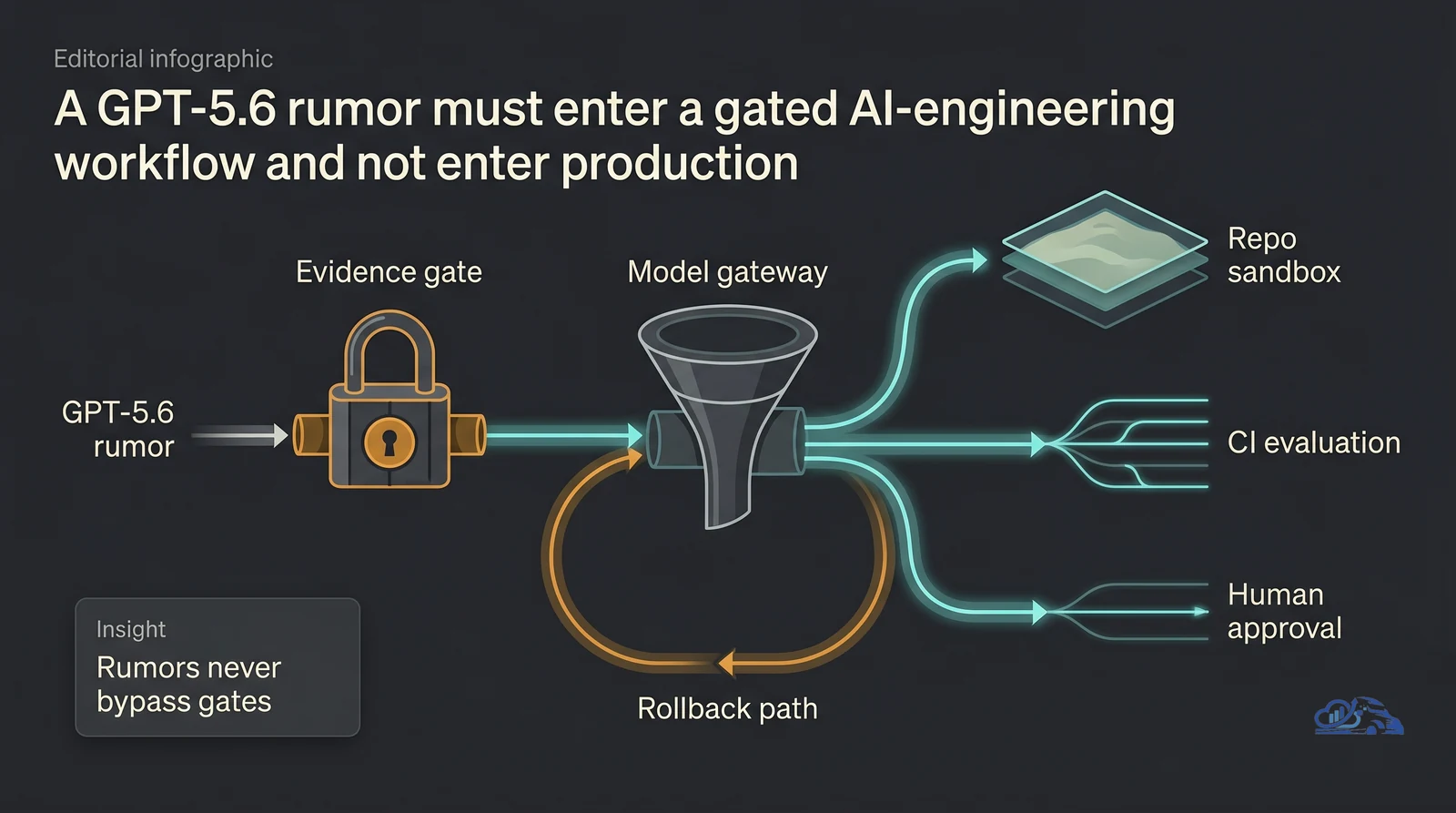
July 11, 2026
GPT-5.6 on Azure Databricks: Production Guide for AI Teams
Deploy GPT-5.6 on Azure Databricks with Foundry, Model Serving, Unity AI Gateway, RAG governance, and MLOps controls, with review gates and rollout criteria.
Article focus
GPT-5.6 on Azure Databricks should be evaluated as a production architecture question: whether OpenAI GPT-5.6 can be used in Azure Databricks through Model Serving endpoints after purchase in Microsoft Foundry, with governance enforced through Unity AI Gateway.
Section guide
GPT-5.6 on Azure Databricks should be evaluated as a production architecture question: whether OpenAI GPT-5.6 can be used in Azure Databricks through Model Serving endpoints after purchase in Microsoft Foundry, with governance enforced through Unity AI Gateway. The cited Azure update page is the reference point teams should verify before treating model access, governed data workflows, endpoint operations, logging, and review controls as one Azure Databricks operating model.
The buyer problem is not "Can we call a newer model?" The real question is whether product, data, and platform teams can expose that model to real workflows without losing control of data access, cost, payload logs, fallback behavior, or human review. At Van Data Team, we start by mapping the workflow first: what data is retrieved, which decisions the model is allowed to make, which tools it can call, where a human must approve output, and what the rollback path looks like when quality drops. That is where our AI and data engineering services connect directly to this evaluation.
This guide translates the proposed release path into an implementation plan: how Microsoft Foundry, Model Serving endpoints, and Unity AI Gateway fit together; where GPT-5.6 would belong in RAG and agent workflows; what to check before production; and how to choose between Sol, Terra, and Luna without turning model selection into a guessing exercise.
Key Takeaways
- The Azure Databricks deployment path should be verified against the cited Azure update before teams treat GPT-5.6 as available through Azure Databricks, with Microsoft Foundry for access, Model Serving endpoints for the API surface, and Unity AI Gateway for governance.
- Microsoft Learn lists
gpt-5.6-sol,gpt-5.6-terra, andgpt-5.6-lunawith a 1,050,000-token context window, including 922,000 input tokens and 128,000 output tokens. - The practical production layer is Unity AI Gateway, which Microsoft Learn says can configure usage tracking, payload logging, rate limits, and guardrails on a model serving endpoint.
- RAG governance should be designed before rollout, not added later, because retrieval quality, prompt assembly, payload review, PII detection, and output evaluation all affect operational risk.
- The right deployment plan should include endpoint permissions, usage budgets, evaluation logs, fallback behavior, review queues, and an MLOps handoff owner.
What GPT-5.6 on Azure Databricks Changes
GPT-5.6 on Azure Databricks would change model adoption from a separate application integration into a governed Databricks platform workflow. The model would no longer be just an external API that app teams call from scattered services; it could be accessed through a Databricks serving layer and governed through the same platform discipline teams already use for data and AI assets.
The operating model is straightforward:
| Layer | Role in the deployment | What the team should decide |
|---|---|---|
| Microsoft Foundry | Model purchase and availability | Which GPT-5.6 variant is approved for each workload |
| Azure Databricks Model Serving | REST endpoint layer for applications, notebooks, jobs, and SQL functions | Endpoint ownership, permissions, traffic routing, readiness checks |
| Unity AI Gateway | Governance and observability layer | Rate limits, payload logging, usage tracking, guardrails, fallbacks |
| RAG or agent workflow | Business process using the model | Retrieval scope, tool permissions, review gates, evaluation criteria |
Microsoft Learn describes Model Serving endpoints as a managed way to operate serving endpoints through the UI, REST API, Databricks Workspace Client, and MLflow Deployments SDK. The same documentation lists endpoint states such as Ready, Ready (Update failed), Not ready (Updating), Not ready (Update failed), and Not ready (Stopped), which matters because production readiness is not a slide in an architecture review. It is an observable state that deployment tooling can check.
The mistake we see is treating a platform listing as permission to skip platform design. Availability lowers adoption friction only after verification, but it does not define the workflow, retrieval boundaries, evaluation plan, or escalation path. Those remain engineering decisions.
How Foundry, Serving Endpoints, and Unity AI Gateway Fit Together
The following illustration summarizes governed gpt-5.6 request path:
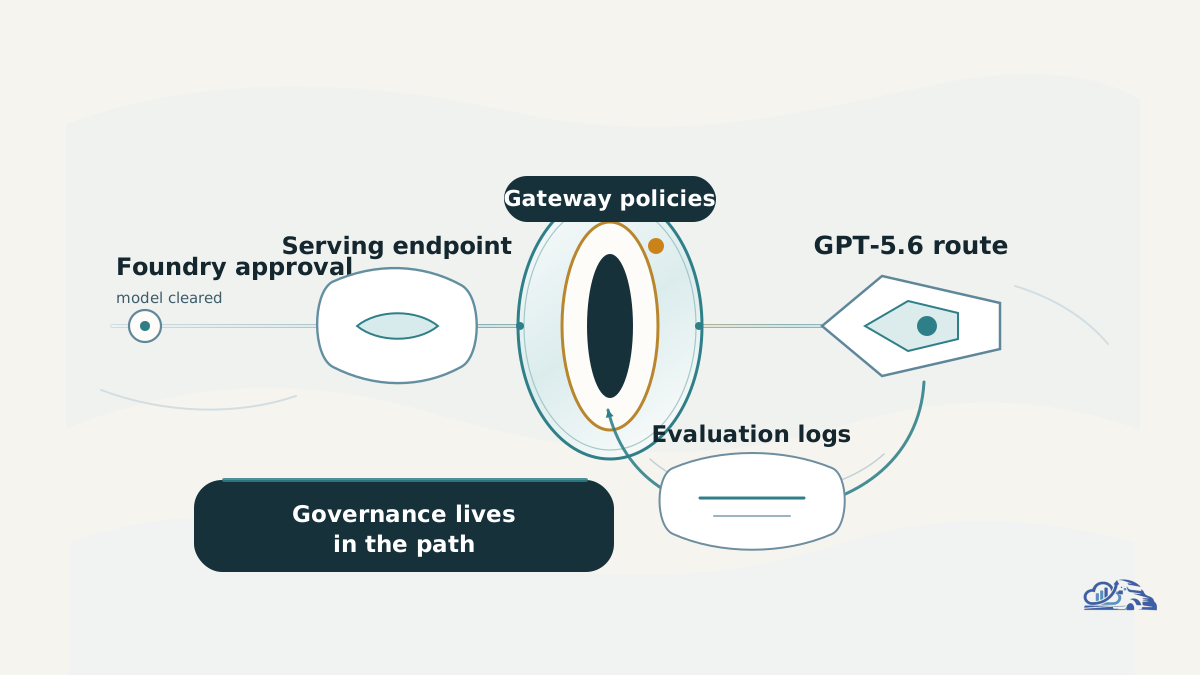
Microsoft Foundry, Model Serving endpoints, and Unity AI Gateway form a clean chain: approve and access the model in Foundry, expose it through Databricks serving, then govern runtime behavior through the gateway. Each layer has a different owner and a different failure mode.
Microsoft Foundry is the procurement and model access layer. It answers which model family is available, which deployment category applies, and which variant should be approved for a workload. The Microsoft Foundry model-family documentation identifies gpt-5.6-sol, gpt-5.6-terra, and gpt-5.6-luna, all dated July 9, 2026 in the model table.
Azure Databricks Model Serving is the operational API layer. It gives teams a serving endpoint that can be queried by applications and platform workflows. For a data team, that matters because the model call can live near notebooks, jobs, SQL AI functions, Delta tables, Unity Catalog permissions, and evaluation datasets.
Unity AI Gateway is the control plane in front of runtime AI behavior. Microsoft Learn describes Unity AI Gateway as the Azure Databricks governance solution for enterprise AI, built on Unity Catalog and extended to runtime interactions between models, agents, MCP servers, and tools. That wording is important. Governance is not only "who can see the table." It is also who can call the model, what the request contains, what gets logged, which guardrails run, and what happens when the primary route fails.
A practical request path looks like this:
- A product feature, notebook, job, SQL function, or internal agent sends a request to a Databricks Model Serving endpoint.
- Unity AI Gateway applies access controls, usage policies, payload logging, rate limits, and guardrails.
- The request is routed to the approved GPT-5.6 served entity.
- The response returns to the workflow and is written to logs, review tables, or downstream application state.
- Evaluation jobs inspect retrieval quality, prompt behavior, model output, user feedback, and cost signals.
If that path is not explicit, the deployment is not ready. It may work in a demo, but it will fail under organizational pressure because no one knows where to debug cost spikes, quality regressions, or blocked users.
For teams building this into production, Van Data Team's data pipeline engineering work usually starts upstream of the model call. Retrieval quality, data freshness, schema contracts, access policies, and lineage need to be dependable before a powerful model is allowed to summarize, reason, or act on that data.
Production Use Cases That Actually Fit
The strongest use cases for GPT-5.6 in Azure Databricks are workflows where governed enterprise data, model reasoning, and operational logs need to stay close together. This is less about chatbots and more about controlled decision support.
Governed RAG over enterprise data
A RAG workflow can use Databricks-managed data as the retrieval base, assemble context, call GPT-5.6 through the serving endpoint, and log the full request and response for review. The governance question is not only whether the model can answer. It is whether the answer was grounded in the right source data, whether the retrieved chunks were allowed for that user, and whether sensitive fields entered the prompt.
A practical RAG governance pattern should define:
- The approved source tables, document collections, or vector indexes.
- The retrieval filters tied to Unity Catalog permissions.
- The prompt template and context budget.
- The payload fields allowed into logging.
- The evaluation dataset used before release.
- The human review queue for uncertain or high-impact outputs.
Consider a revenue operations team building an internal account research assistant. The prototype works because analysts paste account notes into a notebook and ask for next-step recommendations. Production breaks when the assistant retrieves stale CRM fields, exposes restricted renewal notes, and gives confident advice without showing evidence. The fix is not a better prompt alone. The fix is a governed retrieval path, source citations, payload review, and an escalation rule for high-value accounts.
Agentic workflows with tool permissions
GPT-5.6 Sol is a natural candidate for agentic workflows that need deeper reasoning, tool calls, and multi-step planning. Microsoft Learn lists GPT-5.6 models with functions, tools, and parallel tool calling in the Foundry model table, so the platform conversation should move quickly from "Can it call tools?" to "Which tools may it call, under which identity, and with what audit trail?"
This is where production AI agent workflows need discipline. An agent that can read a dashboard, summarize a variance, draft a Jira ticket, and notify a channel may be useful. An agent that can do all of that without tool permissions, dry-run modes, and approval gates is just operational risk with a friendly interface.
High-volume summarization and classification
GPT-5.6 Luna may fit workloads where latency sensitivity and volume matter more than deep reasoning. A support analytics pipeline, for example, might summarize ticket themes, classify sentiment, extract product areas, and write structured labels back into a Delta table. The work is repetitive, evaluation can be sampled, and cost control matters because volume grows quickly.
A common failure mode is launching the high-volume job before usage tracking and budgets are configured. When the workflow succeeds, spend rises. When it fails, retries multiply the problem. Endpoint budget controls, sampling rules, and retry limits should be part of the first production version, not a cleanup task.
RAG Governance and MLOps Deployment Checklist
A production deployment should be reviewed as a workflow release, not as a model switch. The checklist below is the minimum operating bar we would want before a team exposes GPT-5.6 to internal users or customer-facing systems.
Access and procurement
Confirm the model is approved in Microsoft Foundry, the owning team is named, and the expected use cases are documented. Do not give every team access to every variant by default. Sol, Terra, and Luna should map to workload classes, not personal preference.
Endpoint configuration
Create the Databricks Model Serving endpoint with a clear owner, naming convention, permissions, served entity, and readiness check. The Model Serving documentation shows that endpoint status can be checked through REST, the Workspace Client, or MLflow Deployments SDK. Use that in deployment automation.
Gateway controls
Put Unity AI Gateway in front of production calls. Configure usage tracking, payload logging, rate limits, and guardrails through the gateway layer. Microsoft Learn explicitly lists usage tracking, payload logging, rate limits, and guardrails as configurable AI Gateway features for model serving endpoints.
RAG evaluation
If the workflow uses retrieval, evaluate retrieval separately from generation. Track missing evidence, wrong source selection, stale records, permissions leakage, and answer faithfulness. A strong answer built on the wrong context is still a production bug.
Observability and review
Log enough to debug prompts, retrieval, model choice, latency symptoms, user identity, and output quality. But logging is not the same as governance. Sensitive payloads need retention rules, access controls, redaction policy, and review ownership.
Fallback and recovery
Define what happens when the model route fails, the endpoint is not ready, guardrails block the response, or evaluation scores drop. Fallback can mean another model, a narrower prompt, a cached response, a human review queue, or a hard stop. The correct answer depends on workflow risk.
Here is a compact runbook artifact a platform owner can adapt:
1. Define the GPT-5.6 on Azure Databricks decision.
2. List required inputs, owner, and stop conditions.
3. Run the smallest safe workflow.
4. Validate output quality before publishing or deployment.
5. Escalate unresolved risk to a human reviewer.
If your team wants an external review before rollout, Van Data Team can scope a GPT-5.6 readiness review that produces a workflow map, endpoint control checklist, RAG evaluation plan, cost-risk register, and implementation sequence. The natural starting point is a Strategy Sprint when the goal is a concrete deployment plan rather than a broad advisory call.
Choosing Sol, Terra, or Luna
Choosing between Sol, Terra, and Luna should start with workflow pressure: reasoning depth, latency tolerance, review burden, expected volume, and cost sensitivity. Do not start with a favorite model name.
| Variant | Best fit | Production watchpoint |
|---|---|---|
| GPT-5.6 Sol | Complex reasoning, agentic workflows, multi-step analysis, tool-heavy tasks | Higher review burden because the workflow often carries more decision authority |
| GPT-5.6 Terra | Balanced internal assistants, everyday knowledge work, governed RAG, analyst copilots | Needs clear evaluation thresholds so it does not become the default for every workload |
| GPT-5.6 Luna | High-volume summarization, classification, routing, latency-sensitive workflows | Cost and retry behavior should be controlled before scale increases |
Microsoft Learn lists all three GPT-5.6 variants with the same 1,050,000-token context window, but context capacity should not be treated as a reason to stuff every source into a prompt. Large context windows reduce some truncation pressure, but they do not remove the need for retrieval ranking, source filtering, prompt discipline, or output evaluation.
A balanced internal knowledge assistant is usually a Terra candidate. A research agent that compares contracts, extracts obligations, checks policy, and drafts a recommended action is closer to Sol. A nightly job summarizing thousands of customer messages into structured fields is closer to Luna.
The selection rule is simple: use the least complex variant that meets the workflow's quality target under evaluation. Upgrade when evaluation proves the cheaper or faster path is failing, not because the flagship model feels safer.
Common Mistakes to Avoid
Most failed production AI deployments do not fail because the model is weak. They fail because the platform team shipped access before ownership, evaluation, observability, and recovery were clear.
The first mistake is bypassing Unity AI Gateway for convenience. Direct model calls may feel faster during prototyping, but they scatter logs, permissions, cost controls, and failure handling across application code. Once teams build around direct calls, retrofitting governance becomes political and technical debt.
The second mistake is treating payload logging as optional. Without request and response logs, teams cannot debug poor outputs, compare prompt versions, evaluate retrieval, or identify misuse patterns. Logging must be designed with privacy and access control, but absence of logs is not a privacy strategy. It is blindness.
The third mistake is launching RAG without retrieval evaluation. A product manager may see fluent answers in a demo and approve rollout. A month later, analysts report that the assistant cites old policy, misses newer documents, and answers outside its evidence base. The model becomes the visible failure, but the retrieval layer caused the defect.
The fourth mistake is skipping cost controls until after adoption. Usage tracking, rate limits, and workload tagging belong in the first production design. Van Data Team's cloud cost optimization work often finds that AI spend becomes hard to manage when teams only group cost by service instead of workflow, owner, endpoint, and business outcome.
The fifth mistake is assuming availability removes internal review. General availability, once verified, means the platform is available for production use. It does not mean your specific workflow is production ready. Your workflow still needs evaluation datasets, access policy, fallback behavior, on-call ownership, and a release record.
Practical Deployment Example
A practical GPT-5.6 deployment starts with one narrow workflow and expands only after measurement. For example, a data team may build a governed RAG assistant for finance analysts who need to ask questions about revenue variance, billing exceptions, and account-level notes.
The first version should not let the assistant write back to source systems. It should retrieve governed data, answer with citations, log prompts and responses, and route uncertain answers to review. The endpoint owner should track usage by team and workflow. The reviewer should sample outputs weekly and record failure types: missing source, stale source, wrong aggregation, unsupported conclusion, or sensitive field exposure.
After the workflow passes review, the team can add structured actions: draft a variance note, create a review task, or generate a dashboard annotation. Each new action should add a new permission and a new evaluation case. That is how an assistant becomes an operational system instead of a prompt pasted into production.
At Van Data Team, we prefer this staged path because it keeps architecture honest. The first release proves retrieval and governance. The second release proves workflow integration. The third release can add automation where the review data shows the model is reliable enough to act.
Conclusion
GPT-5.6 on Azure Databricks is best understood as a governed production architecture question, not just a model announcement. The important pattern is clear: Microsoft Foundry handles model access, Azure Databricks Model Serving exposes the endpoint, and Unity AI Gateway applies the controls that make real workflows auditable, recoverable, and measurable.
For data and AI teams, the next step is to pick one workflow and design it properly. Define the source data, retrieval rules, endpoint owner, gateway controls, evaluation set, review gate, cost boundary, and fallback path before broad rollout. That work is less exciting than a demo, but it is what keeps the system usable after users arrive.
Van Data Team helps teams turn that design into shipped infrastructure: governed RAG pipelines, production AI agents, endpoint monitoring, dashboard gaps, review workflows, and MLOps deployment plans. A scoped review can give your team the practical artifacts that matter: a workflow map, signal map, control checklist, implementation scope, and risk-review workflow for the first GPT-5.6 production release.
Article FAQ
Questions readers usually ask next.
These short answers clarify the practical follow-up questions that often come after the main article.
Need a similar system?
If this article maps to a workflow your team already operates, the next step is usually a scoped review of the system, constraints, and rollout path.
Free architecture review
Govern GPT-5.6 Before Launch
Map GPT-5.6 on Azure Databricks into governed endpoints, RAG controls, agent review gates, and rollout steps your team can act on.
- Foundry access and Model Serving readiness checklist
- Unity AI Gateway governance gap review
- RAG and tool-use workflow risk map
- Human review and fallback control plan
- Next-step implementation scope for Sol, Terra, or Luna
Related articles
View all
Quantum-Safe Key Import Lands in Google Cloud KMS
VS Code Multi-Agent Orchestration: What GitHub and VS Code Sources Describe
DeepMind's Running Guide agent and the A24 partnership: what real-time spatial and creative AI agents mean for engineers