August 3, 2026
Agentic AI security after Project Perception: governance before action
Project Perception moves agentic AI security from alerts to action. Get a runbook for approval gates, least privilege, rollback, audit logs, and evals.
Article focus
Project Perception makes agentic AI security an operating issue, not another alerting story. It matters to engineering, security, and platform teams building or defending with AI agents.
Section guide
Project Perception makes agentic AI security an operating issue, not another alerting story. It matters to engineering, security, and platform teams building or defending with AI agents. Machine-speed attacks can outrun human-speed response, while alert-only agents leave every fix to overloaded analysts. This guide provides a governance and rollout runbook for agents that act: approval gates, scoped access, staged deployment, rollback, and audit evidence. At Van Data Team, we operationalize that shift through production AI agent workflows that map permissions, review gates, and recovery before write access.
Project Perception is now in public preview. Microsoft states the operating shift plainly in its July 27, 2026 announcement, which set the public preview for August 3, 2026 and described attack simulation, threat investigation, and vulnerability remediation:
"It will be their ability to continuously perceive, reason and act."
This article separates Microsoft's reported facts from Van Data Team's operating recommendations. It focuses on defensive architecture and governance, not exploit instructions.
Key Takeaways
Project Perception's operating lesson is that action authority needs stronger controls than alert authority. The following controls form a practical baseline.
- Project Perception connects risk mapping, investigation, and corrective action inside a coordinated multi-agent loop.
- The reusable pattern separates evidence generation, risk judgment, and controlled execution.
- High-impact changes need human approval, staged rollout, automatic rollback, least privilege, and tamper-evident logs.
- Benchmark strength doesn't prove production safety; teams must also evaluate regressions, policy compliance, recovery, cost, latency, and data quality.
What Project Perception changes about agentic AI security
Project Perception changes security operations by linking attack simulation, threat investigation, and corrective action inside a coordinated agent system. It moves the workflow from alert generation toward managed execution.
Reported fact: Project Perception moves beyond alerting
Microsoft describes Project Perception as a workforce of specialized agents that reasons across security data, tools, and workflows. The agents expose gaps, investigate threats, and remediate them. The platform remains a public preview, so teams should evaluate its controls before assigning production authority.
According to Microsoft AI's model announcement, MAI-Cyber-1-Flash is Microsoft's first in-house-trained security model. It is designed to find challenging vulnerabilities in complex code and runs inside MDASH. Microsoft reports that MDASH coordinates more than 100 specialized agents across frontier and distilled models. The harness has found vulnerabilities in Microsoft's codebases and scores about 96% on CyberGym, roughly 12 percentage points above a Mythos-based configuration.
According to the Project Perception product page, the platform starts with Red, Blue, and Green agents. Red maps attack paths and vulnerabilities. Blue investigates findings and identifies meaningful risk, while Green writes and deploys patches and strengthens defenses.
The product page also says high-impact actions remain under human sign-off. That boundary matters when interpreting "autonomous." The final column below is Van Data Team's recommended control model, not a Microsoft product claim.
| Agent role | Reported function | Recommended control boundary |
|---|---|---|
| Red | Maps attack paths and vulnerabilities | Produces evidence but cannot approve remediation |
| Blue | Investigates findings, filters noise, and identifies meaningful risk | Applies risk and policy judgment but cannot deploy |
| Green | Writes and deploys patches and strengthens defenses | Executes an approved scope but cannot expand privileges |
The reusable lesson isn't the color naming. It is separation of duties between discovery, judgment, and action. Teams designing similar authority boundaries can use our guide to AI agents with human review as a companion pattern. It shows where review gates belong when an agent can change an external system.
Red, Blue, and Green form a safer control loop
Red, Blue, and Green separation improves control only when no agent can produce evidence, approve its meaning, and authorize its own change. The loop fails when those authorities collapse into the same role.
Van Data Team analysis: separate evidence, judgment, and execution
The following illustration summarizes no direct path from finding to production:
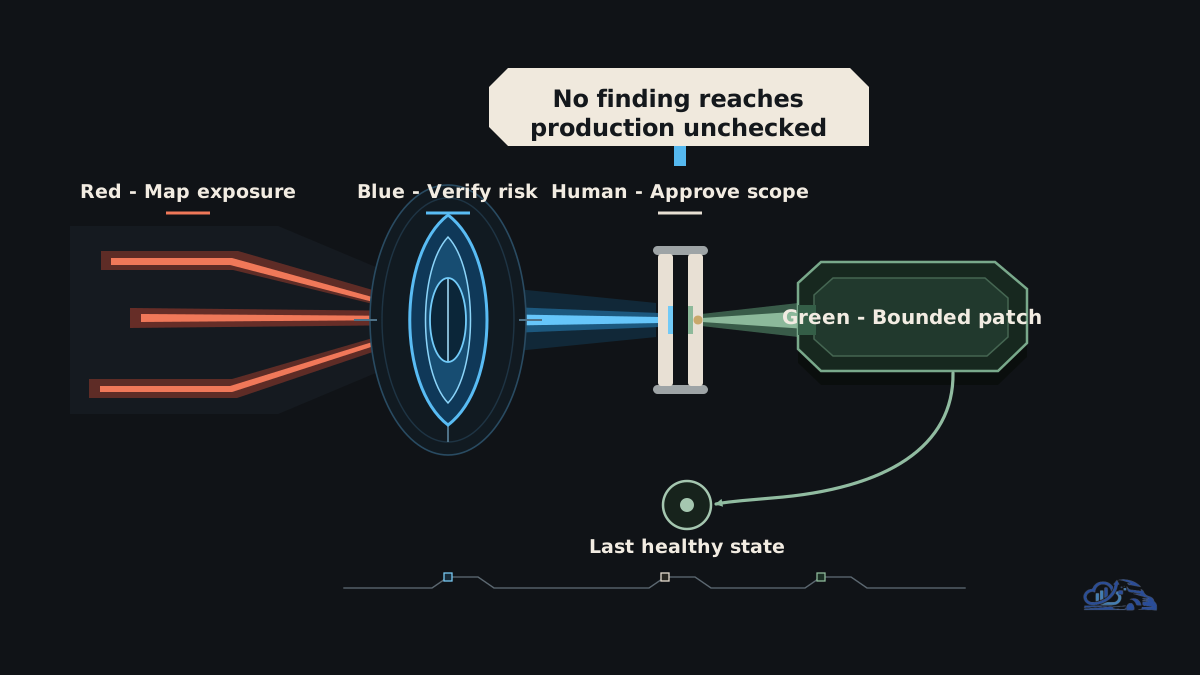
Treat Red as the evidence generator, Blue as the risk and policy boundary, and Green as the controlled executor. A Red finding should never trigger a Green action directly. Blue should independently test whether the evidence is relevant, current, and inside policy.
A useful Blue handoff includes source evidence, confidence, affected assets, proposed scope, asset ownership, and escalation status. It should also record material disagreement between agents. Green should reject the task when that handoff is incomplete or conflicts with policy.
Consider a hypothetical identity-service finding. Red maps a possible exposure, while Blue checks the deployed version, reachability, owner, and telemetry freshness. If the risk is meaningful, Green opens a patch in a branch and validates it in isolation. A service owner approves a bounded rollout, and health signals determine whether the change expands or rolls back.
This design limits correlated failure. The agent that confidently finds a weakness might still misunderstand business context or deployment dependencies. Independent triage creates a place to catch that error before it reaches production.
MDASH's orchestration scale also makes runtime discipline unavoidable. Cost, latency, token budget, observability, and evaluation become first-order design constraints. Trace every tool call and handoff, cap retries, define conflict resolution, and measure the full workflow rather than an agent in isolation.
Govern autonomous remediation before production access
Act-capable agents should earn production authority in stages, with broader access granted only after evidence shows bounded and reversible behavior. The permission path should expand more slowly than the agent's technical capability.
Van Data Team analysis: classify the action before granting access
Classify each action by reversibility, affected dependencies, data sensitivity, required privilege, and operational blast radius. The default should be the least dangerous authority that still produces useful evidence.
A safe progression follows the sequence below. Each stage adds evidence before it adds authority.
- Read and investigate within approved assets
- Propose a patch in a branch or pull request
- Validate the change in an isolated environment
- Deploy to a bounded production slice after the required approval
- Expand only while health signals and regression gates pass
Use this governance and approval-gate checklist as a starting implementation artifact. Adapt its owners and thresholds to the services being protected.
| Gate | Recommended default | Evidence required before action | Block or rollback condition |
|---|---|---|---|
| Agent identity | Distinct workload identity with least privilege and short-lived credentials | Approved resources, actions, environment, owner, and expiry | Deny and escalate any scope mismatch |
| Input trust | Approved telemetry, code, and asset sources only | Freshness, lineage, ownership, and SLA status | Stop when evidence is stale, incomplete, or untraceable |
| Risk separation | Mapping cannot authorize remediation | Independent triage, affected assets, confidence, and policy result | Stop when risk is unverified or agents materially disagree |
| Patch creation | Branch or pull request by default | Rationale, diff, tests, dependency impact, and source evidence | Reject when tests or policy checks fail |
| Isolated validation | Non-production environment before production | Regression results, security checks, health signals, and rollback test | Revert and escalate on unexpected behavior |
| Production approval | Human sign-off for high-blast-radius changes | Risk class, accountable owner, rollout scope, and recovery plan | Block when approval or rollback readiness is missing |
| Staged rollout | Smallest useful production slice | Baseline, canary health, error signals, and expansion criteria | Roll back when approved thresholds fail |
| Audit record | Tamper-evident log outside agent write authority | Identity, evidence, versions, tools, approvals, changes, and outcomes | Block when trace capture fails |
Human approval belongs where a mistake could spread broadly or resist recovery. Identity changes, sensitive-data access, irreversible migrations, and cross-service changes should reach an accountable service or security owner. Policy-bounded automation fits reversible actions with a narrow scope, reliable monitoring, and a tested rollback.
An agent must never expand its own permissions to finish a task. Permission management should sit behind a separate identity and approval path. This prevents a blocked remediation from becoming an authorization bypass.
Rollback is part of the action contract, not a cleanup step. Capture the pre-change baseline, define health thresholds, test the revert path, and stage the deployment. If a threshold fails, the system should roll back automatically and escalate with the full trace.
Keep the audit record outside the agent's write authority. Record the acting identity, evidence, model and policy versions, tool calls, proposed change, approver, resulting diff, health signals, and rollback outcome. That record must support replay and review after an incident.
Treat autonomous security agents as zero-trust identities
An autonomous security agent is a workload identity with scoped privileges, not a trusted insider with broad access. Its access should expire, remain attributable, and stop at explicit resource boundaries.
Scope identity, permissions, and time
Give every role a distinct identity. Grant access to named resources, actions, and environments, then issue short-lived credentials for the approved task. Separate code read, patch write, merge, deployment, and permission-management authority.
Deny requests outside the declared scope and route them for review. The same rule applies whether a tool arrives through native function calling, an MCP server, a CI runner, or a cloud API. Each tool is an authority surface.
Treat data quality as part of the security boundary
Agents can make a wrong decision when telemetry is incomplete, stale, or detached from ownership. Require freshness status, source lineage, asset ownership, and service-level agreement context alongside every finding.
A mature data pipeline engineering foundation matters because an agent can't reason safely over telemetry nobody trusts. The workflow should stop when required signals are late, contradictory, or untraceable. "No action" is the correct result when the evidence contract fails.
Framework choice doesn't replace operating controls
LangGraph, LangChain, CrewAI, native function calling, Model Context Protocol (MCP), and Plan-and-Execute can implement similar role separation. They can model state, route tool calls, and pause for review. They don't supply your identity policy, rollback design, or accountability model.
At Van Data Team, we treat cost per completed workflow, end-to-end latency, token budget, trace completeness, and evaluation results as acceptance criteria. Our multi-agent research workflow shows the adjacent orchestration pattern in another domain. Security raises the permission and recovery stakes, but the operating dimensions remain.
Evaluate autonomous remediation beyond benchmark scores
CyberGym provides evidence about exploit generation on known vulnerabilities, but it doesn't establish safe autonomous remediation in production. Production trust requires a wider regression and governance suite.
According to SecurityWeek, CyberGym measures whether a model can generate working proof-of-concept exploits for known software vulnerabilities. The MAI-Cyber-1-Flash plus GPT-5.4 configuration reports about 95.95% on that benchmark. The same coverage reports roughly 50% cost savings against the current in-market MDASH configuration.
These are narrow, configuration-specific results. The reported CyberGym scores don't measure safe triage, patch correctness, approval quality, unknown threats, or production recovery. The cost result isn't a guarantee for another workload, model-routing policy, or security environment.
A production regression suite should test both task quality and control integrity. Its coverage should include:
- Decision quality: finding relevance, false positives, and material agent disagreement
- Change safety: patch correctness, dependency impact, and regression risk
- Governance: policy compliance, approval enforcement, and unauthorized-action attempts
- Recovery: rollback success, escalation behavior, and failure containment
- Runtime: tool failures, handoff errors, cost, latency, token use, and retry ceilings
- Evidence: trace completeness, telemetry freshness, lineage, and asset ownership
Re-run the suite whenever models, prompts, tools, policies, permissions, dependencies, or source data change. Compare the candidate against a fixed baseline and block deployment when safety gates regress. Store the evaluation artifacts beside the action trace.
In a hypothetical rollout, an agent might first repair a non-production dependency and pass every required test. It then proposes a bounded canary rather than a fleet-wide change. If error or latency signals worsen, the platform reverts and escalates. Broader autonomy follows repeated evidence; it isn't the starting configuration.
For the surrounding runtime controls, use the AI agent ops and human escalation playbook to define ownership, monitoring, and incident handoffs. It complements the regression suite above.
The hard problem is controlled action
Project Perception makes the alert-to-act transition concrete: security agents can map risk, judge findings, and make corrective changes. The operating lesson for agentic AI security is that capability and authority must be designed separately.
Start with distinct identities, read-only investigation, patch proposals, isolated validation, human gates, bounded rollout, automatic rollback, and tamper-evident logs. Require regression evidence after changes to models, prompts, tools, policies, permissions, or telemetry. Reduce review only when measured behavior supports it.
Van Data Team can turn this pattern into a scoped risk-review workflow. A security agent scoping review can produce a signal and permission map, an approval matrix, an evaluation plan, and a phased delivery scope. The goal isn't maximum autonomy. It is controlled action that engineering and security owners can observe, stop, recover, and explain.
Article FAQ
Questions readers usually ask next.
These short answers clarify the practical follow-up questions that often come after the main article.
Need a similar system?
If this article maps to a workflow your team already operates, the next step is usually a scoped review of the system, constraints, and rollout path.
Book your free workflow review here.
Related articles
View all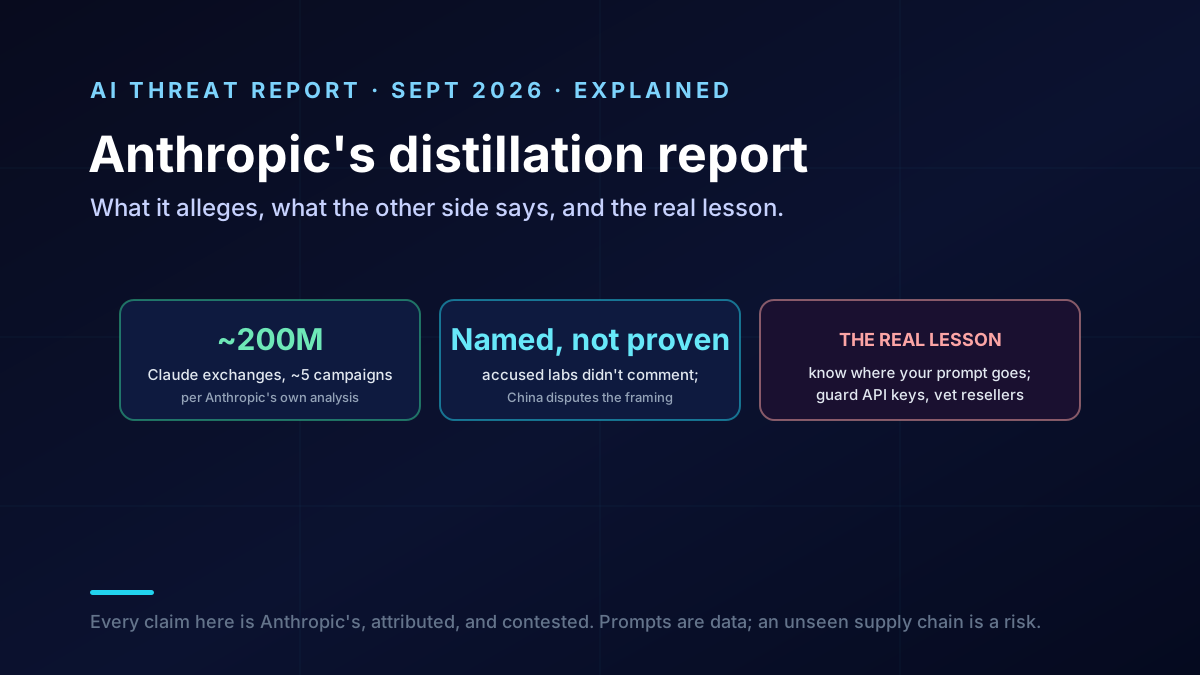
Anthropic's AI Distillation Report: What It Alleges
Model Portability: The Cursor-OpenAI Cutoff Lesson
Computer-Use Agents: An Engineer's Production Guide