August 5, 2026
Qwen 3.8-Max: How to Evaluate a Giant MoE
Evaluate Qwen 3.8-Max for AI agents using task quality, serving cost, latency, token budgets, observability, and honest open-weight trade-offs in production.
Article focus
Published coverage makes Qwen 3.8-Max worth testing, not automatically adopting, for engineering, ML-platform, and AI-product teams choosing models for agent workloads.
Section guide
Published coverage makes Qwen 3.8-Max worth testing, not automatically adopting, for engineering, ML-platform, and AI-product teams choosing models for agent workloads. Picking a frontier model from hype or benchmark headlines can produce slow, costly, hard-to-serve deployments that stall before production. This guide provides a task-level evaluation checklist and a cost-and-serving framework for deciding when Alibaba's reported giant sparse model would beat a smaller model.
At Van Data Team, we start with the workflow: intake, retrieval, decisions, tool permissions, review gates, and recovery. Our founder-led delivery model keeps discovery, architecture, and implementation in the same loop. That matters because model quality can improve while the surrounding agent still fails.
The decision isn't Qwen versus GPT, Claude, or Llama in the abstract. It is whether a candidate raises accepted outcomes under your real cost, latency, token budget, observability, evaluation, and governance limits.
Key Takeaways
The right adoption decision depends on measured workflow outcomes, not model scale alone.
- Sparse activation separates total capacity from per-token computation, but full-model hosting overhead remains.
- Long context helps only when selected evidence improves task completion.
- Test the model inside the same agent loop as the incumbent and a smaller candidate.
- Choose API access or self-hosting by cost per accepted outcome, control requirements, and operational readiness.
- Use routing when difficult and routine steps need different model profiles.
For related implementation context, see AI agent development.
What Qwen 3.8-Max Actually Ships
Published coverage from MarkTechPost and TechNode Global describes Qwen 3.8-Max as combining frontier-scale capacity, sparse activation, long context, multimodality, and a planned open-weight path.
Reported claim. MarkTechPost reported on August 3, 2026 that Qwen 3.8-Max had been released and characterized it as Alibaba's largest model to date. The report says the launch targets long-horizon agents and complex software, research, and data workflows.
| Decision input | Reported status | Why it matters |
|---|---|---|
| Architecture | MarkTechPost describes a sparse MoE with 2.4 trillion total parameters and roughly 95 billion active per token | Total capacity and active inference compute create different resource demands. |
| Context and inputs | MarkTechPost reports up to 1 million tokens with native text and visual inputs | Large repositories, document sets, tables, and screenshots can enter the same workflow. |
| Target workloads | MarkTechPost identifies long-horizon agents, code generation, full-stack development, and data analysis | These are reasonable evaluation targets, not proof of production fit. |
| Access | TechNode Global reports access through Alibaba Cloud Model Studio APIs and QwenWork, described as Alibaba's workplace AI agent platform | Teams can begin through managed access before committing to infrastructure. |
| Market position | MarkTechPost says the model is positioned against leading OpenAI and Anthropic models, while TechNode Global reports arena positions around fifth in text and second in vision | Arena results are useful discovery signals, not adoption gates. |
| Open-weight plan | TechNode Global reported that weights were expected about a week after the reported launch and described this as the first Max-class Qwen planned for an open-weight release | Teams should verify the checkpoint, license, formats, and deployment assets when published. |
These are reported launch claims. They don't prove lower latency, safer tool use, or better task completion for a specific agent.
Van Data Team analysis. Treat the reported architecture and arena position as reasons to run an evaluation. They aren't reasons to replace the incumbent. A model can lead a public benchmark and still fail your tool schemas, evidence rules, or response-time objective.
If you need a decision-ready test instead of another model demo, Van Data Team can map the workflow, freeze a holdout set, define trace fields, and produce an adoption gate. The output should tell engineering exactly where the model belongs, if anywhere.
What Sparse MoE Changes for Serving
The following illustration summarizes sparse compute, full hosting footprint:
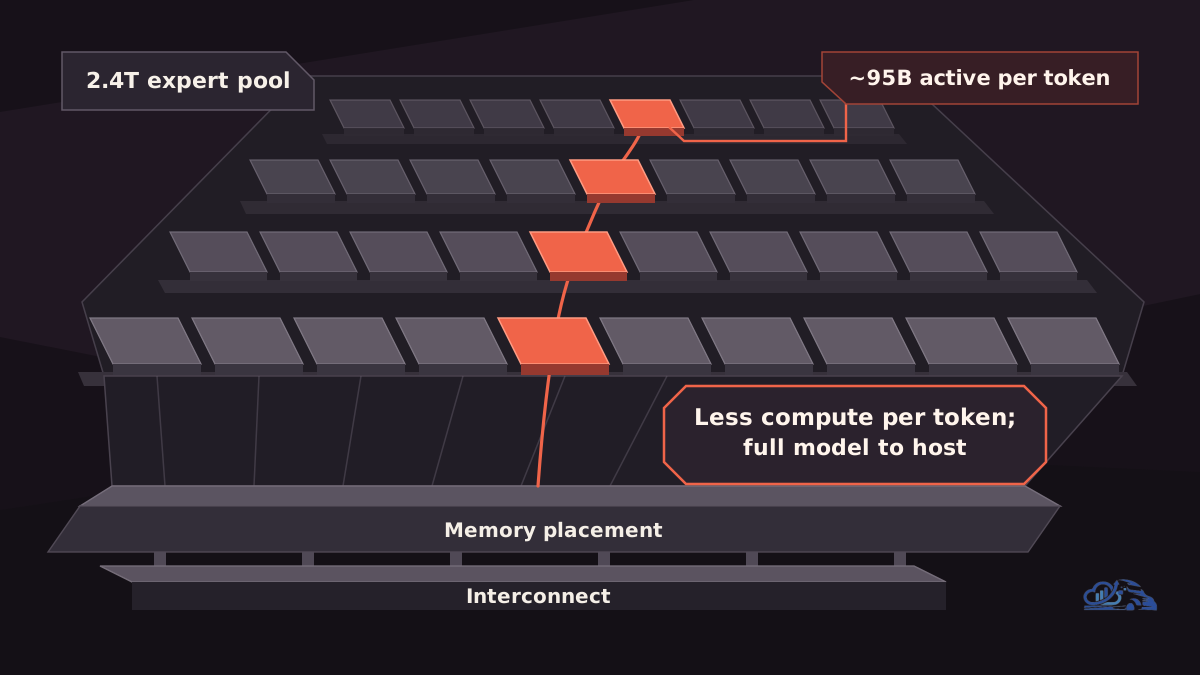
For an architecture matching the published descriptions, sparse MoE reduces active computation per token, but it doesn't make a Max-class model simple or cheap to self-host.
Technical context. Sparse MoE architectures route tokens through selected experts instead of applying the complete parameter pool at every step. That creates a useful distinction between total model capacity and active inference computation.
Van Data Team analysis. The practical intuition is broad expert capacity with active compute nearer the selected subset than the full pool. It is not a promise that the reported model serves exactly like a dense 95B model. Real latency still depends on routing, batching, memory placement, expert balance, and communication between accelerators.
In a deployment matching the reported architecture, the full expert pool also has to live somewhere. A self-hosted deployment must load, place, secure, monitor, and update the weights. Storage, accelerator memory, networking, startup time, and failure recovery remain part of the serving design.
Managed API users avoid most of that infrastructure work. They still inherit provider rate limits, regional availability, data-handling terms, and variable request latency. They also pay for every loop, retry, oversized prompt, and failed completion.
Hypothetical scenario: Priya's platform team connects the reported model to a LangGraph coding agent. The agent reads repository context, checks architecture notes, calls test tools, and proposes a patch. A strong first answer has little value if expert-routing delays or repeated tool errors make the complete run miss its response objective.
The decision rule is straightforward: use the giant MoE only where measured quality gains offset its cost, latency, and operational complexity. Route routine work elsewhere when a smaller model completes it reliably.
Where Long Context and Multimodality Help
Long context and native multimodality matter when they remove brittle handoffs, not when they merely increase prompt size.
The strongest candidates are workflows where evidence is distributed across code, documents, tables, and visual interfaces. A coding agent may need repository files, issue history, and architecture decisions. A research agent may compare contracts, reports, and attached tables. A visual operations agent may inspect a screenshot before choosing a tool.
Plan-and-Execute workflows can also benefit when later decisions depend on evidence collected earlier. The model may preserve more working context without aggressive compression between stages.
Yet context capacity isn't context quality. Retrieval, ranking, permissions, memory policies, and summarization still determine what reaches the model. Filling a large window with stale or duplicated material can increase latency and cost while making the answer less grounded.
Most classification, extraction, routing, and short function-calling tasks don't need the maximum window. These tasks often benefit more from a tight schema, deterministic validation, and a smaller model with predictable latency.
Hypothetical scenario: Minh runs a LangChain research workflow that compares policy documents and visual tables. Instead of loading every available file, the system retrieves relevant sections, preserves source identity, and applies a strict evidence budget. The evaluation tests whether added context improves accepted synthesis, not whether the model can ingest more tokens.
Long context should therefore be treated as available capacity. It isn't a target consumption level. Set a token budget for retrieved evidence, memory, tool results, reasoning, and the final response.
How to Evaluate the Model in a Real Agent Stack
Evaluate the model inside an unchanged production-like agent loop, then compare accepted outcomes against the incumbent and a smaller candidate.
For related implementation context, see reduce AWS costs without slowing delivery.
Start with the same adapter, system instructions, prompts, retrieval results, tool schemas, permissions, retry rules, stopping conditions, and human review gates. Changing the surrounding system during comparison makes the result difficult to interpret.
The framework doesn't change this requirement. Run representative workflows through LangGraph, LangChain, CrewAI, native function calling, MCP tools, or a Plan-and-Execute pattern. Capture the complete path from user request to accepted outcome.
Build a frozen holdout containing normal work, difficult work, and known failure modes. Keep it separate from prompt tuning. Score the final result and tool behavior instead of rewarding fluent intermediate text.
Model-adoption and serving scorecard
| Evaluation gate | Evidence to collect | Pass condition | Serving implication |
|---|---|---|---|
| Task quality | Held-out completions and human review | Meets the predeclared acceptance rule without critical regressions | Use the larger model only where quality gains are material |
| Cost | Model tokens, tool calls, retries, failed runs, infrastructure, and review effort | Cost per accepted outcome fits the workflow budget | Compare complete API and self-host costs |
| Latency | End-to-end timing for normal and slow-path runs | Meets the production response objective | Keep latency-sensitive steps on a smaller model when needed |
| Token budget | Prompts, retrieval, memory, tool outputs, and completions | Preserves required evidence without uncontrolled growth | Add retrieval, compression, caching, and context limits |
| Tool reliability | Tool choice, argument validity, permissions, and error recovery | No unacceptable action or schema regressions | Restrict risky tools or retain the incumbent |
| Observability | Traces across model calls, tools, routing, retries, and escalation | Failures can be located and reproduced | Reject operationally opaque workflows |
| Governance | Data handling, license, lineage, access control, and auditability | Passes internal security and compliance review | API and self-host paths may produce different decisions |
| Operations | Capacity, rollback, monitoring, upgrades, and incident ownership | The platform team can run the chosen path reliably | Prefer managed access if self-host readiness is weak |
Calculate cost per accepted outcome from model billing, tool charges, platform cost, failed runs, and human review. Divide that total by accepted completions. Token price alone hides loop amplification and low-quality outputs.
Observability is equally important. Trace each model call, tool call, routing decision, retry, context mutation, escalation, and final action. A capable model that can't be diagnosed safely may still be a poor production choice.
Where practical, hide model identity during human review. Freeze acceptance rules before viewing comparative results. That reduces the chance that brand preference or polished wording changes the score.
Van Data Team can turn this scorecard into a scoped workflow review, evaluation set, signal map, trace schema, routing policy, and delivery plan. Those outputs give the platform team an implementation decision, not a generic model recommendation.
When a Giant MoE Beats a Smaller Model
A giant MoE beats a smaller model only when its quality lift survives cost, latency, reliability, and operational gates.
Strong test candidates include difficult coding plans, cross-document synthesis, visual reasoning, and agents with several dependent decisions. These tasks can benefit from broader capacity, richer context, and stronger planning.
A smaller model often remains the better choice for structured extraction, deterministic routing, short tool calls, and high-volume background work. If the workflow constrains decisions through schemas and business rules, extra model capacity may add little value.
Don't infer complexity from prompt length alone. Use prior failure patterns, tool complexity, context diversity, action risk, and expected task value. A short request can trigger a high-risk workflow, while a long document can still require simple extraction.
Hypothetical scenario: Elena operates a CrewAI workflow that prepares product reporting. A smaller model handles routine classification and structured updates. Complex investigations escalate to the Max model only when evidence conflicts or a high-impact action requires deeper review. The holdout determines whether that routing policy improves accepted outcomes.
A qualified verdict looks like this:
- Test the giant model for high-value tasks where reasoning, code, vision, or cross-document context drives current failures.
- Prefer a smaller model where speed, volume, predictable structure, and low unit cost matter more.
- Route between models when the workflow contains both routine steps and difficult decision points.
- Keep the incumbent when the challenger doesn't produce a material outcome gain under identical conditions.
This framework remains vendor-neutral. Qwen, GPT, Claude, and Llama candidates should face the same prompts, tools, evidence, and acceptance rules.
API Access, Open Weights, and Serving Cost
Reported API access offers the fastest evaluation path, while a future open-weight release would trade variable token billing for infrastructure, operations, and governance.
Reported specification. A supplied specifications guide reports about $2.00 per million input tokens and $6.00 per million output tokens, an output cap of up to 128k tokens, and a planned smaller open-weight variant of roughly 27B parameters. These details may change. Verify current prices, limits, regions, and model availability in the official Alibaba Cloud Model Studio pricing documentation.
Alibaba Cloud states the billing model directly:
"You are charged for input tokens and output tokens."
Van Data Team analysis. API evaluation removes weight loading, capacity planning, and serving-engine work from the first test. It doesn't remove agent-loop costs. Long prompts, large tool results, retries, and abandoned runs still consume budget.
If released, open weights can improve infrastructure control, data-placement options, and deployment flexibility. They don't make inference free. Spending moves toward accelerators, storage, networking, monitoring, security, upgrades, and platform labor.
Before self-hosting, confirm that an official checkpoint and license terms have been published. Test supported precision and quantization formats, serving-engine compatibility, memory requirements, concurrency, routing behavior, and rollback procedures. Record weight provenance and model lineage so each production response can be tied to a known deployment.
Choose managed API access when evaluation speed, elastic usage, and lower operational burden matter most. Consider self-hosting when sustained workload economics, data-control requirements, and internal platform capability justify the responsibility.
Open-weight availability should not decide the question by itself. The correct comparison is complete cost per accepted production outcome, including idle capacity, failed runs, engineering effort, incident response, and human escalation.
Conclusion: Make the Model Earn Its Place
Published coverage presents Qwen 3.8-Max as expanding the choices available to teams building production agents, but scale isn't the adoption criterion. Its reported sparse architecture, long context, multimodality, and planned open-weight path create potential opportunities alongside substantial serving and governance questions.
For related implementation context, see Vietnam-based data engineering.
Select a valuable workflow, freeze the holdout, and keep the surrounding system constant. Compare the candidate with your incumbent and a smaller model. Trace the full loop, then gate adoption on accepted quality, cost, latency, tool reliability, observability, and governance.
The best outcome may be full adoption, selective routing, API-only use, or no change. Van Data Team can turn that decision into a workflow map, evaluation package, serving recommendation, risk-review design, and implementation scope. The model should earn its place through production evidence, not parameter count.
Article FAQ
Questions readers usually ask next.
These short answers clarify the practical follow-up questions that often come after the main article.
Need a similar system?
If this article maps to a workflow your team already operates, the next step is usually a scoped review of the system, constraints, and rollout path.
Book your free workflow review here.
Related articles
View all
AI Platform Risk: When a Lab Ships Your App as a Feature
OpenAI's Navier-Stokes AI Agent Swarm: What It Shows
Governing Agentic AI at Scale: Securing AI-Generated Code in the CI/CD Pipeline