Microsoft Databricks Partnership Expands for Governed AI
The Microsoft Databricks partnership expands enterprise AI integration. Learn what changed and how data teams can prepare governed, context-aware assistants.

On July 23, 2026, Microsoft and Databricks announced an extension of their decade-long strategic partnership through the 2030s. The Microsoft Databricks partnership now combines Unity AI Gateway governance, Genie Ontology grounding, deeper Genie integration across Microsoft workflows, and expanded Azure Databricks infrastructure.
For data engineering, platform, and MLOps teams, the practical question is not whether an assistant can write a polished answer. It is whether the answer uses an approved definition, current data, authorized sources, and traceable evidence.
At Van Data Team, we start by mapping the questions, identities, source systems, business definitions, review gates, and failure paths before choosing models or tools. That founder-led delivery model keeps discovery and implementation in one loop. This guide separates the reported announcement from our broader analysis, then provides a grounding comparison, readiness checklist, governance gate, and evaluation criteria.
Key Takeaways
Microsoft and Databricks are moving enterprise AI closer to the governed data and workflows that teams already operate.
- Reported fact: Unity AI Gateway governs models, agents, and costs; Genie Ontology grounds agents on enterprise data; and Genie brings that data experience into Microsoft work surfaces.
- Reported fact: Azure Databricks remains part of the core data foundation, while Azure Cobalt infrastructure is being adopted for agentic and data-intensive workloads.
- Van Data Team analysis: Better models cannot repair conflicting metric definitions, excessive permissions, stale tables, missing lineage, or weak evaluation.
- Operational recommendation: Start with a bounded assistant workflow, enforce a request-to-answer governance gate, and test against trusted questions before broad rollout.
What the Microsoft Databricks partnership announced
The announcement joins governance, semantic grounding, workflow integration, and Azure infrastructure into a shared enterprise AI direction.
| Layer | Reported role | Van Data Team operational reading |
|---|---|---|
| Unity AI Gateway | Governs models, agents, and costs | A control point matters, but it still depends on sound identity, data, and evaluation design. |
| Genie Ontology | Grounds agents on enterprise data | Business meaning needs an explicit layer instead of living only in prompts. |
| Genie | Databricks' "AI co-worker" integrated across Microsoft 365, Teams, and Copilot | Governed data becomes useful when it reaches the workflow where a decision occurs. |
| Azure data foundation | Azure Databricks supports core operations and the unified lakehouse | Reliable assistant answers still begin with reliable source data. |
Microsoft says it will continue integrating the Databricks Data and AI platform across its products. The named connections include Microsoft Entra, Azure Data Lake Storage, OneLake, Power BI, Microsoft Purview, Microsoft Foundry, Power Platform, Teams, and Copilot. Genie, Genie Ontology, and Unity AI Gateway should not be treated as interchangeable products.
Microsoft and Databricks are also deepening Azure Databricks for core operations and the unified lakehouse. Databricks is adopting Azure Cobalt 200, which Microsoft says delivers up to 50% better performance for agentic and data-intensive workloads, with memory encryption enabled by default.
That performance statement is Microsoft's claim, not an independent workload benchmark. It does not establish a universal latency, cost, or throughput result.
In the Microsoft Source announcement, Judson Althoff, CEO of Microsoft Commercial Business, framed the operating goal this way:
The next generation of AI will be defined by how effectively organizations turn their unique knowledge into intelligence.
The quote points to the important engineering question: can the organization turn knowledge into a controlled, testable input to an assistant?
Van Data Team analysis: business context is the bottleneck
The production bottleneck is usually not whether a model can produce fluent language; it is whether the surrounding system can supply authorized, current, and correctly defined business evidence.
Hypothetical example: Priya, a finance platform lead, asks an internal assistant for active customers. A contract table defines an active customer by commercial status, while a product model defines it by recent usage. Both sources are technically valid. If the assistant silently chooses one, a more capable model may produce a more persuasive answer, but not a more defensible one. The system should bind the question to an approved definition or ask Priya to clarify.
Business context therefore includes more than text retrieved at answer time. It includes:
- approved terms, metrics, entities, and relationships;
- the identity making the request and its permitted data scope;
- authoritative sources, owners, and classifications;
- transformation lineage, quality checks, and freshness expectations;
- policies for evidence, abstention, escalation, and audit;
- trusted examples used to evaluate answer quality.
Reported fact: the announcement describes Genie Ontology as grounding agents on enterprise data. Van Data Team analysis: a semantic or ontology layer can give an assistant approved concepts and relationships, such as which revenue definition applies or how accounts relate to regions. This is a broader architectural interpretation, not a claim about unreported Genie Ontology internals.
Reported fact: Unity AI Gateway governs models, agents, and costs. Van Data Team recommendation: place a governance boundary around each request where identity, authorization, allowed source scopes, logging, budgets, evaluation conditions, and escalation rules can be enforced. Those recommended controls should not be read as additional confirmed Unity AI Gateway capabilities.
Neither layer can compensate for a failed ingestion job, an untested transformation, missing ownership, or a stale table. Business meaning and governance only work when the data underneath them remains dependable.
How enterprise AI grounding techniques compare
No single grounding technique supplies business meaning, permission control, fresh data, and reliable answers by itself.
Evidence boundary: The Microsoft and Databricks announcement does not introduce or describe RAG, retrieval-augmented generation, vector search, embeddings, or vector databases. They appear below only as Van Data Team analysis of the broader techniques enterprises may use to ground assistants.
| Layer or technique | Primary contribution | What it does not solve alone | Status in this article |
|---|---|---|---|
| Governed pipelines and tables | Supply tested, owned, current structured data | Business meaning, generation, or complete access policy | Broader architecture analysis |
| Semantic or ontology layer | Defines concepts, entities, relationships, and approved meanings | Pipeline reliability, freshness, or complete authorization | Broader analysis; Genie Ontology is the announced example |
| Governance gateway | Creates a boundary around model and agent use | Data correctness or semantic consistency | Broader analysis; Unity AI Gateway's reported role is models, agents, and costs |
| Retrieval or RAG | Selects source context for an answer | Authorization, source quality, semantic agreement, or truth | Not named in the announcement |
| Vector search or indexes | Finds semantically similar candidate content | Validity, permissions, freshness, or metric definitions | Not named in the announcement |
| Tool interfaces, including MCP patterns | Let assistants query systems or perform controlled actions | Correct policy, reliable source data, or safe action design | Not named in the announcement |
These layers complement each other. A finance assistant might use a semantic layer to resolve the approved margin definition, a governed table to calculate it, retrieval to locate policy commentary, and a tool interface to run an authorized query. A vector index may help find candidate documents, but similarity is not proof that a document is current, permitted, or correct.
The design order matters. Establish identity and source authority before optimizing retrieval. Define business meaning before asking a model to infer it. Repair pipeline quality before tuning prompts around bad data.
Implementation architecture and data-context readiness
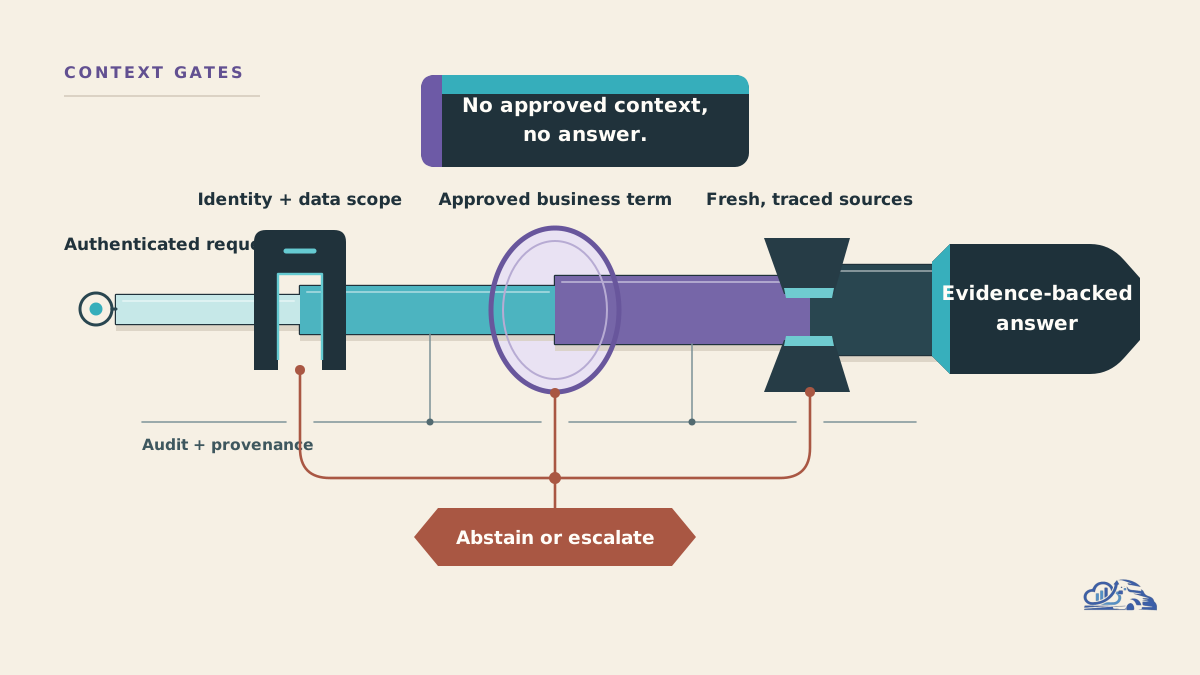
A trustworthy assistant should pass every request through identity, semantics, data health, evidence, and release gates.
The request flow should authenticate the user, authorize the data scope, resolve the approved business definition, verify source quality and freshness, and only then query or retrieve context. After generation, the system should attach source evidence, apply policy and quality checks, decide whether to answer, abstain, or escalate, and retain an audit record.
Use this readiness artifact before production release:
| Gate | Pass condition | Failure response |
|---|---|---|
| Identity | The user or service is authenticated | Reject the request |
| Authorization | Every accessible source is permitted for that identity and task | Remove the source or deny the request |
| Ownership | Every agent-readable dataset has an accountable owner | Block production use until ownership exists |
| Semantic definition | Terms, metrics, entities, and relationships have approved meanings | Ask for clarification or abstain |
| Data quality | Required fields and tables pass agreed checks | Stop the answer path and alert the owner |
| Lineage | Outputs trace to source data and transformation history | Treat the answer as unverified |
| Freshness | Sources meet the workflow's declared freshness expectation | Mark stale, use an approved fallback, or abstain |
| Retrieval and tools | Queries, context, and actions remain inside authorized boundaries | Discard the context or action and record the policy event |
| Auditability | Identity, sources, semantic version, agent path, and outcome are recorded | Do not release the workflow |
| Evaluation | Trusted questions have expected answers, evidence, and access conditions | Keep the workflow in controlled testing |
| Abstention and escalation | The assistant can decline and route uncertain cases to an owner | Add the missing failure path |
| Change control | Data, ontology, policy, prompt, model, and tool changes trigger regression review | Pause deployment until checks pass |
Existing data engineering tools fit around these gates as options, not a prescribed bundle. A lakehouse or Delta-style layer can hold governed analytical data. Airflow or comparable orchestration can manage dependencies; dbt or comparable transformation tooling can test business models; Kafka or comparable streaming infrastructure can support event-driven freshness.
Catalog and governance systems can track ownership, classification, and lineage. Vector indexes may support semantic candidate retrieval, while MCP or other tool interfaces can expose controlled queries and actions.
None of those adjacent tools was introduced by this announcement. Choose them based on the workflow's data origins, change frequency, consumers, risk, and recovery needs.
Teams that want a bounded starting point can scope a data-context readiness review with Van Data Team. The output should be concrete: a source and identity map, semantic backlog, pipeline and service-level gaps, governance-gate design, trusted-answer set, risk register, and phased delivery plan.
Failure modes and production evaluation
The fastest way to lose trust is to ship a fluent assistant whose access, sources, or definitions cannot be explained.
Common failure modes include:
- granting the assistant broader data access than the requesting user;
- querying stale, duplicated, or unowned data;
- defining critical business terms only inside prompts;
- treating RAG as a replacement for authorization or data quality;
- treating vector similarity as proof of truth;
- logging prompts without source, semantic-version, and access-decision evidence;
- testing only successful demonstrations instead of abstention and recovery paths;
- conflating Genie, Genie Ontology, and Unity AI Gateway;
- generalizing Microsoft's Azure Cobalt claim into an independent benchmark.
Production evaluation should use a trusted question set with expected answers, accepted evidence, permitted user roles, freshness conditions, and required abstention behavior. Track semantic accuracy, evidence correctness, access-policy compliance, stale-source attempts, abstentions, escalation outcomes, and audit completeness.
Production observability should cover latency, token consumption against the workflow's token budget, per-workflow cost, retries, model routing, human review burden, and failure recovery. Treat volatile values as measurements from the organization's own workload, not as universal promises. A faster answer is not an improvement if it uses the wrong metric or crosses an authorization boundary.
Hypothetical example: An operations assistant receives an inventory question after its source freshness check fails. The safe path is to label the source stale, use an approved fallback if one exists, or abstain and notify the data owner. Generating a plausible stock position would hide the actual incident.
Operational Budget
The expanded Microsoft Databricks partnership puts cost governance beside model and agent governance: Microsoft and Databricks say Unity AI Gateway governs models, agents, and costs. That reported capability is a control point, not evidence that a workflow is economical in production.
Van Data Team analysis: vendor token pricing is only the starting input. Before rollout, run every candidate against the same bounded, identity-aware workflow and trusted evaluation set, then score:
- Accepted-output cost: total model, platform, retry, reviewer, and recovery expense per approved result.
- Latency and token budget: end-to-end response time and tokens consumed within the approved ceiling.
- Retry rate and reviewer minutes: how often automation repeats work and how much human time acceptance requires.
- Failure recovery: time, effort, and auditability needed to diagnose, contain, and rerun a failed case.
- Evaluation results: accuracy against trusted answers, correct source use, authorization compliance, and appropriate abstention.
Calculate cost per approved workflow result as total operating cost divided by approved outputs. A candidate that is cheap per call can still be expensive if it creates rejected answers, slow escalations, or manual cleanup. Re-run the scorecard when models, prompts, tools, data pipelines, or Genie Ontology definitions change.
Conclusion: Build context before expanding the assistant
The Microsoft Databricks partnership matters because it puts business context, governance, workflow integration, and data infrastructure in the same enterprise AI direction. The announcement is not a RAG or vector database launch. Its named mechanisms include Unity AI Gateway, Genie Ontology, Genie integrations, Azure Databricks, and Azure Cobalt infrastructure.
For data teams, the next move is operational: choose a bounded workflow, define the approved business meaning, restrict sources by identity, enforce pipeline health, retain evidence, and evaluate answers against a trusted set. Model selection comes after those foundations are explicit.
If you need to move from architecture discussion to an accountable delivery scope, work with Van Data Team on a bounded implementation plan that includes the source map, governance gates, evaluation design, failure runbook, and phased build sequence. Trustworthy enterprise AI is built through controlled context, not polished demos.

Founder of Van Data Team. Builds Vanaxity, the AI agent system for SEO, GEO, and AEO, and leads data engineering delivery for B2B teams.
About the authorArticle FAQ
Questions readers usually ask next.
These short answers clarify the practical follow-up questions that often come after the main article.
Need a similar system?
If this article maps to a workflow your team already operates, the next step is usually a scoped review of the system, constraints, and rollout path.
Free, no-obligation review
Assess Your Microsoft and Databricks Readiness
Review your Microsoft and Databricks AI data context and governance, then leave with a prioritized implementation plan and concrete next steps.
- A current-state map of identities, governed data sources, semantic definitions, and agent access paths
- A fit assessment for Genie Ontology, Unity AI Gateway, retrieval, vector indexes, and existing pipelines
- A governance-gate checklist covering permissions, lineage, freshness, audit trails, and cost controls
- A trusted-question evaluation plan with owners, acceptance criteria, and prioritized next steps
Consultation
Scope your next AI workflow.
Share the system and blockers. We will map fit, gaps, and the next step.