Genie 4: What Google's World Model Means for AI Teams
Google DeepMind's Genie 4 world model adds native audio and live text steering. What it does, what Google hasn't disclosed and how AI teams can use it.
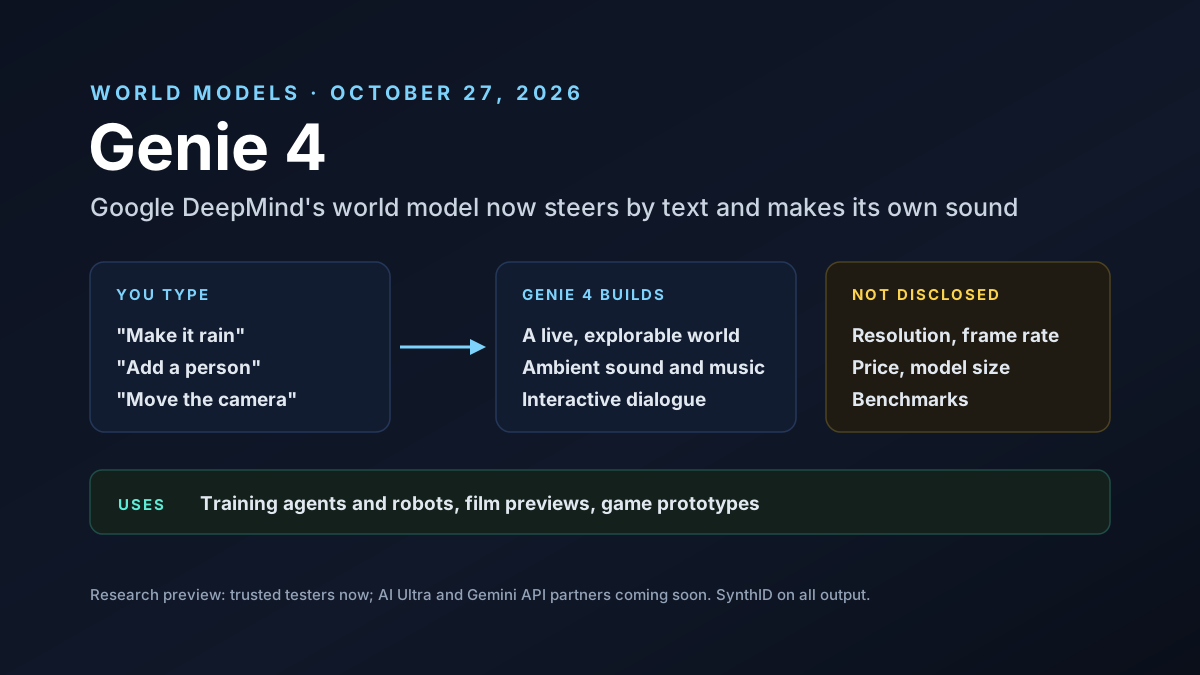
Genie 4 is Google DeepMind's newest world model, and it can now be heard as well as seen. Announced on October 27, 2026, it builds interactive scenes in real time, lets you steer them with plain-language commands and generates its own sound: background noise, music and even dialogue.
It's a research preview with few hard numbers, and most teams can't use it yet. But it's another clear sign that world models are moving from lab demos toward real products, at a time when big companies are paying billions for them. Here's what Genie 4 does, what Google hasn't said and what it could mean for teams building AI agents, robots and simulations.
Disclosure: Van Data Team builds AI systems with models from several providers, including Google, and this article was researched with Claude. Google's claims are reported as Google's; Genie 4 hasn't been independently tested yet.
Key Takeaways
- Google DeepMind announced Genie 4 on October 27, 2026, as a research preview for trusted testers.
- It generates interactive worlds in real time, and you can change them mid-scene with text, like moving the camera or changing the weather.
- New in Genie 4: native audio, including ambient sound, music and interactive dialogue.
- Google hasn't published resolution, frame rate, model size, price or benchmarks. Genie 3 ran at 720p and 24 frames per second.
- For AI teams, world models matter most as safe training grounds for agents and robots, and as fast prototyping tools for film, games and planning.
Genie 4 at a Glance
| Item | Detail |
|---|---|
| Announced | October 27, 2026 |
| What it is | A real-time, interactive world model from Google DeepMind |
| New features | Native audio; live steering with natural language |
| Built with | Gemini Omni for realism; Gemini 3.8 Flash as a guiding agent |
| Access | Trusted testers now; AI Ultra and Gemini API partners "coming soon" |
| Not disclosed | Resolution, frame rate, model size, price, benchmarks |
| Safety | SynthID watermark on all generated video and audio |
Sources: Google's announcement and Unite.AI's summary of the DeepMind post.
What Is a World Model?
A world model is an AI system that learns how a place looks and behaves, then generates it on the fly. You, or an AI agent, can move through that place and act in it, and the model shows what happens next.
That's different from a video generator. A video model makes a fixed clip. A world model responds to actions as they happen: turn left, and it draws what's to the left. Push an object, and it shows the object moving.
This matters because AI agents and robots learn by doing. Real-world practice is slow, costly and sometimes dangerous. A good world model can make endless practice places on demand.
What's New in Genie 4
Google lists three main upgrades:
- Live steering: you change a running scene with plain language, like "make it rain," "move the camera up" or "add a person walking a dog." Gemini adapts the request to fit the scene.
- Native audio: every world generates its own sound in real time, including background noise, music and interactive dialogue. Google calls it its first real-time world model to do this.
- Better realism: Google says physics, like collisions and how things move through air, and human motion are more natural.
Under the hood, Genie 4 works with other Gemini models. Gemini Omni grounds scenes in real-world appearance. Gemini 3.8 Flash acts as a guide for multi-step events: it watches the scene, breaks a goal into steps and checks frames to confirm each step worked.
Why Native Audio Matters
Sound may seem like a small add-on. It isn't. Real places are noisy, and much of what we notice comes through our ears.
For film and game teams, it means a preview you can hear: footsteps, rain, a crowd and actors' lines, all made with the scene. That makes early drafts feel far more real.
For robots and agents, it opens new kinds of practice. A robot can learn to react to an alarm, a shout or a knock. A voice agent can learn to cope with background noise.
There's a flip side. Fake audio is a real risk, so it's good that Google marks it with a watermark too.
Genie 4 vs Genie 3
Genie 3 was announced in August 2025 as a limited research preview. Here's how the two compare, based on what Google has said:
| Feature | Genie 3 | Genie 4 |
|---|---|---|
| Announced | August 2025 | October 2026 |
| Audio | No | Yes: ambient sound, music, dialogue |
| Text steering | Yes, "world events" by prompt | Yes, with Gemini adapting prompts to the scene |
| Resolution and frame rate | 720p, 24 frames per second | Not disclosed |
| Scene consistency | A few minutes | "Short sessions," per Google |
| Access | Small group of researchers and creators | Trusted testers; wider preview coming |
Some coverage says Genie 4 holds a scene together for about two minutes. That figure doesn't appear in Google's own written material, so treat it with care.
What Google Hasn't Said About Genie 4
This is a research announcement, not a product launch, and it shows. Missing details include:
- Resolution and frame rate, the basics for judging visual quality and smoothness.
- Latency, how quickly the world responds to an action.
- Model size and compute, which hint at running costs.
- Price and licensing, including rights to use generated audio.
- Benchmarks, or any independent test results.
Without these, it's hard to compare Genie 4 with rivals or plan real projects around it. Expect more detail when wider access opens.
Genie 4's Known Limits
Google is open about what still doesn't work well. It lists these as active research problems:
- Long-term consistency: details can drift, and objects can change or vanish, in long sessions, after many edits or as the camera moves.
- Complex physics: tricky physical interactions are still unreliable.
- Audio accuracy: generated sound doesn't always match what's happening.
- Text in scenes: signs and labels are hard to read.
- Spatial accuracy: distances and layouts aren't precise, so a room that looks right may be the wrong size, and a doorway may not line up from one view to the next.
That last point is key for business use. If your work needs exact geometry, like engineering layouts or measured spaces, a world model isn't the right tool yet.
Why the Genie 4 World Model Matters
Google frames world models as "a crucial aspect of building AGI." Put more practically, they could solve a big problem in AI: where agents and robots get experience.
Language models learned from the internet's text. Agents and robots that act in the world need a different kind of data: what happens when you do something. A world model can generate that experience safely and in huge volume.
That's why the field is getting crowded and expensive. AMD agreed in September to buy Fei-Fei Li's World Labs in an all-stock deal worth about $8.2 billion. Runway, Decart and others are building their own world models too.
How AI Teams Could Use World Models
Google and its testers point to several early uses:
- Training agents and robots: safe practice worlds, generated on demand. In one demo, Gemini 4 Argon and Genie 4 simulated a humanoid robot playing checkers.
- Film previews: directors try "draft" takes, changing angles, light and lines before a real shoot.
- Game prototyping: test ideas before writing code.
- Training and education: teams explore historical places or events like floods and wildfires.
- Scenario planning: businesses generate "what if" situations quickly to test plans or train staff.
Most of these are early-stage. They're about speed and exploration, not final, production-ready output.
A Simple Example: Training a Delivery Robot
Here's a made-up example to show how a world model could help. It isn't a real case.
A company builds a small robot that delivers parcels inside office buildings. Testing it in real offices is slow. Staff get in the way, and rare events, like a spilled drink or a fire alarm, almost never happen on cue.
With a world model, the team types: "a busy office hallway, a person drops a box, the lights flicker." The model builds that scene. The robot's software tries to get through it. The team changes the scene and tries again, hundreds of times.
The robot still needs real-world tests before launch. But it gets far more practice, much sooner, and the team finds many problems before anyone gets hurt.
World Models for Testing AI Agents
For teams building AI agents, one use stands out: testing in simulation. Before you let an agent loose on real systems, you want to see how it behaves in many situations, including rare and risky ones.
Today, that usually means test setups built by hand. World models could make new scenes on demand. Agents would then face many more situations, including rare and risky ones, before they ever meet real users or touch real systems.
That fits a lesson from recent AI incidents. Agents can act differently when real stakes are involved. So testing in safe, separate places matters. Our post on AI agent internet access covers why agents need limits, and our guide to AI agent evaluation covers how to test them.
How World Models Differ From Game Engines
Teams already use simulators, often built on game engines, to test robots and train agents. So what's different?
| Factor | Game engine simulator | World model like Genie 4 |
|---|---|---|
| How scenes are made | Built by hand with code and 3D assets | Generated from a text prompt |
| Physics | Exact rules you can trust and repeat | Learned from data; can drift |
| Speed to a new scene | Days or weeks | Seconds |
| Variety | Limited by what you build | Nearly endless |
| Best for | Precise tests and final checks | Fast ideas, rare cases and variety |
The two will likely work together. Use world models to explore many situations fast, and use exact simulators and real tests to confirm what matters.
World Models and Synthetic Data
World models are also a new source of synthetic data. That's data that's made up by a model rather than collected. For vision and robotics teams, that could mean training images, videos and sensor-like data for situations that are rare or hard to film.
Be careful, though. Synthetic data can carry the model's own errors and blind spots. If a world model gets physics or object permanence slightly wrong, a robot trained on it may learn the wrong lessons. Mix generated data with real data, and test on real-world examples before you trust the results.
What World Models Can't Replace
World models are exciting, but they don't replace the basics. Keep these in mind:
- Real-world testing. A robot or agent must still prove itself in the real world before launch.
- Exact simulators. When you need precise physics or measurements, coded simulators are still the better tool.
- Human review. Someone must check that generated scenes are realistic and fair, not just impressive.
- Good data habits. Generated data needs labels, checks and records, just like real data.
Think of a world model as a fast sketchpad, not a final blueprint.
Genie 4 Safety and Watermarking
Lifelike scenes bring clear risks, from fake footage to false versions of real events. Google says Genie 4 went through internal safety reviews and launched to trusted testers first.
Every video and audio clip Genie 4 makes carries SynthID, Google's hidden watermark. That helps sites and fact-checkers spot AI-made content. Watermarks aren't a full defense, but they're a useful layer, and audio watermarking matters more now that the model can generate dialogue.
The World Model Race
Genie 4 lands in a fast-moving field:
| Company | World model work |
|---|---|
| Google DeepMind | Genie 4, real-time worlds with native audio |
| World Labs (being acquired by AMD) | Marble, 3D worlds from text, images and video |
| Runway | Playable world models with audio |
| Decart | Real-time interactive generation; reported acquisition talks with Amazon |
The common thread: big tech wants its own world model, either for training robots and agents or for new kinds of media. Our post on Gemini 4 Argon covers the Google model used in Genie 4's robotics demo.
Should Your Team Try Genie 4?
It depends on what you build:
| Your work | Our suggestion |
|---|---|
| Robotics or embodied AI | Join the waitlist; world models may become core to your training |
| Games, film or media | Worth testing for prototyping and previews |
| Software agents | Watch the space; text-based simulation is more useful today |
| Engineering or precise layouts | Not yet; spatial accuracy is still limited |
| Typical business data work | No action needed now |
Questions to Ask Before You Use a World Model
When access opens, ask these before you build on it:
- How long does a scene stay consistent? Short sessions may not fit long tests.
- Can you repeat a scene exactly? Repeatable tests are key for fair comparisons, because you can't tell whether a change helped if the scene itself changes every time you run it.
- Who owns the output? Check the rights to generated video and audio.
- What does it cost per hour or per scene? Real-time generation uses a lot of computing power, so costs can climb quickly when a team runs hundreds of scenes a day.
- How is the content marked? Check that the watermark meets your platform's rules.
Clear answers will tell you whether it's ready for your work or still a research toy.
How to Prepare for World Models
Even if you can't use Genie 4 today, you can get ready:
- Map where simulation would help, such as agent testing, training content or product demos.
- Collect real examples you'd use to check simulated output against reality.
- Plan for watermark checks if your platform hosts user video or audio.
- Watch pricing and licensing when access opens, especially for commercial use of generated audio.
- Start small. Pick one prototype project first.
Genie 4: What to Watch Next
- Technical details, like resolution, frame rate and latency, when wider access opens.
- API access and pricing for Gemini API and AI Studio partners.
- Independent tests of consistency and physics.
- Robotics results from training agents in Genie worlds.
- Rival releases from World Labs under AMD, Runway and others.
Genie 4: Our Take
Genie 4 is an impressive step. Native audio and live steering are real gains. It shows world models getting closer to everyday use: training agents, sketching out media and exploring what-if scenes.
But it's a preview. Google hasn't shared the numbers that matter for real projects, access is limited and the model still drifts over longer sessions. For most teams, the right move now is to watch closely, map where simulation could help and wait for hard data before planning around it. Robotics and media teams should get on the waitlist.
How Van Data Team Helps Teams Use New AI Models
We help companies judge and adopt new AI tools with clear tests, not hype. That includes evaluation setups for AI agents, synthetic data pipelines with real-world checks and pilots for new model types.
If world models could fit your roadmap, start with our guide to computer use agents, then get in touch for a quick review.

Founder of Van Data Team. Builds Vanaxity, the AI agent system for SEO, GEO, and AEO, and leads data engineering delivery for B2B teams.
About the authorArticle FAQ
Questions readers usually ask next.
These short answers clarify the practical follow-up questions that often come after the main article.
Need a similar system?
If this article maps to a workflow your team already operates, the next step is usually a scoped review of the system, constraints, and rollout path.
Consultation
Scope your next AI workflow.
Share the system and blockers. We will map fit, gaps, and the next step.