July 14, 2026
AI Agent Evaluation: From Offline Tests to Runtime Graders
Why single-turn LLM evals miss agent failures, and how to connect incident data, task rubrics, runtime traces and graders such as Anthropic Outcomes.
Article focus
AI agent evaluation is now a production control problem. Engineering teams must verify the entire task trajectory, including planning, tool use, retries, delegation, and final outcomes, while the agent is still running.
Section guide
AI agent evaluation is now a production control problem. Engineering teams must verify the entire task trajectory, including planning, tool use, retries, delegation, and final outcomes, while the agent is still running. A model can improve on a generic benchmark yet make a deployed workflow loop, misuse a tool, or report success after completing only part of the job.
At Van Data Team, we start by mapping the business outcome, mutable state, tool permissions, failure recovery, and human review gate. That produces an evaluation plan tied to the workflow, not a leaderboard. For teams deploying production AI agent workflows, the practical output should be an incident-derived test set, outcome rubric, trace specification, escalation policy, and model-release gate.
Anthropic is addressing this operating problem through education and shipped runtime capabilities. Preston Tuggle and Jimmy Chan from Anthropic's Applied AI team host an educational developer session on July 14, 2026, from 10:00 to 11:00 a.m. PT. Separately, the Claude Managed Agents update documents Outcomes, multiagent orchestration, memory, and other runtime capabilities.
Anthropic states the product-builder problem plainly:
Most teams shipping AI agents can't tell whether a new model actually improves their product.
The webinar is not a product launch, and Anthropic has not announced or shipped a product called an "Agent Evaluation Framework." The webinar teaches evaluation practice. Managed Agents is the shipped public-beta runtime story. Together, they point toward evaluation becoming infrastructure inside the agent loop.
Key Takeaways
Production-ready agent evals connect incident data, task rubrics, runtime traces, and human escalation.
- Single-turn LLM evaluation cannot verify tool behavior, state changes, delegation, retries, or stopping decisions.
- Anthropic's webinar is educational, while Outcomes puts an independent rubric grader inside Claude Managed Agents.
- Runtime grading can trigger targeted revision, but every grader call adds tokens, latency, and another possible source of error.
- A new model is an upgrade only when it improves product-specific outcomes without unacceptable regressions in safety, cost, tool use, or review burden.
What AI Agent Evaluation Means in Production
AI agent evaluation measures whether an agent completes a real task correctly, through an acceptable trajectory, under the tools, permissions, state, and recovery rules it will encounter in production.
Offline suites and runtime graders solve different parts of that problem:
| Dimension | Offline benchmark or regression suite | Runtime outcome grader |
|---|---|---|
| Timing | Before deployment or model adoption | During the active agent task |
| Evaluation object | Fixed prompt, task, trace, or expected result | Current outcome and supporting evidence |
| Success definition | Expected behavior or aggregate test score | Product-specific rubric |
| Feedback path | Model, prompt, or configuration selection | Pass, targeted revision, or escalation |
| Primary risk | Test set does not represent production | Added cost, latency, and grader error |
These layers are complementary. Offline tests catch known regressions before release. Runtime grading handles outcomes that must be verified against the current task state before the workflow can safely continue.
According to Anthropic's engineering guide to agent evals, evaluating agents requires attention to dynamic, multi-step behavior rather than only static model responses. The relevant unit is the trajectory and outcome together.
A production evaluation should detect distinct failure classes:
- Loop regression: The agent repeats a tool call or revision without making meaningful progress.
- Tool misuse: The final prose looks correct, but the agent used the wrong tool, supplied unsafe arguments, or changed the wrong resource.
- Multi-step drift: Intermediate decisions gradually move away from the original goal.
- Silent partial success: The agent completes the visible part of the task while omitting a required artifact or state change.
- Premature stopping: The agent exits before every acceptance criterion is satisfied.
- Coordination failure: Specialist outputs conflict, arrive in the wrong order, or never reach the lead agent.
Consider a hypothetical reporting lead named Maya. Her agent produces a polished weekly narrative and marks the task complete. The prose is accurate, but the workflow never creates the reconciliation file or writes the approved snapshot. A response-only judge may pass the answer. A task-level rubric fails it because the business outcome remains incomplete.
The decision rule is simple: if success depends on tools, mutable state, retries, delegation, or stopping behavior, a prompt-response benchmark is insufficient by itself.
Anthropic's Webinar and Runtime Work Point in the Same Direction
The following illustration summarizes where evaluation enters the loop:
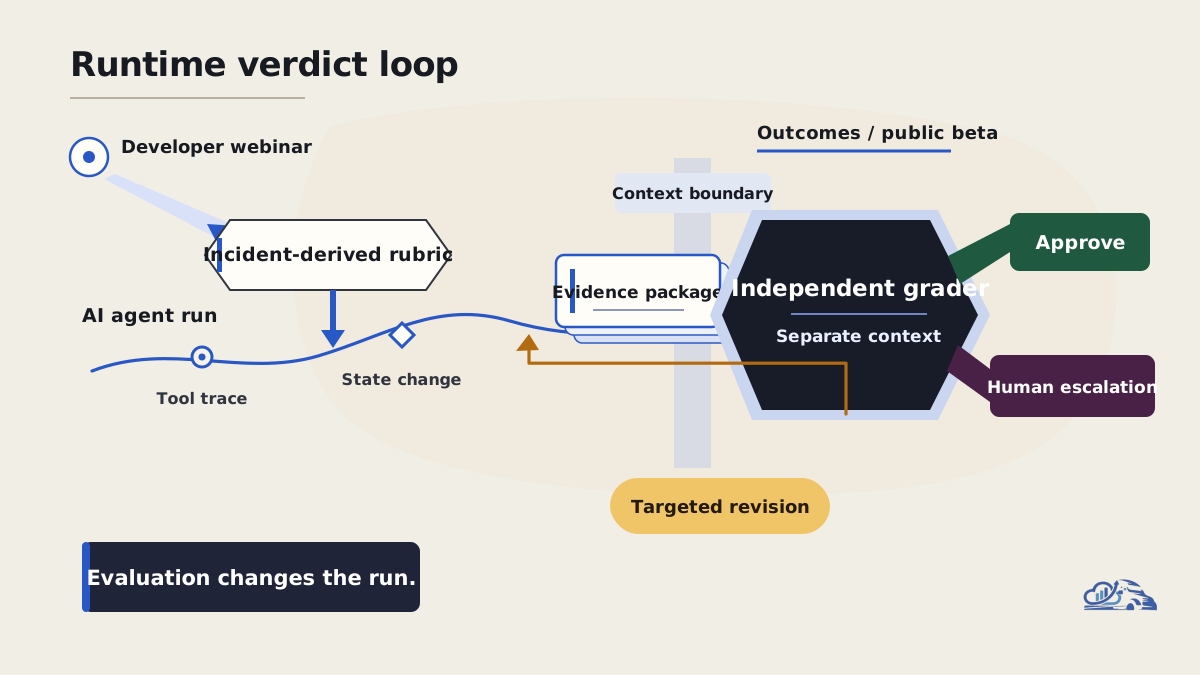
Anthropic is treating evaluation as both an engineering discipline and a runtime control, while keeping the educational webinar separate from the Managed Agents product.
The developer session covers why conventional evaluations miss agent failures, how to construct datasets from production problems, and how to decide whether a new model improves a specific product. Those are model-adoption and evaluation practices, not a newly launched framework.
Outcomes changes the execution loop. A team writes a rubric describing success, the agent works toward that outcome, and a separate grader evaluates the result in its own context window. The Managed Agents outcome-grader cookbook shows how failed criteria can produce targeted feedback and send the work back for revision.
The separate context window is a meaningful design choice. It prevents the grader from being directly influenced by the agent's reasoning, but it also requires the system to construct a complete evidence package for evaluation. That consumes additional context, tokens, execution time, and engineering effort. Isolation reduces one source of bias; it does not make the grader infallible or eliminate correlated errors between agent and grader models.
The runtime pattern is:
task -> agent and tools -> artifacts -> independent grader -> pass, revision, or human escalation
For an agentic BI and reporting workflow, a compact outcome contract could look like this:
git status --short
python -m pytest -q
git diff --check
# ship only after review confirms the scoped change
This rubric defines the outcome without prescribing a single reasoning path. Deterministic checks can verify required files and reconciled totals. A rubric grader can assess whether the narrative is supported by the approved evidence.
Managed Agents also supports orchestration in which a lead agent decomposes work and delegates it to specialists. Each specialist can have its own model, prompt, and tools, work in parallel on a shared filesystem, and return results to the lead agent's context. The Claude Console preserves the execution trace so operators can inspect which agent acted, in what order, and why.
The availability boundary matters: Outcomes, multiagent orchestration, and memory are in public beta, while dreaming is in research preview. Teams should treat those labels as delivery constraints when planning production adoption.
Build the Eval Dataset From Production Incidents
The highest-value eval dataset starts with real failures and difficult successful runs because those traces preserve the state, tool, and permission conditions that synthetic prompts usually omit.
A practical incident-to-regression workflow is:
- Capture failed, partially successful, high-friction, and human-corrected traces.
- Remove secrets and unnecessary customer information.
- Record the original goal and relevant environment state.
- Preserve available tools, permissions, dependencies, and stopping conditions.
- Define the expected outcome without prescribing a preferred chain of thought.
- Label the failure class, business impact, and escalation requirement.
- Convert acceptance criteria into a testable rubric.
- Replay the case against candidate prompts, models, and agent configurations.
- Add confirmed failures to the regression set.
- Version the dataset, rubric, tool definitions, and expected evidence together.
Include difficult successes as well as obvious failures. A system that learns only from failures may become overly cautious, escalate safe tasks unnecessarily, or reject valid alternative solutions. Ambiguous cases are useful because they expose where the rubric needs clearer evidence requirements or a human decision.
For example, turn Maya's missing reconciliation file into a repeatable case. Preserve the source snapshot, permitted tools, required artifacts, and stop condition. The case fails if the reconciliation file is absent, even when the narrative is persuasive. That prevents superficial output quality from masking silent partial success.
A scoped Van Data Team evaluation-readiness review can turn existing traces into a failure taxonomy, signal map, dataset specification, rubric backlog, and implementation plan. The deliverable should show what can be checked deterministically, what needs model-based grading, and where human judgment remains necessary.
Gate New Models on Your Product, Not a Leaderboard
A new model is an upgrade only when it improves production-relevant outcomes without creating unacceptable regressions in safety, tool behavior, cost, latency, or escalation burden.
Keep the comparison environment as stable as possible: use the same incident-derived tasks, tool definitions, permissions, prompts, relevant state, and rubric version. Repeat nondeterministic tasks enough to expose variance, then inspect failures by workflow class rather than relying on one aggregate score.
| Decision dimension | What to compare | Hold adoption when |
|---|---|---|
| Outcome quality | Completeness and rubric verdicts | Critical task classes regress |
| Tool behavior | Selection, arguments, errors, and side effects | Unsafe or incorrect actions increase |
| Trajectory | Retries, loops, drift, and stopping | Better prose hides worse execution |
| Review burden | Corrections, overrides, and escalations | Operators must intervene more often |
| Runtime economics | Token use, latency, and grading overhead | Gains do not justify operating cost |
| Reliability | Variance across comparable runs | Results become too inconsistent |
Imagine a hypothetical platform lead named Jon testing a candidate model. It writes clearer summaries than the current model, but it retries a failed export without changing its approach and escalates routine tasks more often. The aggregate output score improves while workflow reliability declines. For Jon's product, that model is not an upgrade.
Product evidence outranks generic benchmark improvement. Adopt only when gains survive your tools, permissions, task state, rubrics, and recovery policies.
Instrument Runtime Grading for Traceability and Recovery
Agent observability must connect every grader verdict to the execution trace, evidence, business outcome, and recovery action that produced it.
The mistake we see is logging the final response while dropping the tool arguments, state changes, delegation decisions, and stop reason. That makes a failure visible but not diagnosable.
Capture at least:
- Trace and session identifiers, agent role, and parent-child relationships.
- Model, prompt, rubric, tool, and policy versions.
- Tool calls, arguments, results, errors, and side effects.
- Execution order, delegation decisions, and intermediate artifacts.
- Retry reasons, stop reasons, and revision feedback.
- Grader verdicts and evidence for every rubric criterion.
- Human overrides, escalation reasons, and final business outcomes.
- Token consumption, latency, and cost by agent and grader.
Multi-agent evaluation also needs artifact provenance. Record which specialist produced each artifact, how the lead agent used it, and whether the final synthesis contradicted specialist evidence. The production AI agent ops and human escalation playbook provides a broader operating model for connecting traces, review queues, recovery, and ownership.
Control the grader as carefully as the agent
Runtime grading improves recoverability, but it creates new failure modes. Every grader call consumes tokens and adds latency. A weak rubric may reward superficial compliance. Agent and grader errors can be correlated, while repeated revisions can become another loop regression.
Use deterministic validation for permissions, schemas, required artifacts, calculations, and state transitions whenever possible. Reserve model-based grading for semantic quality, evidence alignment, completeness, and other judgments that rules cannot express cleanly.
Version rubrics, cap revision behavior with an explicit stop policy, audit successful samples, and track grader disagreement and human overrides. Ambiguous, irreversible, or high-impact outcomes should move to an operator. Our guidance on designing AI agents with human review loops explains how to place those gates without turning every task into manual approval.
For teams with fragmented traces, Van Data Team can deliver a signal map, dashboard gap review, grader-monitoring specification, escalation runbook, and prioritized delivery scope.
Production Implementation Checklist
A production rollout should connect offline regression coverage, runtime verification, observability, and failure recovery before grading is expanded across workflows.
- Define the business outcome before writing the rubric.
- Collect real incidents and difficult successful cases.
- Preserve tools, permissions, state, and stop conditions.
- Separate deterministic checks from semantic grading.
- Add runtime grading where revision is safe and valuable.
- Define retry limits, stop behavior, and human escalation.
- Trace specialist work and artifact provenance.
- Compare model releases on the same product dataset.
- Review latency, tokens, cost, and operator burden.
- Feed confirmed production failures back into the regression set.
Tooling And Landscape Fit
Anthropic’s Outcomes is the closest fit when a team already runs work in Claude Managed Agents and needs a rubric grader to inspect the current task, request a targeted revision, or route an uncertain result for review. Its advantage is proximity to execution: grading can influence the live loop rather than merely score a stored transcript.
Framework-agnostic suites such as Inspect AI, OpenAI Evals, and promptfoo fit pre-release comparison better. They help teams replay a stable eval dataset across models, prompts, and configurations, but they do not automatically verify mutable production state. Trace and evaluation platforms such as LangSmith, Braintrust, and Arize Phoenix add cross-run observability, experiment comparison, and failure analysis; they suit agents spanning providers or custom infrastructure.
Orchestrators such as LangGraph and Temporal solve a different layer. They define state transitions, retries, checkpoints, and durable execution. Those controls make trajectories testable, but they are not outcome judges. Likewise, schema validation, permission checks, retry budgets, and human approval gates constrain behavior without proving the business task succeeded.
A strong AI agent evaluation stack therefore combines offline regression suites, trace capture, deterministic runtime checks, and rubric-based outcome grading. Choose Outcomes for integrated live correction; add external tooling when portability, longitudinal analysis, or independent release gating matters.
Operational Budget
Before promoting a model, prompt, or grader configuration, evaluate the complete operating cost—not just vendor token pricing. A cheaper model can become the expensive option when it triggers repeated Outcomes revisions, tool retries, failure recovery, or human intervention.
Score every candidate on:
- Outcome-rubric results, including critical failure classes and incomplete state changes
- End-to-end latency across successful, retried, and escalated runs
- Input, output, and grader-token consumption against the workflow’s token budget
- Retry rate, reviewer minutes, and recovery behavior after tool or grader failures
The practical metric is cost per approved workflow result: total model, grader, tool, infrastructure, retry, and human-review cost divided by the outputs that satisfy the rubric and pass required state verification. Failed and abandoned runs still belong in the numerator because production pays for them even when users receive no usable result.
This scorecard keeps AI agent evaluation tied to business performance. A candidate should advance only when its evaluation gains justify any added latency, token use, review burden, and recovery risk. If a stronger rubric score depends on excessive revision loops or manual rescue, the workflow is not yet economically ready for production.
Conclusion: Make Evaluation Part of the Runtime
AI agent evaluation can no longer end at a pre-launch test report. Production agents need offline regression coverage for known failures and runtime grading for outcomes that must be verified before the workflow continues.
Anthropic's webinar and Managed Agents capabilities reflect different parts of that shift. The webinar teaches teams to build representative datasets and judge model upgrades against their products. Outcomes places rubric-based verification, feedback, and revision inside execution.
The operating model is straightforward: collect real incidents, define observable success, preserve the trajectory, grade against independent evidence, limit revisions, and escalate unresolved risk. Keep humans responsible for ambiguity and high-impact decisions.
If your team is moving an agent from demo to production, bring Van Data Team one priority workflow. We can return a failure taxonomy, incident-derived eval plan, runtime rubric, trace schema, dashboard gap review, escalation runbook, and scoped delivery backlog.
Article FAQ
Questions readers usually ask next.
These short answers clarify the practical follow-up questions that often come after the main article.
Need a similar system?
If this article maps to a workflow your team already operates, the next step is usually a scoped review of the system, constraints, and rollout path.
Book your free workflow review here.
Related articles
View all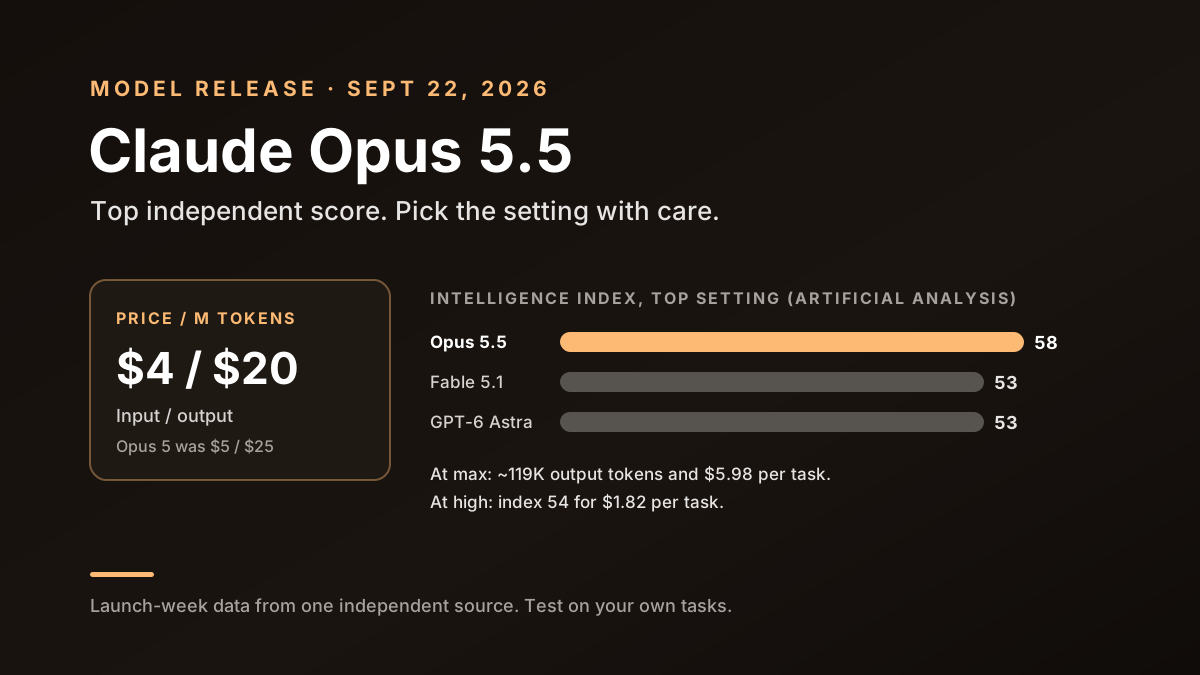
Claude Opus 5.5: Tops the Independent Index at a Lower Price
Jev vs Fable 5.1 vs GPT-6 Astra: Which Model for Which Job
GPT-5.6 on Amazon Bedrock: What Agent Teams Should Do Next