Kimi K3.1 Pro: Benchmarks, Price and Should You Switch?
Kimi K3.1 Pro ranks 4th on Artificial Analysis at $2/$10 per million tokens, with open weights due Nov 4. What the benchmarks hide and who should switch.
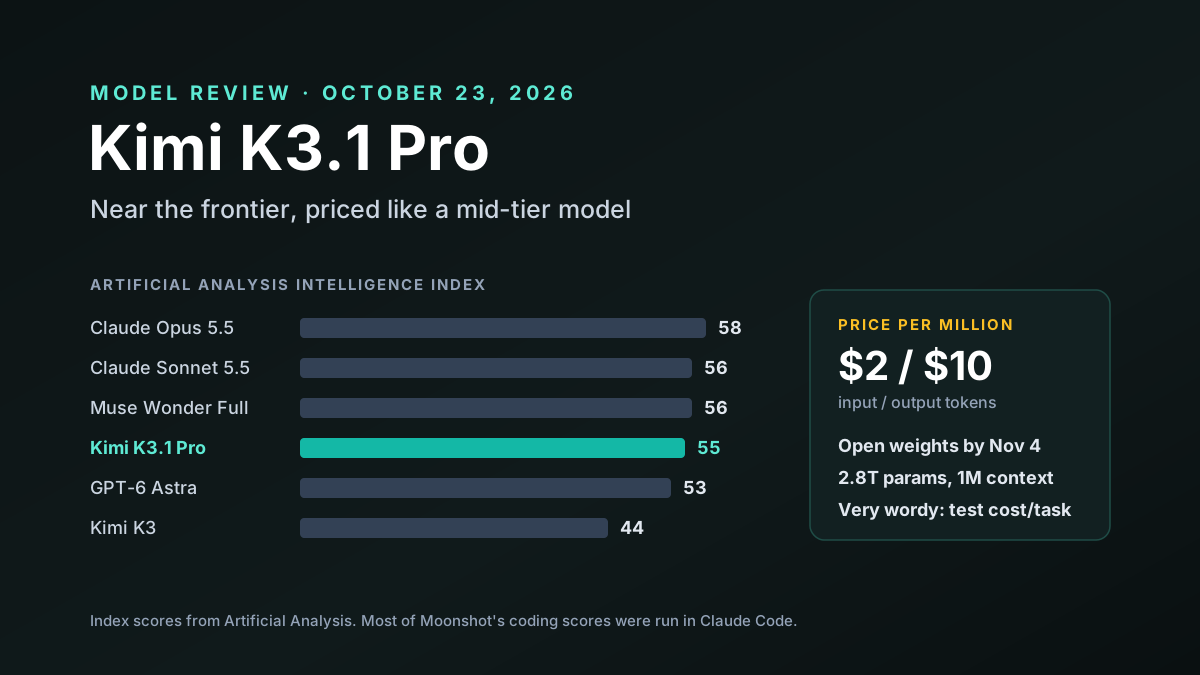
Kimi K3.1 Pro is the strongest model yet that's due to become open weights. Moonshot AI released it on October 23, 2026, and the independent Artificial Analysis Intelligence Index put it fourth in the world, ahead of GPT-6 Astra and Claude Fable 5.1. It costs $2 per million input tokens and $10 per million output, and Moonshot says the full weights will ship by November 4.
That makes it a serious option for coding agents, office work and finance tasks. But the headline numbers come with catches: most of Moonshot's coding scores were run inside another company's tool, the model is very wordy, and the weights are still a promise. Here's what's real, what to check and which teams should test it.
Disclosure: Van Data Team builds AI systems with models from many providers, and this article was researched with Claude. Anthropic, which makes Claude, competes with Moonshot, and Moonshot ran most of its coding tests in Anthropic's Claude Code. We report scores as published and label our own math.
Key Takeaways
- Kimi K3.1 Pro scores 55 on the Artificial Analysis Intelligence Index, fourth overall and 11 points above Kimi K3. Only Claude Opus 5.5, Claude Sonnet 5.5 and Meta's Muse Wonder Full rank higher.
- It costs $2 and $10 per million tokens, the same as Sonnet 5.5, half of Opus 5.5 and about 80% below GPT-6 Astra.
- Most of Moonshot's coding scores were run inside Claude Code, so they may not match what you see in other tools.
- It uses far more output tokens than most models, so the real cost per task is about the same as Kimi K3's.
- Weights are due by November 4. At 2.8 trillion parameters, self-hosting needs serious hardware.
Kimi K3.1 Pro at a Glance
| Item | Detail |
|---|---|
| Maker | Moonshot AI, Beijing |
| Released | October 23, 2026 |
| Size | 2.8 trillion parameters, 104 billion active per token |
| Context window | 1 million tokens; text and image input |
| Price | $2 input, $10 output per million tokens; $0.20 cached input |
| Highspeed version | 2 to 3 times faster, at $4 and $20 |
| Weights | Promised by November 4, 2026; license not yet published |
| Where to use it | Kimi apps, Kimi Work, Kimi Code and the Kimi API |
Sources: Moonshot's launch post, its pricing page and Artificial Analysis.
What Is Kimi K3.1 Pro?
Kimi K3.1 Pro is the first model in Moonshot's K3.1 series. It isn't a new base model. It's Kimi K3, released in July, with much more training on top.
Moonshot says it used far more compute for post-training, mostly reinforcement learning across hundreds of task types. It also rebuilt the systems that run that training so the extra compute kept paying off. The result is the same size and design as K3, with much better scores.
That matters beyond Moonshot. It suggests a lab can gain a lot by training an existing model harder, without paying to build a new one from scratch.
Kimi K3.1 Pro Benchmarks: The Independent View
The most useful number comes from Artificial Analysis, which runs the same tests on every major model. Its Intelligence Index put Kimi K3.1 Pro at 55, fourth of more than 200 models.
| Model | Intelligence Index | List price per million tokens (input / output) |
|---|---|---|
| Claude Opus 5.5 | 58 | $4 / $20 |
| Claude Sonnet 5.5 | 56 | $2 / $10 |
| Muse Wonder Full (Meta) | 56 | n/a |
| Kimi K3.1 Pro | 55 | $2 / $10 |
| Claude Fable 5.1 | 53 | $10 / $50 |
| GPT-6 Astra | 53 | $10 / $50 |
| Gemini 4 Argon | 53 | n/a |
| Kimi K3 | 44 | $3 / $15 |
If the weights ship on time, Kimi K3.1 Pro will be the top open-weight model on this index. Based on Artificial Analysis data, The Decoder reports that the gap between the best open and best closed models would shrink from 12 points to 3.
One correction to some early posts: Meta's Muse Wonder Full ranks above Kimi K3.1 Pro, not below it.
Moonshot's Own Kimi K3.1 Pro Benchmarks
Moonshot's launch table compares the model with Claude Opus 5.5, Fable 5.1, GPT-6 Astra, DeepSeek V4.1 Flash and GLM-5.3. These are the company's numbers, run at maximum effort:
| Test | Kimi K3.1 Pro | Claude Opus 5.5 | GPT-6 Astra |
|---|---|---|---|
| Terminal-Bench 4.0 (long terminal work) | 65.7% | 66.4% | 58.2% |
| SWE-Marathon (very long coding jobs) | 51.7% | 46.3% | 42.5% |
| ProgramBench (whole programs) | 31.5% | 65.0% | 50.0% |
| Terminal-Bench Science | 38.1% | 63.3% | 68.1% |
| OSWorld-V2.1 (using a computer) | 79.6% | 81.8% | 75.8% |
| OfficeQA Pro v2 (finance documents) | 64.4% | 62.2% | 54.4% |
| GDPval-AA (office tasks, Elo) | 1846 | 1866 | 1573 |
The pattern is clear. Kimi K3.1 Pro is strong on long agent jobs, office work and finance documents. It's weak at writing whole programs and at science tasks in a terminal.
Overall, "near Opus 5.5" is fair. "Past Opus 5.5" isn't.
The Claude Code Catch
Here's the detail that matters most. Moonshot ran nearly all of its coding tests, including Terminal-Bench 4.0, SWE-Marathon, DeepSWE and ProgramBench, inside Anthropic's Claude Code. That's the tool, or harness, that tells the model how to plan, use tools and edit files.
The harness can change scores a lot. A model tested in Claude Code may score very differently in Kimi Code, Cursor or your own agent loop. So treat Moonshot's coding numbers as a best case for one setup.
Some reviewers also spotted placeholder text where scores should be in Moonshot's API docs at launch, and hallucination figures that didn't match the blog. Small slips, but another reason to wait for more independent runs before you trust a single number.
Where You Can Use It Today
Kimi K3.1 Pro went live on launch day across Moonshot's own products. Here's where to find it:
- Kimi apps: the web app and the iOS, Android and HarmonyOS apps.
- Kimi Work: the desktop app, version 3.1.0 or later, for Windows and Apple silicon Macs.
- Kimi Code: Moonshot's coding agent. Switch with the /model command.
- Kimi API: model IDs kimi-k3.1-pro and kimi-k3.1-pro-highspeed, with zero data retention available.
- Kimi Business: admins can turn it on. It was off by default at launch.
- Third-party routers: OpenRouter lists it too, which makes quick tests easy.
If you already use an OpenAI-style client, testing it is mostly a matter of changing the base URL, key and model name.
The Real Cost of Kimi K3.1 Pro
On paper, Kimi K3.1 Pro is a third cheaper than K3. In practice, the saving mostly disappears:
- List price: $2 and $10 per million tokens, down from $3 and $15.
- Output tokens: many more per task, which cancels most of the price cut.
- Net cost per task: about the same as K3.
Artificial Analysis found the model very wordy. It used about 150 million output tokens to run the index, against a median of 87 million. That's a lot. Output tokens are the expensive part, so a model that writes more costs more per task.
Our math, based on reports: Kimi K3.1 Pro costs about $2 per index task, roughly the same as Kimi K3. You get a much better model for the same money, but not a cheaper one. That's still a good deal against GPT-6 Astra or Fable 5.1, which list at $10 and $50.
Wordiness also hits subscription limits. One developer on Hacker News said a $99 monthly Kimi plan hit its five-hour cap within 47 minutes of a single coding session.
How Fast Is It?
K3's biggest complaint was speed, and Moonshot has two answers. The standard model thinks more efficiently, and some early testers saw it run nearly twice as fast as K3 on their tasks.
But Artificial Analysis measured about 73 output tokens per second on Kimi's API, a bit below the median for the models it tracks. It also took about 3 seconds to start answering. That's fine for background agents. It may feel slow in a chat window.
For speed, there's Kimi K3.1 Pro Highspeed. Moonshot says it runs two to three times faster, at double the price, which makes sense for chat tools and user-facing replies where a slow first answer costs you users.
Hacking Skills Removed on Purpose
The most unusual part of the launch is a section on cybersecurity. Moonshot found that hacking-related data in its training was making the model better at finding and exploiting software flaws. So it removed that data before the open-weight release.
It published the cost of that choice. On its own exploit test, the version without the filter solved 90.5% of tasks. The shipped model solves 81.0%. Moonshot says it aims not to release open weights that push the frontier of cyber capability.
That's a notable step. Open weights can't be recalled once they're out, and anyone can remove safety training. Showing what was held back, and by how much, helps buyers and security teams judge the risk. Our post on AI agent attacks explains why this matters, and how attackers already use AI agents to find and exploit flaws faster than teams can patch them.
Fewer Made-Up Facts
Moonshot also says the model makes things up much less. On its internal stress test, the share of false claims fell from 23.4% for K3 to 8.3%.
Read that carefully. It's Moonshot's own test, on prompts chosen to trip models up.
GPT-6 Astra scored 5.5% on the same test. So the direction is good, but it isn't an everyday error rate. Keep checking facts in anything that matters, especially numbers in finance, legal or medical work, where one wrong figure can do real damage.
Self-Hosting When the Weights Land
Open weights are the big draw. But this is a huge model, and running it yourself isn't cheap.
Our estimate: at 2.8 trillion parameters, the weights alone need about 2.8 TB of GPU memory at 8-bit precision and about 1.4 TB at 4-bit. You also need room for the context, and a 1 million token window needs a lot. In practice, that means a full high-end 8-GPU server at minimum, and often more. That's a lot of hardware.
Only 104 billion parameters are active for each token, which helps speed. It doesn't shrink the memory you need to hold the full model.
For most teams, the realistic paths are:
- Use Moonshot's API, with zero data retention if your data allows it.
- Use a cloud host that serves the open weights in your region, once providers add it.
- Self-host only if you already run large GPU clusters and have a strong reason, such as strict data rules.
Data, Policy and Risk
Kimi K3.1 Pro comes from a Chinese company, and that raises questions for some buyers.
Three things to weigh:
- API data: if you use Moonshot's API, your prompts go to Moonshot's servers. Moonshot offers zero data retention for API customers, and its business plan separates personal and company accounts. Check where data is processed. Does it fit your rules?
- Policy: rules are moving too. The US just ordered federal civilian agencies to remove DeepSeek, as we covered in our DeepSeek ban post. That order doesn't name Moonshot. But teams that sell to government or work in regulated industries should expect more questions about Chinese models.
- Self-hosting: running the open weights keeps data on your own systems. It doesn't remove risks built into the model, so test it like any other model before you trust it with real work.
Kimi K3.1 Pro vs Claude Sonnet 5.5 at the Same Price
The most direct rival is Claude Sonnet 5.5. Both list at $2 and $10 per million tokens, and they sit one point apart on the Artificial Analysis index.
| Factor | Kimi K3.1 Pro | Claude Sonnet 5.5 |
|---|---|---|
| Intelligence Index | 55 | 56 |
| List price | $2 / $10 | $2 / $10 |
| Open weights | Promised by November 4 | No |
| Maker based in | China | United States |
| Data location | Moonshot API, or your own servers once weights ship | Anthropic and major cloud providers |
The choice comes down to open weights and data location, not raw scores. Our Claude Sonnet 5.5 review covers the other side.
Which Teams Should Test Kimi K3.1 Pro?
| Your situation | Our suggestion |
|---|---|
| Long-running coding agents on a budget | Test it now against your current model, in your own harness |
| Finance, spreadsheet and document work | Strong candidate; check facts and figures carefully |
| You need open weights for data control | Plan a pilot for after November 4, and check the license |
| Science, research code or whole new programs | Stay with Opus 5.5 or GPT-6 Astra for now |
| Fast chat or user-facing replies | Try the Highspeed version, or keep a faster model |
| Government or regulated work | Check policy and data rules before any test |
How to Test Kimi K3.1 Pro Fairly
Don't switch on the strength of a launch table. Run a short test on your own work first:
- Pick 20 to 50 real tasks from your backlog, with known good answers.
- Run them in your own harness, not just Claude Code, since that's how you'll use the model.
- Track cost per finished task, not price per token, because the model is wordy.
- Time each task. Include the slow start.
- Check for silent errors, like wrong numbers in finance outputs.
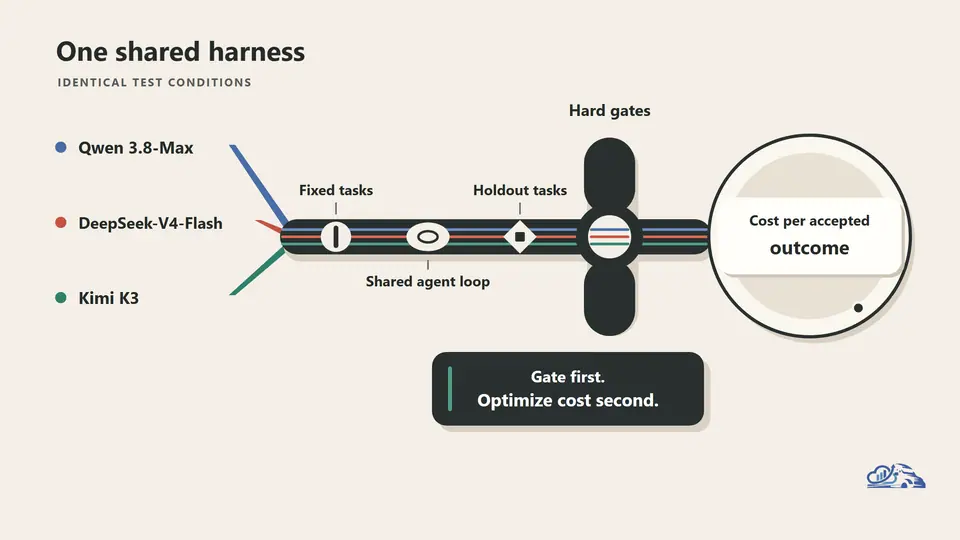
Our comparison of Qwen vs DeepSeek vs Kimi has a scorecard you can reuse. And keep your system ready to swap models, as our post on model portability explains.
What Developers Are Saying
Early reactions were mixed, in a useful way:
- Post-training researchers read the jump as proof that Moonshot got its reinforcement learning right, since the base model didn't change.
- Benchmark builders asked why almost every coding score ran inside Claude Code, and want runs in standard harnesses.
- Early testers on Hacker News reported it was close to twice as fast as K3 on their own tasks.
- Subscription users complained about usage caps that run out fast.
- Opus users said Kimi wins some benchmarks, but Opus 5.5 still feels ahead on terminal coding and computer use.
That's a fair summary of the launch. Big gains, real questions and a need for more independent tests.
What to Watch Next
- The weights on November 4, and the license that comes with them.
- Independent coding scores. Look for runs outside Claude Code.
- Cloud providers adding the model, which would make hosted open weights easier.
- Real-world reports on speed, limits and cost per task.
- Replies from rivals, since Anthropic, OpenAI and Google will feel price pressure.
Kimi K3.1 Pro: Our Take
Kimi K3.1 Pro is the closest an open-weight model has come to the best closed models, and it's priced like a mid-tier model. That's real progress, and it came from training an existing model harder, not from building a bigger one.
But it isn't a clear winner. Opus 5.5 still leads overall, the coding scores depend on Claude Code, and the model's wordiness eats most of the price cut. For teams with long agent jobs, office work or a need for open weights, it's well worth a test. Test first. Then wait for the weights before you plan around them.
How Van Data Team Helps Teams Choose Models
We help companies pick, test and run AI models on their own work. That includes fair side-by-side tests, cost per task tracking, model gateways that make swaps easy and self-hosted deployments of open-weight models.
If you're weighing Kimi K3.1 Pro against your current model, start with our guide to AI agent development costs, then get in touch for a quick model review.

Founder of Van Data Team. Builds Vanaxity, the AI agent system for SEO, GEO, and AEO, and leads data engineering delivery for B2B teams.
About the authorArticle FAQ
Questions readers usually ask next.
These short answers clarify the practical follow-up questions that often come after the main article.
Need a similar system?
If this article maps to a workflow your team already operates, the next step is usually a scoped review of the system, constraints, and rollout path.
Consultation
Scope your next AI workflow.
Share the system and blockers. We will map fit, gaps, and the next step.