DeepSeek Ban and $15B Raise: What AI Teams Should Do Now
The US ordered federal agencies to remove DeepSeek, then DeepSeek raised about $15B. Who the DeepSeek ban covers, what it means for vendors and what to check.
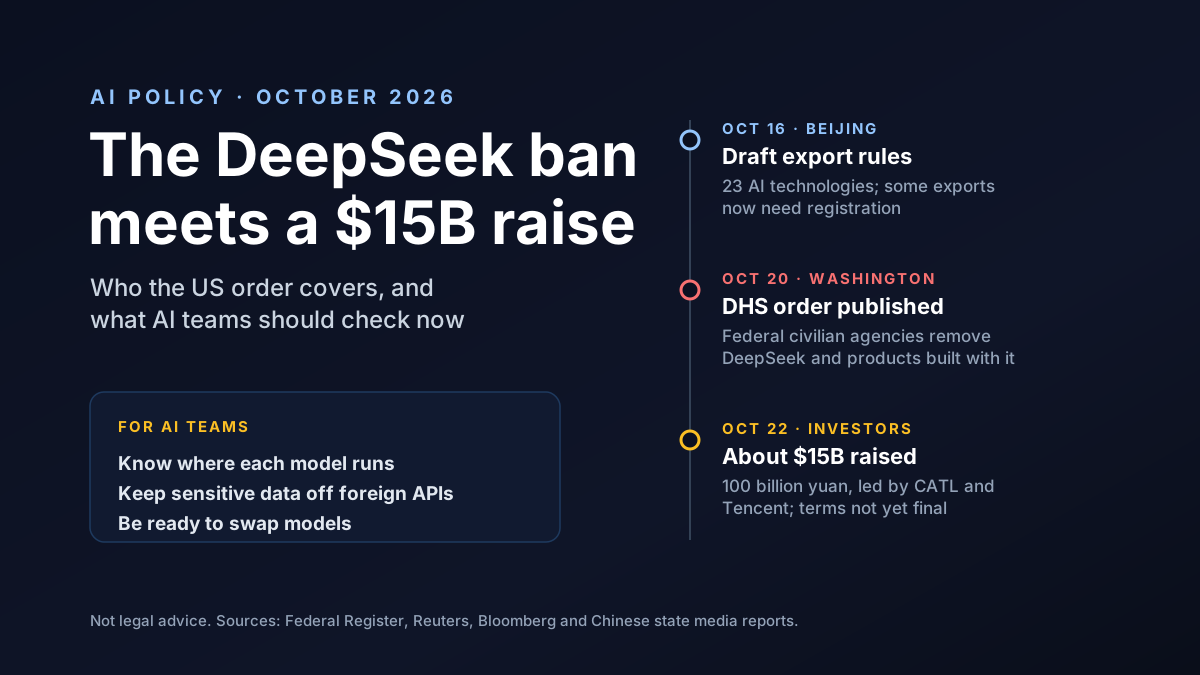
The DeepSeek ban is now official US policy for federal civilian agencies. On October 20, 2026, the government published an order telling them to stop buying DeepSeek and remove it, along with other products built using it. Two days later, Reuters reported that DeepSeek was wrapping up a raise of about $15 billion.
So one of the world's best-known AI labs is being pushed out of US government systems just as its investors double down. China, too, has new rules. Its AI firms must now register some exports. For teams that use DeepSeek models, sell software to the government or simply pick models for clients, all three stories matter.
Disclosure: Van Data Team builds AI systems with models from many providers, including open-weight models, and this article was researched with Claude. Claude's maker, Anthropic, competes with DeepSeek. We explain what the news means for teams that build with AI. This isn't legal or investment advice.
Key Takeaways
- A US order published October 20 bars federal civilian agencies from buying DeepSeek and requires them to remove it, plus third-party products "developed using DeepSeek implementations."
- The order doesn't apply to private companies or state governments. But vendors that sell IT to federal civilian agencies need to check their products.
- DeepSeek raised about 100 billion yuan, roughly $15 billion, according to Reuters. Sources put its value at 500 billion yuan before the new money.
- China now requires registration for some AI technology exports. State media said DeepSeek and MiniMax completed it, but using Chinese models through an API was never covered.
- For most teams, the right move is an inventory: find where DeepSeek runs in your stack, how data flows and which customers would care.
DeepSeek Ban and Funding at a Glance
| Story | What happened | Source |
|---|---|---|
| US DeepSeek ban | Federal civilian agencies must stop buying and remove DeepSeek products and products built with it | Federal Register, October 20 |
| Funding round | About 100 billion yuan (about $15 billion) from 15+ investors, led by CATL and Tencent | Reuters and Bloomberg, October 21 to 22 |
| Valuation | 500 billion yuan (about $75 billion) before the new money, up from about $52 billion in June | Reuters sources and investor filings |
| China export registration | DeepSeek and MiniMax reportedly first to file under new rules | State media, October 22 |
Most of the funding details come from unnamed sources. They could still change. DeepSeek didn't comment.
What the DHS DeepSeek Ban Actually Says
The order comes from the Department of Homeland Security. Secretary Markwayne Mullin signed it in July. It was made public in the Federal Register on October 20. It uses a 2018 law on supply chain security that lets the government block risky tech suppliers.
The order does two things:
- It blocks new purchases. Federal civilian agencies can't buy IT products or services made by DeepSeek or its affiliates.
- It removes what's already there. Agencies must take out DeepSeek products and "third-party products and services developed using DeepSeek implementations."
The second part reaches further. It covers other companies' software that is built on DeepSeek, not just the DeepSeek app or website.
Reports say DHS cited risks to data kept on servers in China, and the chance of hidden security flaws. A group of agencies that reviews supply chain threats had asked for the order.
Who the DeepSeek Ban Covers, and Who It Doesn't
Here's how the order lands for different groups, based on its published text:
| Group | Covered? | What to do |
|---|---|---|
| Federal civilian agencies | Yes | Remove DeepSeek and products built with it; no new purchases |
| Vendors selling IT to those agencies | Indirectly | Check whether any product you sell them uses DeepSeek |
| State and local governments | No | Check state rules; several states already ban DeepSeek on devices |
| Private companies | No | Your choice, but customers may ask |
| Individual users | No | No change from this order |
In short, it's a rule for what the government buys. It isn't a ban on DeepSeek for everyone. But government rules often shape what big companies do next.
The Unclear Phrase: "DeepSeek Implementations"
The order doesn't say what "developed using DeepSeek implementations" means. That gap matters for software vendors.
Think about the cases it might cover:
- A chatbot that calls DeepSeek's API in the background.
- A product that runs DeepSeek's open weights on its own US servers, with no data sent to China and no contract with DeepSeek at all.
- A model fine-tuned from a DeepSeek base model.
- A smaller model trained on DeepSeek outputs, often called a distilled model.
- A coding tool that lets users pick DeepSeek from a menu.
The first one is clearly in scope. The rest are less clear. Until DHS or CISA, its cyber agency, gives guidance, vendors that sell to federal civilian agencies should assume the broader reading. It's easier to remove a model now than to explain it later.
Is This the First DeepSeek Ban?
No. Governments started restricting DeepSeek soon after its R1 model made headlines in January 2025.
In 2025, Texas, New York and Virginia banned DeepSeek on state government devices. The US Navy and NASA told staff not to use it. Abroad, Italy's privacy regulator blocked the app, South Korea paused new downloads, and Australia and Taiwan barred it from government devices.
What's new is the scope. Earlier steps mostly targeted the DeepSeek app on work phones and laptops. This order also covers products built with DeepSeek. That pulls in a lot more software.
Inside DeepSeek's $15 Billion Raise
Two days after the order went public, Reuters reported that DeepSeek had raised about 100 billion yuan, or $14.98 billion, in its latest round. Bloomberg was first to report the $15 billion figure.
According to the people Reuters spoke with:
- Biggest investors: battery maker CATL and Tencent, both existing shareholders.
- Other backers: chipmaker GigaDevice, food delivery firm Meituan, carmaker Geely, Midea, NetEase and several funds.
- Size: more than 15 investors in total.
- Valuation: 500 billion yuan before the new money, or about $75 billion at Reuters' exchange rate.
- Target: 100 billion yuan. That's double the original goal of 50 billion yuan.
The round was expected to close within days, but one source said terms and investors could still change. The Hangzhou lab raised $7.4 billion in its first outside round in June. Investor filings put its value then at about 351 billion yuan, around $52 billion.
How Big Is DeepSeek's Business?
The Information reported in September that DeepSeek's yearly revenue rate had reached $1 billion. Most of it comes from businesses and developers paying to use its models through an API.
Our math: a value of about $75 billion before the new money is roughly 75 times that revenue. That's a steep multiple, but not unusual for leading AI labs in 2026.
DeepSeek is also preparing to go public. Reuters reported in September that it had hired CITIC Securities for a possible listing on Shanghai's STAR Market. Its newest model, DeepSeek V4.1 Flash, came out in September and got an update on October 17. Our post on DeepSeek V4.1 Flash 1017 covers what changed, including the memory claim that sent Asian chip stocks lower and what it means for teams that run the model themselves.
Why Investors Are Betting Big Despite the DeepSeek Ban
The timing looks odd at first. Why pour money into a company the US government just barred? Look at who's paying. The investors are almost all Chinese, and DeepSeek's main market isn't the US government.
A few reasons stand out:
- Supply chain strategy: CATL, GigaDevice, Geely and Midea make batteries, chips, cars and appliances. An analyst at Omdia told Reuters he could see DeepSeek becoming a key part of China's domestic tech supply chains.
- Open models: DeepSeek's free, open-weight models are widely used around the world, which gives it reach that bans don't erase.
- The IPO path: a big round sets its price before a listing.
- The national race: Beijing wants Chinese labs to stay competitive with US ones, and many backers have state ties.
The raise lands during a rough patch for AI stocks. Hong Kong-listed AI labs Z.AI and MiniMax have fallen sharply from their peaks this year. Our look at AI bubble fears explains the wider market worries.
China's Export Registration: What DeepSeek Actually Cleared
Many posts say DeepSeek became the first lab Beijing allowed to export AI. That overstates it.
On October 16, China's commerce and science ministries put out a draft that adds 23 AI technologies to its export control list. Part of it took effect right away. Companies must now register with the commerce ministry before certain deals, such as licensing a technology abroad or selling control to a foreign firm. Open-source releases get a fast, automatic process.
Late on October 22, a social media account tied to state broadcaster CCTV said DeepSeek and MiniMax were the first to complete registration, along with open-source and overseas steps. We couldn't confirm it. Neither company has published its own statement on the details.
Officials also said foreign users who reach Chinese models through an app, website or API aren't affected. So the registration mostly matters for open-weight releases and overseas licensing deals. Our guide to China's AI export controls covers the draft in detail.
A Squeeze From Both Sides
Put the stories together and you see a lab caught between two governments. Washington is pushing DeepSeek out of federal systems. Beijing is adding paperwork for sending AI technology abroad. Investors, meanwhile, are betting it will thrive anyway.
For AI teams, this means model choice now carries policy risk in two directions. A model that's fine today could face new limits from either country next year, whether that's a US buying rule, a Chinese export rule or a customer contract that copies one of them. That's a strong argument for building systems that can swap models without a rewrite. Our post on model portability shows how.
What the DeepSeek Ban Means for Private Companies
If you don't sell to federal agencies, the order doesn't require anything of you. But it's a signal, and three groups should pay attention.
- Government suppliers of any size. Rules for federal agencies often spread to defense, states and other buyers.
- Regulated firms in finance, health and insurance, where auditors already ask where data goes.
- B2B software vendors. Big customers often copy government security rules in their vendor forms.
Expect more questions. Many customers will ask: "Does your product use DeepSeek?" It helps to have a clear, accurate answer ready.
API vs Self-Hosted Weights: Different Risks
Using DeepSeek can mean two very different things. The risks change a lot depending on which one you mean.
| Factor | DeepSeek API or app | Self-hosted open weights |
|---|---|---|
| Where your data goes | To DeepSeek's servers in China | Stays on servers you control |
| Legal exposure | Chinese law can require firms to help state intelligence work | Mostly your own jurisdiction |
| Silent model changes | Possible under the same API name | You choose when to update |
| Model behavior risks | Same as weights, plus provider-side filters | Built into the model; test before use |
| Covered by the US order? | Yes, for federal civilian use | Unclear; likely if in products sold to those agencies |
Self-hosting removes the data transfer risk. It doesn't remove risks baked into the model.
In September 2025, a US government test found older DeepSeek models easier to hijack and trick than top US models. They also often repeated Chinese government talking points. The test came from a NIST unit that checks AI models. Test any model, from any country, before you trust it with real work.
If You Sell to the US Government
Vendors to federal civilian agencies have the most urgent work. Here's a practical order of steps:
- First, find every model in your product. Include APIs, open-weight models, fine-tunes, distilled models and any model your router, gateway or plugin system can pick on its own.
- Ask your own suppliers. Your vendors may use DeepSeek under the hood. Get it in writing.
- Plan a replacement for any DeepSeek component, and test the swap for quality and cost.
- Document what you found. Keep a simple AI bill of materials listing each model, its source and its version.
- Talk to your contracting officer if anything is unclear. Don't guess on a federal contract.
This isn't legal advice. If you hold federal contracts, check your obligations with your counsel.
How to Audit Your Stack for DeepSeek
Even if you don't sell to the government, a quick audit is cheap and useful. Look in five places:
- API keys and endpoints: search code and config for DeepSeek's API address and keys.
- Model files: check your model hubs.
- Model routers: services like OpenRouter or internal gateways may send traffic to DeepSeek automatically.
- Derived models: fine-tunes and distilled models often carry DeepSeek in their name or model card.
- Third-party tools: coding assistants, chatbots and analytics tools may offer DeepSeek as an option.
Write down what you find, who owns it and what data it touches. That one list answers most customer and auditor questions in minutes, and it gives you a head start the next time a government changes its rules.
Should You Keep Using DeepSeek?
There's no single answer. DeepSeek's models are strong and cheap, and the open weights are useful. The right call depends on your situation:
| Your situation | Our suggestion |
|---|---|
| You sell to US federal civilian agencies | Remove DeepSeek from those products and document it |
| You handle regulated or sensitive data | Avoid the API; use self-hosted weights only after a security review |
| Internal tools with low-risk data | Self-hosted weights can work well; test and monitor them |
| Enterprise B2B software | Offer a non-DeepSeek option and be ready to explain your setup |
| Prototypes and research | Fine to compare, but keep real customer data out |
Whatever you choose, build so you can switch. Our comparison of Qwen vs DeepSeek vs Kimi shows how to run a fair test across models.
What to Watch Next
- Guidance on "DeepSeek implementations" from DHS or CISA, which would settle the open weights question.
- Wider US rules, since Congress has weighed bills to bar federal use of AI from rival nations.
- The round closing, and whether the investor list or valuation changes.
- DeepSeek's IPO filing, which would reveal real revenue and costs for the first time.
- China's final export rules. They're due after the comment period.
- DeepSeek's next model, and whether it keeps releasing open weights.
DeepSeek Ban: Our Take
The DeepSeek ban is narrower than the headlines suggest. It covers federal civilian agencies and their suppliers, not everyone. But its reach into "products developed using" DeepSeek is new, and the unclear wording will push cautious buyers to avoid DeepSeek in anything sensitive.
The $15 billion raise shows DeepSeek isn't going away. It will keep shipping strong, cheap models, and many teams will keep using them. The smart move isn't to panic or to ignore the news. It's to know exactly where each model runs in your stack, keep sensitive data away from foreign APIs and make sure you can swap models fast when rules change.
How Van Data Team Helps Teams Manage Model Risk
We help companies choose, test and run AI models with clear data controls. That includes model inventories and AI bills of materials, self-hosted deployments of open-weight models, model gateways that make swaps easy and side-by-side tests on your own tasks.
If the DeepSeek ban has customers asking questions, start with our guide to AI governance, then get in touch for a quick model review.

Founder of Van Data Team. Builds Vanaxity, the AI agent system for SEO, GEO, and AEO, and leads data engineering delivery for B2B teams.
About the authorArticle FAQ
Questions readers usually ask next.
These short answers clarify the practical follow-up questions that often come after the main article.
Need a similar system?
If this article maps to a workflow your team already operates, the next step is usually a scoped review of the system, constraints, and rollout path.
Consultation
Scope your next AI workflow.
Share the system and blockers. We will map fit, gaps, and the next step.