China AI Export Controls: What Changes for AI Teams
China's draft AI export controls cover 23 AI technologies and models over 2 trillion parameters. What's restricted, what's exempt and what it means for teams.
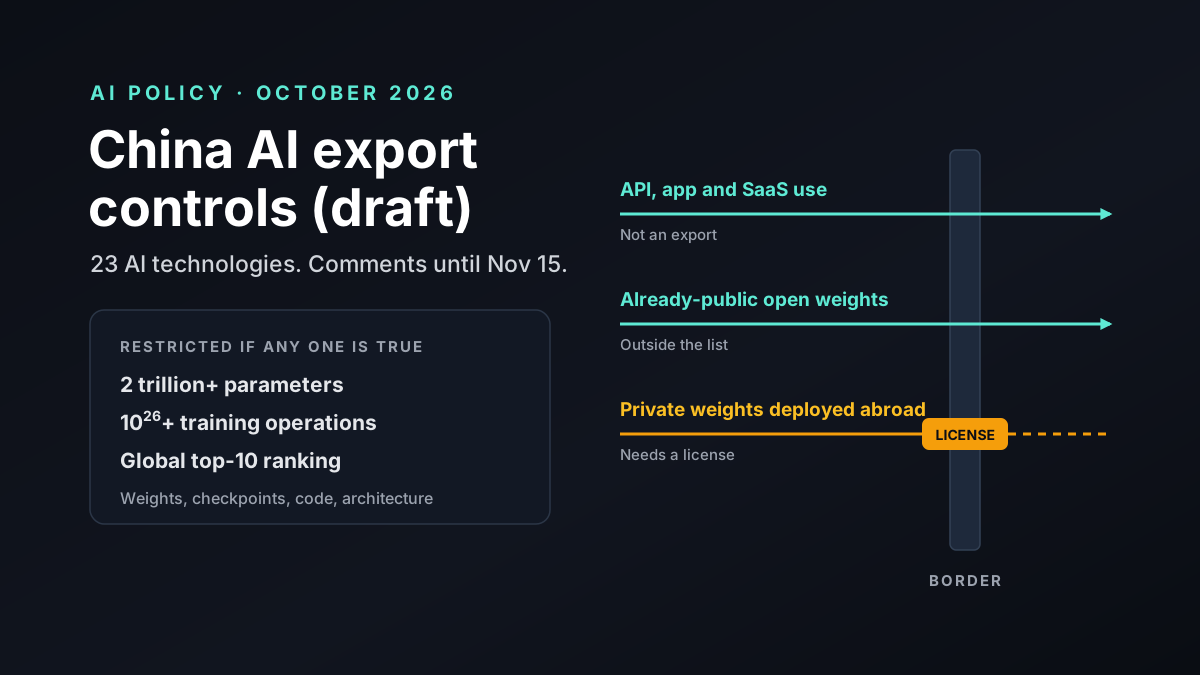
China plans to limit or ban exports of 40 technologies, 23 of them in AI, under a draft published on October 16, 2026. The draft would cover AI models with at least 2 trillion parameters, 10^26 training FLOPs or a global top-10 ranking, including their weights and code. But it leaves out tech that's already open source, and it doesn't count API use as an export. For most teams using Chinese models today, little changes yet.
Key Takeaways
- China's commerce and science ministries proposed adding 40 technologies to the country's export control catalog: 14 to be banned and 26 to be restricted.
- Twenty-three are in AI, covering large models, agents, compute clusters and data processing.
- Models above 2 trillion parameters, 10^26 training FLOPs or a global top-10 ranking could need a license to export their weights, checkpoints, code and architecture.
- Technology already public through open source or papers is exempt, and API, app and SaaS use don't count as exports.
- It's a draft. Comments close on November 15, 2026, and the final rules could change.
China's AI Export Controls at a Glance
| Item | What the draft says |
|---|---|
| Published | October 16, 2026, as a draft for public comment |
| Issued by | Ministry of Commerce and Ministry of Science and Technology |
| Technologies added | 40 in total: 14 banned, 26 restricted |
| AI technologies | 23, across large models, agents, compute clusters and data processing |
| Model thresholds | 2 trillion parameters, 10^26 training FLOPs or a global top-10 ranking |
| What's covered | Weights, checkpoints, source code, architecture and training or inference methods |
| Main exemptions | Already-public open source and papers; API, app and SaaS use |
| Comment deadline | November 15, 2026 |
The draft updates China's list of technologies that are banned or limited for export. That list decides what Chinese firms need permission to sell or send abroad.
How AI Export Controls Work in Plain Terms
An export control is a rule that says what a country's companies can send abroad. It isn't only about goods in boxes. Code, model files and know-how count too.
China keeps a list for this. Items on it fall into two groups:
- Banned: the item can't leave the country at all.
- Restricted: the item can leave, but only with a license from the government, which looks at who is buying it, which country it's going to and what it will be used for.
Getting a license means filing papers that say who gets the item, where it's going and what it's for. Some cases get an automatic license, which means the filing is a formality. Others need a real review, which can take weeks.
The draft adds AI items to this list for the first time at this scale. Until now, most AI export rules in the news came from the United States, aimed at stopping chips going to China.
What China's AI Export Controls Would Cover
The AI items fall into two tiers. According to the Associated Press, Global Times and The Decoder, they include:
Proposed bans:
- Core tech for large models trained on China's most sensitive national data.
- AI agents built for defense, key public systems and core government work.
- AI tools that can write or change malware on their own to attack critical infrastructure, the military or government agencies.
Proposed restrictions:
- Core tech for large models above the size or skill thresholds.
- AI tools for finding software vulnerabilities.
- Some AI data tools, and tech that can tell who is speaking from their voice.
The commerce ministry said the rules aim to protect "the security bottom line," stop misuse and keep AI under human control. A spokesperson also said the update is routine and doesn't target any one country.
Which Models Cross the Thresholds?
A model falls under the core-technology rule if it meets any one of three tests, according to The Decoder's reading of the draft:
- Training compute: at least 10^26 math operations used to train it.
- Size: at least 2 trillion parameters.
- Ranking: a place in the global top 10, based on public rankings from Chinese and foreign evaluators.
The draft doesn't name any models. The Associated Press notes that Moonshot's Kimi K3 and Alibaba's Qwen 3.8-Max are both above 2 trillion parameters. Other recent Chinese models sit close to the line, and the ranking test could catch a smaller model if it scores well enough.
For comparison, the 10^26 figure is the same compute line the United States used for model weights in its January 2025 AI diffusion rule, which it later withdrew. Commentators have called the Chinese draft a mirror image of the US approach.
What's Exempt From China's AI Export Controls
This is the part that matters most for teams outside China, and it's where early headlines went too far. The draft carves out several common cases:
- Public open source: Global Times reports the draft says tech that's already public, through open source, papers or other means, is outside the list.
- API and app use: using a restricted model through an API, an app, a website, a SaaS tool or a small on-device version isn't an export, according to reports on the ministry's notes.
- Automatic licenses: The Decoder reports that some cases get a license as soon as the papers are filed. These include open-sourcing a model, running it in a firm's own data centers abroad, and joint research with foreign partners.
What does count is putting a restricted model on servers abroad. Selling private weights to a foreign firm, or setting them up on servers outside China, would need a license.
There's also a filing step now. China AI Dispatch reports that a notice issued with the draft already makes Chinese firms file with the commerce ministry before they sell large-model weights to a foreign buyer. The author reads that as a formality for open releases.
Will This Lock Up China's Open Models?
Not on the current text. Kimi K3 already has public weights. China AI Dispatch argues both Kimi K3 and the Qwen 3.8 family are already public and so exempt. Public weights stay public, and API access isn't an export.
The open question is the future. If a Chinese lab trains a new model above the thresholds, does open-sourcing it still get an automatic license? The reports say yes, after a filing.
But a filing is also a checkpoint. A government that sees every release before it happens can, in principle, slow one down.
There's a simple reason Beijing may want open models to keep flowing. Chinese open models are used by developers around the world, and that reach brings influence, feedback and talent. Shutting them off would hand that ground back to US labs.
Our read is that the draft is built to keep China's open-model strategy alive while giving Beijing visibility and a brake. That's worth watching, but it's not a ban on open models.
Is This the First Time China Has Controlled AI Exports?
No, though the headline framing suggests it. China updated the same list in August 2020. It added AI items then too, such as the code that picks what to show each user and AI chat interfaces. That change gave Beijing a say in the planned sale of TikTok's US business, since ByteDance needed a license to transfer the technology.
What's new in 2026 is the target. The earlier list covered specific AI features. This draft goes after large models, agents and the compute behind them, the same layer the United States has tried to control from the other side.
How China's Rules Compare With US Controls
The two countries now control AI from opposite ends. The US has mostly limited what goes into China. China's draft limits what comes out.
| Point | United States | China's 2026 draft |
|---|---|---|
| Main target | Advanced chips and chipmaking tools, since 2022 | Large models, agents, chip design and solar know-how |
| Model weights | Covered in the January 2025 diffusion rule above 10^26 FLOPs, later withdrawn | Covered above 10^26 FLOPs, 2 trillion parameters or a top-10 ranking |
| Open weights | Published weights were left out of the 2025 rule | Already-public open source is outside the list |
| Status | Chip rules in force, weight rule withdrawn | Draft, with comments open until November 15 |
Both sides draw the line in a similar place, at the largest and most capable models, and both spare open releases. That may be the clearest sign that the two governments see the same risks, even as they compete.
Chips, Solar and Biotech Are on the List Too
AI gets the headlines, but the list reaches further. Global Times counts 12 solar and 5 biomedicine items alongside the 23 AI ones, and the AI group itself reaches into hardware:
- Chips: design technology for 2.5D and 3D AI chips and for 3D flash memory would be restricted.
- Solar: 12 items on how to make the silicon, wafers and cells that go into solar panels. One newer type of solar cell tech, perovskite, would be banned, and another, known as HJT, limited.
- Biomedicine: 5 items, including cell and gene work and some new kinds of drugs.
The solar items may matter as much as the AI ones. China makes most of the world's solar parts, so limits on how-to knowledge could slow other countries trying to build their own.
Why China Is Doing This Now
The timing is notable. The AP reports the draft came as China and the US made progress in talks on AI safety and on setting up a way to notify each other of AI incidents that could threaten national security. We covered what shared testing between the two would take in our piece on the US-China AI agreement.
Analysts quoted by the AP offered two readings:
- A response to the West. Lian Jye Su of Omdia said it can be seen as a reply to Western countries setting sovereignty requirements on AI, robots and telecoms.
- A more fragmented world. Gary Ng of Natixis said the world is splitting not only in trade and investment but also in access to technology.
The AP also noted a US case. In June, the US Commerce Department asked Anthropic to stop foreign nationals from using its Fable 5 and Mythos 5 models, citing national security. Those limits were later lifted. Both governments now treat their top models as strategic assets.
Who Is Most Affected?
The rules hit some groups much harder than others. Here's how we see it:
- Chinese AI labs carry most of the load. They'll need to file before sharing large models abroad, and to think about the rules before each big release.
- Foreign firms with private deals come next. If you license a custom model from a Chinese vendor to run on your own servers, expect a license step.
- Cloud and hosting firms outside China may see fewer Chinese partners setting up local copies of top models.
- Developers using public weights are mostly fine. Weights that are already out stay out.
- App builders using APIs are the least affected, since API use isn't an export.
- Researchers working with Chinese labs may get automatic licenses, but should still expect paperwork.
What China's AI Export Controls Mean for Your Team
Here's how we'd sort the common cases, based on the draft as reported. These are our readings, not legal advice.
| What you do | Likely affected? | Why |
|---|---|---|
| Call a Chinese model through its API | No | API, app and SaaS use isn't treated as an export |
| Download and run already-public open weights | No | Public open-source technology is outside the catalog |
| License private or custom weights from a Chinese vendor | Yes | Sending a restricted model abroad needs a license |
| Have a Chinese partner deploy a large model on your servers | Yes | Overseas local deployment counts as an export |
| Run joint research with a Chinese lab | Possibly | May get a license as soon as you file |
The biggest effect may be on future plans, not current ones. If you're counting on a next-generation Chinese model being released openly, or on a private enterprise deal for one, build in time for a license step.
How to Prepare Your AI Stack
You don't need to change anything today, but a few steps will make you ready for the final rules:
- List your Chinese model dependencies. Note which you use by API, which you self-host from public weights and which come from private deals.
- Save the weights you rely on. If a public model is central to your product, keep your own copy and record its license and version.
- Keep your stack portable. A routing layer and your own test set let you swap models if access changes. Our model portability lesson explains how.
- Check contracts with Chinese vendors. Ask who handles export filings and what happens if a license is denied or delayed.
- Watch the final text. The thresholds, exemptions and the top-10 test could all change after November 15.
If you're weighing Chinese open models against each other, our Qwen vs DeepSeek vs Kimi comparison covers how they stack up for agents and coding.
What to Watch Next
- The final list: whether the open-source and API exemptions survive the comment period, which ends on November 15 and may bring changes from Chinese firms that want more room to sell abroad.
- The top-10 test: which rankings count.
- Future open releases: whether new models above the thresholds still ship with public weights.
- The US response: whether Washington adjusts its own controls on chips or model weights in return.
- Company behavior: whether Chinese labs start holding back their largest models or moving work to overseas data centers.
China AI Export Controls: Our Take
China's draft is a real shift. For the first time, Beijing is treating its frontier models, not just chips or apps, as technology it can hold back. The thresholds are clear, and they reach the top Chinese models today.
But the early alarm goes too far. China's open models aren't being locked up. On the current text, public weights stay public, API use isn't an export, and open-sourcing gets an automatic license. What changes is visibility and control over what comes next.
For AI teams, the practical response is the same as for any supplier risk. Know what you depend on, keep copies of what you can, and make it easy to switch. We'll update this post when the final rules come out after the comment period closes on November 15. If the open-source exemption changes, we'll flag it at the top.
How Van Data Team Helps Teams Manage Model Risk
We help companies build AI systems that don't break when a vendor, a model or a rule changes. That means mapping your model dependencies, testing alternatives on your own data, setting up routing so you can switch quickly, and keeping records that satisfy legal and compliance teams.
If export rules or supplier risk are on your list this quarter, our AI governance guide is a good place to start.

Founder of Van Data Team. Builds Vanaxity, the AI agent system for SEO, GEO, and AEO, and leads data engineering delivery for B2B teams.
About the authorArticle FAQ
Questions readers usually ask next.
These short answers clarify the practical follow-up questions that often come after the main article.
Need a similar system?
If this article maps to a workflow your team already operates, the next step is usually a scoped review of the system, constraints, and rollout path.
Consultation
Scope your next AI workflow.
Share the system and blockers. We will map fit, gaps, and the next step.