August 12, 2026
Muse Glimmer: The Reported Local Agent Model, Reviewed
Muse Glimmer guide for production teams: compare workflow fit, risk, cost, review burden, and deployment guardrails before shipping.
Article focus
Verdict — Is Muse Glimmer ready for production? No—not on reported specifications alone. Muse Glimmer is ready for workload-specific evaluation, but production deployment requires evidence that it meets the workload's quality, latency, safety, operating, observability, and.
Section guide
Verdict — Is Muse Glimmer ready for production?
No—not on reported specifications alone. Muse Glimmer is ready for workload-specific evaluation, but production deployment requires evidence that it meets the workload's quality, latency, safety, operating, observability, and governance gates.
Key Statistics
| Key statistic | Reported value |
|---|---|
| Quantized VRAM fit | About 24 GB of VRAM for four-bit-class variants |
| DFlash speedup | Approximately 210% above baseline—the arithmetic equivalent of the reported 3.1x speed—on an NVIDIA RTX 5090 |
VentureBeat describes Muse Glimmer as an open-weights multimodal model from Meta for local agent loops. The reported design combines vision, tool use, and consumer-GPU deployment, potentially giving AI, ML, and platform engineers a path around costly cloud calls, data leaving their environment, and vendor lock-in. This guide provides an evaluation and adoption framework to test whether the model meets each workload's quality, latency, safety, and operating needs.
Key Takeaways
- Private multimodal agent loops are now practical on local hardware, but hardware fit doesn't prove production fit.
- Quantization addresses memory pressure, while the reported DFlash speculative-decoding approach is intended to reduce generation delay inside multi-step loops.
- Reported benchmarks are useful screening evidence, not a substitute for tests on your tools, documents, and failure paths.
- Local inference favors sensitive, steady workloads; cloud APIs favor frontier capability, elastic demand, and low serving burden.
- Production use still requires traces, restricted tool access, approval gates, fallbacks, and rollback.
At Van Data Team, we start with the workflow, data boundary, permissions, review gates, and recovery path. Our AI and data engineering services turn those findings into an eval plan and delivery scope. A model is one component in that operating system.
For years, local candidates often failed either the quality gate or the loop-latency gate. The reporting changes the shortlist, not the acceptance bar. The practical question is whether the described model package, runtime, and controls work together under your actual load.
Use this local-agent adoption matrix before choosing a runtime or framework. Define each pass condition from your workload, risk level, and target hardware.
| Gate | Local tends to fit when | Cloud tends to fit when | Evidence required |
|---|---|---|---|
| Data boundary | Inputs, images, payloads, and traces must stay controlled | Approved provider handling meets policy | Reviewed data-flow map |
| Task quality | A local candidate meets the workload standard | Frontier capability is essential | Labeled task results |
| Tool reliability | Local tool calls pass recovery tests | A managed model is more reliable | Step-level traces |
| Multimodal quality | Local vision works on your material | Hosted vision performs materially better | Gold answers and error samples |
| Performance | Target hardware meets the loop budget | Demand is bursty or highly variable | End-to-end measurements |
| Economics | Utilization can justify owned infrastructure | Usage is light or unpredictable | Full workload cost model |
| Observability | Your team can own traces and alerts | Managed telemetry is sufficient | Trace samples and dashboards |
| Governance | You can operate permissions and rollback | Managed serving lowers the operating burden | Threat model and runbook |
What Did Meta Ship With Muse Glimmer?
Secondary coverage describes an open-weights vision-language agent model intended for local, multi-tool workflows. VentureBeat reports that Meta made Muse Glimmer available as a 30-billion-parameter model under Apache 2.0, distilled from Muse Spark.
A vision-language model, or VLM, accepts both visual and textual input. MarkTechPost describes the reported model as using a dedicated perception encoder for screenshots, charts, documents, and images. The coverage portrays its training as spanning planning, tool use, observations, and follow-up actions. A Hugging Face post says its training data spans more than 100 languages.
Assuming the 30B parameter release described in secondary coverage, teams can download and run the model parameters. An open-weights distribution isn't the same as a hosted API, and it doesn't make every training detail open. Teams should still review the license, model card, dependencies, and distribution obligations.
A Hugging Face post lists support across Transformers, llama.cpp, and vLLM. VentureBeat reports compatibility with OpenClaw and Hermes agent scaffolds. For a concrete llama.cpp smoke test, point llama-cli at the downloaded four-bit model artifact:
llama-cli --model muse-glimmer-30b-q4
Use the actual local artifact name or path supplied by the chosen build. That reported packaging matters because an agent model needs serving, tool schemas, state, retries, and traces around it.
VentureBeat's coverage presents the intended positioning in broader terms:
Paraphrased positioning: an open agentic model intended to run on user-controlled hardware.
How Does It Run on One Consumer GPU?
The following illustration summarizes two optimizations make the local loop viable:
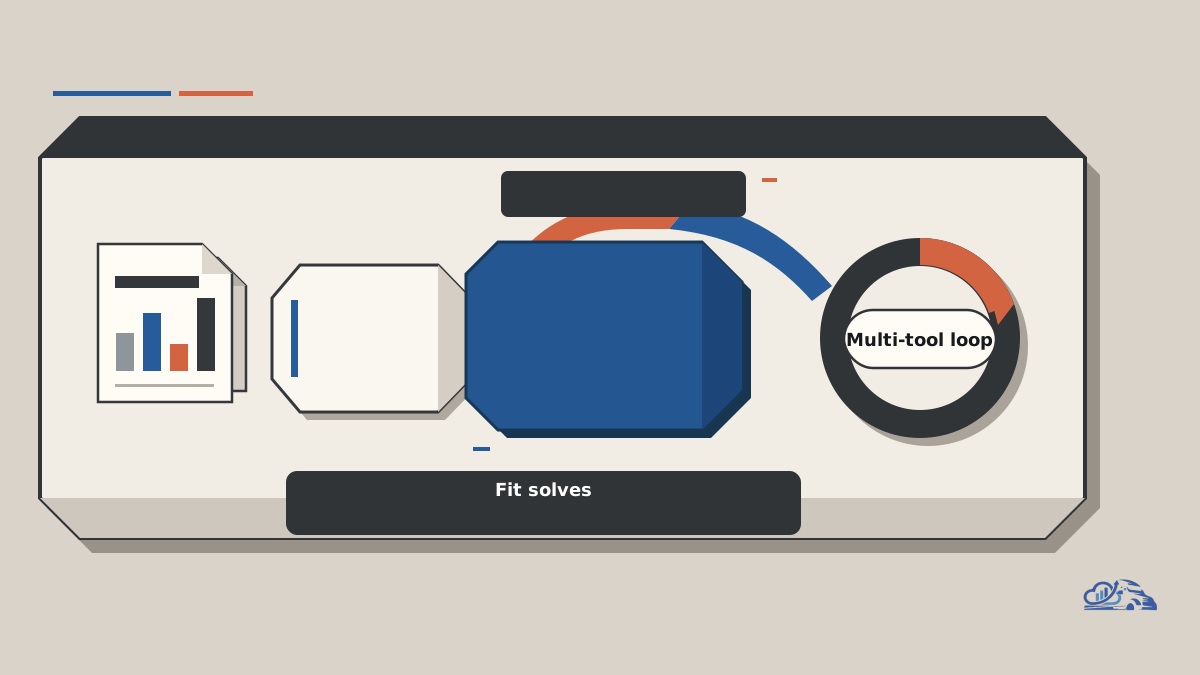
Secondary coverage attributes the claimed single-GPU fit to a split vision-text architecture, lower-precision weights, and faster decoding. MarkTechPost reports an approximate 2-billion-parameter Vision Transformer perception encoder with a 28-billion-parameter text decoder. Teams should verify that precise split against an official model card if one becomes available.
In the reported design, the perception encoder turns visual input into representations the text decoder can reason over. The decoder then plans, selects tools, interprets observations, and produces the next action. This architecture would keep vision native to the loop instead of relying on a separate optical character recognition step.
Quantization stores model weights at lower numerical precision to reduce memory use. It can also change quality or runtime behavior. MarkTechPost says the available four-bit-class variants are intended to fit in about 24 GB of VRAM. A Hugging Face post lists BF16 weights, GGUF k-quants, and ExecuTorch builds for different deployment paths.
DFlash addresses a different reported constraint: waiting for generated tokens. Speculative decoding lets a smaller drafter propose output that the main model verifies. MarkTechPost describes DFlash as an ICML 2026 speculative-decoding method. The outlet reports about a 3.1x speed increase on an NVIDIA RTX 5090, with smaller gains on Apple M-series hardware.
Quantization and speculative decoding solve different bottlenecks. Quantization makes the weights fit; DFlash tries to shorten generation. Neither fixes slow retrieval, tool execution, oversized prompts, or serial approval queues. Profile each stage because the model may not be the main source of delay.
That reported speed matters because agent latency compounds. A loop may plan, call a tool, inspect the result, retry, and ask for approval. Small pauses at each stage can make the workflow feel blocked. Measure wall-clock task completion, not only token-generation speed.
Coverage describes intended visual inputs as documents, charts, screenshots, and images. Treat any claim about video understanding without audio as provisional until an official model card confirms it.
What Do the Reported Benchmarks Show?
The published secondary coverage reports broad strength across tool use, research, assistant tasks, and software engineering. MarkTechPost's technical coverage reports Muse Glimmer as the leader on the listed evaluations.
| Benchmark | Reported result | What it helps screen |
|---|---|---|
| MCP Atlas | Reported score: 75.5 | Multi-tool agent behavior |
| DeepSearch QA | Reported score: 74.6 | Research-oriented question answering |
| Gaia2 | Reported score: 43.3 | General assistant workflows |
| SWE-Bench Pro | Reported score: 51.2 | Software-engineering tasks |
Van Data Team hasn't independently reproduced these figures. If an official model card becomes available, check its prompts, tool setup, scoring rules, hardware, and later revisions.
A leaderboard result can qualify a model for testing. It cannot prove reliable function arguments, recovery after a bad observation, or accurate reading of your private charts. Those behaviors belong in a workload eval.
When Does a Local Model Beat a Cloud API?
A local model beats a cloud API when data control, steady utilization, runtime control, or provider independence matters more than peak capability. This is a workload decision, not a universal model ranking.
The reported release details summarize what secondary coverage says was made available. The guidance in this section is Van Data Team analysis. Local inference keeps prompts, images, tool payloads, and traces within an environment you control. It also removes a recurring per-token API charge.
Local isn't free. Hardware, power, utilization, deployment work, maintenance, and on-call time still count. A cloud API may be the better choice for frontier reasoning, elastic bursts, managed availability, or teams that don't want to serve models.
Latency also cuts both ways. Local execution removes a network boundary, but slow hardware or poor serving can erase that gain. Compare complete tasks under the same token budget, retry policy, and tool set. Include observability and evaluation effort in the decision.
A hybrid route is often cleanest. Keep sensitive or steady work local, then route approved hard cases or bursts to a cloud model. The router needs explicit policy, traceability, and a safe response when either path fails.
This approach also suits edge AI environments with limited or unreliable connectivity. However, offline inference still needs local retrieval, secrets handling, updates, and failure recovery. A local model doesn't remove those dependencies.
Assuming the 30B parameter release, the model can sit behind LangGraph, LangChain, CrewAI, native function calling, MCP, or a Plan-and-Execute pattern. Those layers don't fix weak model behavior. They shape state, tools, retries, and review, which makes failures easier to detect and recover.
Consider a hypothetical private-document workflow. Maya's platform team needs an agent to read internal charts, retrieve reports, and draft an analyst note. The local candidate passes its accuracy and tool tests while keeping source material inside the environment. The team uses cloud inference only for approved escalations that need stronger reasoning.
How Should Teams Evaluate a Local Agent Model?
Teams should evaluate a local agent on representative end-to-end work, using predefined acceptance gates and full traces. At Van Data Team, we start by defining a successful trace and the failure states that must block release.
Build the eval set from real document shapes, screenshots, charts, retrieval results, and tool payloads. Remove sensitive values when the test environment requires it. Include normal cases, ambiguous inputs, malformed tool results, permission failures, and recovery paths.
Hold the scaffold constant across candidates. Use the same prompts, tools, schemas, retry policy, token budget, context, and completion rules. Compare the reported Muse Glimmer candidate with relevant Qwen, DeepSeek, or Kimi candidates and cloud APIs. Our Qwen vs DeepSeek vs Kimi comparison offers broader open-model context, but this decision needs your workload data.
Measure the following dimensions separately:
- Task completion: Did the workflow produce the required business outcome?
- Tool reliability: Did it choose the right tool, form valid arguments, and recover cleanly?
- Multimodal quality: Did it read your layouts, charts, screenshots, and document details correctly?
- Performance: What were end-to-end latency, throughput, memory pressure, and stability on target hardware?
- Economics: What do hardware, power, utilization, maintenance, and avoided API charges imply?
- Trace quality: Can operators inspect plans, calls, tokens, retries, errors, and final outcomes?
Run repeated trials to expose unstable behavior. Test cold starts, long inputs, concurrent work, tool timeouts, and corrupted observations. Re-run the suite after changing weights, quantization, prompts, runtime, or tool schemas. Deployment is ready only when regression evidence and rollback steps are both available.
Use the adoption matrix above as the decision record. Set workload-specific pass conditions before reviewing results. Don't hide critical failures inside one average score. Group failures by tool selection, arguments, vision, retrieval, reasoning, permissions, and recovery.
Consider a hypothetical coding-agent test. Ravi's team asks each candidate to inspect a repository, edit a file, run tests, and request approval before a consequential change. One model reaches the final answer but repeats a tool after a malformed observation. A top-line success label misses that risk; the step trace exposes it.
For a concrete next step, Van Data Team can scope the evaluation workflow and deliver a data-flow map, labeled eval plan, risk review, trace design, and implementation scope.
How Do You Govern an On-Prem Agent?
An on-prem agent is safe only when its tools, credentials, data paths, and actions are governed. Local inference changes the data boundary. It doesn't make model output trustworthy or limit what connected tools can do.
Sandbox tool execution and grant least-privilege credentials. Restrict network and filesystem access by default. Require human approval before sending messages, changing production data, merging code, or updating a system of record. Our guide to designing AI agents with human review shows where those gates belong.
Record the prompt version, model package, retrieved sources, tool calls, arguments, outputs, approvals, and final result. Protect secrets and redact sensitive trace fields. Add timeouts, retry ceilings, fallbacks, escalation paths, and rollback procedures. The production agent operations playbook covers this control loop in more depth.
The mistake we see is treating local deployment as the security control. It is only one control. A private model can still delete the wrong file, expose data through an allowed network call, or repeat a costly action. Governance must cover the whole agent loop.
The Adoption Decision
Secondary coverage presents Muse Glimmer as a candidate that could expand the set of private multimodal workflows running on local hardware. That reporting doesn't establish that it replaces every cloud model, and a claimed consumer-GPU fit isn't a production-readiness certificate.
Start with one bounded workflow. Map its data, tools, decisions, and consequences. Then define acceptance gates, run local and cloud candidates under the same conditions, and inspect every failure class. Ship only when quality, latency, economics, observability, and governance meet the workload's standard.
The durable advantage isn't owning model weights. It is owning the evidence and controls around the agent loop. Explore more Van Data Team engineering guides, or bring us a target workflow for a scoped evaluation and delivery plan.
Article FAQ
Questions readers usually ask next.
These short answers clarify the practical follow-up questions that often come after the main article.
Need a similar system?
If this article maps to a workflow your team already operates, the next step is usually a scoped review of the system, constraints, and rollout path.
Free scoping session
Test Muse Glimmer for Your Workload
Map Muse Glimmer against your hardware, privacy, agent-loop, and governance needs, then leave with clear local-versus-cloud next steps.
- A local-versus-cloud decision matrix for your workload
- A task-specific benchmark and evaluation plan
- Consumer-GPU memory and latency test criteria
- Tool-access, observability, and approval guardrails
- A prioritized adoption plan with concrete next steps
Related articles
View all
What Happened to OpenAI Operator?
OpenAI's Jalapeño Chip: First Inference Benchmarks
VS Code Multi-Agent Orchestration: What GitHub and VS Code Sources Describe