Claude Fable 5.2 vs Opus 5.5, GPT-6 Astra and Mythos 5.2
Fable 5.2 vs Opus 5.5, Fable 5.1, GPT-6 Astra and Gemini 4 Carbon, plus Mythos 5.2 vs GPT-6 Cyber: benchmarks, prices and which Claude model to use today.
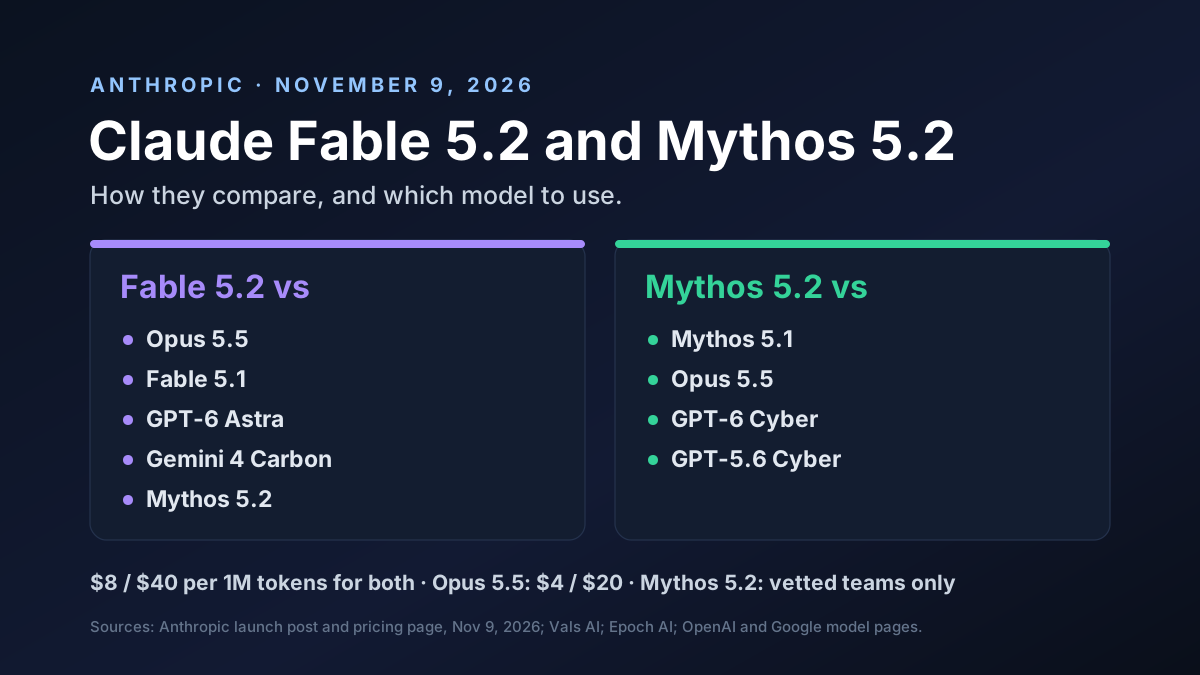
Anthropic released Claude Fable 5.2 and Claude Mythos 5.2 on November 9, 2026. Fable 5.2 is now its most capable model open to everyone, and it costs 20% less than Fable 5.1. Mythos 5.2 is the same model with fewer safety blocks, for vetted security and science teams.
This guide compares Fable 5.2 with the five models people weigh it against most: Opus 5.5, Fable 5.1, GPT-6 Astra, Gemini 4 Carbon and Mythos 5.2. It then compares Mythos 5.2 with Mythos 5.1, Opus 5.5, GPT-6 Cyber and GPT-5.6 Cyber. Each pair links to a full side-by-side page in our AI model comparison tool.
Disclosure and scope: Van Data Team builds AI systems for clients on models from Anthropic, OpenAI and Google, and we have no paid ties to any of them. We drafted this with help from Anthropic's Claude. Most scores below come from the vendors themselves, and we say so each time.
Where we found an independent test, from Epoch AI or Vals AI, we show it next to the vendor's numbers. We label our own math.
Key Takeaways
- Fable 5.2 leads most tests in Anthropic's launch table, from coding and computer use to long knowledge work.
- It's cheaper: $8 and $40, down from $10 and $50.
- Opus 5.5 is still the default. It costs half as much.
- Rivals win some tests: Gemini 4 Carbon leads AutomationBench, and GPT-6 Astra leads Epoch's GPQA Diamond.
- Mythos 5.2 is for vetted teams only.
- Security models are hard to rank, since Mythos 5.2, GPT-6 Cyber and GPT-5.6 Cyber are each scored on their maker's own tests and nobody has tested all three the same way.
Fable 5.2 and Its Rivals at a Glance
| Model | Released | Price per 1M tokens (in / out) | Access |
|---|---|---|---|
| Claude Fable 5.2 | Nov 9, 2026 | $8 / $40 | Open to all |
| Claude Mythos 5.2 | Nov 9, 2026 | $8 / $40 | Vetted organizations only |
| Claude Opus 5.5 | Sep 22, 2026 | $4 / $20 | Open to all |
| Claude Fable 5.1 | Sep 1, 2026 | $10 / $50 | Open to all, now legacy |
| GPT-6 Astra | Sep 3, 2026 | $10 / $50 | Open to all |
| Gemini 4 Carbon | Oct 28, 2026 | $2 / $10 at launch | Limited, Fairwind Program |
All prices are list prices per million tokens. Fable 5.2 and Opus 5.5 both handle 1M tokens of context and up to 128,000 output tokens. Gemini 4 Carbon's $2 and $10 are launch rates, and Google says $4 and $20 apply later.
What's New in Fable 5.2
Anthropic lists four main changes from Fable 5.1:
- Lower price: $8 and $40 per million tokens, against $10 and $50
- More speed: up to 30% faster output, plus a fast mode that runs up to 2.5 times faster at $16 and $80
- Fewer blocks: about 55% fewer blocked requests than Fable 5.1 in early testing
- Big score gains: FrontierCode 2.0 rose from 32.4% to 49.1%, and the Remote Labor Index from 17.9% to 41.3%
If you already run Fable 5.1, the upgrade is the easy call: it's better, it's cheaper, and Anthropic now lists 5.1 as a legacy model. See the Fable 5.1 vs Fable 5.2 comparison for every number.
Fable 5.2 vs Opus 5.5: Worth Twice the Price?
This is the question most teams ask. Opus 5.5 costs $4 and $20 per million tokens, half the price of Fable 5.2. Anthropic calls Opus 5.5 its "strongest daily driver" and tells users to start there.
Fable 5.2 wins on almost every test in Anthropic's table. The gaps are largest on long, open-ended work. On the Remote Labor Index, which uses real freelance jobs, Fable 5.2 scores 41.3% against 21.3%. On coding, the gap is smaller: 49.1% against 45.5% on FrontierCode 2.0.
Effort matters here too. Anthropic says Fable 5.2 at high effort scores 45.3% on FrontierCode, about the same as Opus 5.5's best. So you may get Opus-level coding from Fable at a lower setting.
There's also a usage angle. On Pro plans and standard Team seats, Fable can use up to half of the weekly usage limit, so plan which tasks deserve it.
Our read: keep Opus 5.5 as the default, and send only your hardest tasks to Fable 5.2. Compare them line by line on our Fable 5.2 vs Opus 5.5 page.
Fable 5.2 vs GPT-6 Astra
GPT-6 Astra is OpenAI's frontier model. On price, Fable has the edge:
- Astra: $10 and $50 per million tokens
- Fable 5.2: $8 and $40, so 20% cheaper
- Long prompts: OpenAI rebills a whole Astra request at $20 and $75 once it crosses a size threshold
On Anthropic's table, Fable 5.2 leads Astra on every shared test. Independent numbers tell a closer story:
| Independent test (Epoch AI) | Fable 5.2 | Opus 5.5 | GPT-6 Astra | Fable 5.1 |
|---|---|---|---|---|
| GPQA Diamond | 93.9% | 90.6% | 95.8% | Not measured |
| FrontierMath Tiers 1 to 3 | 95.1% | 91.2% | 93.7% | 90.2% |
| SimpleQA Verified | 94% | 72.2% | 75.6% | 70.8% |
Epoch AI's tests show Fable 5.2 ahead on math and on fact recall, and Astra ahead on GPQA Diamond, a test of expert science questions. Astra also reports very strong long-context recall. See the Fable 5.2 vs GPT-6 Astra page for the full set.
Fable 5.2 vs Gemini 4 Carbon
Gemini 4 Carbon was Google's strongest model at its October 28 launch. It's built for cyber defense and long engineering tasks. At $2 and $10 per million tokens during launch, it's by far the cheapest model here.
The catch is access. Google is giving Carbon to a small group of cyber defenders and partners through its Fairwind Program, with no public API yet. So for most teams, it's not a real option today.
On Anthropic's table, the two split the wins:
- Carbon leads on AutomationBench, 53.9% against 51.4%
- Fable leads on OSWorld 2.1, 89.3% against 81.5%
- Fable leads on FrontierCode 2.0, 49.1% against 41.1%
- Close call on Chartography, 73.4% against 72.5% Compare them on our Fable 5.2 vs Gemini 4 Carbon page.
Fable 5.2 vs Mythos 5.2: Same Model, Different Guardrails
Anthropic says Fable 5.2 and Mythos 5.2 are the same model. Both cost $8 and $40, and both scored nearly the same on Terminal-Bench-Science, 74.6% and 75.3%. The difference is what each one will do.
Fable 5.2 runs safety checks that block some requests. When it does, an older model answers instead:
- High-risk cyber work, such as penetration testing and exploit writing, goes to Opus 4.8
- Most research biology goes to Opus 5
- A small set of AI research topics, such as chip kernel tuning, can also fall back to Opus 5
Mythos 5.2 drops some of those checks. Only vetted groups can use it, through programs such as Anthropic's Cyber Verification Program. See the Fable 5.2 vs Mythos 5.2 page.
Benchmark Scores Side by Side
Here are the main rows from Anthropic's launch table, at each model's highest available effort:
| Test (Anthropic's table) | Fable 5.2 | Opus 5.5 | GPT-6 Astra | Gemini 4 Carbon | Fable 5.1 |
|---|---|---|---|---|---|
| FrontierCode 2.0 | 49.1% | 45.5% | 42.8% | 41.1% | 32.4% |
| FrontierSWE v2 | 69.9% | 62.3% | 65.5% | 61.2% | 56.3% |
| AutomationBench | 51.4% | 42.5% | 41.4% | 53.9% | 31.4% |
| Terminal-Bench-Science 0.1 | 74.6% | 58.7% | 68.1% | 64.8% | 52.6% |
| OSWorld 2.1 | 89.3% | 87.2% | 79.5% | 81.5% | 83.5% |
| Remote Labor Index | 41.3% | 21.3% | 20.8% | Not listed | 17.9% |
| Chartography | 73.4% | 64.4% | 71.0% | 72.5% | 44.8% |
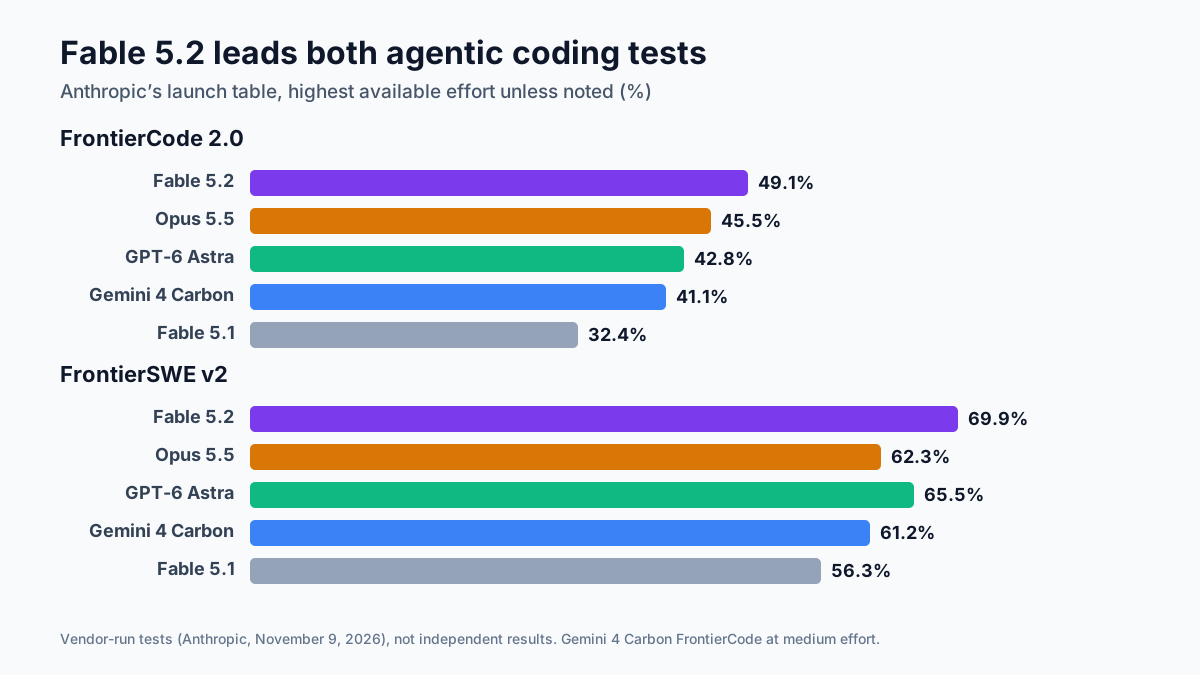
Two notes. First, Anthropic ran these tests, and it picked which ones to show. Second, an independent check agrees on the big picture: Vals AI ranks Fable 5.2 first of 36 models on its Vals Index, at 71.31%. Arena hadn't rated it yet when we wrote this.
Mythos 5.2 vs Mythos 5.1
Mythos 5.2 replaces Mythos 5.1, which came out on September 1. The upgrade covers both price and safety:
- Price: $8 and $40 per million tokens, down from $10 and $50
- Bug finding: 14.4% more vulnerabilities found on Anthropic's CVE Rediscovery test, 89.6% against 78.3%
- Sandbox escapes: used planted credentials in 3.1% of test cases, against 21% for Mythos 5.1 and 39% for Mythos 5
That last point matters most for security teams. A model that hunts for flaws should not try to slip out of its own test box. See the Mythos 5.1 vs Mythos 5.2 page.
Mythos 5.2 vs Opus 5.5 for Security Work
Opus 5.5 is open to everyone and costs half as much. But for security work, it isn't a fair match. Normal Claude products block much of that work, so most teams can't use Opus 5.5 for exploit research anyway.
Anthropic tested Opus 5.5 with its safeguards off, to compare raw skill. Here's what it found:
- CVE Rediscovery: Mythos 5.2 found 10.2% more vulnerabilities, 89.6% against 81.3%
- Sandbox escapes: about even, 3.1% against 3.3%
- Price: Opus 5.5 is half the cost, but it isn't cleared for this work See the Mythos 5.2 vs Opus 5.5 page.
Mythos 5.2 vs GPT-6 Cyber and GPT-5.6 Cyber
OpenAI has its own security models for approved teams. GPT-6 Cyber came out on November 5, built on GPT-6 Astra. GPT-5.6 Cyber came out in August, built on GPT-5.6 Sol. Here's how they line up with Mythos 5.2:
| Item | Mythos 5.2 | GPT-6 Cyber | GPT-5.6 Cyber |
|---|---|---|---|
| Released | Nov 9, 2026 | Nov 5, 2026 | Aug 10, 2026 |
| Price per 1M tokens (in / out) | $8 / $40 | $20 / $100 | $12.50 / $75 |
| Context window | 1M tokens | 1.05M tokens | 400K tokens |
| Who can use it | Vetted via Anthropic's verification programs | Approved Daybreak Red customers | Approved Daybreak Red customers |
| Headline vendor claim | 10.2% more CVEs found than Opus 5.5 | 48.5% on ExploitGym | 95.0% of advanced cyber requests completed |
Mythos 5.2 is the cheapest of the three by far, and it matches GPT-6 Cyber on context size. GPT-5.6 Cyber has a smaller 400K-token window.
Don't read the claims as a contest. Each lab tests on its own tasks, and Anthropic's table even notes that each lab's CyScenarioBench scores come from unique tasks.
Until an outside group tests all three the same way, compare them on your own approved work. Before you apply to any of these programs, check three things:
- Whether your work fits the program's rules
- How the vendor checks identity and logs use
- Which data the model can see during tests Start with our Mythos 5.2 vs GPT-6 Cyber and Mythos 5.2 vs GPT-5.6 Cyber pages.
Which Model Should You Use?
Here's our short answer for each kind of work:
| If you need | Start with | Why |
|---|---|---|
| A daily default for coding and knowledge work | Opus 5.5 | Half the price, and Anthropic's own pick |
| The hardest agent runs and long research tasks | Fable 5.2 | Top scores on most of Anthropic's tests |
| The lowest token price, if you have access | Gemini 4 Carbon | $2 / $10 at launch |
| Deep long-context retrieval | GPT-6 Astra | Strong reported long-context recall |
| Approved security research on Claude | Mythos 5.2 | Fable 5.2 skills with fewer cyber blocks |
| Exploit work inside OpenAI's program | GPT-6 Cyber | OpenAI's newest cyber model |
A simple routing rule works for most teams:
- Send routine tickets, drafts and reviews to Opus 5.5
- Move to Fable 5.2 after a failed attempt, or for multi-hour agent runs
- Log both, so you can see which tasks really needed Fable
Most teams will end up with two models: a cheaper default and a stronger one for hard cases. The split saves money without giving up quality where it counts.
Worked Example: What Fable 5.2 Costs per Task
Here's a simple cost model, using our own math and made-up numbers. Take a coding agent task that reads 200,000 tokens and writes 20,000:
- Opus 5.5: $0.80 for input plus $0.40 for output, or $1.20
- Fable 5.2: $1.60 for input plus $0.80 for output, or $2.40
- Fable 5.1: $2.00 for input plus $1.00 for output, or $3.00
So Fable 5.2 costs twice as much as Opus 5.5 for the same tokens. It only pays off if it finishes tasks Opus fails, or needs fewer retries. If Fable solves one in five tasks that Opus gets wrong, and a wrong answer costs you more than a few dollars, the math tips its way.
Caching changes this a lot. Agents that replay a long prompt pay $0.20 per million for cache reads on both models. Test with your own prompts, because token counts vary with effort settings.
What the Benchmarks Don't Tell You
There are limits to every number in this guide:
- Vendor tests: most scores come from the model makers, on tests they chose
- Effort levels: each model can run at several settings, and results change with them
- Missing rows: Gemini 4 Carbon and the cyber models skip several tests
- New releases: Fable 5.2 is a day old, and more independent results will follow
So use these tables to build a short list, not to make the final pick. Then run your own tasks on two or three models and measure success rate, cost and time per finished task.
Fable 5.2: Our Take
Fable 5.2 is a clear step up from Fable 5.1, and it's cheaper. It's the strongest model you can buy from Anthropic today, and it leads most rivals on the tests Anthropic shows.
But Opus 5.5 is still the smarter default for most teams. Use Fable 5.2 where the work is long, hard and costly to get wrong. Mythos 5.2 matters only if you're a vetted security or science team, and for them, the lower price and lower sandbox escape rate are real gains.
How Van Data Team Helps
We help teams pick and run the right AI models for their work:
- Model trials on your own tasks, measuring cost and success per task, through AI agent development.
- Cost reviews for model and cloud spend, via our cloud cost optimization service.
- Live comparisons of 160 models in our AI model benchmarks hub.
Not sure whether Fable 5.2 is worth it for your team? Get in touch and we'll help you test it against Opus 5.5 on your real work.
AI Model Brief
The AI models worth knowing, once a week
What shipped, how it scores on independent benchmarks, what it costs per million tokens and what was deprecated, from the data behind our AI model benchmarks.
We use your address only to send the brief. See our privacy policy.
See this week’s brief
Founder of Van Data Team. Builds Vanaxity, the AI agent system for SEO, GEO, and AEO, and leads data engineering delivery for B2B teams.
About the authorAI model benchmarks
Models in this article
Current pricing, context window and independent scores for each model.
Article FAQ
Questions readers usually ask next.
These short answers clarify the practical follow-up questions that often come after the main article.
Need a similar system?
If this article maps to a workflow your team already operates, the next step is usually a scoped review of the system, constraints, and rollout path.
Consultation
Scope your next AI workflow.
Share the system and blockers. We will map fit, gaps, and the next step.