July 3, 2026
Claude Fable 5 vs GPT 5.6: Benchmarks, Cost, Access, and Best Use Cases
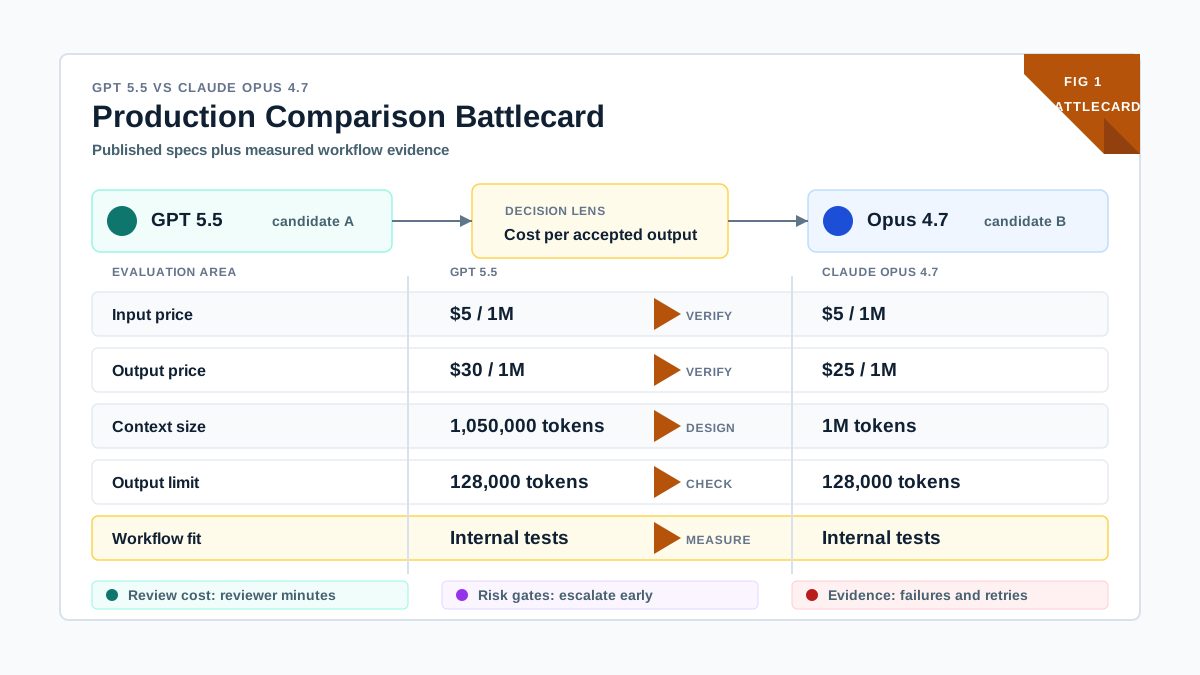
Claude Fable 5 Vs GPT 5.6 guide for production teams: compare workflow fit, risk, cost, review burden, and deployment guardrails before shipping safely.
Article focus
Claude Fable 5 vs GPT 5.6 is a production model-selection question, not a leaderboard question. In the supplied sources, GPT-5.6 Sol is presented as the stronger candidate for terminal-driven autonomous coding, while Claude Fable 5 is presented as the stronger candidate for.
Section guide
Claude Fable 5 vs GPT 5.6 is a production model-selection question, not a leaderboard question. In the supplied sources, GPT-5.6 Sol is presented as the stronger candidate for terminal-driven autonomous coding, while Claude Fable 5 is presented as the stronger candidate for repository-level software-engineering work and long-horizon coding workflows.
The buyer problem is simple: engineering, product, ops, and data teams need to know which model should touch which workflow, what it will cost, what review gates are required, and what happens when a preview-gated model is not available. At Van Data Team, we start by mapping the workflow before choosing the model: task intake, tool permissions, context retrieval, validation checks, escalation paths, and rollback behavior. That is the same operating lens we use in AI agent development, where model choice is only one part of a production agent system.
This guide gives you a practical comparison across the supplied benchmark, pricing, availability, safety, and implementation claims. The goal is not to crown a universal winner. The goal is to decide when to route work to GPT-5.6 Sol, GPT-5.6 Terra, GPT-5.6 Luna, Claude Fable 5, or a cheaper fallback if those are the models under evaluation.
Decision Matrix
A useful comparison should give a qualified operating verdict, not a universal winner. Treat each row as the first option to test, then validate it against your own workload and current source documentation.
| Reader need | Claude Fable 5 first test | GPT 5.6 first test | Evidence to collect |
|---|---|---|---|
| Highest quality on a narrow task | Test when its sourced strengths match the task | Test when its sourced strengths match the task | Accepted-output rate, reviewer edits, blocking failures |
| Cost-sensitive batch work | Test when accepted-output cost is lower after retries | Test when accepted-output cost is lower after retries | Tokens, cache hit rate, retries, reviewer minutes |
| High-risk production action | Use only if evidence handling and escalation pass | Use only if evidence handling and escalation pass | Failure logs, escalation rate, audit completeness |
| Platform fit | Prefer when it fits the team's auth, data, and tooling constraints | Prefer when it fits the team's auth, data, and tooling constraints | Integration effort, governance, observability, support path |
Key Takeaways
- GPT-5.6 Sol is the best sourced choice in the supplied materials for terminal-driven autonomous coding when preview access is available, with the cited GPT-5.6 source listing 88.8% on Terminal-Bench 2.1 and 91.9% for Sol Ultra.
- Claude Fable 5 is the best sourced choice in the supplied materials for repository-level software engineering, with Vellum reporting 80.3% on SWE-Bench Pro and 29.3% on Cognition's FrontierCode Diamond split.
- Access changes the recommendation: supplied GPT-5.6 sources frame the model family as preview-gated, while comparison sources describe Claude Fable 5 as available for current coding workflows.
- List price is not real project cost. Retries, output length, failed tool calls, review time, and rollback effort matter more than token price alone.
- Production teams should use model routing, not a single default model, with logging, permission boundaries, human review, and fallback paths.
Quick Verdict: Which Model Should You Use?
The practical verdict from the supplied materials is to choose GPT-5.6 Sol for terminal-driven autonomous work when access is available and Claude Fable 5 for repository-level issue resolution where long-context coding behavior matters.
| Use case | Best starting model | Why it fits | Caveat |
|---|---|---|---|
| Terminal-driven autonomous coding | GPT-5.6 Sol or Sol Ultra | The cited GPT-5.6 source lists 88.8% for Sol and 91.9% for Sol Ultra on Terminal-Bench 2.1. | Preview access may limit immediate rollout. |
| Balanced GPT-5.6 routing | GPT-5.6 Terra | Lushbinary reports GPT-5.6 Terra and Claude Fable 5 tied at 84.3% on Terminal-Bench 2.1. | Do not infer repository-level strength from this benchmark alone. |
| Repository-level engineering tickets | Claude Fable 5 | Vellum reports 80.3% on SWE-Bench Pro. | Higher-cost tasks need careful routing and review. |
| Large codebase reasoning | Claude Fable 5 | Vellum reports 1M context and 128K max output. | Context capacity still needs cost controls. |
| High-volume simple work | GPT-5.6 Luna | Lushbinary lists Luna at $1 input and $6 output per one million tokens. | Use for bounded work, not high-risk autonomous changes. |
A good Claude Fable 5 vs GPT 5.6 framework starts with the workload. Terminal benchmarks reward command execution, tool use, iteration, and subagent orchestration. Repository benchmarks reward issue understanding, codebase navigation, patch quality, and long-horizon consistency. Those are related skills, but they are not the same buying decision.
What These Models Are
The supplied materials present GPT-5.6 as a preview-stage model family with Sol, Terra, and Luna tiers, while Claude Fable 5 is positioned in the supplied sources as a long-horizon coding model for complex repository work.
GPT-5.6 Sol is framed as the flagship tier in the supplied materials. It is the model to test when your agent needs to run commands, inspect outputs, recover from failed steps, and coordinate tool-heavy work. Sol Ultra is presented as a higher-ceiling path for harder tasks, but it should be treated as a premium path, not the default route for every ticket.
Terra is described as the balanced GPT-5.6 tier. Luna is described as the lower-cost, high-volume tier. That makes the GPT-5.6 family more suitable for routing systems than for one-size-fits-all model selection. The mistake we see is treating "best model" as a static procurement label. In production, the better question is which model should handle this task type under this budget and review policy.
Claude Fable 5 is the stronger repository-level candidate in the supplied benchmark set. Its reported advantage shows up where an agent has to understand a large codebase, preserve intent across a long task, and produce patches that survive review. For teams building coding agents, data workflow agents, or automation copilots, that is often closer to the real workload than a standalone benchmark prompt.
This is also where Van Data Team's workflow-first stance matters. A model comparison should lead to an implementation plan: task classes, routing rules, eval sets, observability, review gates, and fallback behavior. Our broader AI and data engineering services are built around that operating model.
Benchmark Fit: Terminal Autonomy vs Repository Engineering
The supplied benchmark split is clear: GPT-5.6 Sol leads the cited terminal-autonomy data, while Claude Fable 5 leads the cited repository-engineering data.
For terminal-driven work, the cited GPT-5.6 source lists GPT-5.6 Sol at 88.8% on Terminal-Bench 2.1 and Sol Ultra at 91.9%. Lushbinary's comparison also reports that GPT-5.6 Terra and Claude Fable 5 tie at 84.3% on Terminal-Bench 2.1. That supports a practical route: reserve Sol for difficult terminal-style autonomous execution, and test Terra when you need a cheaper GPT-5.6 path.
For repository-level software engineering, Vellum reports Claude Fable 5 at 80.3% on SWE-Bench Pro. Vellum also reports Claude Fable 5 at 29.3% on Cognition's FrontierCode Diamond split, compared with Claude Opus 4.8 at 13.4% and GPT-5.5 at 5.7%. That is the strongest supplied evidence for Fable 5 as the repository-level coding candidate.
A practical example: a SaaS platform team wants an agent to fix flaky integration tests. The terminal-heavy part is running the suite, reading logs, installing missing packages, and iterating on failures. GPT-5.6 Sol is the first model to test under the supplied comparison. But when the same task turns into a repository-level issue involving domain models, migration files, and subtle backwards compatibility, Claude Fable 5 deserves a separate test lane.
Do not translate one benchmark into every decision. Terminal-Bench is useful for agentic command-line work. SWE-Bench Pro and FrontierCode are more relevant to codebase-level work. Your internal eval should include both types if your agent will do both.
Pricing, Access, and Source Freshness
Pricing and access can overturn the benchmark winner because a model that is cheaper or stronger on paper may still be unavailable, slower to approve, or more expensive after retries.
Lushbinary lists GPT-5.6 Sol at $5 input and $30 output per one million tokens, GPT-5.6 Terra at $2.50 input and $15 output per one million tokens, GPT-5.6 Luna at $1 input and $6 output per one million tokens, and Claude Fable 5 at $10 input and $50 output per one million tokens. Those prices make Sol look more economical than Fable 5 for many tasks, but preview-gated access changes the operational answer.
| Model | Token economics | Access posture | Production note |
|---|---|---|---|
| GPT-5.6 Sol | $5 input / $30 output per one million tokens | Preview-gated in supplied sources | Strong terminal candidate, but keep a fallback. |
| GPT-5.6 Terra | $2.50 input / $15 output per one million tokens | Preview-gated in supplied sources | Test for balanced routing when available. |
| GPT-5.6 Luna | $1 input / $6 output per one million tokens | Preview-gated in supplied sources | Best suited to bounded, high-volume work. |
| Claude Fable 5 | $10 input / $50 output per one million tokens | Available in comparison sources | Stronger repository candidate, but route selectively. |
Source freshness note: treat pricing, latency, rate limits, access rules, and safety throttles as procurement checks before rollout. The supplied benchmark data is useful for initial routing hypotheses. It is not a substitute for testing your own codebase, prompts, tools, and review workflow.
The cost mistake is looking only at token price. A cheaper model that fails repeatedly, over-edits files, or creates extra review work may cost more than a higher-priced model that produces a smaller, correct patch. For data pipeline engineering, we would measure cost per accepted pipeline change, not cost per prompt.
Safety, Permissions, and Deployment Review
Safety-sensitive autonomous work needs explicit tool boundaries because any high-capability model can become materially more powerful when connected to shells, browsers, repositories, secrets, and deployment systems.
The supplied GPT-5.6 safety source classifies the model family as high-capability in cybersecurity but below the critical threshold under tested conditions. It also reports that GPT-5.6 Sol is competitive with Claude Mythos Preview on ExploitBench while using about one-third of the output tokens.
The supplied safety source places GPT-5.6 Sol in a high-capability cybersecurity category while saying it remains below that source's critical threshold.
That sentence matters for production teams. A coding agent is not just a text generator. It can run commands, inspect files, make changes, call APIs, and create deployable artifacts. The deployment risk comes from the model plus tools plus permissions plus missing review, not the model alone.
For either GPT-5.6 or Claude Fable 5, require human approval before production code changes merge. Log prompts, model versions, tool calls, file diffs, test results, policy checks, and reviewer decisions. Keep a fallback path when a model refuses a legitimate request, loses access, exceeds budget, or produces a patch that fails validation.
Production Evaluation Workflow
A production evaluation workflow should test models against real task classes before you standardize procurement, routing, or deployment policy.
Start with workload classification. Separate terminal automation, repository issue resolution, code review, data transformation, dashboard generation, reporting agents, and workflow automation. Then design eval tasks that mirror the work: real tickets, anonymized logs, flaky test cases, schema drift examples, dashboard requests, and known bad outputs.
Use a small routing policy artifact like this as the starting point:
model_routing_policy:
 terminal_autonomy:
 first_choice: gpt-5.6-sol
 fallback: claude-fable-5
 review: required_before_merge
 repository_issue_resolution:
 first_choice: claude-fable-5
 fallback: gpt-5.6-sol
 review: required_before_merge
 high_volume_simple_edits:
 first_choice: gpt-5.6-luna
 fallback: gpt-5.6-terra
 review: sampled_plus_policy_checks
 reporting_and_bi_workflows:
 first_choice: route_by_task_complexity
 validation: compare_output_to_source_tables
 blocked_or_high_risk_tasks:
 action: escalate_to_human
 logs: retain_prompt_tools_diff_and_tests
Then measure what matters: accepted output rate, reviewer burden, failed tool-call rate, retry count, output length, latency, rollback frequency, policy violations, and cost per accepted task. For agentic BI and reporting, the eval should also test whether the model can explain numbers from governed data sources instead of inventing analysis.
A technical leadership team should not ask "which model is smarter?" first. Ask which task classes are safe to automate, which ones need human review, and which ones should remain manual until validation improves.
If you want help turning this into a concrete implementation scope, Van Data Team can run a Strategy Sprint that produces a workload map, model-routing table, evaluation set, risk-review workflow, and rollout plan. That is more useful than a generic recommendation because it ties the model decision to your actual operating constraints.
Best Practices for Model Routing and Guardrails
The best practice is to use model routing with narrow tool permissions, observable execution, and explicit review gates.
Use GPT-5.6 Sol where terminal-style autonomy is the point if your team is evaluating the supplied GPT-5.6 path. That includes tasks where the agent must run commands, inspect logs, iterate on failures, and coordinate tool use. Use Claude Fable 5 where the supplied benchmark evidence maps better to repository-level reasoning, long-context understanding, and careful patch construction. Use Terra or Luna for cheaper task lanes only after internal evals show they can handle the work without creating review drag.
Keep permissions narrow. A coding agent that can read a repository, run tests, and open a pull request is already powerful. It does not need production credentials, unrestricted shell access, or write access to every workspace. Use separate execution environments for risky work, and make deployment a human-approved step.
Compare adjacent implementation patterns too. A single-model chatbot is simpler, but it hides cost and failure modes. A model router is more complex, but it lets you match task type to model strength. A benchmark-only procurement process is faster, but it misses the workflows that actually break in production. Internal evals take more effort, but they expose review burden before launch.
One practical example: a data engineering team asks an agent to generate transformation code from messy source tables. Claude Fable 5 may be stronger when the task requires reading a large repository and preserving conventions, based on the supplied repository-focused sources. GPT-5.6 Sol may be stronger when the task requires running a local pipeline, reading failures, and iterating through command output, based on the supplied terminal-autonomy sources. The right workflow may use both, with tests, schema checks, and human approval before merge.
Common Mistakes To Avoid
The most common mistake is declaring one model the universal winner before testing the workflow.
Do not compare only headline benchmark scores. Terminal-Bench, SWE-Bench Pro, and FrontierCode reward different behaviors. Do not treat lower token price as lower project cost. Failed outputs, retries, and extra review time are real costs. Do not ignore preview-gated access. A strong model that your team cannot call reliably should not be the only path in your workflow.
Do not deploy autonomous coding agents without code review and permission boundaries. The safer pattern is intake, context retrieval, model routing, tool execution, validation, human review, and merge or rollback. The visual workflow diagram for this article should show that path as a controlled production loop, not a straight line from prompt to deploy.
Do not use GPT-5.6 terminal results to make unsupported repository-level claims. Also do not use Claude Fable 5's repository strengths to assume it is best for every terminal-heavy autonomous loop. Each claim needs the right evidence.
Finally, do not confuse demo quality with operating quality. The production question is whether the model can produce useful work repeatedly under budget, latency, security, and review constraints.
Conclusion
The right answer to Claude Fable 5 vs GPT 5.6 is workload fit. GPT-5.6 Sol is the better sourced choice in the supplied materials for terminal-driven autonomous tasks when access is available. Claude Fable 5 is the better sourced choice in the supplied materials for repository-level issue resolution and long-horizon coding workflows. Terra and Luna matter when cost, latency, and volume are the main constraints.
For production teams, the decision should not stop at benchmarks. Build a model-routing workflow, run internal evals, track cost by task type, narrow tool permissions, require human review for production changes, and keep fallback paths ready.
At Van Data Team, we would turn this comparison into an operating plan: workflow map, eval suite, routing rules, dashboards, review gates, and implementation scope. That is where model selection becomes production value instead of another benchmark debate.
Article FAQ
Questions readers usually ask next.
These short answers clarify the practical follow-up questions that often come after the main article.
Need a similar system?
If this article maps to a workflow your team already operates, the next step is usually a scoped review of the system, constraints, and rollout path.
Book your free workflow review here.
Related articles
View all
Grok 4.7: Same Price as Grok 4.6, but Check Cost per Task
Grok 4.6 and Persistent VM Agents
ChatGPT for Academic Researchers: GPT-5.6 Sol Pro