August 13, 2026
Grok 4.6 and Persistent VM Agents
Evaluate Grok 4.6's long context, pricing cliff, benchmarks, and cloud VM runtime with a practical framework for cost, security, and controlled adoption.
Article focus
Direct Answer: Grok 4.6 merits a controlled enterprise trial, not an automatic migration. Adopt it only if production-shaped tests validate outcomes and total cost, and if persistent VM use has isolation, least privilege, approval gates, audit logs, budgets, cleanup, and a kill.
Section guide
Direct Answer: Grok 4.6 merits a controlled enterprise trial, not an automatic migration. Adopt it only if production-shaped tests validate outcomes and total cost, and if persistent VM use has isolation, least privilege, approval gates, audit logs, budgets, cleanup, and a kill control.
Grok 4.6 gives AI, ML, and platform engineers a frontier-model candidate, while Grok Bot provides a separate persistent cloud-VM runtime for long-running agents. The opportunity is real, but so are two costly risks: brittle execution and long-context loops that cross a higher pricing band. Van Data Team's framework below separates model quality from runtime design, then shows how to evaluate outcomes, model cost, govern VM access, and adopt the stack safely.
Key Takeaways
The release deserves a controlled production trial, not an automatic migration.
- xAI's frontier-parity benchmark results are shortlist signals. Production fit depends on accepted outcomes, tool reliability, latency, token use, and reviewer effort on your workload.
- The low headline token rate has a long-context toll booth. Crossing its prompt boundary can move the whole request into a much higher band.
- A persistent cloud VM can make stateful work resumable, but browser, terminal, filesystem, and network access enlarge the security boundary.
- Teams should test the model and runtime separately, start with reversible work, and expand autonomy only after cost and control gates pass.
The direct comparison below distinguishes facts established by the article's cited sources from competitor details those sources do not establish.
| COST / CAPABILITY | GROK 4.6 | COMPETITOR MODEL: GPT-5.6 SOL | COMPETITOR MODEL: CLAUDE 3.5 |
|---|---|---|---|
| Artificial Analysis Intelligence Index | CITED: xAI reports a score of 61 | CITED: xAI reports the same score of 61 | NOT ESTABLISHED: No Claude 3.5 score is claimed by this article's cited sources |
| GDPVal-AA v2 | CITED: xAI reports a score of 1753 | CITED: xAI reports a score of 1728 | NOT ESTABLISHED: No Claude 3.5 score is claimed by this article's cited sources |
| Context capacity | CITED: 500,000 tokens | NOT ESTABLISHED: No GPT-5.6 Sol context figure is claimed here | NOT ESTABLISHED: No Claude 3.5 context figure is claimed here |
| Input/output cost below 200,000 prompt tokens | CITED: About $2 input and $6 output per million tokens | NOT ESTABLISHED: No GPT-5.6 Sol price is claimed here | NOT ESTABLISHED: No Claude 3.5 price is claimed here |
| Input/output cost at 200,000 prompt tokens or more | CITED: About $4 input and $12 output per million tokens, applied to the whole request | NOT ESTABLISHED: No equivalent pricing-cliff claim is made here | NOT ESTABLISHED: No equivalent pricing-cliff claim is made here |
| Persistent cloud-VM capability | CITED: A separate Grok Bot runtime with browser, filesystem, and terminal access | NOT ESTABLISHED: No equivalent runtime claim is made here | NOT ESTABLISHED: No equivalent runtime claim is made here |
| Production decision | CONTROLLED TRIAL: Advance only if accepted outcomes, cost, and control gates pass | COMPARATOR: Test under the same workload, tools, context policy, and evaluator | COMPARATOR: Apply the same held-out workload and acceptance rules if eligible |
Key Risks — Non-Negotiable Constraints
- Do not migrate from benchmark headlines alone.
- Do not treat the 500,000-token context window as a token target or ignore the higher pricing band at 200,000 prompt tokens or more.
- Do not place production secrets or unrestricted production access inside a persistent VM.
- Do not permit destructive changes, external messages, financial actions, permission changes, or production writes without human approval.
- Do not deploy a VM-backed agent without scoped browser, network, terminal, filesystem, and tool access; end-to-end logs; budgets; cleanup; and a kill control.
What xAI Shipped With Grok 4.6
xAI released Grok 4.6 as a frontier model and documented Grok Bot as a separate persistent cloud-computer runtime for long-running agents.
The August 12, 2026 launch documentation says xAI, referred to as SpaceXAI in some coverage, released the model through the xAI API, Grok Build, Cursor, OpenRouter, Vercel, and Cloudflare. The same launch announcement says Grok 4.6 builds on Grok 4.5, with a particular focus on long-running agents and ambitious interactive and visual work.
The model underwent a longer supplemental training run than Grok 4.5. xAI attributes its gains to curated model-generated reasoning data, engineering data, SFT, and RL across agentic tasks. Grok Build and the Grok Bot runtime are different products: one supplies a coding-agent harness, while the other supplies an execution environment.
| Decision input | Specification | What it means for a trial |
|---|---|---|
| Context capacity | A 500,000-token context window | Large enough for long histories, but capacity is not a token target |
| Launch benchmarks | xAI reports a 61 Artificial Analysis Intelligence Index score matching GPT-5.6 Sol and a 1753 GDPVal-AA v2 score | Evidence for a bake-off, not proof of workload fit |
| Lower prompt band | xAI lists about $2 per million input tokens and $6 per million output tokens for prompts below 200,000 tokens | The attractive headline rate |
| Long-context band | xAI lists about $4 per million input tokens and $12 per million output tokens at 200,000 prompt tokens or more, with the higher rate applied to the whole request | The material pricing cliff |
| Agent runtime | A persistent cloud VM with a browser, filesystem, and terminal | Resumable state with a larger control surface |
According to xAI's Grok Bot documentation, the runtime model is direct:
"Each Bot runs on a persistent cloud VM with a browser, filesystem, and terminal."
That is xAI's documented product shape. Grok 4.6, Grok Build, and Grok Bot are separate layers: the model handles inference, Grok Build supplies the coding-agent harness, and Grok Bot provides the persistent runtime. Check current availability, scope, and rates in xAI's documentation before procurement.
Need to operationalize the release? Van Data Team can turn one candidate workflow into a model bake-off and context-cost model. Its production AI agent and data engineering services can also define the runtime boundary and delivery plan.
Does Grok 4.6 Earn a Production Trial?
Yes, Grok 4.6 earns a production-shaped trial, but its launch scores don't justify a default migration.
xAI reports a 61 Artificial Analysis Intelligence Index score tied with GPT-5.6 Sol. The same launch page reports 1753 on GDPVal-AA v2. Those vendor-reported results support the frontier-parity claim. They don't reveal how the model handles your tool schemas, repository conventions, approval rules, or failure recovery.
At Van Data Team, we start by defining an accepted outcome and a stop condition. Then we build a held-out workload from production-shaped inputs. Grok, GPT-5.6 Sol, and other eligible models get the same instructions, tools, context policy, and evaluator.
Measure accepted outputs, tool failures, retries, latency, input and output tokens, reviewer effort, and total cost. Keep failed and repaired runs in the denominator. A model that produces a polished first answer can still be a poor agent if it misuses tools or needs costly recovery.
Consider a hypothetical repository-maintenance trial. One model explains the bug well but edits unrelated files. Another writes less elegant prose yet produces a clean patch and passes the required checks. The second model has the better accepted outcome, even if a general leaderboard ranks it lower.
The decision rule is simple: advance a model only when it improves accepted-outcome quality, operating cost, or both. For a broader shortlist, compare frontier and open model options under the same evaluation discipline.
What Does the Long-Context Pricing Cliff Actually Cost?
The following illustration summarizes the 200k pricing threshold:
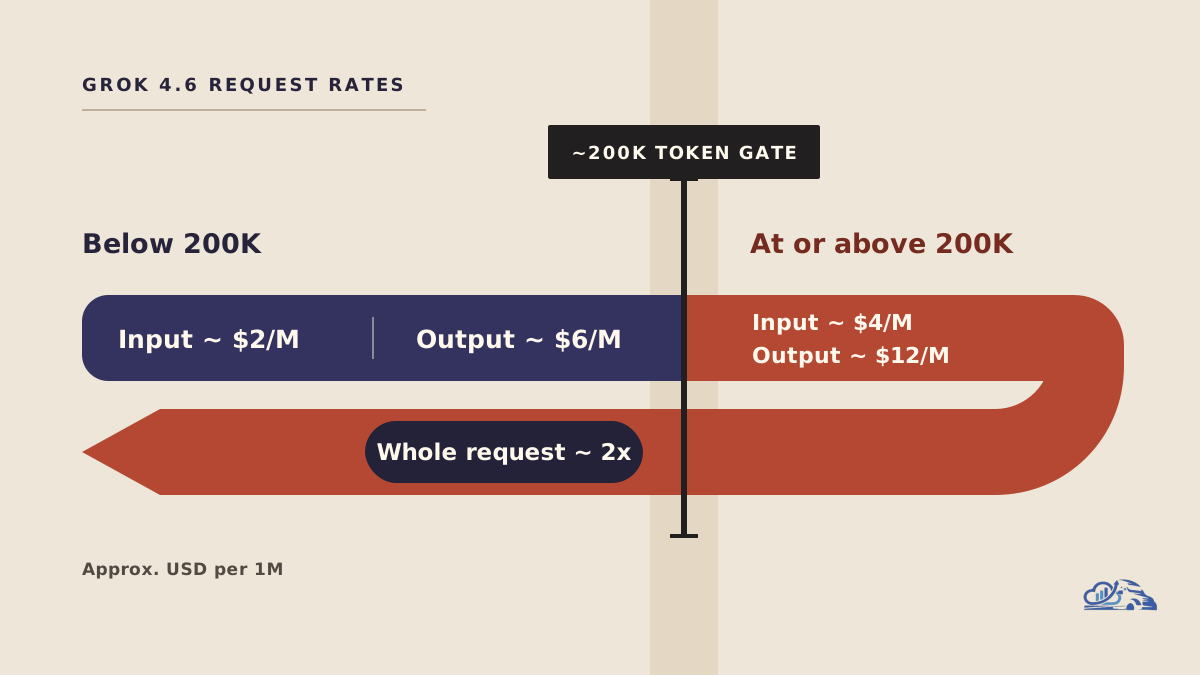
The long-context pricing cliff can double the input and output rates for a request that reaches the documented prompt boundary.
Agents don't make one clean call. They read files, retain tool output, revise plans, retry failed steps, and carry history forward. A growing prompt can pass the toll booth late in a run. xAI's pricing documentation states that the higher rate then applies to the whole request, not only the tokens above the boundary.
Model your actual context distribution. Log prompt tokens, output tokens, retries, repair calls, and accepted outcomes for every run. Then use this structured operating model:
{
  "prompt_boundary_tokens": 200000,
  "rate_selection": {
    "prompt_tokens_below_200000": {
      "approximate_input_usd_per_million_tokens": 2,
      "approximate_output_usd_per_million_tokens": 6
    },
    "prompt_tokens_at_or_above_200000": {
      "approximate_input_usd_per_million_tokens": 4,
      "approximate_output_usd_per_million_tokens": 12,
      "higher_rate_applies_to": "the whole request"
    }
  },
  "request_model_cost_formula": "(input_tokens / 1000000 * applicable_input_rate) + (output_tokens / 1000000 * applicable_output_rate)",
  "cost_per_accepted_outcome_formula": "total_model_and_runtime_spend / accepted_outcomes",
  "required_run_logs": [
    "prompt_tokens",
    "output_tokens",
    "retries",
    "repair_calls",
    "accepted_outcomes"
  ]
}
A hypothetical coding agent shows the failure mode. It retains full test logs, copied source files, browser output, and every earlier plan. A later turn crosses the pricing boundary. The request moves into the higher band, fails a tool call, and repeats much of the same context. The headline token rate no longer describes the cost of the accepted patch.
Context discipline is therefore part of product design. Retrieve only relevant files. Summarize completed steps. Keep structured facts while dropping verbose tool output. Pass diffs instead of entire documents when possible. Split independent work into bounded jobs rather than carrying one ever-growing transcript.
Don't optimize only to stay below the boundary. A shorter prompt that causes more retries may cost more overall. Compare retrieval, summarization, and retention policies on the same held-out tasks. Choose the policy with the best accepted-outcome rate, latency, and total spend. The context window is a ceiling, not a target.
When Is a Persistent Cloud VM Worth It?
A persistent cloud VM is worth using when retained state and managed tools remove more operating work than the VM adds in cost, security, and governance.
"Persistent" means the execution environment can keep working files and task state between agent steps. That helps research, coding, browser work, and other long-running tasks. A job can resume after a model error or control-plane interruption without rebuilding every artifact.
An ephemeral local script remains the better fit for short, stateless, reversible work. It has less platform overhead and a smaller surface when tools are tightly constrained. Yet it becomes brittle when a laptop sleeps, a process dies, a browser session disappears, or state must be reconstructed manually.
A managed VM can preserve files, browser state, and terminal processes. It may also remove custom harness code. In return, the team pays for compute, storage, idle time, instrumentation, cleanup, and a stronger security boundary.
Consider a hypothetical research agent gathering evidence across several sites. On a local script, an interrupted browser session forces manual recovery and makes provenance hard to reconstruct. In an isolated VM, the agent can retain downloaded files and an auditable task state. That advantage disappears if the job only calls a narrow read-only API and returns one response.
Use the VM when work genuinely needs resumability, local artifacts, browser interaction, or long-lived processes. Prefer native function calling or a constrained worker when the task is narrow and stateless. Our guide to computer-use agents covers the browser-control risks behind this decision.
How Should Teams Govern VM-Backed Agents?
Teams should govern every VM-backed agent as a privileged automation worker, not as a disposable chatbot session.
Start with isolation. Give each runtime its own identity, workspace, and scoped storage. Keep production secrets and unrestricted production access outside the VM. Restrict browser destinations, network egress, terminal commands, filesystem paths, and tool permissions to what the workflow needs.
Place human approval at consequential boundaries. Destructive changes, external messages, financial actions, permission changes, and production writes should stop for review. Approval should attach to the action and evidence, not to an arbitrary point in the agent's plan.
Observability must cover the whole execution chain. Record model calls, tool calls, file changes, network actions, approvals, failures, retries, and final outcomes. Link events under one task identity so an operator can reconstruct what happened. Log summaries alone aren't enough when the agent can alter files or call external systems.
Set time, token, retry, and spend budgets before execution. Add a kill control that works even when the model is unresponsive. Define cleanup for browser sessions, temporary files, packages, credentials, and stale VMs. Recovery should resume from a verified checkpoint, not from an opaque memory state.
A hypothetical operations agent may draft a vendor update safely but shouldn't send it from the VM without approval. The useful design is not "full autonomy." It is bounded autonomy with a clear escalation path. The AI agent ops and human escalation playbook expands this control model.
How Should Teams Adopt Grok 4.6?
Teams should adopt Grok 4.6 through separate model, cost, and runtime gates, beginning with bounded and reversible work.
Test the model before coupling it to a new execution environment. Otherwise, a strong runtime can hide weak model behavior, or a poor harness can make a capable model look unreliable. Keep the workload and evaluator fixed while changing one major layer at a time.
At Van Data Team, we start by mapping the intake, decisions, tools, handoffs, review points, and failure paths already present. That map defines the trial boundary. It also shows where an agent should retrieve context, call a tool, pause, retry, or escalate.
Adoption and evaluation checklist
Model evaluation
- [ ] Define the accepted outcome and stop condition before testing.
- [ ] Build a held-out workload that resembles production inputs.
- [ ] Compare Grok, GPT-5.6 Sol, and other eligible models under the same conditions.
- [ ] Record accepted outputs, tool failures, retries, latency, token use, and reviewer effort.
- [ ] Set the advancement rule before reviewing results.
Pricing-cliff cost model
- [ ] Capture input and output tokens for every request.
- [ ] Separate requests below and above the documented long-context boundary.
- [ ] Include retries, repairs, failed runs, and runtime charges in total spend.
- [ ] Calculate cost per accepted outcome, not cost per successful API response.
- [ ] Compare retrieval, summarization, and tool-output pruning policies.
- [ ] Recheck rates and threshold semantics in xAI's current pricing documentation.
Cloud-VM governance
- [ ] Give every runtime an isolated identity and workspace.
- [ ] Exclude production secrets and unrestricted production access.
- [ ] Limit browser, terminal, filesystem, network, and tool permissions.
- [ ] Log every external action, state change, approval, and failure.
- [ ] Require human approval for consequential or irreversible work.
- [ ] Enforce time, token, retry, and spend budgets.
- [ ] Provide a kill control, cleanup policy, and incident-review path.
Run the first trial in a sandbox with reversible outputs. Review false acceptances and unsafe attempts, not only successful tasks. Expand tool access only when evaluation, cost, and control gates remain healthy under production-shaped load.
To turn this checklist into delivery work, first scope a bounded automation workflow. Van Data Team can then return a scoped workflow review, evaluation plan, cost model, control map, and implementation scope instead of a generic model recommendation.
Where Does This Fit in the Agent Stack?
A persistent cloud VM is the execution layer; it doesn't replace orchestration, tool protocols, planning patterns, or model selection.
LangGraph, LangChain, and CrewAI coordinate state and workflow. Native function calling connects a model to constrained tools. MCP standardizes access to tools and context. Plan-and-Execute separates planning from execution. The VM is where browser, terminal, and filesystem work runs.
These layers can be combined. A LangGraph workflow may call Grok through its API, expose approved tools through MCP, and execute selected steps inside an isolated VM. A simpler job may need only native function calling and a short-lived worker. A role-based multi-agent workflow may use CrewAI without giving every role shell access.
Judge the full stack on cost, latency, token budget, observability, evaluation quality, review burden, and failure recovery. More layers create more control points, but also more states to debug. Keep each boundary explicit: the model proposes, the orchestrator routes, the protocol exposes tools, the runtime executes, and the human approves consequential actions.
The mistake we see is comparing brand names as if they were interchangeable products. Model quality and runtime design are separate decisions. Continue the evaluation with more AI agent and model-selection guides, but keep the same held-out tasks and acceptance rules.
Conclusion
Grok 4.6 is worth a controlled trial because the model and persistent-VM pattern address real long-running agent problems.
Don't migrate from benchmark headlines or lower-band pricing alone. Measure accepted outcomes, retries, latency, token budget, reviewer effort, and total cost across your actual context distribution. Treat any browser, filesystem, and terminal runtime as privileged infrastructure with isolation, least privilege, audit trails, approval gates, cleanup, and a kill control.
The practical next step is small: choose one reversible workflow, define acceptance before execution, test the model and runtime separately, and expand only when every gate passes. Van Data Team can turn that workflow into a scoped review, cost model, risk-control plan, and delivery scope through its AI agent and data engineering services. For related operating guidance, explore the Van Data Team blog.
Article FAQ
Questions readers usually ask next.
These short answers clarify the practical follow-up questions that often come after the main article.
Need a similar system?
If this article maps to a workflow your team already operates, the next step is usually a scoped review of the system, constraints, and rollout path.
Free agent review
Pressure-Test Your Grok 4.6 Plan
Review Grok 4.6 costs, production evals, and persistent-VM controls, then leave with a practical, no-obligation adoption plan.
- A workload-specific model evaluation scorecard
- A 200K pricing-cliff cost model
- A persistent-VM security and governance checklist
- A bounded pilot plan with budgets, approval gates, and success criteria
Related articles
View all
Gemini 3.8 Flash TTS: Price, Rankings and the Fine Print
GDPval-AA Chart Fact-Check: Opus 5.5 vs GPT-6 Astra on Cost
Microsoft Copilot Cowork Adoption: Operations Guide