Microsoft Copilot Cowork Adoption: Operations Guide
Adopting Microsoft Copilot Cowork: bounded workflows, stop conditions and approval gates for long-running agents, and how to attribute Copilot Credits.
Microsoft scheduled a live adoption AMA for July 22, 2026 about driving adoption of Microsoft 365 Copilot and Copilot Cowork across global workforces. The listing framed the session as adoption guidance, not a product launch. Copilot Cowork had already reached worldwide general availability on June 16, 2026.
Microsoft Copilot Cowork adoption is therefore an operations problem: teams must decide which work an agent may perform, which data it may touch, how much usage a workflow may consume, and where a person must intervene. At Van Data Team, we start by mapping the workflow, data dependencies, tools, owners, review gates, and recovery path before selecting the runtime. Our production AI agent workflow approach turns that map into an implementation scope, telemetry plan, and controlled rollout.
This guide provides a comparison framework, credit attribution ledger, governance gates, and deployment checklist.
Key Takeaways
Enterprise agent adoption needs bounded workflows and accountable ownership.
- Microsoft's event listing described a scheduled adoption AMA about existing capabilities, not a Copilot Cowork launch.
- Long-running agents need explicit success criteria, stop conditions, retry controls, approval gates, and recovery procedures.
- Copilot Credits should be attributed to teams, workflows, environments, runs, and accepted outcomes.
- Microsoft Foundry supplies a managed platform layer, while enterprises still own reliability, permissions, incident response, and business results.
- Data quality, freshness, lineage, access governance, and audit evidence must extend from pipelines to agent actions.
What the Microsoft Copilot Cowork adoption AMA listing supports
Microsoft's event listing presented the scheduled AMA as adoption guidance, not a Copilot Cowork launch. It invited practical audience questions about AI adoption and said the Microsoft 365 Copilot team would answer them. It did not say the session would cover Copilot Credits or Microsoft Foundry.
| Signal | Verified Microsoft fact | Operational reading |
|---|---|---|
| Event role | The listing scheduled a live webinar and AMA about AI adoption, resources for Microsoft 365 Copilot and Copilot Cowork, and audience questions. | Adoption depends on workflow design, enablement, governance, and measurement. |
| Cowork behavior | Microsoft describes Copilot Cowork as planning, executing, and delivering work across long-running, multi-step workflows involving apps, files, and data. | A run may hold state, call tools, and create effects beyond a conversational answer. |
| Commercial model | Microsoft says Copilot Cowork requires a Microsoft 365 Copilot license and uses usage-based Copilot Credits. | Platform and FinOps teams need workload-level attribution, budgets, and review. |
| Agent platform | Microsoft Foundry unifies agents, models, tools, observability, and governance, while publishing Foundry agents into Teams and Microsoft 365 Copilot is documented as an Early Access Preview. | A managed platform still needs an enterprise operating model around it. |
Microsoft's event title states the adoption brief plainly:
"Live AMA: Driving AI adoption with Microsoft 365 Copilot and Copilot Cowork."
The event listing states the adoption purpose. The Cowork operating model, licensing and usage model, and Foundry's role are documented in the separate Microsoft sources cited above. The FinOps model, governance controls, and implementation guidance below are Van Data Team recommendations, not claims about native Microsoft features.
Long-running agents change the workflow contract
A long-running agent changes the workflow contract because it can continue planning and acting after the initial request, while a conventional copilot usually returns a bounded response.
| Decision dimension | Single-request copilot | Long-running agent | Deterministic automation |
|---|---|---|---|
| Best fit | Drafting, explanation, analysis, or a recommendation | Bounded work that spans tools, data, decisions, and handoffs | Stable rules with predictable inputs and outputs |
| State and action | Short-lived context with limited side effects | Persistent state and multiple tool actions | Explicit state transitions encoded in software |
| Main failure risk | Poor or unsupported output | Partial completion, repeated actions, stale context, or an unsafe side effect | Broken logic, dependency failure, or schema drift |
| Control model | User reviews the answer | Policy gates, checkpoints, approvals, and run evidence | Tests, deployment controls, monitoring, and rollback |
| Cost lens | Usage around a request | Usage across a complete run, including retries and escalation | Infrastructure and maintenance cost per job or service |
As a rule of thumb: deterministic automation is best for stable rules with predictable inputs; a single-request copilot is the stronger fit when a person makes the decision; and a long-running agent is the weaker fit until multi-step value clearly justifies the state, permissions, monitoring, and exceptions it adds. Choose the simplest tier that clears the bar, and first test any agent on a bounded, reversible workflow before you route real volume through it.
At Van Data Team, the mistake we see is defining the happy path and calling it the workflow. The real contract also covers a tool timeout, a permission change during execution, stale source data, retry duplication, an unbounded loop, and a technically completed task that the business rejects.
Before production, record:
- Accepted inputs, required data quality, and allowed sources.
- Permitted tools, identities, targets, and action scopes.
- Completion criteria and evidence that proves the outcome.
- Stop conditions for policy violations, stale data, repeated failure, or resource limits.
- Retry rules, idempotency controls, checkpoints, and escalation triggers.
- Human approvals for outward, destructive, privileged, or irreversible actions.
- Recovery steps, including cancellation, compensation, replay, and incident ownership.
Put approval next to the risky action, not at the start of a long run. A person can approve the exact recipient, proposed change, data range, or permission request with current evidence. The production AI agent ops and human escalation playbook expands this pattern for retries, incidents, and operator handoffs.
Treat Copilot Credits as a metered operating cost
Usage-based Copilot Credits turn agent execution into a metered operational cost that should be connected to owners, workflows, and outcomes.
Microsoft documents Copilot Cowork as usage-based and denominated in Copilot Credits. The attribution design here is Van Data Team's recommendation, not a description of a native Microsoft tagging or hard-cap feature. Because credit rates and included allowances can change, verify the current numbers against Microsoft's official documentation as of your rollout date rather than a blog snapshot, and re-check them whenever you plan capacity.
Agent credit and outcome ledger
| Field | What it connects | Operating control |
|---|---|---|
workflow_id | Usage to a registered business workflow | Block production activation until the workflow has an owner and policy |
owner_team | Cost and incidents to accountable operators | Route budget and reliability review to the named team |
run_id | Usage, actions, approvals, and outcomes | Correlate the full execution in internal telemetry |
environment | Experimental and production consumption | Keep test activity from obscuring production behavior |
budget_class | The run to an internal usage policy | Apply warning, approval, escalation, or stop behavior |
credits_consumed | Metered use to the run | Reconcile with authoritative Microsoft usage records |
data_assets_touched | Agent activity to data lineage | Record governed reads and write targets |
tool_actions | Side effects to identity and result | Retain the action, target, authorization, and response |
approval_state | Controlled work to human authorization | Prevent gated actions without valid approval |
outcome_status and stop_reason | Consumption to value or failure | Separate accepted, failed, abandoned, and escalated work |
Build the ledger from internal workflow telemetry, then reconcile it with the authoritative usage records available to your organization. The useful unit is a completed business outcome, with failed runs, retries, rework, human intervention, data exceptions, and policy stops visible beside it.
Internal policies can assign a budget class, notify an owner near a threshold, require approval for exceptional use, and stop work at a defined limit. Validate which controls your Microsoft environment exposes, then implement missing enforcement in the surrounding platform.
A scoped AI agent development engagement can produce the workflow registry, telemetry schema, credit ledger, budget policy, dashboard specification, and rollout plan needed to make this model operational.
Microsoft Foundry makes ownership an operations question
Microsoft Foundry hosted agents provide a managed platform for deploying and operating agents, with tooling and governance, while publishing into Teams and Microsoft 365 Copilot is documented as an Early Access Preview. The enterprise must still assign responsibility for every production workflow.
Managed runtime does not mean managed accountability. Van Data Team recommends naming owners before deployment:
| Responsibility | Accountable role | Required operating answer |
|---|---|---|
| Business outcome | Workflow sponsor | What accepted result justifies continued operation? |
| Agent behavior | Product or workflow owner | Which inputs, actions, stops, and approvals are allowed? |
| Runtime and deployment | Platform team | Who can release, pause, roll back, and recover the agent? |
| Data dependencies | Data owner | What quality, freshness, lineage, and access promises apply? |
| Permissions and review | Security and risk owners | Which actions need least privilege or human authorization? |
| Usage budget | FinOps and service owner | Who reviews consumption, exceptions, and outcome efficiency? |
| Incidents | Named on-call function | Who investigates failed, duplicated, or unsafe actions? |
Observability should connect run state, tool calls, data dependencies, approvals, credit use, outcome status, and stop reason. Recovery needs a way to pause runs, preserve evidence, identify affected actions, compensate or replay safely, and return control to an operator.
Extend data-engineering controls to agent actions
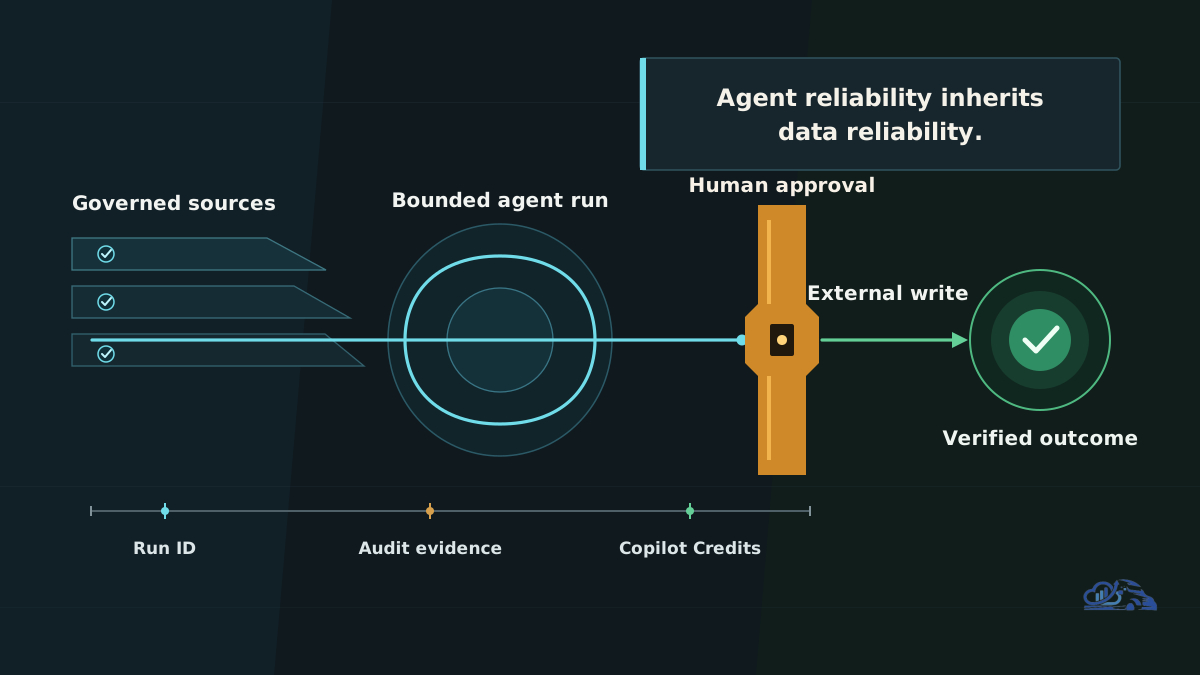
Agent reliability depends on the quality and governance of the business data and tools the workflow reads and changes.
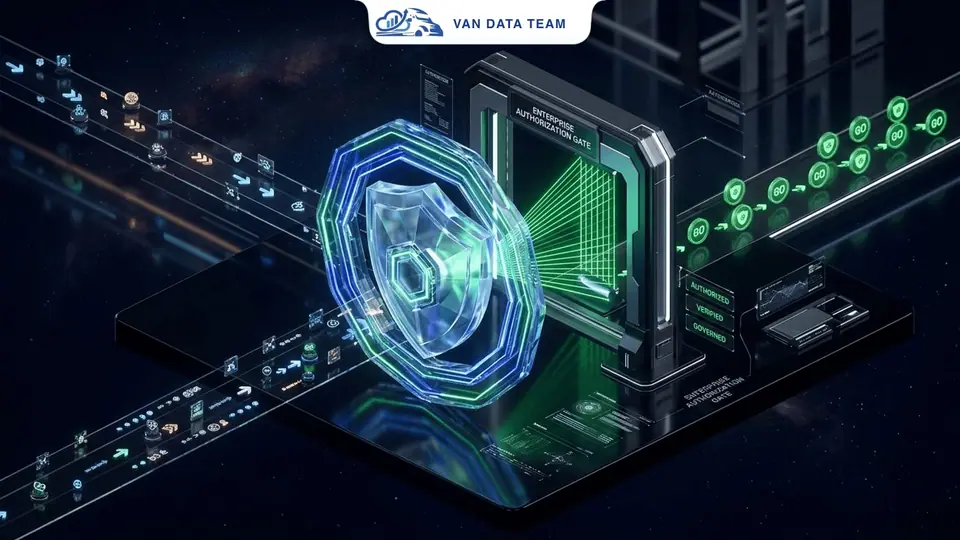
A practical architecture begins with governed intake, passes the request through policy checks, runs the agent with bounded tool permissions, pauses at approval gates, verifies the result, and writes the outcome to an audit log and usage ledger. The agent runtime is only one layer. Data pipelines, tool interfaces, identities, review queues, observability, and recovery procedures complete the system.
Extend familiar data-engineering controls in both directions:
- Quality: Validate required fields, semantic expectations, and business rules before an agent acts.
- Freshness: Stop or escalate when a source is too old for the decision.
- Lineage: Record the assets read, transformations relied on, tools called, and targets changed.
- Access: Apply least privilege to sources, tool operations, environments, and identities.
- Service expectations: Define data and tool SLAs, plus the response when a dependency misses its operating promise.
- Write safety: Capture before state, proposed change, authorization, result, and recovery status.
Consider a hypothetical data incident workflow. A freshness check finds a late business dataset. An approved agent gathers orchestration logs, transformation-test results, lineage context, and the relevant runbook. It proposes a retry, backfill, or stakeholder notice. It cannot change production data, launch the backfill, or send the message until an authorized person approves the exact action. The ledger records the run and decision evidence.
Airflow may supply orchestration context, dbt may expose transformation tests and lineage artifacts, and Kafka may carry operational events. MCP or other tool interfaces can expose bounded actions, while an observability platform correlates the run. These are adjacent options, not a prescribed stack or a claim of native Copilot Cowork integration. Use human escalation patterns for production agents to design the handoff around the systems you already operate.
An adoption and operations checklist
A production candidate should expand only after its measured outcomes justify its cost, review burden, and operational risk.
- [ ] Select a repeated, high-value workflow with a named business owner.
- [ ] Define accepted inputs, successful output, rejection criteria, and evidence.
- [ ] Set stop conditions for stale data, denied access, repeated failure, policy breaches, and resource limits.
- [ ] Register allowed data sources, tools, identities, actions, and environments.
- [ ] Test data quality, freshness, lineage coverage, and service expectations.
- [ ] Make retries idempotent where possible and define recovery for partial completion.
- [ ] Require human approval for external, destructive, privileged, material, or irreversible actions.
- [ ] Attribute Copilot Credits to the workflow, team, environment, run, and outcome.
- [ ] Monitor tool errors, retries, intervention, approval delay, policy stops, and rejected results.
- [ ] Assign incident response, rollback authority, approval-queue ownership, and audit retention.
- [ ] Review accepted outcomes against consumption and risk before expanding or rolling back.
Use this default governance gate:
| Proposed action | Default recommendation | Evidence to retain |
|---|---|---|
| Read an approved internal source | Allow within least-privilege access | Identity, source, purpose, and run |
| Draft an internal artifact | Allow or queue for policy-based review | Inputs, artifact, policy result, and reviewer |
| Change a production record | Require authorized approval | Before state, proposed change, approver, and result |
| Send an external message | Require human approval | Recipient, content, business context, and approver |
| Trigger a backfill or change access | Require workflow-specific or privileged approval | Scope, dependencies, expected effect, owner, and audit record |
| Perform an irreversible action | Block by default unless explicitly authorized | Action plan, approval, execution result, and recovery status |
Van Data Team can turn this checklist into a scoped production-agent delivery plan with a workflow review, data dependency map, governance matrix, credit attribution design, observability gap review, and implementation backlog.
Conclusion
Microsoft Copilot Cowork adoption succeeds when teams treat agents as production workflows rather than smarter chat sessions. Microsoft's event listing presented the scheduled AMA as an adoption event, not a launch, and the operating guidance here is clear: long-running work needs explicit ownership, governed data, metered-cost attribution, stop conditions, approval gates, observability, and recovery.
Start with one bounded workflow whose outcome matters. Register its data and tools, build the credit and outcome ledger, keep people at consequential decision points, and expand only when evidence supports the cost and risk. Van Data Team can scope the production workflow and delivery controls from intake and data dependencies through governance, reporting, rollout, and incident readiness.

Founder of Van Data Team. Builds Vanaxity, the AI agent system for SEO, GEO, and AEO, and leads data engineering delivery for B2B teams.
About the authorArticle FAQ
Questions readers usually ask next.
These short answers clarify the practical follow-up questions that often come after the main article.
Need a similar system?
If this article maps to a workflow your team already operates, the next step is usually a scoped review of the system, constraints, and rollout path.
Consultation
Scope your next AI workflow.
Share the system and blockers. We will map fit, gaps, and the next step.