July 30, 2026
ChatGPT for Academic Researchers: GPT-5.6 Sol Pro
ChatGPT for Academic Researchers brings GPT-5.6 Sol Pro and Codex to scientists. Learn how to build reproducible, observable research workflows safely.
Article focus
ChatGPT for Academic Researchers puts frontier models and Codex within reach, but research engineers must still prove that AI-generated code, data transformations, tool calls, and scientific conclusions can be reproduced and audited across runs.
Section guide
ChatGPT for Academic Researchers puts frontier models and Codex within reach, but research engineers must still prove that AI-generated code, data transformations, tool calls, and scientific conclusions can be reproduced and audited across runs. This article provides a practical architecture, cost-and-observability harness, evaluation gates, and deployment checklist for production-grade agentic research workflows, using Van Data Team’s approach of tying every execution to versioned environments, lineage, traces, and human review.
OpenAI has launched ChatGPT for Academic Researchers, a program designed to give 100,000 faculty and postdoctoral researchers free access to frontier models across ChatGPT, ChatGPT Work, and Codex. The rollout begins with about 10,000 researchers this summer and expands through 2027, with GPT-5.6 Sol Pro available to selected researchers. The announcement changes who can use frontier research tooling. It does not remove the engineering work required to make results reproducible.
Engineering leaders and research teams now face the harder buyer problem: how do you turn powerful model access into an auditable system without uncontrolled tool calls, stale data, or unverifiable claims? At Van Data Team, we start by mapping the research specification, data lineage, execution boundaries, review gates, and recovery path. Our approach to production AI agent workflows treats code generation as one component inside a controlled delivery system. This guide separates OpenAI's reported facts from our recommendations, then gives you an architecture, harness design, evaluation model, and reusable review checklist.
Key Takeaways
- OpenAI is extending free frontier-model access across ChatGPT, ChatGPT Work, and Codex to a planned 100,000-person research cohort.
- GPT-5.6 Sol owns the FrontierMath result; GPT-5.6 Sol Pro owns the GeneBench Pro result. They test different work and should not be collapsed into one ranking.
- Codex-style execution becomes research infrastructure only when code, data, environments, prompts, tool outputs, and review decisions are versioned together.
- A production agent harness needs budgets, tool permissions, full traces, stop conditions, evaluation gates, and recoverable failure behavior.
- Research agents inherit the quality, freshness, lineage, and access limits of the pipelines and retrieval indexes they read.
What ChatGPT for Academic Researchers includes
REPORTED FACT: ChatGPT for Academic Researchers gives qualifying faculty and postdoctoral researchers at selected high-research universities free access to OpenAI's research products and frontier models.
The program spans ChatGPT, ChatGPT Work, and Codex. OpenAI says participants receive expanded deep research, higher usage limits, larger context windows, training, and research support. According to Axios's program report, selected researchers can send up to four collaborator invitations and receive business-grade privacy. OpenAI says workspace data is not used to train its models by default. Axios also reports that model weights remain unavailable.
| Model tier | OpenAI's reported positioning | Practical article framing |
|---|---|---|
| GPT-5.6 Terra | Balanced capability and efficiency | Everyday research work |
| GPT-5.6 Luna | Faster responses for lighter tasks | Lower-complexity work where speed matters |
| GPT-5.6 Sol | The hardest scientific and mathematical problems | Advanced reasoning and difficult analysis |
| GPT-5.6 Sol Pro | Highest research tier offered in the program | Selected researchers and demanding workflows |
OpenAI reports that GPT-5.6 Sol scored 83% on FrontierMath Tier 4, compared with 72.5% for GPT-5.5. That research-level mathematical reasoning result belongs to Sol, not Sol Pro. Separately, SiliconANGLE reports that GPT-5.6 Sol Pro solved 31.5% of GeneBench Pro tasks, a benchmark for complex biological data analysis and scientific reasoning. These results come from different evaluations, so they do not support a direct model ranking.
The program is part of OpenAI's commitment of more than $250 million through 2027 to support external scientific research and discovery. OpenAI frames that investment around researcher agency in its official program announcement:
"Scientific progress depends on researchers asking the right questions, testing new ideas, and building on what others have discovered."
The quote captures the right operating boundary. Models can expand the search space, write code, and accelerate analysis. Researchers still own the question, method, evidence, and conclusion.
Codex makes research executable, not automatically reproducible
REPORTED FACT: OpenAI says Codex can write and debug research code, analyze datasets, and build reproducible workflows inside the new program.
VAN DATA TEAM ANALYSIS: A successful agent run is not the same as a reproducible scientific workflow. The run becomes defensible only when another qualified researcher can reconstruct its inputs, environment, decisions, and outputs.
Consider a hypothetical biological analysis. A research engineer asks Codex to clean a dataset, select features, run an analysis, and summarize the result. The code executes and the chart looks plausible. Later, a reviewer discovers that the dataset changed between runs and a package update altered preprocessing behavior. The model did useful work, but the workflow cannot support the claim because the team cannot recreate the original path.
A production implementation should preserve:
- the approved research question, scope, assumptions, and success criteria;
- immutable dataset snapshots, source records, schema checks, and content hashes;
- the repository revision, notebook or pipeline version, environment lockfile, and container digest;
- random seeds, deterministic settings, prompt version, model tier, and tool policy;
- every tool request, validated argument, response, generated artifact, retry, and failure;
- test results, evaluation results, reviewer decisions, and final artifact hashes.
Notebooks remain useful for exploration. Before an AI-assisted result supports a scientific claim, the relevant notebook cells should become a versioned script or pipeline with explicit inputs, outputs, tests, and rerun instructions. The key shift is from "the agent produced this" to "this recorded system produced this under stated conditions."
A reproducible research architecture surrounds every agent action
The following illustration summarizes the reproducibility envelope:
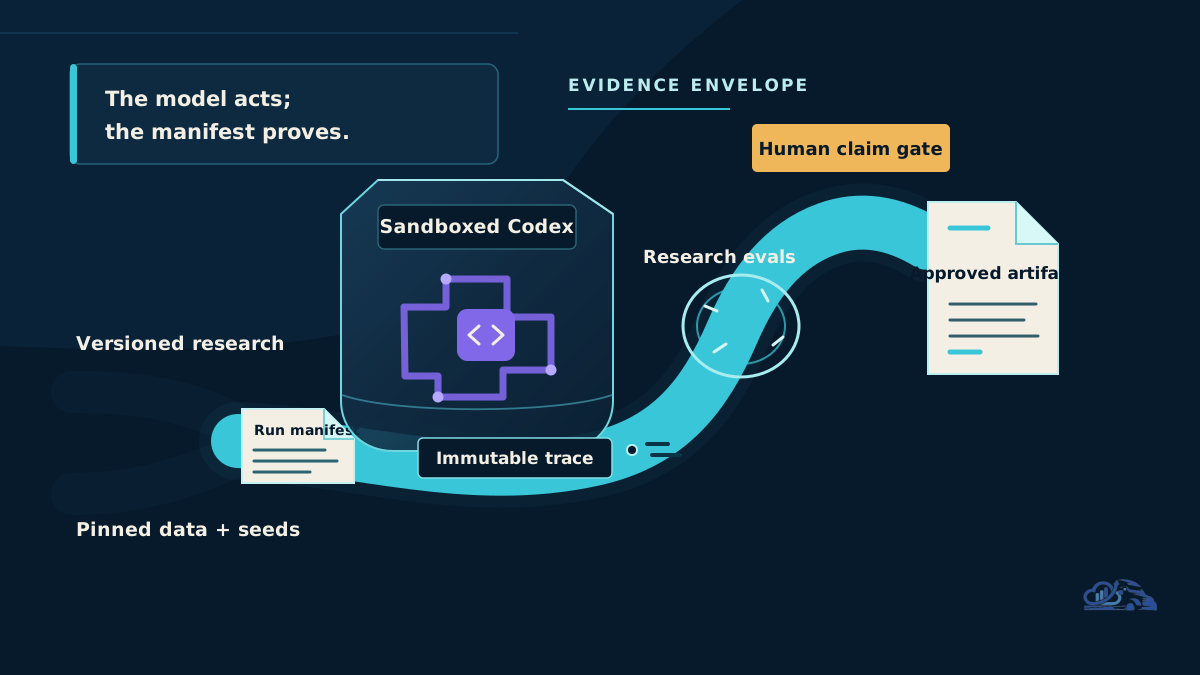
VAN DATA TEAM ANALYSIS: The safest architecture treats the model as a planner and code author inside a versioned research pipeline, not as the system of record.
The workflow begins with a research specification. That specification defines the question, allowed evidence, approved tools, method boundaries, evaluation criteria, and conditions that require a human decision. Data intake then resolves source permissions, freshness, schemas, lineage, and immutable snapshots before the agent sees the material.
The agent plans against that controlled context. A tool gateway validates every request, runs code in an isolated environment, and blocks unapproved network, data, or write access. Outputs flow into automated checks and domain evals. A claim-evidence map then links each proposed conclusion to source records, transformations, tests, limitations, and reviewer approval.
The mistake we see is treating the prompt as the system of record. It is not. The run manifest is. It should connect the research specification, model and policy versions, data snapshot, tool trace, code revision, tests, review decisions, and publishable artifact.
A hypothetical mathematics workflow shows why this matters. A reasoning model can propose a proof strategy and generate supporting code, but a separate verification stage should test formal constraints and identify unresolved steps. The harness should route any gap to a mathematician instead of polishing an incomplete argument into a confident conclusion.
This architecture also supports recovery. A failed tool call should resume from a known checkpoint. A changed dataset should trigger a new lineage branch. A failed invariant should stop the run before downstream summaries are regenerated. Reproducibility is therefore not only a publication property; it is the mechanism that makes debugging and reruns affordable.
The agent harness controls cost, tools, traces, and recovery
VAN DATA TEAM ANALYSIS: A production agent harness should make spend, tool behavior, and execution paths explicit before a research task begins.
Start with budgets at the run and stage level. Record input and output tokens, tool activity, latency, cache hits, retries, and failure class. Route routine work to the lightest model tier that passes your evals, and reserve higher-capability routes for tasks that demonstrate a need. Stop when evidence is missing, tests fail, recursion repeats, or a policy budget is exhausted.
The harness also needs a narrow tool boundary. Allowlists determine which tools exist for a task. Schemas validate arguments. Sandboxed runtimes isolate code. Idempotent write patterns prevent retries from duplicating or corrupting artifacts. Redaction and access policies protect restricted research inputs. A complete trace links every model response to the context it received and every tool result it used.
LangGraph, LangChain, CrewAI, native function calling, Plan-and-Execute, and MCP-based tool interfaces are adjacent implementation options, not OpenAI recommendations for this program.
| Pattern | Best fit | Strength | Limitation to test |
|---|---|---|---|
| Native function calling | Bounded, mostly linear workflows | Small control surface | Custom orchestration grows with branching |
| LangGraph | Stateful workflows with checkpoints | Explicit state and recovery paths | More graph design and state management |
| LangChain | Fast integration across models and tools | Broad component ecosystem | Abstraction layers can obscure traces |
| CrewAI | Role-based delegation | Clear agent responsibilities | Coordination can add cost and review burden |
| Plan-and-Execute | Long tasks with separable planning and action | Inspectable plan before execution | Plans can drift as evidence changes |
| MCP tool interfaces | Standardized access to external capabilities | Reusable tool contracts | Authorization and policy enforcement remain yours |
Choose the smallest pattern that passes your workflow evals. A linear pipeline with native tool calls is often easier to audit than a multi-agent graph. Add branching, delegation, or parallel work only when measured task quality justifies the extra token cost, latency, tracing complexity, and review load.
For a deeper operating model, our agent observability and escalation playbook covers traces, stop states, fallbacks, and human handoffs that stay tunable after launch.
Evals, human review, and data foundations set the quality ceiling
VAN DATA TEAM ANALYSIS: Research output is usable only when teams evaluate code, method, evidence, reproducibility, and operations separately, then stop material claims for human review.
Code correctness needs unit tests, integration tests, schema checks, numerical sanity checks, and scientific invariants. Research correctness needs domain reference tasks, source-grounding checks, method validation, and regression suites. Reproducibility needs clean-environment reruns from the stored manifest. Claim quality needs evidence mapping, citation checks, uncertainty review, and explicit limitations.
Human gates should appear before privileged tool use, method changes, material data transformations, and publication. Reviewers need the code diff, source provenance, failed and passed evals, unresolved uncertainty, and the exact evidence behind each claim. Our guide to AI agents with human review explains how to make those gates visible without turning every low-risk action into a meeting.
Research agents also inherit every weakness in their data platform. Airflow can schedule work, dbt can test transformations, Kafka can move events, and warehouses can serve governed datasets. None of those names guarantees trustworthy inputs. The controls that matter are schema contracts, freshness checks, lineage, replay procedures, versioned datasets, retrieval-index refresh status, document provenance, access policy, and observable service commitments.
A hypothetical literature agent makes the point. Its reasoning path may be sound, yet its conclusion can still be wrong for the task because the retrieval index missed a newly ingested paper or exposed an unauthorized document. The agent trace must therefore record the index version, refresh state, query, returned documents, and access decision. Observable data pipeline engineering gives research agents inputs that can be inspected, replayed, and repaired instead of silently trusted.
Reproducible agentic research workflow checklist
VAN DATA TEAM ANALYSIS: A research result is ready for review only when every stage leaves evidence and every material risk has a stop condition.
| Workflow stage | Required control | Evidence to preserve | Human stop condition |
|---|---|---|---|
| Research specification | Versioned question, scope, assumptions, allowed sources, and success criteria | Approved specification | Scope or method changes materially |
| Data intake | Snapshotting, schema tests, provenance, lineage, and freshness checks | Dataset manifest, hashes, timestamps, and source records | Data is stale, incomplete, unauthorized, or invalid |
| Environment | Locked dependencies, runtime configuration, container identity, and deterministic settings | Build manifest and environment lockfile | Environment cannot be recreated |
| Agent planning | Versioned prompt, evaluated model route, tool allowlist, and stop policy | Plan trace and policy configuration | Agent requests an unapproved tool or method |
| Tool execution | Validated arguments, isolated runtime, bounded retries, and safe writes | Tool requests, responses, logs, and artifacts | Execution changes protected data or breaches policy |
| Analysis | Versioned code, recorded seeds, intermediate outputs, and tests | Repository revision and run manifest | Tests or scientific invariants fail |
| Evaluation | Domain tasks, regressions, grounding checks, and rerun comparison | Evaluation report linked to the run | Correctness or stability criteria fail |
| Claim review | Evidence mapping, limitations, uncertainty, and citation validation | Reviewer record and decision | A claim lacks evidence or overstates the result |
| Publication and monitoring | Reproduction bundle, audit trail, cost telemetry, failures, and freshness alerts | Published artifacts and operational history | Required approvals are missing or a policy threshold is breached |
Use this table during architecture review and before approving an AI-assisted result. It also defines the minimum fields for an audit dashboard: run identity, specification version, model route, prompt and policy versions, data and index identifiers, tool activity, token use, cost estimate, latency, code revision, eval results, provenance, reviewer decision, and artifact hashes.
Teams that want a working reference can examine our autonomous research agent workflow. For a scoped implementation, Van Data Team can return a workflow map, data and tool policy, trace schema, evaluation plan, review-gate design, and delivery sequence.
How Van Data Team Makes This Operational
REPORTED FACT: OpenAI says ChatGPT for Academic Researchers includes Codex for writing and debugging research code, automating data analysis, and building reproducible workflows. Access alone, however, does not prove that a result is reproducible or scientifically sound.
VAN DATA TEAM ANALYSIS: We map the full handoff from research question to reviewed conclusion: source systems, data owners, decisions, review gates, dashboards, failure states, and recovery paths. The output is a scoped delivery plan identifying which signals to collect, which workflow gaps to close, which automation requires human approval, and which dashboard or runbook guides the next action.
Our reproducible-agentic-research-workflow checklist:
- Pin environments, dependencies, datasets, retrieval snapshots, prompts, seeds, and model configurations.
- Capture provenance, execution paths, tool calls, token consumption, costs, and generated artifacts for every run.
- Convert notebooks into versioned pipelines with data-quality, lineage, freshness, and SLA checks.
- Give agents narrow tool permissions through controlled interfaces such as MCP.
- Gate generated code, statistical methods, and scientific claims with tests, research-specific evals, and domain-expert review.
- Define budgets, stop conditions, retries, rollback procedures, and escalation owners.
The result is a recoverable research workflow whose evidence, decisions, and operating costs can be inspected before anyone relies on its conclusions.
Operational Budget
REPORTED FACT: OpenAI says ChatGPT for Academic Researchers gives qualifying participants free access to frontier models and research coding tools. That removes access fees for participants, but it does not establish the operating cost of a reproducible research workflow.
VAN DATA TEAM ANALYSIS: Before production rollout, score each model-and-harness candidate against the same representative tasks and approval standard:
- Accepted-output cost: model usage, tool and infrastructure charges, reviewer labor, and failed-run recovery divided by approved results.
- Latency and budget: end-to-end completion time, tokens allowed per run, and tool-call ceilings.
- Reliability: retry rate, failure class, checkpoint coverage, and time to resume without repeating successful work.
- Review load: reviewer minutes per result and the share escalated for scientific or code review.
- Evaluation quality: pass rates for task-specific correctness, reproducibility, provenance, and safety—not a benchmark score borrowed from another workload.
Record each run’s prompt, token use, tool calls, execution trace, data version, and review decision. Compare candidates under the same pinned environment, data snapshot, seed policy, and stop conditions. Vendor token pricing is only the starting point; the useful decision metric is cost per approved workflow result, with quality gates held constant.
The takeaway for research engineering teams
ChatGPT for Academic Researchers gives more scientists, mathematicians, and engineers access to frontier models and Codex, but benchmark performance does not replace workflow-level validation. The production unit is not the chat session. It is the versioned chain from research question to data, code, tools, evals, evidence, review, and published artifact.
Research teams should start by defining the claim boundary, pinning inputs and environments, constraining tool execution, and deciding where the system must stop. Then instrument token use, cost, latency, failures, freshness, and reviewer decisions. That turns agentic execution into something a team can rerun, challenge, and improve.
Van Data Team designs these systems from the workflow outward, with data engineering, agent controls, observability, and human review in one delivery loop. If you are evaluating the new OpenAI program or building an equivalent internal stack, scope a reproducible research-agent workflow and receive a workflow map, risk register, trace design, evaluation plan, and implementation scope.
Article FAQ
Questions readers usually ask next.
These short answers clarify the practical follow-up questions that often come after the main article.
Need a similar system?
If this article maps to a workflow your team already operates, the next step is usually a scoped review of the system, constraints, and rollout path.
Free scoping session
Make ChatGPT Research Workflows Reproducible
In a free, no-obligation session, review your ChatGPT for Academic Researchers workflow and leave with an auditable, cost-controlled path from agent-generated code to reviewed claims.
- A workflow map covering pinned environments, data versions, seeds, lineage, and notebook-to-pipeline handoffs
- An agent-harness design for token budgets, tool-call limits, retries, and execution-path tracing
- A research-grade evaluation plan for code, data transformations, retrieval outputs, and scientific claims
- Human review gates with named owners, evidence requirements, and release criteria
- Prioritized next steps for your data pipelines, retrieval indexes, and observability stack
Related articles
View all
Grok 4.6 and Persistent VM Agents
Computer-Use Agents: An Engineer's Production Guide
WeatherNext: Evaluating AI Cyclone Forecasting