AI Bubble Fears: What Meta's $825B Bill Means for AI Buyers
AI bubble fears are back: Meta's cash flow turned negative, its credit risk hit a record and neoclouds slid. What it means for companies buying AI and GPUs.
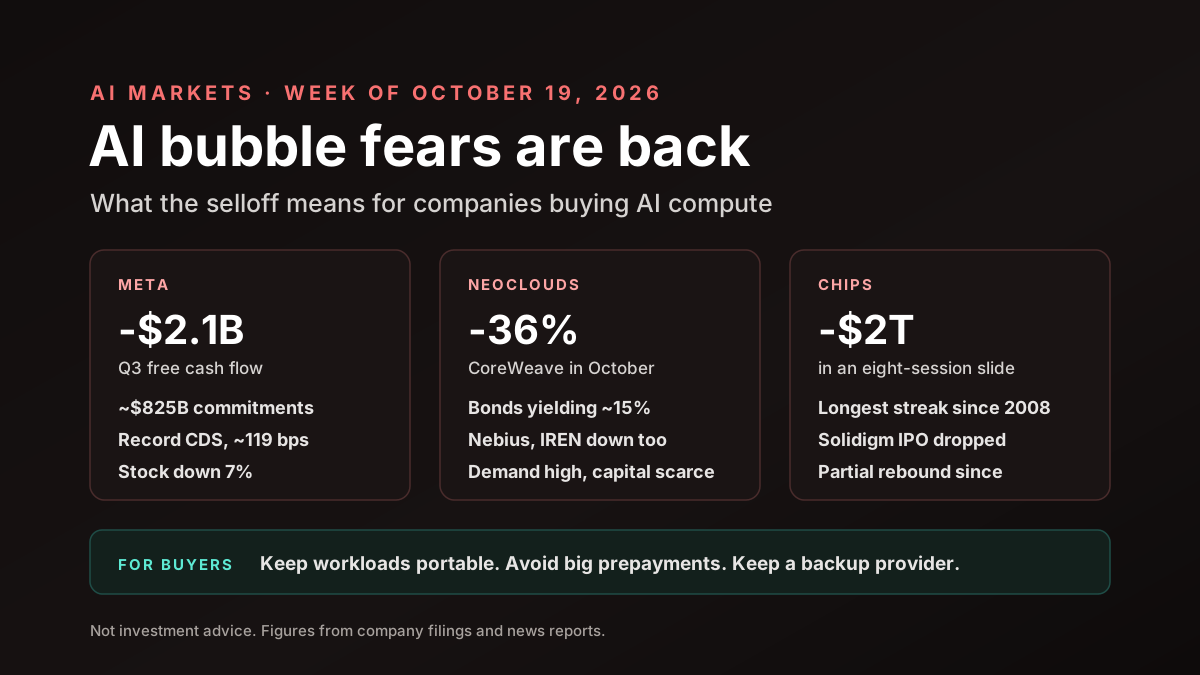
AI bubble fears are back. In the week of October 19, 2026, Meta reported its first negative free cash flow as a public company, the cost of insuring its debt hit a record and AI cloud companies saw their stocks and bonds slide. SK Hynix dropped a planned IPO, and chip stocks had already lost about $2 trillion in an eight-day slide.
None of this means AI demand has vanished. But it does change the risks for companies that rent GPUs, sign cloud contracts or plan big AI projects. Here's what happened, what the numbers mean and what to do about it.
Disclosure: Van Data Team builds AI systems on several clouds and model providers, and this article was researched with Claude. We explain what market moves mean for AI buyers. This isn't investment advice.
Key Takeaways
- Meta's stock fell 7% on October 22 after it reported negative free cash flow of $2.1 billion and raised the floor of its 2026 spending plan to $135 billion.
- Meta's future AI-related commitments total about $825 billion, a figure Bloomberg added up from three items in its quarterly filing.
- The cost of insuring Meta's debt against default hit a record. Neocloud CoreWeave's bonds yielded around 15%.
- SK Hynix dropped plans to list its Solidigm unit in the US, and chip stocks lost about $2 trillion in an eight-session slide.
- For AI buyers, the lesson is to manage supplier risk: keep workloads portable and avoid long prepayments to weaker providers.
AI Bubble Fears at a Glance
| Signal | What happened |
|---|---|
| Meta stock | Down 7% on October 22, to $648.85 |
| Meta free cash flow | Negative $2.1 billion in Q3, against positive $10.6 billion a year earlier |
| Meta commitments | About $825 billion in future leases and contracts, up from nearly $700 billion in July |
| Meta credit risk | Five-year credit default swaps at a record of about 119 basis points |
| Neoclouds | CoreWeave down 36% in October through the 21st; its bonds yielding around 15% |
| Solidigm | SK Hynix dropped a planned US IPO once reported at up to $150 billion |
| Chip stocks | About $2 trillion lost in an eight-session slide, the longest since 2008 |
What Set Off the Latest AI Bubble Fears
The trigger was Meta. On October 21, it reported strong third-quarter revenue of $64.6 billion, up 26%. But it also spent $34.9 billion on data centers and equipment in one quarter, pushing free cash flow to negative $2.1 billion. A year earlier, it was positive $10.6 billion.
Meta also raised the bottom of its 2026 capital spending range to $135 billion, from $130 billion. Investors focused on the cost, not the revenue. CNBC reports the stock fell nearly 7% the next day, its worst day in about three months.
Meta wasn't alone. The same week, AI cloud companies kept sliding, a big chip IPO was pulled and credit markets showed growing worry about AI-related debt.
What the $825 Billion Really Is
The headline number needs care. Meta's quarterly filing doesn't contain a single $825 billion figure. Bloomberg added up three separate items, according to an analysis of the filing:
| Item in Meta's 10-Q | Amount |
|---|---|
| Leases that haven't started yet | About $356 billion |
| Non-cancelable contractual commitments | About $455 billion |
| Contingent cloud purchase obligations | About $15 billion |
| Total, as calculated by Bloomberg | About $825 billion |
A few caveats apply. The leases run through 2036, so this isn't one year's bill.
Some categories may overlap. And the non-cancelable bucket also includes consumer hardware, not only AI. Still, the direction is clear: Meta has promised to spend far more on computing in the years ahead than it did a few months ago.
Why Meta's Credit Risk Hit a Record
A credit default swap is a kind of insurance against a company not paying its debts. When its price rises, investors are paying more for that protection.
Meta's five-year swaps rose to about 119 basis points, the highest since they began trading, with one report putting the intraday peak above 124. That's still far from distress. Meta remains highly rated, holds about $82 billion in cash and investments and runs one of the world's most profitable ad businesses.
What changed is the trend. Investors now expect big tech companies to borrow more to fund AI, and they want to be paid more for that risk. Swaps on Oracle, Microsoft and Broadcom also widened.
Neoclouds Under Pressure
The sharpest moves came from neoclouds, the cloud companies that specialize in renting GPUs for AI. Many grew fast using debt, so higher interest rates and nervous lenders hit them hardest.
- CoreWeave: its bonds yielded around 15% in mid-October, and its stock was down 36% for the month by October 21, CNBC reports.
- Nebius and IREN: both fell with CoreWeave. Over the past month, Nebius dropped about 29% and IREN about 46%.
- Gartner: the research firm predicts that by 2030, cost pressure will force more than 80% of neocloud providers to stop operating on their own.
Demand isn't the problem. Nvidia's Jensen Huang said neocloud demand is "off the charts" but capital is scarce. The worry is about funding: whether these companies can keep borrowing to build data centers before customers pay them back. That's a question every neocloud customer should be asking too.
Solidigm Pulls Its IPO
SK Hynix said on October 23 that it had stopped considering a US listing for Solidigm, its storage subsidiary. Reports had valued the possible IPO at up to $150 billion, with a raise of $10 billion to $15 billion, though SK Hynix never confirmed those numbers.
The company cited market conditions and share price trends. Some reports also point to warnings from South Korean regulators about listing a subsidiary separately from its parent. Either way, a deal tied to AI storage demand was shelved in the middle of the selloff.
For buyers, Solidigm matters because it makes the storage drives that hold AI training data. A shelved IPO doesn't change its products today. It does show how fast investor appetite for AI hardware deals can cool.
The Chip Selloff
Chip stocks had already taken a hit earlier in the month. The Philadelphia Semiconductor Index fell for eight straight sessions in mid-October, erasing about $2 trillion in market value. It was the index's longest losing streak since 2008.
Reports blamed doubts about AI spending, higher interest rate expectations and stress at AI cloud companies. The index then bounced back partway, which shows how jumpy the market has become.
For buyers, falling chip stocks don't mean cheaper chips right away. GPU and memory prices depend on supply and contracts, which move far more slowly than share prices.
Are AI Bubble Fears Justified? Both Sides
There's a real debate here, and both sides have a point.
The worried case:
- Spending is running ahead of cash. Meta spent more on infrastructure than its operations brought in this quarter.
- Debt is rising across the industry, AI-related bond sales have surged this year and lenders are now charging noticeably more to fund data centers whose payback could take a decade.
- Some AI cloud providers depend on a few big customers and on borrowing to grow.
The calmer case:
- Demand is still strong. Revenue at Meta, chipmakers and AI labs keeps growing fast.
- The biggest spenders are highly profitable and can absorb a few weak quarters.
- Compute is still scarce.
The honest answer is that nobody knows yet. What's clear is that the market now punishes heavy spending without near-term returns, and that weaker, debt-funded players are more exposed than the giants.
What AI Bubble Fears Mean for Companies Buying AI
Most of our clients don't trade chip stocks. They rent GPUs, call model APIs and sign cloud contracts. For them, the market turmoil turns into a few practical risks:
- Supplier risk: a smaller GPU provider under financial stress could raise prices, cut service or change hands.
- Contract risk: long prepayments or minimum commitments become riskier if a supplier's position weakens.
- Budget pressure: if the AI story cools, leaders may ask harder questions about AI projects without clear returns.
- Price swings: compute prices could rise if funding dries up, or fall if too much capacity comes online.
None of these are reasons to stop using AI. They're reasons to plan with more care.
If You Rent GPUs From a Neocloud
Neoclouds often offer good prices and fast access to scarce GPUs. That's valuable. But in today's market, a few steps reduce your exposure:
- Avoid big prepayments. Pay monthly where you can, and keep any prepaid amount small.
- Keep your workloads portable. Use containers and standard tools so you can move to another provider in weeks, not months.
- Back up your data elsewhere. Don't keep the only copy of training data or models with one provider.
- Read the exit terms. Check what happens to your data and contract if the provider is sold or stops service.
- Have a second source ready. Test a backup provider before you need it.
Our post on cloud cost guardrails covers how to keep spending visible across providers.
A Simple Exposure Check for Your Team
How exposed is your company to AI market turmoil? This quick check helps. The more answers fall in the right-hand column, the more work you have to do:
| Question | Lower risk | Higher risk |
|---|---|---|
| How many compute providers do you use? | Two or more, tested | One, with no backup |
| How do you pay? | Monthly or usage-based | Large prepayments or multi-year minimums |
| Where are your data and models stored? | Copies in more than one place | Only with one GPU provider |
| How long would a move take? | Days or weeks | Months |
| Can you show returns on AI spending? | Yes, per project | Not yet |
Most teams land in the middle. Pick the one or two rows where you're most exposed and fix those first, because a single well-tested backup provider removes far more risk than a long list of half-finished plans ever will.
What This Means for AI Startups
Startups feel market mood quickly. When investors worry about AI spending, they look harder at how much a startup spends on compute and how fast that spending turns into revenue.
- Expect sharper questions about gross margins and the cost of each AI task.
- Use credits wisely. Programs like Grok for Startups and Claude for Startups can stretch your runway, but they expire.
- Avoid long compute contracts.
- Show efficiency, such as caching, smaller models for simple tasks and clear cost per customer.
Startups that can explain their AI costs clearly will find fundraising easier, whatever the market does next.
Will AI Prices Go Up or Down?
It could go either way, and that's the point. Two scenarios are plausible:
- Tighter supply: if lenders pull back, fewer data centers get built, and GPU prices stay high or rise.
- A glut: if demand slows while new capacity keeps arriving, prices fall and buyers gain leverage.
For buyers, the safest plan works in both cases. Avoid locking in long, fixed prices unless the discount is large. Keep the ability to switch providers. And track your cost per finished task, not just the price per GPU hour.
How to Protect Your AI Projects If AI Bubble Fears Grow
A little planning now makes your AI work much more resilient. These steps help whatever the market does:
- Tie each AI project to a business result, such as hours saved or revenue gained, so it can survive a budget review.
- Spread risk across providers for both compute and models. Our look at OpenAI models on Google Cloud shows how many options buyers now have.
- Prefer usage-based pricing for now.
- Watch your suppliers' health, including any news about funding, layoffs or ownership changes.
- Keep a plan B for every critical AI workload, tested at least once a year.
Big AI labs are making long-term bets too, and the commitments they sign today will shape what compute costs everyone else for years to come. Our breakdown of the Anthropic S-1 draft shows how large and fixed those compute commitments have become.
What Past Tech Booms Suggest
Big infrastructure booms often follow a similar pattern. Money pours in, companies borrow heavily to build ahead of demand, and then the market asks who will pay. Around 2000, many companies that borrowed to lay fiber-optic cable failed when the dot-com boom ended. Yet the cable stayed.
That history cuts both ways for AI. A correction could hurt investors and push weaker providers out of business. But the data centers, chips and networks being built won't disappear. They'd likely end up with stronger owners, often at lower prices for users.
For buyers, the practical lesson is to avoid depending on the companies most likely to fail, while staying ready to benefit if capacity becomes cheaper.
Questions to Ask Your AI and Cloud Vendors
Use this moment to get clear answers from the companies you depend on:
- How is your capacity funded, and do you expect any changes in the next year?
- What happens to our contract and data if your company is sold or restructured?
- Can we lower our commitment or move to monthly terms?
- How quickly can we export everything if we need to leave?
- What price changes do you expect over the next 12 months?
A good vendor will answer plainly. Evasive answers, on the other hand, are a clear signal to start reducing your dependence on that provider before you're forced to.
What to Watch Next as AI Bubble Fears Build
A few signals will show whether the worries grow or fade:
- Big tech spending plans for 2027, which Meta and others will share in coming months.
- Neocloud funding news, including new debt deals, equity raises or acquisitions.
- Credit markets, especially bond yields and default swap prices for AI-related companies.
- AI revenue growth.
Our earlier piece on AI slowdown stocks looked at how markets split between chipmakers and cloud giants. The same split matters now: the giants can absorb shocks, while smaller, debt-funded players are more fragile.
AI Bubble Fears: Our Take
This week didn't prove a bubble. It showed that markets have started to ask who pays for the AI build-out and how long the payback takes. Meta can carry its spending. Smaller, debt-funded providers are under real pressure.
For companies that buy AI, the right response isn't panic. It's good supplier management: keep workloads portable, avoid big prepayments to weaker providers, tie projects to measurable results and keep a backup plan. Those habits pay off whether the boom continues or cools.
How Van Data Team Helps Teams Plan AI Spending
We help companies build AI systems that don't depend on a single provider. That means designing portable workloads, comparing compute and model costs across providers, setting up spending dashboards and alerts and planning backups for critical AI work.
If market turmoil has you rethinking AI budgets, start with our guide to AI agent development costs and our post on cloud cost guardrails.

Founder of Van Data Team. Builds Vanaxity, the AI agent system for SEO, GEO, and AEO, and leads data engineering delivery for B2B teams.
About the authorArticle FAQ
Questions readers usually ask next.
These short answers clarify the practical follow-up questions that often come after the main article.
Need a similar system?
If this article maps to a workflow your team already operates, the next step is usually a scoped review of the system, constraints, and rollout path.
Consultation
Scope your next AI workflow.
Share the system and blockers. We will map fit, gaps, and the next step.