October 10, 2026
Claude for Startups: What You Get and Who Qualifies
Claude for Startups offers partner discounts, VC-linked API credits, higher rate limits and office hours. What's really included, the catches and how to apply.
Article focus
Anthropic's Claude for Startups program promises up to $45,000 in discounts and up to $100,000 in API credits. But the $45,000 comes from partner companies, the bigger credits come through VCs, and some offers are over capacity. Here's what the program actually includes, who qualifies, and how to make it worth applying for.
Section guide
Claude for Startups is Anthropic's program for early-stage companies building on Claude. Members get partner discounts worth up to $45,000, higher rate limits with credits, and office hours with Anthropic's team. Startups backed by partner VCs may get up to $100,000 in API credits. It's worth applying for, but read the fine print first.
Key Takeaways
- Claude for Startups offers a "Startup Stack" of partner discounts worth up to $45,000, higher API rate limits for members with credits, office hours and events.
- The $45,000 comes from independent partner companies, not from Anthropic. The page says so directly.
- Startups in Anthropic's VC partner network may get up to $100,000 in API credits, claimed through their VC.
- The program is open to bootstrapped and pre-seed startups too, but some offers, including $1,000 API credits, are currently over capacity.
- Credits work only on the first-party Claude API, not on AWS Bedrock or Google Vertex AI.
What Is Claude for Startups?
A bundle of perks for founders building products on Claude.
From Anthropic's page: The Claude for Startups page groups the benefits into three parts: a Startup Stack of partner offers, Applied AI support from Anthropic's team, and community events. Here's what each includes:
| Benefit | What the page says | Who provides it |
|---|---|---|
| Startup Stack | Discounts and credits worth up to $45,000 | Independent partner companies |
| VC-linked API credits | Up to $100,000, claimed through your VC | Anthropic, via partner VCs |
| Higher rate limits | Automatic for members who receive credits | Anthropic |
| Applied AI office hours | 45-minute live sessions, every other week | Anthropic |
| Events | Startup events, hackathons and meetups | Anthropic and community |
Members redeem partner offers with codes in the Claude Console, Anthropic's developer platform. Anthropic recently hosted a Claude Founder House in San Francisco during SF Tech Week, from October 6 to 8, according to the page.
What's in the Startup Stack?
Discounts on tools that many AI startups use, from data to voice to documents. The page lists offers such as these:
| Partner | Offer |
|---|---|
| ClickHouse | $5,000 in ClickHouse Cloud credits |
| ElevenLabs | 12 months free plus 33 million characters |
| Hex | 6 months free on the Enterprise plan |
| Granola | 3 months of Business free, up to 10 seats |
| Firecrawl | 2.5 times the plan's monthly credits for a year |
| Gamma | 25% off the first year of Gamma Pro annual |
There are more, including offers from Attention, Augment Code and Emergent. The page is clear about who stands behind them: "Claude Startup Stack benefits are offered by independent third-party companies, not by Anthropic."
Our view: the "up to $45,000" figure adds up the best case across every partner. Most startups will use only a few of these tools, so the real value to you is the sum of the offers you'd actually use. Make that list before you count the savings.
Who Qualifies for Claude for Startups?
More founders than you might expect.
The page says the program is open to bootstrapped, pre-seed and venture-backed startups. When it asks whether you need VC funding, the answer is simply "No."
The VC link matters for the biggest credit offer, though. "You may be eligible to receive up to $100K in additional API credits, claimed through your VC," the page says. It doesn't list which firms are in the partner network, so ask your investors whether they participate.
Applying is simple. Sign in to the Claude Console and fill out the startup application. Anthropic says it aims to review every application within one week and emails its decision. Existing members don't need to reapply.
What Are the Catches?
Four things worth knowing before you build plans around the program.
- Some offers are full. The FAQ says Anthropic is "currently over capacity on the Claude Team and $1,000 API credit offers." Applications will be re-reviewed, which may change the status of some. Offers already claimed stay the same.
- Credits only work on Anthropic's own API. They "can't be used on AWS Bedrock, Google Cloud Vertex AI, or other third-party platforms." If your company runs on one cloud's AI service, that matters.
- Key details aren't public. The page doesn't name partner VCs or say when credits expire, so you'll only learn those terms once you're inside the Console or talking to your investors.
- The $45,000 isn't Anthropic's money. It's a set of partner discounts, as covered above.
None of these are deal-breakers. They just mean you should read the terms in the Console before you plan your runway around any number.
How Does It Compare With Other AI Startup Programs?
Most big AI and cloud companies run startup programs, and they follow a similar pattern. Exact amounts change often, and third-party guides disagree, so check each company's official page before you decide.
| Program type | Typical structure | What to check |
|---|---|---|
| AI model labs, such as Anthropic and OpenAI | API credits, often larger when your VC is a partner | Which models the credits cover, and expiry |
| Cloud providers, such as AWS, Google Cloud and Microsoft Azure | Tiered cloud credits, with bigger tiers for funded startups | Whether credits cover the AI models you want to use |
| Tool vendors | Free months or discounts on their own products | What happens to pricing after the free period |
There's one point unique to Claude for Startups to weigh. Cloud credit programs such as AWS Activate or Google for Startups can sometimes pay for Claude models through Bedrock or Vertex AI, depending on their terms. Claude for Startups credits can't be used there. So the best combination depends on where you plan to run your product.
Some startups use both. They run prototypes and evaluation on the first-party Claude API with program credits, then decide later whether production should stay there or move to a cloud platform for reasons like data residency, existing contracts or procurement. Keeping your code free of provider-specific shortcuts makes that choice easier when the time comes.
What Can You Build With Claude for Startups Credits?
Credits go furthest when they buy learning, not scale. Some of the best uses:
- Prototypes. Test whether an AI feature solves a real customer problem before you invest in it.
- Evaluation runs. Compare models and prompts on your own tasks. This takes many calls, and credits make it painless.
- Internal tools. Automate support triage, document summaries or data cleanup for your own team first.
- Agents in staging. Run new agents against test data for weeks before they touch real customers.
- Early customer pilots. Give a few customers access while you learn what they actually use.
What credits shouldn't do is hide a broken business model. If a feature only works because tokens are free, it will hurt the day the credits end. Track what each feature would cost at full price from the start, so the switch to paying isn't a shock.
How Do You Make API Credits Last?
Credits run out faster than founders expect. A few habits stretch them:
- Route by task. Send simple jobs to cheaper, faster models and save the strongest models for hard work. Our Claude Sonnet 5.5 analysis shows how cost per task changes by model and effort setting.
- Use prompt caching. Reusing long system prompts and documents from cache costs far less than sending them fresh every time, as Anthropic's prompt caching docs explain.
- Batch what can wait. Anthropic's Message Batches API processes non-urgent jobs at a discount compared with standard requests.
- Watch effort settings. Higher effort settings can use many more tokens per task. Start low and raise it only where quality needs it.
- Track cost per task, not per token. Log tokens per job, so you know which features burn the most credits.
Our guide to token efficiency explains why tokens per task drive the bill more than price per token.
What Should You Ask Before Joining Claude for Startups?
The page answers a lot, but not everything. Before you rely on the program, find out:
- When do the credits expire? The page doesn't say, so check the terms in the Console.
- Which models do the credits cover? Confirm they apply to the models you plan to use, including the newest ones.
- How much higher are the rate limits? "Higher" helps, but your launch plan needs real numbers.
- What happens when credits run out? Know your bill on day one after the credits end.
- Is your VC in the partner network? That decides whether the larger credit offer is even possible.
- Does it affect existing plans? The page says Claude Max and Team members keep their monthly API credits in the Console as usual.
Write the answers down. Credits are easy to forget about until the first full-price invoice arrives.
What Mistakes Do Startups Make With AI Credits?
The same few, again and again:
- Choosing a model because it's free. The cheapest model this quarter can be the most expensive one to switch away from later.
- No cost tracking. Teams learn which feature is expensive only after the credits are gone.
- Building for one platform by accident. Hard-coding one provider's API makes it painful to move if pricing or terms change.
- Ignoring rate limits. A launch that works in testing can fail under real traffic.
- Treating partner offers as savings. A free tool you don't need still costs setup time.
Avoiding these keeps credits doing what they should: buying time to find product-market fit.
Should Your Startup Apply?
If you're building on Claude, probably yes. It costs nothing but a short form.
- Apply if Claude is your main model or a serious candidate, you'd use several Startup Stack tools, or your investors are in Anthropic's partner network.
- Think twice if your whole stack runs through Bedrock or Vertex AI, since the credits won't apply there.
- Either way, don't let credits pick your model. Test the models that fit your product, then use credits to lower the cost of the one you choose.
Credits are a runway extension, not a strategy, and they end on a date you should know from day one. The decision that matters is which model and architecture serve your customers best. Our guide to AI agent evaluation covers how to compare models on your own tasks.
How Do You Get the Most From Claude for Startups?
A short plan for the first month:
- Day 1: Apply through the Claude Console, and ask your investors whether they're in the VC partner network.
- Week 1: List the Startup Stack offers you'd really use, and redeem those first.
- Week 2: Book an Applied AI office hours session with a specific question, such as prompt design, tool use or cost.
- Week 3: Set up cost tracking per feature before usage grows.
- Week 4: Review spend and decide which features need cheaper models or caching.
The office hours may be the most underrated part, especially for small teams without an AI specialist on staff. A focused 45-minute session with people who know the models well can save weeks of trial and error.
How Van Data Team Helps Startups Build on Claude
We help startups turn model credits into working products. That means choosing models by task, setting up caching and routing, tracking cost per feature and building AI agents that are tested before customers rely on them.
Claude for Startups can lower your costs early on. If you want help making the most of it, our AI governance guide is a good place to start.
Article FAQ
Questions readers usually ask next.
These short answers clarify the practical follow-up questions that often come after the main article.
Need a similar system?
If this article maps to a workflow your team already operates, the next step is usually a scoped review of the system, constraints, and rollout path.
Book your free workflow review here.
Related articles
View all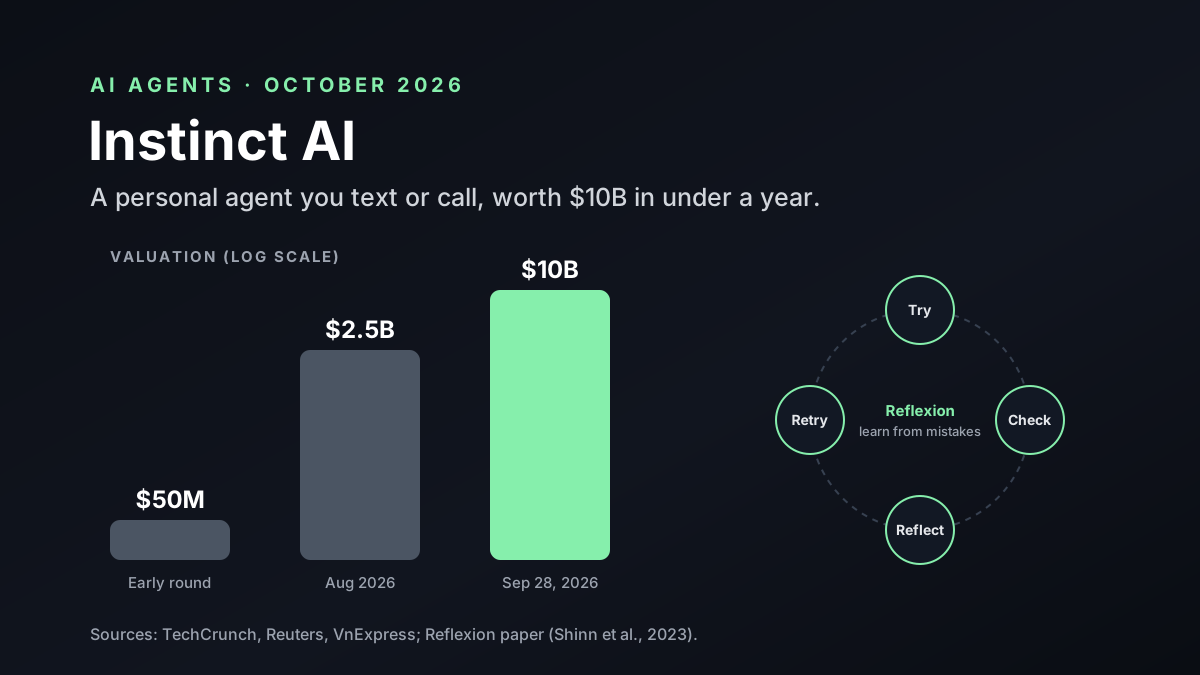
Instinct AI: What a $10B Personal Agent Teaches Builders
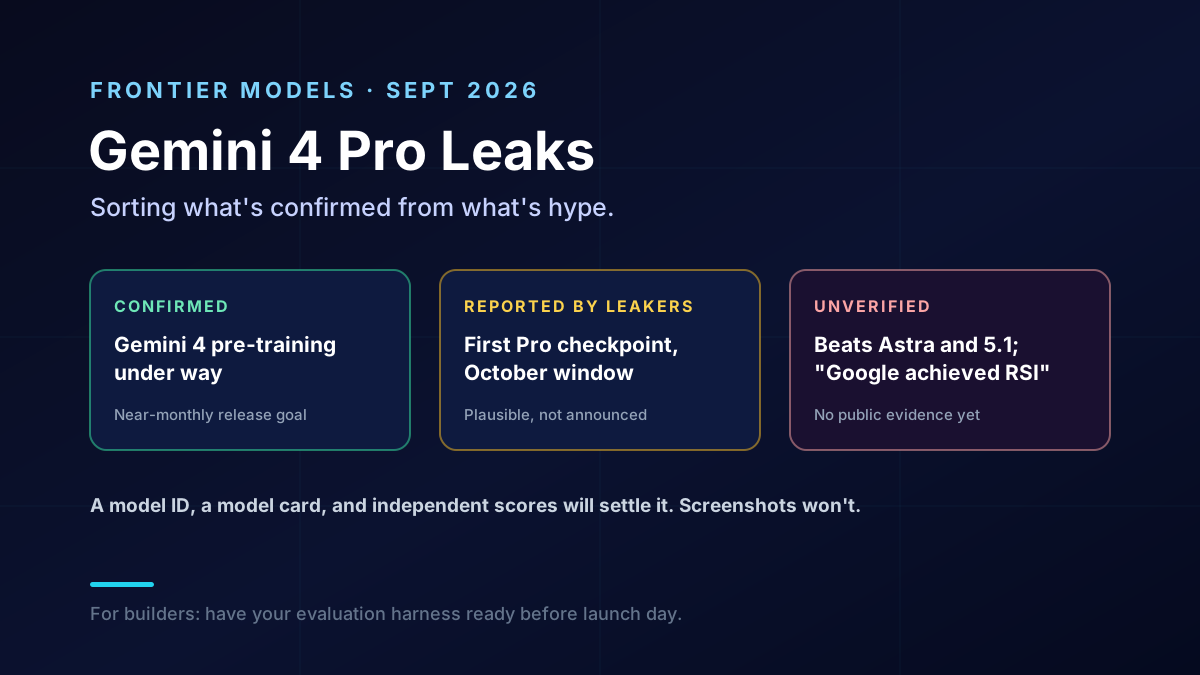
Gemini 4 Pro Leaks: What's Verified and What's Hype
Agentic Document Extraction and Databricks Precision Mode