September 14, 2026
Gemini 4 Pro Leaks: What's Verified and What's Hype
Gemini 4 Pro leaks say it'll beat GPT-6 Astra and Fable 5.1 and launch in October. Here's what's verified, what's rumor, and why the RSI claim falls short.
Article focus
A viral post says Gemini 4 Pro will beat GPT-6 Astra and Fable 5.1, that Google achieved RSI, and that launch is weeks away. We traced each claim to its source and sorted the confirmed from the rumored, with a practical read for teams.
Section guide
Gemini 4 Pro leaks claim Google's next flagship will beat GPT-6 Astra and Claude Fable 5.1 and launch in October, maybe late September. Some of that is plausible: a leaker says a first Pro checkpoint exists, and Google has confirmed Gemini 4 is in the works. But the benchmark wins are unverified, the dates are estimates, and the claim that Google "achieved RSI" isn't backed by public evidence.
Key Takeaways
- A viral X post from @Mr_Salio, viewed about 120,000 times, claims Gemini 4 Pro will beat GPT-6 Astra and Fable 5.1, that Google "achieved RSI," and that launch could come in October or late September.
- The release window traces to leaker Pankaj Kumar, who says Google has a first checkpoint of its next Pro model. Google hasn't confirmed a date, a name, or a checkpoint.
- What's confirmed: Gemini 4 is being built, Google wants a near-monthly release cadence, and Gemini 3.5 Pro has missed several promised dates since May.
- The RSI claim stretches real facts. Google says agent loops helped refine Gemini 3.8 Flash, but that's AI-assisted training, not a proven self-improving system.
- For builders, the smart move is to stay model-agnostic and have an evaluation set ready, so launch-day testing replaces leaked benchmarks.
What Do the Gemini 4 Pro Leaks Actually Say?
The Gemini 4 Pro leaks come mostly from one viral post and the leaker it builds on. A post from @Mr_Salio, viewed roughly 120,000 times, bundles five claims into a single list. They range from plausible to unsupported, so each one deserves its own look.
- Gemini 4 Pro "is expected to beat Astra and Fable 5.1."
- Google "achieved RSI," which supposedly makes its new model more powerful.
- Google has released the first checkpoint for its upcoming Pro model.
- Gemini 4 Pro could finally launch in October.
- A late-September launch is also possible.
Most of the concrete detail traces back about a week earlier to Pankaj Kumar, a leaker who posted that Google "released its first checkpoint for the upcoming Pro model." He expected a public release in October, plus a new Flash-Lite model in September. He also hedged the name: "This could be Gemini 4 Pro." The viral version dropped that hedge and stacked the RSI and benchmark claims on top.
A checkpoint is a saved snapshot of a model partway through development. Its existence tells you a model is real and moving through testing. It doesn't tell you how good the final version will be, or when it'll ship.
Which Gemini 4 Pro Claims Are Verified?
Only the least exciting ones. Here's each claim, what the public record shows, and where that evidence comes from.
| Claim | Status | What the evidence shows | Source |
|---|---|---|---|
| Gemini 4 is in development | Confirmed | Google's CEO said it's "investing heavily in a larger Gemini 4 base model" | Google's July 2026 earnings call |
| A first Pro checkpoint exists | Reported | A leaker says Google released one; Google hasn't commented | Pankaj Kumar on X |
| October launch, maybe late September | Estimate | No official date, model ID, or pricing | Leakers |
| Beats GPT-6 Astra and Fable 5.1 | Unverified | Leaked evals are described, but no numbers are public | Unnamed sources |
| Google achieved RSI | Not supported | Google describes agent loops that refine models, not a self-improving system | Google blog; researcher posts |
| Gemini 3.5 Pro was shelved | Disputed | SemiAnalysis reportedly says shelved; Google still lists it as coming soon | SemiAnalysis via reports; Google |
The honest read: this leak follows a familiar shape. A couple of plausible, hard-to-disprove details, like a checkpoint and a release window, lend credibility to bigger claims stacked on top. Each claim needs its own evidence, and the big ones don't have it yet.
When Is the Gemini 4 Pro Release Date?
There isn't an official one. The October window comes from leakers, and it's plausible. But Google's recent record on Pro-tier dates argues for holding it loosely.
Start with what Google has said. On its July earnings call, Sundar Pichai said that "releasing models almost at a monthly cadence is part of our road map as we are building Gemini 4 as well." Reports say Gemini 4 pre-training began on July 21, 2026. That confirms the model is coming. It doesn't confirm when.
Now the track record. Google announced Gemini 3.5 Pro at I/O on May 19, 2026, and Pichai said it'd arrive within a month. It didn't. It slipped past June, mid-July, and early August, and Google's site still lists it as "coming soon." Fortune reported that internal 3.5 Pro candidates were discarded because they didn't improve enough over Flash. SemiAnalysis reportedly concluded that the model was shelved in favor of Gemini 4.
Meanwhile, the Flash line hasn't slowed at all. Google shipped four Flash models in 106 days, and Gemini 3.8 Flash landed on September 2, just three weeks after 3.7 Flash. So Google can clearly ship fast. The open question is whether it can ship a Pro model that clears its own bar.
Two things make a firm October date hard to bank on:
- The timeline is tight. If pre-training started in late July, an October launch leaves about 10 to 14 weeks for training, tuning, safety testing, and rollout. That's fast for a flagship, unless the Pro model builds on earlier work, which is possible but unconfirmed.
- The bar keeps moving. A new Pro model has to clearly beat Google's own Flash models and rival flagships at launch, which is the test 3.5 Pro reportedly failed.
The honest read: treat October as a window, not a date. When Google publishes a model ID in AI Studio or Vertex AI, with pricing and a model card, that's your signal. A leaker's calendar isn't.
Did Google Really Achieve RSI?
Not by any public evidence. The claim takes real, notable facts about how Google trains models and stretches them into something much bigger. It's worth separating the two, because recursive self-improvement is one of the most consequential ideas in AI, and we covered why researchers worry about it earlier this month.
In the strong sense, RSI means an AI system improving its own capabilities in a sustained loop. Each generation builds a better next one, with little human involvement. Here's what actually happened.
- Google's official wording. In its Gemini 3.8 Flash announcement, Google said the model was built with "long-running agentic loops designed to recursively evaluate and refine the underlying models."
- A researcher's framing. Google DeepMind researcher Shunyu Yao called the release "one small step for model, one giant leap for RSI" in a post on X. That's one person's enthusiasm, not a company claim.
- A cryptic leak. On September 9, leak account Lyra posted "huge congRatulationS Indeed!" with capitals spelling RSI, and tagged Google DeepMind, according to a breakdown by Zeniteq.
- Real organizational signals. Demis Hassabis moved from CEO of Google DeepMind to chair and Alphabet chief scientist, telling staff he feels AGI "is close at hand." Sergey Brin has reportedly pushed teams to prioritize self-improvement research.
Add those up and you get a company taking RSI seriously as a research goal. Zeniteq, citing Reuters, says more than 1,000 researchers and engineers are involved in the broader effort. Google's AlphaEvolve system has already made a key training kernel 23% faster, cutting Gemini training time by about 1%.
What you don't get is proof of a working self-improving system. As Zeniteq's analysis puts it, the evidence "does not establish that DeepMind has completed a sustained, recursive improvement loop." Humans still set the goals, design the pipeline, and decide what ships.
The honest read: AI that helps evaluate and refine AI training is real, and it's likely part of why Google's Flash releases arrive every few weeks. But "agent loops refined the model" and "Google achieved RSI" are very different statements. The first is an engineering practice. The second would be one of the biggest events in computing, and it wouldn't arrive through a tweet with odd capital letters.
Can Gemini 4 Pro Beat GPT-6 Astra and Fable 5.1?
It might, but nobody outside Google can say yet. The claim rests on leaked internal evaluations that haven't been published, and "beat" depends a lot on which scoreboard you read.
Reports on the leaked evals say Gemini 4 Pro holds an edge over OpenAI's GPT-6 Astra on multi-step reasoning, and over Anthropic's Fable 5.1 on coding and software engineering tests. We couldn't find a named source, a benchmark list, or a single published number behind those claims. One widely shared write-up about the delay cites no source beyond a YouTube channel.
For context, here's where the current leaders stand on the one independent composite we track. On the Artificial Analysis Intelligence Index, Fable 5.1 scores 66 and GPT-6 Astra scores 61, while OpenAI's own launch table favors Astra on most rows. We broke that split down in our GPT-6 Astra vs Fable 5.1 comparison. Google's newest release, Gemini 3.8 Flash, ranks 10th on that same index, according to Fortune.
So a Gemini 4 Pro that tops both would be a big jump, but not an impossible one. Here's how to weigh it:
- For the claim: Google has huge compute, a confirmed larger base model, and a proven ability to ship quickly. Frontier leads have also been short-lived, so a new model topping the charts at launch is normal.
- Against the claim: leaked evals tend to be cherry-picked, internal test setups favor the home team, and Google's last Pro model reportedly missed its own internal bar.
- The scoreboard problem: a model can win a vendor table and lose an independent index, as Astra and Fable 5.1 already show. "Beats both" needs to say on what.
The honest read: we don't have a favorite in this race, and you shouldn't need one. The right response to "X will beat Y" is to wait for independent scores, then test on your own tasks. Leaked evals tell you a lab is confident. They don't tell you how a model handles your workload.
How Should Builders Read the Gemini 4 Pro Leaks?
As a prompt to get ready, not a reason to change plans. Leaks create pressure to wait, switch, or re-plan around a model you can't use yet. None of those is a good response.
A quick checklist for reading any model leak:
- Trace it to the first source. Viral posts often merge a real report with extra claims. Find the original post and see what it actually said.
- Separate named from anonymous. A company statement, a named analyst, and "leaked internal evals" carry very different weight.
- Look for the dropped hedge. The original report said "this could be Gemini 4 Pro." The viral version didn't.
- Treat dates as windows. Google's Pro-tier dates have slipped several times this year.
- Ask what "beat" means. Which benchmark, whose test setup, and at what price?
And a few things worth doing now, whatever Gemini 4 Pro turns out to be:
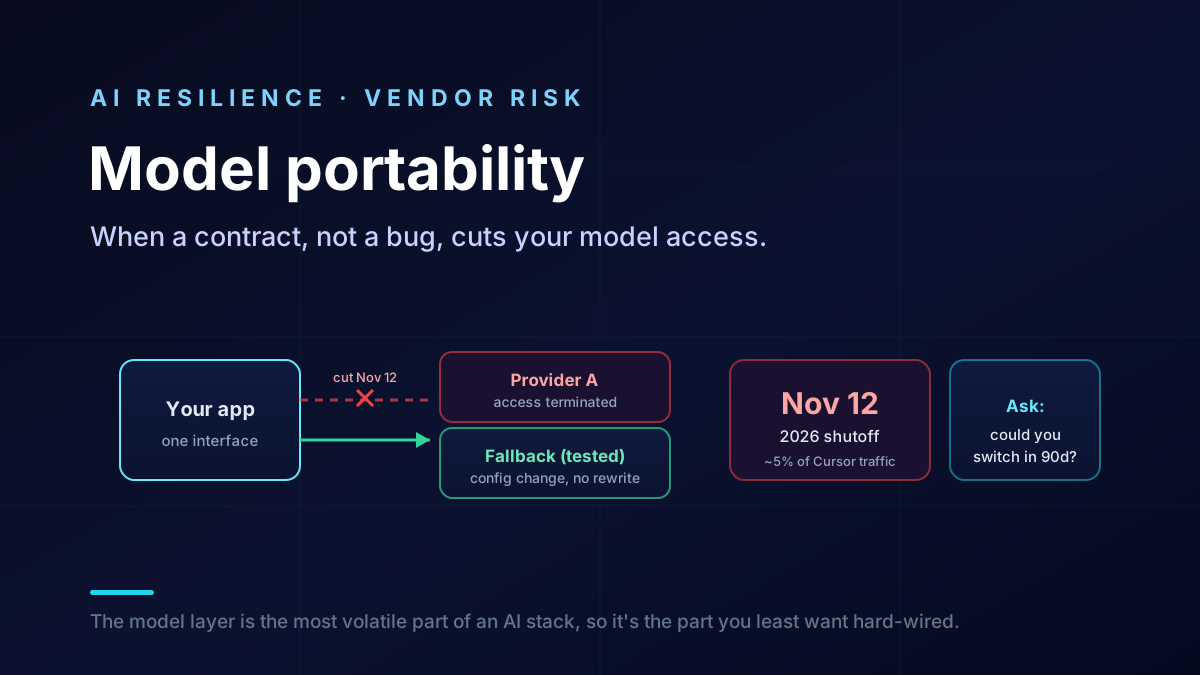
- Keep routing model-agnostic. If swapping models is a config change, a new release is an opportunity rather than a migration project. We cover tier-based routing in Gemini 3.6 Flash vs Claude Opus 5.
- Build your evaluation set today. Pull 50 to 200 real tasks from your own workload, with expected outputs, so you can score any new model within a day of launch. Our guide to AI agent evaluation walks through the setup.
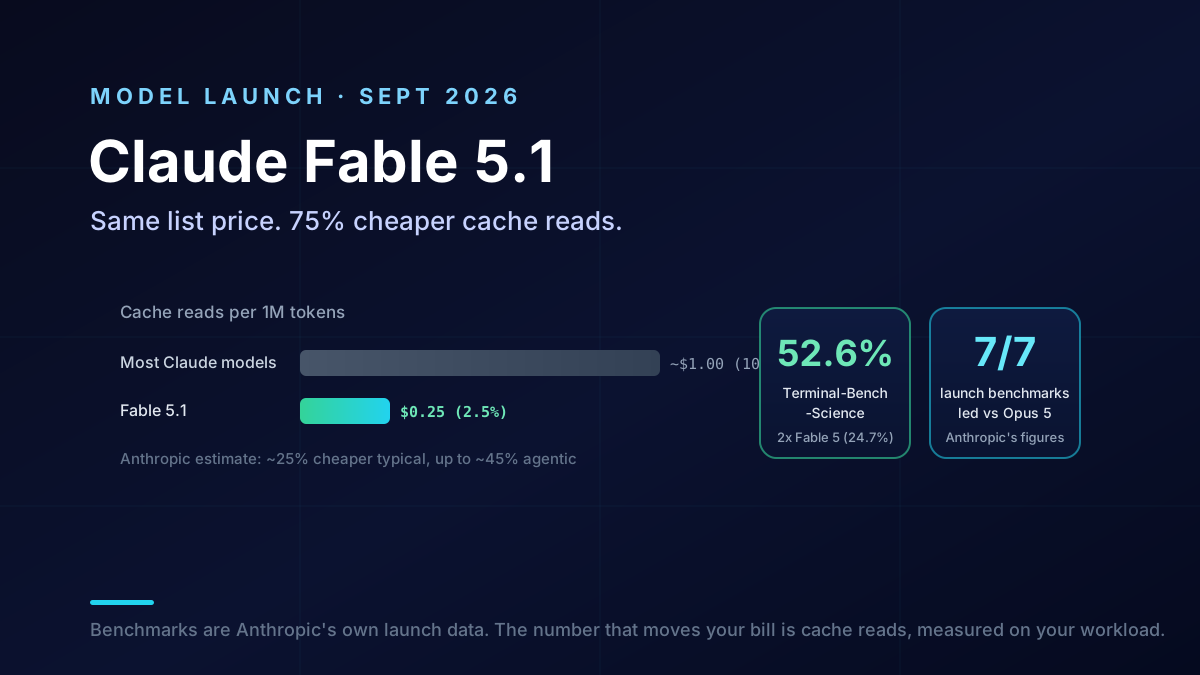
- Measure cost per completed task. List prices hide the real gap, especially cache pricing in agent loops, as the Fable 5.1 launch showed with its 75% cache cut.
- Don't pause a roadmap for a rumor. The model you can use today beats the one you can't.
What Would Confirm These Leaks?
Public, checkable artifacts from Google about Gemini 4 Pro. When these appear, the leaks stop being leaks:
- A model ID and pricing in Google AI Studio or Vertex AI.
- A model card with benchmark results and safety evaluations.
- An official Google blog post naming the model and its availability.
- Independent scores from Artificial Analysis and other third-party testers, run on their own setups.
- Hands-on reports from developers testing it on real work, not just demos.
Until then, the most accurate summary is short. Gemini 4 is real, a Pro launch this fall is plausible, and anything more specific is a claim waiting for evidence. That's not a knock on Google. It's how every lab's pre-launch rumors should be read, including the ones about GPT-6 Astra before it shipped.
How Van Data Team Helps Teams Stay Model-Ready
We help teams build AI systems that can use new models without being rebuilt for each one. That means model-agnostic routing, evaluation sets drawn from your real workload, cost tracking per completed task, and review gates that catch regressions before users do.
When Gemini 4 Pro lands, or the next Astra or Fable release does, the teams that benefit first are the ones that can test it the same afternoon. If you want that in place before the next launch, our work on AI agent evaluation and production AI agent operations is where we'd start.
Article FAQ
Questions readers usually ask next.
These short answers clarify the practical follow-up questions that often come after the main article.
Need a similar system?
If this article maps to a workflow your team already operates, the next step is usually a scoped review of the system, constraints, and rollout path.
Book your free workflow review here.
Related articles
View all
The iPhone Duo: Apple's First Foldable iPhone
Claude Fable 5.1: Same Price, 75% Cheaper Cache
Model Portability: The Cursor-OpenAI Cutoff Lesson