Anthropic Revenue Hits $16.8B: What It Means for AI Buyers
Anthropic revenue reached $16.8B in Q3, up 45%, investors were told before its IPO. What the numbers show, what they leave out and what it means for AI buyers.
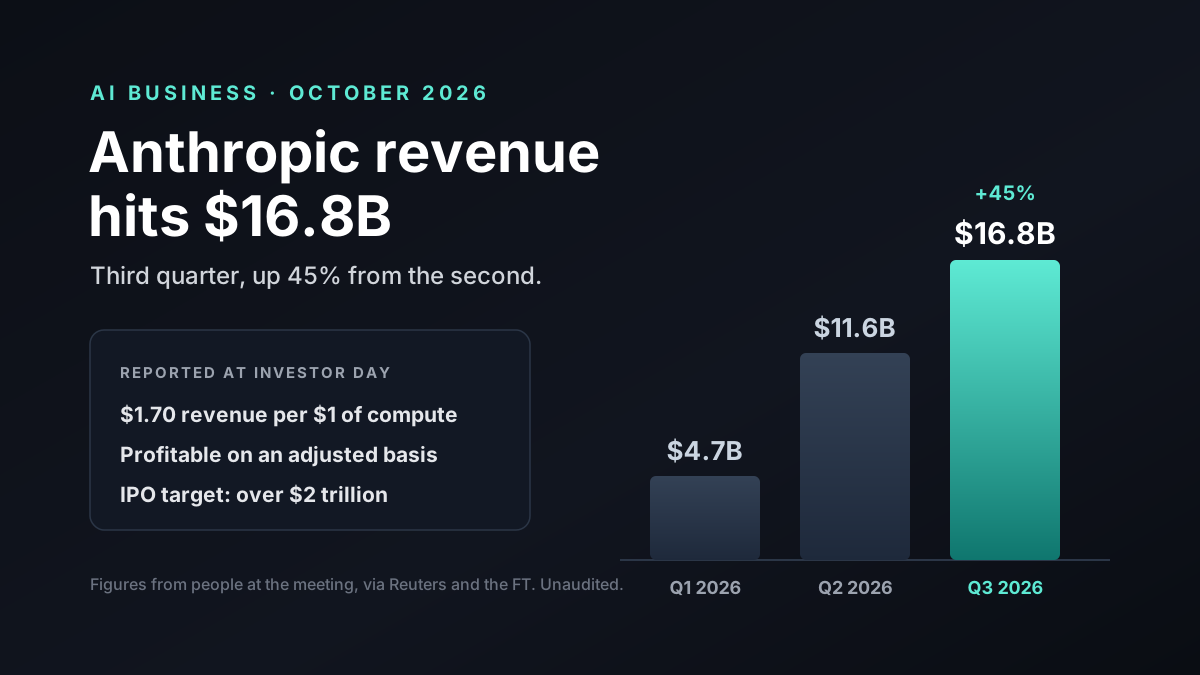
Anthropic revenue reached about $16.8 billion in the third quarter of 2026, up 45% from the second quarter, the company told prospective investors on October 14. It also said it was profitable on an adjusted basis. The numbers came from people at a closed meeting before Anthropic's planned IPO, so no auditor has checked them. Still, they speak to the question the market keeps asking: is anyone making real money from AI?
Disclosure: Van Data Team builds with Claude and other models, and this article was researched with Claude, which Anthropic makes. We've linked each number to its source, labeled our own math and included the risks as well as the growth. This is not investment advice.
Key Takeaways
- Anthropic told investors third-quarter revenue was about $16.8 billion, up 45% from $11.6 billion in the second quarter and $4.7 billion in the first.
- It said it was profitable on an adjusted basis and cash-flow positive, earning about $1.70 in revenue for every dollar spent on computing power.
- Growth is slowing in percentage terms: revenue grew about 147% from the first quarter to the second, and 45% from the second to the third, by our math.
- The numbers are unaudited, the adjustments behind the profit claim aren't public, and Anthropic still carries at least $518 billion in long-term compute commitments.
- For AI buyers, a well-funded vendor lowers one risk, but capacity, pricing and lock-in still need managing.
Anthropic Revenue at a Glance
| Period | Revenue | Change | Source |
|---|---|---|---|
| Full year 2024 | About $386 million | Not applicable | Draft prospectus, via Reuters |
| Full year 2025 | About $4.59 billion | About 12 times 2024 | Draft prospectus, via Reuters |
| Q1 2026 | $4.7 billion | Not applicable | Investor day, via Reuters |
| Q2 2026 | $11.6 billion | About +147% (our math) | Investor day, via Reuters |
| Q3 2026 | $16.8 billion | +45% | Investor day, via Reuters and the FT |
| End of 2026 (projected) | $110 billion run rate | Estimate, not a result | Analysts and investors, via Reuters and WSJ |
A run rate isn't the same as revenue. Think of it as a snapshot. It takes a short period, such as a month, and multiplies it out to a year. That's why run-rate headlines often look much bigger than what a company has actually earned.
How Anthropic Makes Its Money
Anthropic sells access to its Claude models in a few main ways. It hasn't said publicly how its revenue splits across them.
- The API: businesses pay per token to build Claude into their own apps, agents and tools.
- Cloud partners: many companies buy Claude through Amazon Bedrock, Google Cloud and Microsoft, which also count as big partners.
- Plans for people and teams: paid Claude plans for individuals, teams and large firms, billed per seat.
- Coding tools: Claude Code and similar products, which run large numbers of tokens for software teams.
Most of the growth story is about businesses, not consumers. Agents and coding tools use far more tokens than a chat, so a single company can turn into a very large customer fast. That also explains the customer risk in the filing: when two buyers make up nearly a quarter of revenue, losing one would hurt.
What Anthropic Told Investors
The numbers came from an investor day at Anthropic's San Francisco headquarters on October 14, 2026. Reuters reports that attendees met chief executive Dario Amodei and chief financial officer Krishna Rao, and two people who attended described the figures. The Financial Times first reported the third-quarter number.
Here's what was reported from the meeting:
- Revenue: about $16.8 billion in the third quarter, up 45% from the second.
- Profit: profitable on an adjusted basis in the third quarter.
- Cash: cash-flow positive, with about $1.70 in revenue for each dollar spent on computing power, according to the FT as cited by CNBC.
- Outlook: analysts who met executives earlier that week estimated the annual revenue run rate could reach $110 billion by year end.
- Operations: executives described using the company's own AI to run parts of the business, including designing a custom chip.
Anthropic didn't comment publicly. Until a public prospectus or audited results appear, treat every figure here as reported, not confirmed.
How Fast Is Anthropic Revenue Growing?
Very fast, but the pace is easing. Revenue more than doubled from the first quarter to the second, then grew 45% from the second to the third. That's still a huge number for a company this size, but the percentage is coming down as the base gets bigger.
The run-rate milestones tell the same story. Bloomberg reported a run rate above $9 billion in January 2026. CNBC reported that it reached $65 billion at the end of July.
Slower percentage growth is normal. Adding $5 billion to a $4.7 billion base more than doubles it. Adding the same amount to $11.6 billion is under half. The real question is whether the dollar gains keep getting bigger, and so far they have: about $6.9 billion more in the second quarter, then about $5.2 billion more in the third.
Our math:
- $16.8 billion in one quarter is about $67 billion a year if it held flat, roughly in line with the July run rate.
- Reaching a $110 billion run rate by December would need about $9.2 billion of revenue in that month, against an average of about $5.6 billion a month in the third quarter.
- Revenue for the first three quarters of 2026 adds up to about $33.1 billion, roughly seven times all of 2025.
So the year-end target assumes growth speeds up again in the fourth quarter, perhaps from new models, bigger company deals or more coding and agent work that burns through tokens. That's possible, but it's a forecast, not a result.
What "Profitable on an Adjusted Basis" Means
This part needs the most care. An adjusted profit leaves out some costs, such as stock paid to staff or one-off charges. Anthropic hasn't said which costs it left out. So we can't tell how close the number is to a normal profit under US rules.
The 2025 numbers show why the details matter. According to Anthropic's draft prospectus, as reported by Reuters and summarized by Implicator:
- Operating loss: about $8.06 billion on revenue of about $4.59 billion, or roughly $1.76 lost for each dollar of revenue.
- Net loss: about $42 billion, of which about $34 billion was an accounting charge tied to the rising value of financing that could convert into shares, not cash spent running the business.
- Compute and infrastructure: about $7.33 billion, more than half of operating costs.
Going from a big loss in 2025 to an adjusted profit in the third quarter of 2026 would be a sharp turn. It's believable given how fast sales grew. But the checked numbers in the public filing will be the real test.
Is Anthropic Revenue Outrunning Its Compute Bill?
On the reported numbers, yes, for now. The FT's figure of about $1.70 in revenue per dollar of compute means compute cost about 59 cents for each dollar of revenue in the third quarter, by our math. That leaves room for salaries, research and everything else, which fits the adjusted-profit claim.
The long-term bill is much bigger. The draft filing lists at least $518 billion in deals over about ten years with six partners. About 80% of that can't be cancelled, or must be paid however much Anthropic uses.
| Partner | Reported commitment | Period |
|---|---|---|
| At least $111.1 billion | April 2026 to July 2033 | |
| Amazon | $110 billion | May 2026 to April 2036 |
| Broadcom-related leases | About $161.2 billion | Largely non-cancellable |
| Microsoft | $31.4 billion | November 2026 to May 2033 |
| xAI arrangements | Up to $84.5 billion | Through 2029, largely cancellable |
Our math: spread evenly, $518 billion over ten years is about $52 billion a year, roughly what Anthropic would book in all of 2026 if fourth-quarter revenue tops $19 billion. The real schedule isn't even, but the point stands. Revenue has to keep growing for years to cover commitments that were signed in advance.
Google and Amazon are also big investors and sales partners, as well as rivals. That's normal in AI right now. It's one more thing investors will weigh.
The Anthropic IPO: Valuation, Timing and Risks
The investor day was meant to introduce the company to prospective buyers before its listing. Reuters reports that Anthropic is targeting a valuation of over $2 trillion and that the debut is likely to come after the November US midterm elections. It's expected to list before OpenAI. That would make it the first big test of how much public investors want to own a leading AI lab.
What we know and don't know:
- Filing: the prospectus was filed confidentially, so the full audited numbers aren't public yet.
- Timing: no date has been confirmed. Reports point to after the midterms.
- Valuation: over $2 trillion is a target in reports, not a priced offer.
- Risks in the filing: about 80 of its 261 pages cover risk factors, and it warns that advanced AI could pose "catastrophic or existential risks to humanity."
- Customer concentration: nearly a quarter of 2025 revenue came from two customers, who aren't named.
We won't tell you whether to buy the shares. That depends on your own situation, and a licensed adviser is the right person to ask. What we can do is explain what the numbers mean for companies that use these models.
What Could Slow Anthropic Revenue Growth?
Fast growth can stall. Here are the risks we'd watch, in plain terms:
- Rivals cutting prices. Google launched Gemini 4 Argon with a low starting price, and OpenAI is pushing GPT-6 Astra. Price wars squeeze margins.
- Big customers leaving. With two buyers at nearly a quarter of 2025 revenue, one lost deal would show up fast.
- Not enough chips. Revenue can't grow faster than the compute that serves it, and new data centers take time.
- Costs that don't shrink. The compute deals are mostly fixed. If sales slow, the bills don't.
- Rules and trust. New AI laws, safety incidents or data disputes could slow sales to large firms and governments.
None of these is a sure thing. Each is a reason the $110 billion run-rate estimate should be read as a target, not a promise.
Why the Market Is Watching Anthropic Revenue
The news landed in a rough week for AI stocks. On October 14, the Nasdaq fell 1.88% and the S&P 500 fell 1.11%, as hotter inflation data and worries about debt-funded AI spending hit the sector, according to CNBC's market coverage. Shares of AI cloud provider CoreWeave dropped more than 15% that day.
That's why so many outlets ran the Anthropic numbers at once. Many investors see its sales as a gauge for the whole AI market. If a model maker can grow this fast and still cover its compute costs, the huge spending on chips and data centers looks easier to defend. If it can't, the spending looks riskier.
One company's quarter can't settle that debate. But it's some of the clearest proof so far that heavy AI spending can turn into real sales.
What Anthropic Revenue Means for AI Buyers
If your company uses Claude, or is choosing between AI vendors, here's how we read the news. These are our views, not Anthropic's.
- The vendor looks safer. A supplier that's growing fast and says it covers its compute costs is less likely to cut service or disappear. That matters for projects that run for years.
- Capacity may stay tight. Demand growing this fast can mean rate limits, waitlists or priority tiers, especially for the newest models.
- Prices may not keep falling for every model. Cheap small models, like the one in our Haiku 5.5 cost breakdown, sit next to premium ones. Public investors will push for profit, so watch how plans and limits change.
- Lock-in doesn't go away. A strong vendor is still one vendor. Keep prompts, tests and routing easy to move, so you can switch if price or quality changes.
- Contracts deserve a fresh look. Before an IPO, it's a good time to check data terms, price-change notice and exit clauses.
- Budgets need a buffer. If your AI bill is growing with usage, plan for price or limit changes next year rather than assuming today's rates hold.
Our model portability lesson explains why a thin routing layer makes it cheaper to move between providers when you need to.
Questions to Ask Any AI Vendor Now
Strong revenue doesn't replace due diligence. Whether you buy from Anthropic, OpenAI, Google or a smaller lab, ask:
- What happens to our price if we double usage next year, and how much notice do you give before changes?
- What capacity can you guarantee for our main model, and what happens during peak demand?
- How long will our current model version stay available, and how much notice do you give before retiring it?
- Where is our data processed and stored, and is any of it used for training?
- What do we get if the service misses its targets, such as uptime or response time?
Write the answers into the contract. Verbal assurances matter less once a company is public and under pressure to hit quarterly numbers.
What to Watch Next for Anthropic
A few events will show whether the reported numbers hold up:
- The public prospectus: audited financials, the full list of adjustments and an updated risk section.
- The IPO price and date: whether the $2 trillion target survives a market that sold off AI stocks hard in the very week of the investor day.
- Fourth-quarter growth: whether revenue climbs fast enough to hit the $110 billion run-rate estimate.
- OpenAI's listing: a second big AI developer going public will give investors a direct comparison.
- Compute deals: new or revised commitments with Google, Amazon, Microsoft and others.
We'll update this article if Anthropic publishes official figures.
Anthropic Revenue: Our Take
The reported numbers are strong. Revenue of $16.8 billion in a quarter, adjusted profit and positive cash flow would put Anthropic among the few AI developers showing that the business can pay for itself, at least for now.
The caveats are just as real. No auditor has checked the figures. The profit leaves out costs we can't see, growth is slowing in percentage terms, and the company owes hundreds of billions for compute. Both things can be true at once, and the public filing will tell us more.
For companies that use AI, the practical lesson is simple. A healthier vendor is good news, but it's not a reason to stop managing cost, capacity and lock-in.
How Van Data Team Helps Teams Choose AI Vendors
We help companies build AI systems that don't depend on a single provider. That means side-by-side testing on real work, cost tracking per task, routing that can switch models and contracts that hold up when vendors change prices or terms.
If you're reviewing your AI suppliers after this news, our AI governance guide is a good place to start.

Founder, Van Data Team - builds Vanaxity, the AI agent system for SEO, GEO, and AEO, and leads data engineering delivery for B2B teams.
About the authorArticle FAQ
Questions readers usually ask next.
These short answers clarify the practical follow-up questions that often come after the main article.
Need a similar system?
If this article maps to a workflow your team already operates, the next step is usually a scoped review of the system, constraints, and rollout path.
Book your free workflow review here.
Consultation
Scope your next AI workflow.
Share the system and blockers. We will map fit, gaps, and the next step.