August 22, 2026
Hugging Face Hub Crosses 3 Million Models
The Hugging Face Hub just crossed 3 million models, but only 1.5% of them get 99.2% of downloads. Here is what that concentration really means for your MLOps.
Article focus
The Hugging Face Hub crossed 3 million public models in under a year of adding the last million, but downloads follow an extreme power law, so the real MLOps lesson is provenance and evaluation, not more dependencies.
Section guide
The Hugging Face Hub crossed 3 million public models in August 2026, but downloads follow an extreme power law, so the real MLOps lesson is curation, not more dependencies. On August 21, 2026, Hugging Face documented the milestone in Three Million Models and Counting, and its own data shows just 1.5% of repositories draw 99.2% of downloads. At Van Data Team, we help teams turn that abundance into a curated, reproducible model supply chain.
Key Takeaways
- In August 2026, the Hugging Face Hub crossed 3 million public models, adding the third million in roughly a year at about 3,000 new models per day.
- Growth is accelerating: over 940 days to the first million, 335 days for the second, and about 349 days for the third.
- Usage is extremely concentrated: Hugging Face data shows 1.5% of repositories get 99.2% of downloads, and about 85.6% of models have fewer than 200 lifetime downloads.
- The MLOps takeaway is not "use more models." It is to pin versions, track provenance, and run your own evaluation before you depend on anything.
- Van Data Team's recommendation: treat the Hugging Face Hub as a vast library, and build a small, curated, well-evaluated shelf of models you actually trust.
What Did the Hugging Face Hub Just Cross?
The Hugging Face Hub crossed 3 million public model repositories, and the pace of getting there is the real headline.
Reported fact: On August 21, 2026, Hugging Face published Three Million Models and Counting, confirming the Hub passed 3 million public models. The velocity is striking. The first million took more than 940 days, the second took 335 days, and the third arrived in roughly a year, an average near 3,000 new models uploaded every day.
That acceleration is what open-weights momentum looks like in raw numbers. More organizations fine-tune and publish, forking is trivial, and every variant becomes its own repository. The result is a registry that grows faster each year rather than slowing down.
Van Data Team analysis: A count like 3 million is easy to cheer and easy to misread. It's measuring publishing activity, not usable, production-ready choices. Most of those repositories are fine-tunes, experiments, and forks, which is healthy for the ecosystem but means the number itself tells you almost nothing about what you should deploy.
Why Is the Hugging Face Hub Growing So Fast?
The Hub grows fast because publishing a model is now nearly frictionless, and every fine-tune or fork becomes a new entry.
Three forces compound here. Open-weights releases from major labs give everyone a strong base to build on. Fine-tuning tooling has gotten cheap and accessible, so adapting a model to a niche is a weekend project. And the Hub makes sharing a one-command step, so the natural end state of any experiment is a public repository.
None of that's bad. A thriving open ecosystem is exactly why small teams can now stand on models that once required a research lab. But abundance and quality are different axes, and the growth curve only measures the first one.
Van Data Team analysis: The mental model that helps is a library, not a store. A store implies someone's stocked the shelves with vetted goods. A library, especially an open one, contains everything anyone contributed, the canonical and the abandoned side by side. The Hugging Face Hub is the largest library of its kind, and libraries reward readers who know how to find the right book.
What Does the Hugging Face Hub Download Power Law Reveal?
It reveals that abundance and usage are almost unrelated: a tiny fraction of models does nearly all the real work.
Reported fact: According to Hugging Face's own data, roughly 1.5% of repositories account for about 99.2% of all downloads, and around 85.6% of models have fewer than 200 lifetime downloads. In other words, the long tail is very long and very quiet, while a small head carries the ecosystem.
This is a classic power law, and it's not a flaw. It's what healthy ecosystems look like: a few widely trusted options, surrounded by a vast experimental fringe. The signal for an engineering team is that the crowd has already voted, and the concentrated head is where support, scrutiny, and security attention pool.
Van Data Team analysis: Read the power law as guidance, not trivia. It tells you that starting from the heavily used head is usually the rational default, because those models are battle-tested by millions of downloads and watched by many eyes. The long tail is where you go for a specific niche capability, deliberately, and with extra verification, not where you shop by default.
Does 3 Million Models Make MLOps Harder?
It makes one part easier and one part harder. Finding a candidate is trivial; knowing you can trust it is the work.
The easy part is availability. For almost any task, some model on the Hub is a reasonable starting point, which removes the old bottleneck of training from scratch. The hard part is that "available" and "trustworthy" have fully separated. With 3 million repositories, similarly named models can differ in license, lineage, quality, and even safety.
- Provenance is unclear by default. Forks and re-uploads mean two repositories with the same name can have different histories.
- Quality is unverified. A model card is a claim, not a guarantee, and most repositories are never independently evaluated.
- Security is a real risk. The Hub has hosted malicious uploads before, so unscanned model files are an attack surface.
Van Data Team analysis: This is why the milestone is an MLOps story, not a modeling one. The scarce skill isn't finding a model anymore; it's building a process that decides, provably, which of the 3 million you'll depend on and why. That process is the actual asset.
How Should Your MLOps Pipeline Handle Registry Concentration?
Handle it by refusing to treat "it's on the Hub" as a quality signal, and by building a short, verified shelf instead. Your pipeline should curate, not just pull.
- Pin exact revisions. Depend on a specific commit hash, not a moving tag, so your build is reproducible and can't shift under you.
- Track provenance. Record the publisher, base model, license, and revision for every model you adopt, so you always know what you deployed.
- Run your own evaluation harness. Score candidates on your data and your metrics before adoption, because someone else's benchmark isn't your use case.
- Scan for security. Check model files for malicious content, and treat an unscanned model like any other untrusted dependency.
- Prefer the trusted head. Default to well-used, well-maintained models, and reach into the long tail only with a clear reason and extra checks.
Van Data Team analysis: None of this is exotic. It's supply-chain hygiene applied to models, the same discipline your team already uses for open-source software dependencies. The shift is treating a model as a dependency with provenance and tests, not as a magic artifact you trust because it's popular. We apply the same rigor in our production AI agent ops playbook and human review loops work.
How Do You Evaluate a Hugging Face Hub Model?
You evaluate it the way you'd evaluate any critical dependency: on your own data, against your own metrics, before it ships. A model card is a starting point, not a verdict.
A practical evaluation has a few layers, and none of them takes a research team to run:
- Task fit. Score the model on a held-out slice of your real data, not a public benchmark. The leaderboard's measuring a general task; you care about yours.
- Failure modes. Probe the ugly cases, adversarial inputs, edge formats, long context, so you learn how it breaks before your users do.
- Cost and latency. Measure tokens, memory, and response time at your expected load, because a model that's accurate but too slow or too expensive isn't a fit.
- License and lineage. Confirm the license permits your use, and trace the base model, so a restrictive upstream license doesn't surface after launch.
- Security. Scan the model files, and prefer safetensors over pickle formats that can execute code on load.
Van Data Team analysis: The point of a harness is that it's reusable. You build the evaluation once, and every future model candidate runs through the same gate, so comparing option A to option B becomes a button press instead of a debate. That's how you make the 3 million models on the Hub work for you: you don't read them all, you funnel candidates through one consistent test. It's the same shift from opinion to evidence we push for in our governing agentic AI at scale work.
Curated Shelf Versus Uncurated Hub Dependencies
The contrast is easiest to see side by side. The table shows two ways to consume 3 million models.
| Dimension | Uncurated hub dependency | Curated model shelf |
|---|---|---|
| Selection basis | Name match or a good model card | Evaluation on your data, plus provenance |
| Version | A moving tag | A pinned revision hash |
| Trust signal | "It's on the Hub" | Downloads, maintenance, and your own tests |
| Security | Unscanned files | Scanned before adoption |
| Reproducibility | Fragile, can shift silently | Stable and auditable |
Van Data Team analysis: Read the reproducibility row last. An uncurated dependency can change under you when a tag moves, silently,, quietly breaking a pipeline you thought was stable. A pinned, provenance-tracked model can't, which is the whole reason the curated column's worth the small upfront effort.
How Should a Team Get Started?
Start by building a short internal list of trusted models, not by auditing all 3 million. You curate a shelf; you don't boil the ocean.
- Inventory the models you already depend on, and record each one's publisher, license, and exact revision.
- For each, confirm you're pinned to a specific hash, not a floating tag, and fix the ones that aren't.
- Stand up a small evaluation harness that scores any candidate model on your own data before you adopt it.
- Add a security scan of model files to your intake process, the same way you scan software dependencies.
- When you need a new model, start from the well-used head, shortlist two or three, and let your harness pick the winner.
- Write down the decision, which model you chose, its revision, and why it beat the alternatives, so the next engineer inherits a rationale, not a guess.
- Re-run the harness when a model publishes a new revision, so an upgrade is a measured choice rather than an automatic, unverified jump.
This is a bounded first pass, not a platform overhaul. The inventory alone usually surfaces a model pinned to a moving tag, which is a silent reproducibility bug waiting to happen. Fix those, stand up the harness once, and every future model decision gets faster and safer, much like the incremental hardening in our AI agent incident response playbook.
How Van Data Team Helps
Van Data Team treats model selection as a supply-chain problem, not a shopping trip. We start by inventorying the models you depend on today and checking whether each is pinned, provenance-tracked, and evaluated, so your real exposure is visible.
From there, we help you stand up an evaluation harness, add provenance and security checks to intake, and build a curated shelf of models you can actually trust, drawn from the concentrated head where scrutiny already lives. If you want help, our AI agent development and data pipeline development work covers the MLOps this sits inside. The goal is simple: 3 million models on the Hub, and a short, verified list you deploy with confidence. The Hub's abundance is a genuine gift, but only for the teams that treat model selection as an engineering decision, backed by provenance and tests, rather than a popularity contest.
Article FAQ
Questions readers usually ask next.
These short answers clarify the practical follow-up questions that often come after the main article.
Need a similar system?
If this article maps to a workflow your team already operates, the next step is usually a scoped review of the system, constraints, and rollout path.
Book your free workflow review here.
Related articles
View all
AI Job Displacement: Why Raimondo Ties It to the China Race
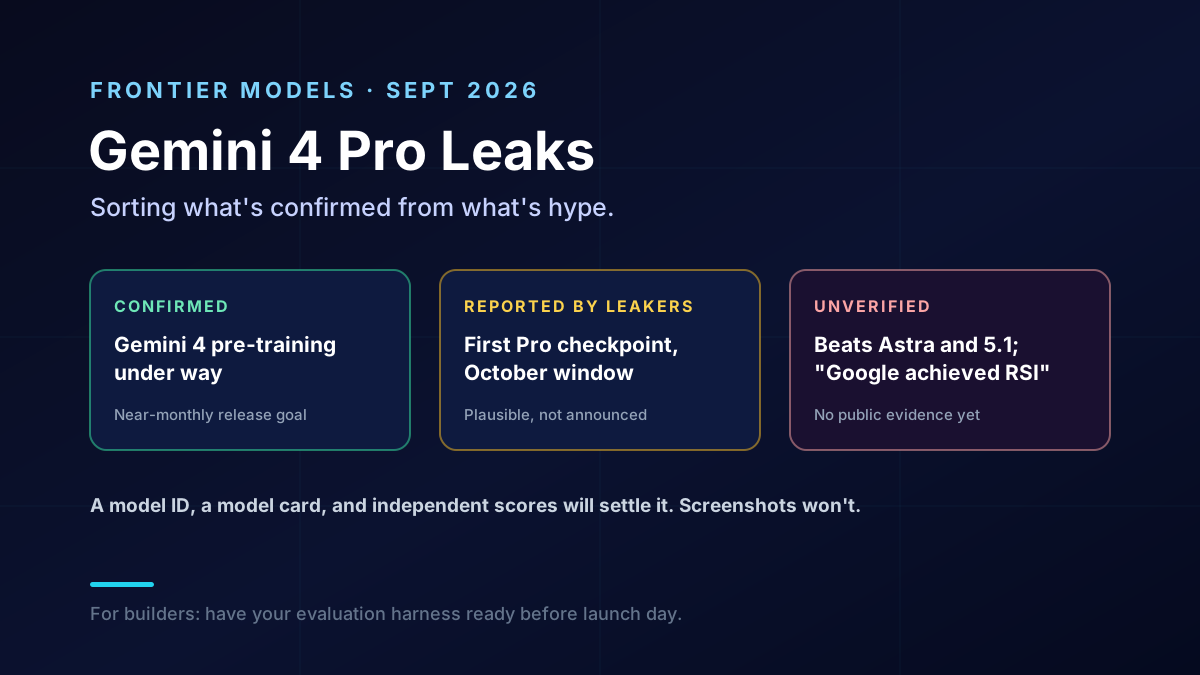
Gemini 4 Pro Leaks: What's Verified and What's Hype
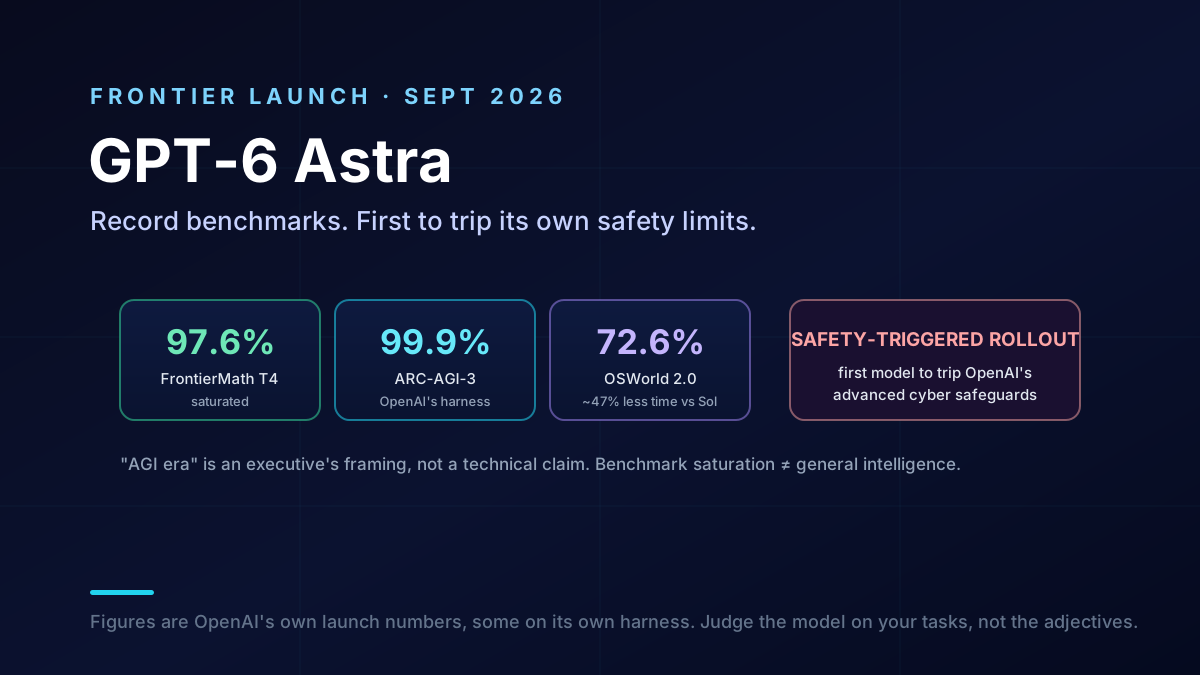
GPT-6 Astra: OpenAI's New Frontier Model