June 30, 2026
Governing Agentic AI at Scale: Securing AI-Generated Code in the CI/CD Pipeline
Governing Agentic AI At Scale: Securing AI-Generated Code In The CI/CD Pipeline guide for production teams: compare workflow fit, risk, cost, review burden.
Article focus
Governing Agentic AI at Scale: Securing AI-Generated Code in the CI/CD Pipeline means putting identity, provenance, policy gates, isolation, monitoring, and escalation around autonomous coding systems before their output reaches production.
Section guide
Governing Agentic AI at Scale: Securing AI-Generated Code in the CI/CD Pipeline means putting identity, provenance, policy gates, isolation, monitoring, and escalation around autonomous coding systems before their output reaches production. The buyer problem is immediate: software teams want the delivery speed of coding agents, but existing DevOps controls still assume a human engineer owns every commit, build, and release.
JFrog reports that 25% to 40% of enterprise code is now AI-generated, and its June 30, 2026 webinar frames agentic AI governance as a CI/CD issue, not just an AI ethics issue. Cybersecurity Dive also reports that roughly one-fifth, about 20%, of firms are entirely unsure whether their AI tools have been compromised or breached. That visibility gap is where governance work begins.
At Van Data Team, we start by mapping the workflow before naming the stack: which agents can write code, which systems they can touch, what evidence the pipeline captures, and where a human must approve risk. Our AI agent development work treats review gates, tool permissions, monitoring, and fallback behavior as part of the delivery system, not an afterthought.
Tooling And Landscape Fit
Do not evaluate the topic in isolation. Compare the main approach against adjacent frameworks, orchestration choices, and runtime controls so the reader can see when each option fits.
Review adjacent options such as LangGraph, LangChain, CrewAI, native function calling, MCP, Airflow, dbt before choosing the implementation path.
Operational Budget
Before production rollout, score each candidate on accepted-output cost, latency, token budget, retry rate, reviewer minutes, failure recovery, and evaluation results. Vendor token pricing is only the starting point; the useful metric is cost per approved workflow result.
Key Takeaways
- AI-generated code now belongs inside normal software delivery governance, with extra evidence around agent identity, prompt context, artifact provenance, and approval history.
- CI/CD is the right control plane because it already decides what code can build, test, package, deploy, and roll back.
- Human review should be risk-based. Low-risk agent changes can pass through policy checks, while dependency, credential, infrastructure, and production-release changes should escalate.
- DORA-style metrics still matter, but they are incomplete when dashboards cannot distinguish human-authored changes from autonomous agent activity.
- The practical operating model is provenance, signing, policy gates, isolated execution, continuous monitoring, and clear rollback ownership.
| Pipeline decision point | Governance question | Control to apply |
|---|---|---|
| Code generation | Which agent created the change, and from what task context? | Agent identity, prompt reference, task ticket, repository scope |
| Commit and pull request | Is the change attributable and reviewable? | AI-generated tag, human owner, diff classification |
| Build and test | Can the artifact be trusted? | Dependency scan, secret scan, policy gate, signed build |
| Deploy and release | Is the risk acceptable for the target environment? | Risk-based approval, environment isolation, rollback plan |
| Monitoring | Did agent behavior or application behavior drift? | Agent activity logs, deployment signals, incident escalation |
"25% to 40% of enterprise code is now AI-generated." - JFrog
What Agentic AI Governance Means in CI/CD
Agentic AI governance in CI/CD means controlling how autonomous coding agents create, modify, test, package, and release software. It is broader than code review because the risk is not only whether the code looks correct. The pipeline also needs to know who or what initiated the change, which tools were used, what artifact was produced, which checks passed, and who is accountable after deployment.
There is a practical difference between AI-assisted coding and agentic coding. In AI-assisted coding, a developer usually asks for help, copies or accepts a suggestion, and remains the accountable actor. In agentic coding, the system may plan tasks, edit files, open pull requests, update dependencies, trigger builds, or move work toward deployment with limited human intervention.
That shift breaks informal governance. A pull request title may say "update auth middleware," but the operational question is sharper: did a human engineer make that decision, did an agent infer it from a prompt, or did a workflow automation chain trigger it from another system?
The mistake we see is treating agentic coding as ordinary automation. It is not. Ordinary automation repeats a known workflow. An agent can interpret context, select tools, and generate novel changes. That makes provenance and policy enforcement central.
Why AI-Generated Code Changes the DevOps Risk Model
AI-generated code changes the DevOps risk model because autonomous changes can weaken ownership, approval, and rollback accountability. Traditional delivery governance assumes that a person made the change, reviewed the diff, understood the production risk, and can explain the rollback path. Agentic systems blur that chain unless the pipeline records it explicitly.
JFrog's CI/CD governance framing is important because it connects agentic AI to delivery accountability. DORA-style metrics can show deployment frequency, lead time, change failure, and recovery behavior, but they do not automatically explain whether a change came from a human engineer, a coding agent, or a mixed workflow. When an autonomous agent can commit, build, and deploy code without normal approval, the dashboard may remain green while accountability becomes unclear.
The security concern is not that AI-generated code is always worse. The concern is that the evidence trail is often weaker. Teams need to see whether a change introduced an untrusted dependency, copied unsafe logic, exposed credentials, modified infrastructure, or altered a control path that should have required approval.
Cybersecurity Dive's financial-sector visibility finding matters here because uncertainty about compromised AI tooling turns into a CI/CD problem. If a team cannot tell whether an AI tool is compromised, it also cannot fully trust agent-generated diffs, tool calls, build artifacts, or deployment triggers.
A useful mental model is supply chain expansion. The agent becomes part of the software supply chain. Its identity, permissions, prompts, outputs, and tool calls need the same seriousness as source repositories, package registries, build runners, and deployment credentials.
Where Governance Controls Belong in the Pipeline
Governance controls belong at every point where an agent can create risk: task intake, code generation, commit, build, test, artifact storage, deployment, and monitoring. The goal is not to slow every change. The goal is to make each change traceable, testable, enforceable, and recoverable.
A production diagram for this workflow should show the agent request flowing into code generation, then into a commit or pull request, then into build and test, then through a policy gate, then into a signed artifact store, then deployment, then monitoring. The visual should also show a human escalation path from each gate.
The controls are practical:
- Agent identity: every agent action should carry an identity distinct from a human user.
- Provenance: every AI-generated change should preserve task context, prompt reference, repository scope, and tool activity.
- Signing: build artifacts should be signed so downstream systems can verify what passed through the trusted pipeline.
- Policy gates: dependency, secret, infrastructure, permission, and deployment rules should run before release.
- Isolation: agent execution should be separated from production credentials unless explicitly approved.
- Monitoring: dashboards should track agent behavior as well as application behavior.
This is where Van Data Team's data pipeline engineering experience matters. Reliable pipelines are built around lineage, validation, alerting, retries, and ownership. Agentic CI/CD governance needs the same discipline, applied to software changes instead of data movement.
A Practical Workflow for Securing AI-Generated Code
A practical workflow starts by inventorying agent authority, then adding evidence capture and policy gates where the pipeline already makes delivery decisions. Start with the simplest question: which AI systems can write, commit, build, deploy, or approve code today?
From there, build the control model in order:
- Inventory agent access. List each coding agent, repository scope, tool permission, credential path, and deployment capability.
- Classify change types. Separate documentation, tests, dependency changes, application logic, infrastructure, secrets, and production configuration.
- Require provenance. Tag AI-generated changes and preserve agent identity, prompt reference, task owner, and tool-call history.
- Apply policy gates. Let routine changes pass automated checks, but escalate high-risk changes to human review.
- Limit permissions. Keep agent execution away from production credentials unless the workflow has an explicit approval step.
- Monitor outcomes. Track agent-authored changes, failed builds, blocked gates, rollback triggers, and unusual tool behavior.
- Review the rules. As agents gain capability, revisit what can pass automatically and what must stop.
A concise CI/CD policy artifact can look like this:
select
  workflow_id,
  count(*) as checked_records,
  sum(case when validation_status = 'failed' then 1 else 0 end) as failed_records
from governing_agentic_ai_at_scale_securing_ai_generated_code_validation_events
group by workflow_id;
This artifact is intentionally small. It gives platform, security, and engineering leaders a shared object to debate. The mature version can move into policy-as-code, but the first useful version is a clear control map.
For teams that need outside help, the right engagement is not a generic AI workshop. Ask for a scoped agent governance review with a workflow map, agent permission inventory, signal map, dashboard gap review, policy-gate backlog, and implementation scope. Van Data Team's AI and data engineering services are built around that kind of operational output.
Best Practices and Practical Examples
The best practice is to govern agentic AI with risk-based controls, not blanket manual review. Manual approval everywhere looks safe, but it usually creates queueing, weak review quality, and shadow automation. Fully automated release looks fast, but it can hide ownership and compromise signals.
Use a risk-based pattern instead.
| Pattern | Strength | Limitation | Use when |
|---|---|---|---|
| Manual review everywhere | Simple to explain | Slow, noisy, hard to sustain | Early experimentation or sensitive repositories |
| Policy gates in CI/CD | Consistent and enforceable | Requires clear rules and ownership | Mature teams with repeatable delivery workflows |
| Isolated agent sandbox | Reduces credential and environment risk | Needs careful tool design | Agents can edit code or run commands |
| Post-deploy monitoring | Finds drift and failure after release | Too late as the only control | Always, but paired with pre-release gates |
Consider a composite platform-team scenario. A coding agent opens a pull request that updates an authentication dependency. Unit tests pass, but the pull request has no agent identity, no prompt reference, and no human owner. Without governance, the change may look routine. With governance, the dependency-change rule escalates it, the pipeline requires a signed artifact, and the reviewer sees the task context before approval.
In another composite scenario, an agent modifies a deployment configuration. The change is syntactically valid, but it expands permissions for a build runner. A good gate blocks the release because infrastructure permission changed. The point is not that the agent made a bad change. The point is that the pipeline recognized a class of change that needs human accountability.
Reporting also matters. A security dashboard that only shows failed builds is too thin. Teams need agentic BI and reporting that explains agent activity, blocked policies, high-risk change classes, and review burden. Governance becomes sustainable when leaders can see where the friction actually sits.
Common Mistakes and Evaluation Criteria
The most common mistake is documenting agent policy without enforcing it inside CI/CD. A wiki page cannot stop an unsigned artifact, detect missing provenance, or prevent an agent from using a credential it should not have.
Avoid these failure modes:
- Treating AI-generated code as normal developer code without extra provenance.
- Letting agents commit or deploy without a named human owner.
- Adding manual review everywhere instead of classifying risk.
- Monitoring application health but ignoring agent behavior.
- Assuming DORA dashboards explain autonomous production changes.
- Allowing agent tools to share broad credentials.
- Failing to test rollback paths for agent-authored changes.
Evaluate the governance program with operational questions:
- Can we identify which agent created a change?
- Can we link the change to task context and a human owner?
- Can we prove which gates the artifact passed?
- Can we block dependency, secret, infrastructure, or production-config risk before release?
- Can we isolate agent execution from production authority?
- Can we detect unusual tool behavior or compromised AI tooling?
- Can we roll back and explain the incident path?
Cost, latency, token budget, observability, and review burden should also be part of the design. A gate that delays every build will be bypassed. A monitoring setup that stores noisy logs but no useful signals will not help incident response. A review model that asks senior engineers to inspect every low-risk agent diff will collapse under normal delivery pressure.
Van Data Team's founder-led delivery model is useful here because governance decisions need architecture and implementation in the same loop. The policy has to match the workflow people actually run.
Conclusion
Governing Agentic AI at Scale: Securing AI-Generated Code in the CI/CD Pipeline is not about slowing engineering teams down. It is about making agentic software delivery accountable enough to scale. The control model is straightforward: identify agents, preserve provenance, sign artifacts, enforce policy gates, isolate tool access, monitor behavior, and escalate risk to humans when the pipeline sees something that should not pass automatically.
The next useful step is a workflow review, not a slogan. Map where agents touch the delivery path, where evidence is missing, where gates should run, and where dashboards fail to explain agent behavior. Van Data Team can turn that into an implementation scope with a signal map, policy-gate backlog, reporting plan, and production rollout path for secure agentic delivery.
Article FAQ
Questions readers usually ask next.
These short answers clarify the practical follow-up questions that often come after the main article.
Need a similar system?
If this article maps to a workflow your team already operates, the next step is usually a scoped review of the system, constraints, and rollout path.
Book your free workflow review here.
Related articles
View all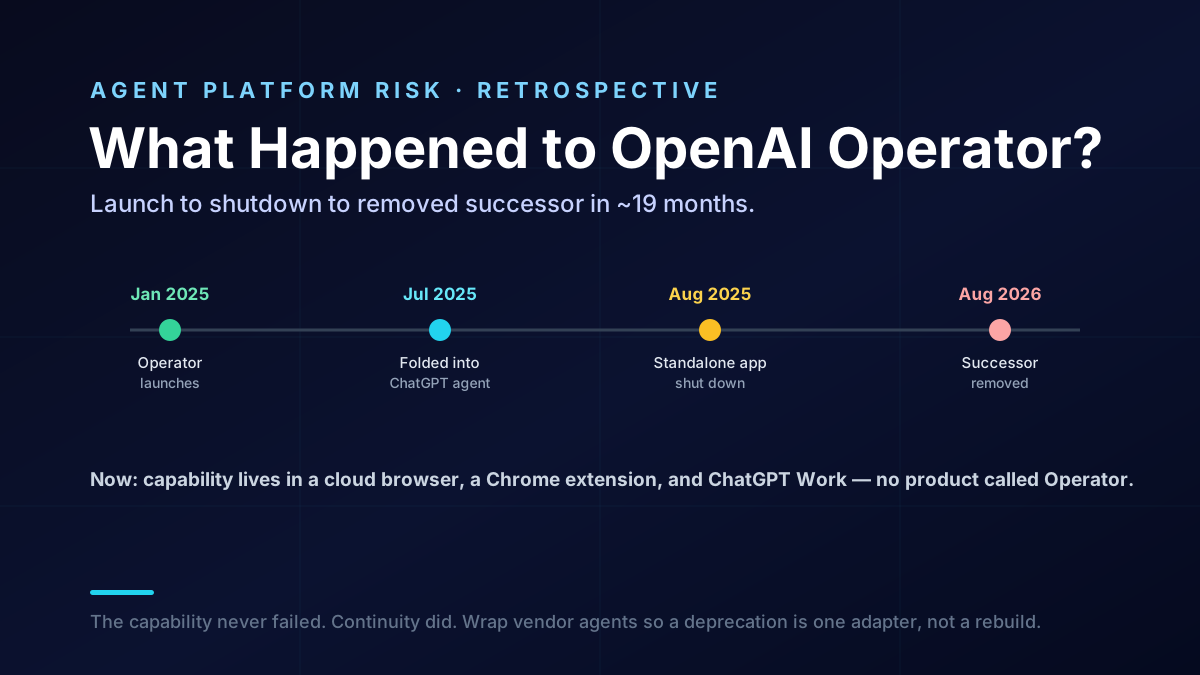
What Happened to OpenAI Operator?
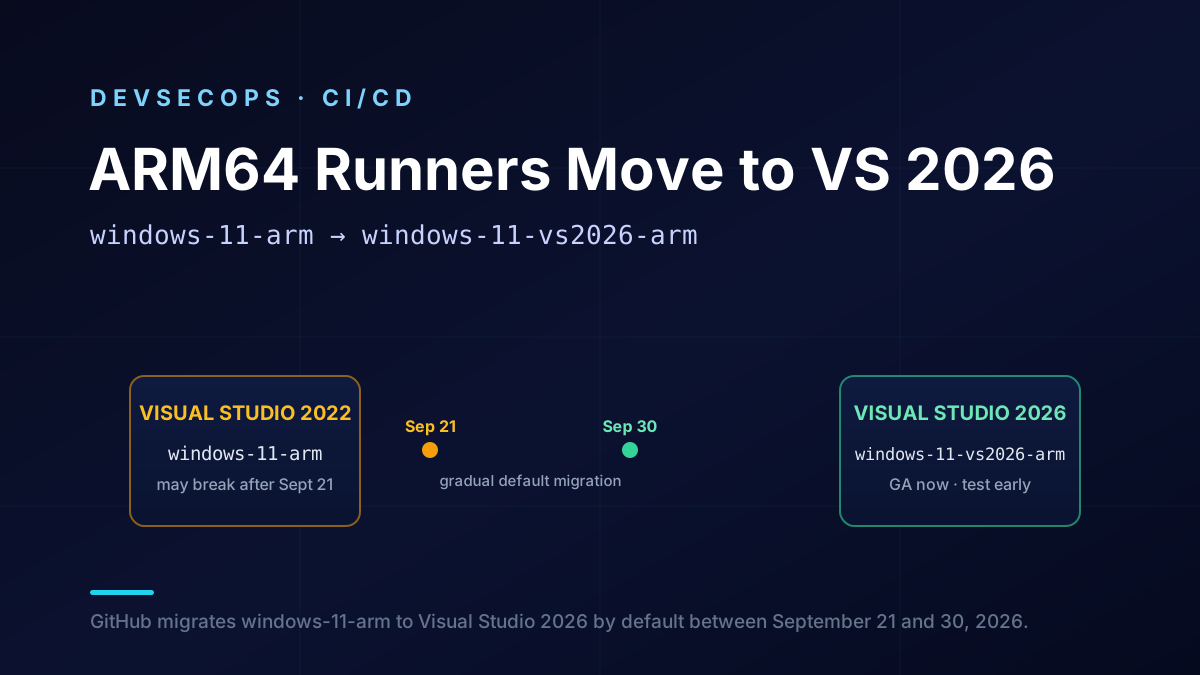
windows-11-arm Runners Move to Visual Studio 2026
Inside A2A's Multi-Cloud FinOps Data Pipeline on AWS