Intel 18A Lands Its First Customer: What It Means for AI
Intel 18A signed its first outside customer, and Microsoft chose Intel's EMIB packaging. What was announced, what is unconfirmed and what it means for AI.
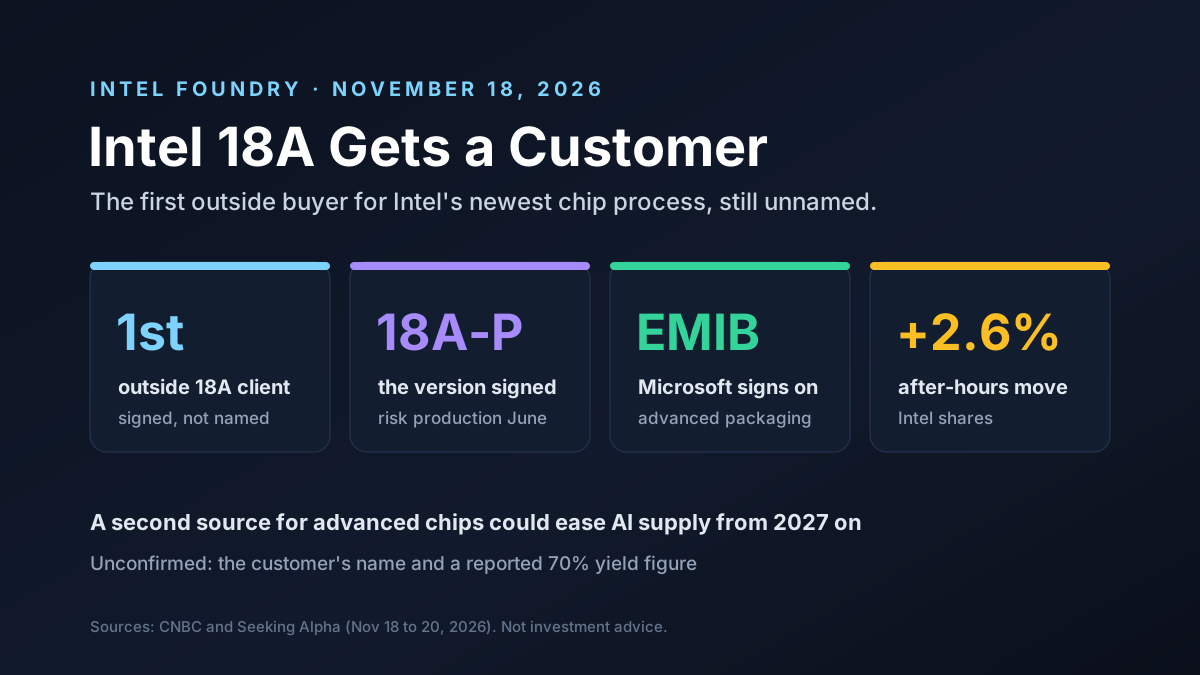
Intel 18A finally has an outside customer. On November 18, 2026, Intel CEO Lip-Bu Tan told the TomorrowX Summit in Austin that the company "just signed the first customer" for its most advanced chip process, as CNBC reported.
He didn't say who it is. But the news still matters. Intel has spent five years and many billions of dollars trying to make chips for other companies, the way TSMC does. Until now, its most advanced process had no outside buyer it could point to.
The same day brought a second win. Tan said Microsoft is the first publicly named customer for Intel's EMIB chip packaging.
This guide covers what was announced, what's still unconfirmed and what it could mean for AI chip supply and the teams that pay for AI compute.
Key Takeaways
- A first outside customer. Intel signed one for 18A, but hasn't named it.
- It's 18A-P. Intel's technology chief said the deal is for the performance version of 18A.
- Microsoft picks EMIB. It's the first named customer for Intel's advanced packaging, a part of chipmaking that has become a real bottleneck for AI.
- Some numbers are shaky. A reported 70% yield figure isn't in CNBC's account or Intel's own statements.
- No quick price change. The effect on AI chip supply is more likely in 2027 and later.
Intel 18A at a Glance
Here's what's been reported, as of November 20, 2026:
| Item | What's reported |
|---|---|
| Announcement | First outside customer for 18A |
| Who said it | CEO Lip-Bu Tan, TomorrowX Summit, Austin |
| Date | November 18, 2026 |
| Process version | 18A-P, per Intel's technology chief |
| Customer name | Not disclosed |
| Packaging news | Microsoft is the first named EMIB customer |
| Stock reaction | Up about 2.6% after hours |
Intel shares rose about 2.6% in after-hours trading on the news, according to Seeking Alpha. That's a modest bounce for a stock that has lost more than half its value since the end of September.
What Intel Announced About 18A
The announcement was short. On stage, Tan said Intel is in production on 18A "and we just signed the first customer." He didn't name the client, the size of the deal or when chips will ship.
Intel's chief technology officer, Pushkar Ranade, added a key detail later on X. The customer signed for 18A-P, a performance-focused version of 18A that went into risk production in June, according to CNBC's June report.
Risk production is an early stage. It means the process works well enough to start making real chips, but it's not yet at full volume or full maturity. Buyers usually test, tune and check chips for months before mass output.
What Is Intel 18A?
Intel 18A is the company's most advanced chip process. The name refers to 18 angstroms, a nod to how small its features are, though such names are partly marketing today.
Two technologies set it apart:
- RibbonFET. A newer transistor design, often called gate-all-around, that controls current better at small sizes.
- PowerVia. It moves power wiring to the back of the chip, which frees space on the front for signals.
Both aim at the same goal: more speed and less power per chip. That's exactly what AI data centers want, since power is now one of their biggest limits.
| Version | What it is | Status |
|---|---|---|
| Intel 4 | An older process, used for Fortinet's security chip | In production |
| 18A | Gate-all-around transistors and backside power | In production for Intel's own chips |
| 18A-P | A performance version of 18A for outside customers | Risk production since June 2026 |
| EMIB | Packaging that links chip dies with silicon bridges | Microsoft named as a customer |
A Quick Glossary for Chip News
Chip news is full of jargon. Here are the terms in this story, in plain words:
- Foundry: a company that makes chips designed by others, like TSMC.
- Process (or node): a set of tools and steps for making chips at a given size, like 18A.
- Wafer: a thin silicon disc.
- Yield: the share of chips on a wafer that work.
- Risk production: early, real production before full volume.
- Die: one piece of silicon. Big AI chips join several.
- Packaging: how dies are joined and wired into one finished chip.
Is the Customer Real? What's Confirmed and What Isn't
With a deal this important and so few details, it helps to separate facts from guesses:
| Claim | Status | Source |
|---|---|---|
| Intel signed a first outside 18A customer | Confirmed by the CEO | CNBC |
| The customer signed for 18A-P | Confirmed by Intel's CTO | CNBC |
| Microsoft uses EMIB packaging | Confirmed by the CEO | CNBC |
| Who the customer is | Unknown | Only analyst guesses |
| 18A yields at 70% | Reported, not confirmed | Some outlets, not CNBC |
| Contract size and volume | Not disclosed | None |
The 70% yield figure needs care. Yield is the share of chips on a wafer that work, and it decides whether a process can make money at all, because every bad chip is pure cost.
Some outlets, such as Crypto Briefing, reported that Tan gave a 70% figure at the event. But CNBC's report doesn't mention it, and Intel hasn't published it. Until Intel confirms it, treat 70% as a claim, not a fact.
Who Could the Intel 18A Customer Be?
Intel won't say, so analysts are guessing. Ben Bajarin of Creative Strategies called the deal "a huge win for foundry" and named a few candidates:
| Candidate | Why it fits | Status |
|---|---|---|
| Nvidia | Invested $5 billion in Intel | A guess |
| Apple | Reported talks with Intel in May 2026 | A guess |
| Cloud providers | Short of TSMC capacity for their own CPUs | A guess |
Bajarin's reasoning was about capacity. He told CNBC that Amazon, Microsoft and Google are struggling to get enough advanced chipmaking capacity at TSMC for their own processors. A second source, even a smaller one, helps.
None of these is confirmed. A big name would likely be announced by the client itself, so watch for that.
Microsoft and Intel's EMIB Packaging
The second piece of news may matter just as much for AI. Microsoft is the first publicly named customer for EMIB, Intel's most advanced packaging technology.
Packaging is how separate chip pieces, called dies, are joined into one product. Modern AI chips are built from several dies, such as compute dies and memory stacks, so packaging has become a major bottleneck. TSMC's own advanced packaging, known as CoWoS, has been in short supply for years as demand for AI chips kept outrunning every expansion.
EMIB links dies with small silicon bridges embedded in the package. If Microsoft uses it for its own chips, it gets a second packaging source, outside TSMC. Intel didn't say which Microsoft chips are involved.
Intel 18A vs TSMC's 2nm Process
The obvious rival for 18A is TSMC's N2, its 2-nanometer process. Here's how they compare, based on what both companies have said in public:
| Intel 18A | TSMC N2 | |
|---|---|---|
| Transistor type | Gate-all-around (RibbonFET) | Gate-all-around (nanosheet) |
| Backside power | Yes (PowerVia) | No, planned for a later process |
| Outside customers | First one signed in November 2026 | Many, including most AI chip makers |
| Track record as a foundry | New | Decades |
The big difference today isn't the transistor. It's the track record. TSMC has made chips for outside customers at scale for decades. Intel is just starting.
Why Intel 18A Matters for AI Chip Supply
Today, nearly every advanced AI chip comes from one company, TSMC, mostly in Taiwan. That includes chips from Nvidia, AMD, Google, Amazon and Microsoft.
That concentration is a risk. Any disruption, from a natural disaster to a trade dispute, could hit almost the whole AI industry at once. It also gives TSMC strong pricing power.
A working second source changes that slowly:
- More capacity. Another advanced fab means more chips can be made in total, which matters when cloud providers already plan their AI budgets around how many GPUs they can get.
- Less single-point risk. Big buyers can split orders between suppliers.
- More price pressure. Competition for orders tends to help buyers over time.
We've covered the other side of AI hardware in our posts on Google's TPU 8tx and 8i Max and Nvidia's Vera Rubin NVL72. All of them depend on advanced fabs and packaging.
Intel's Long Road to a Foundry Business
This deal didn't come out of nowhere. It's the latest step in a long and costly push:
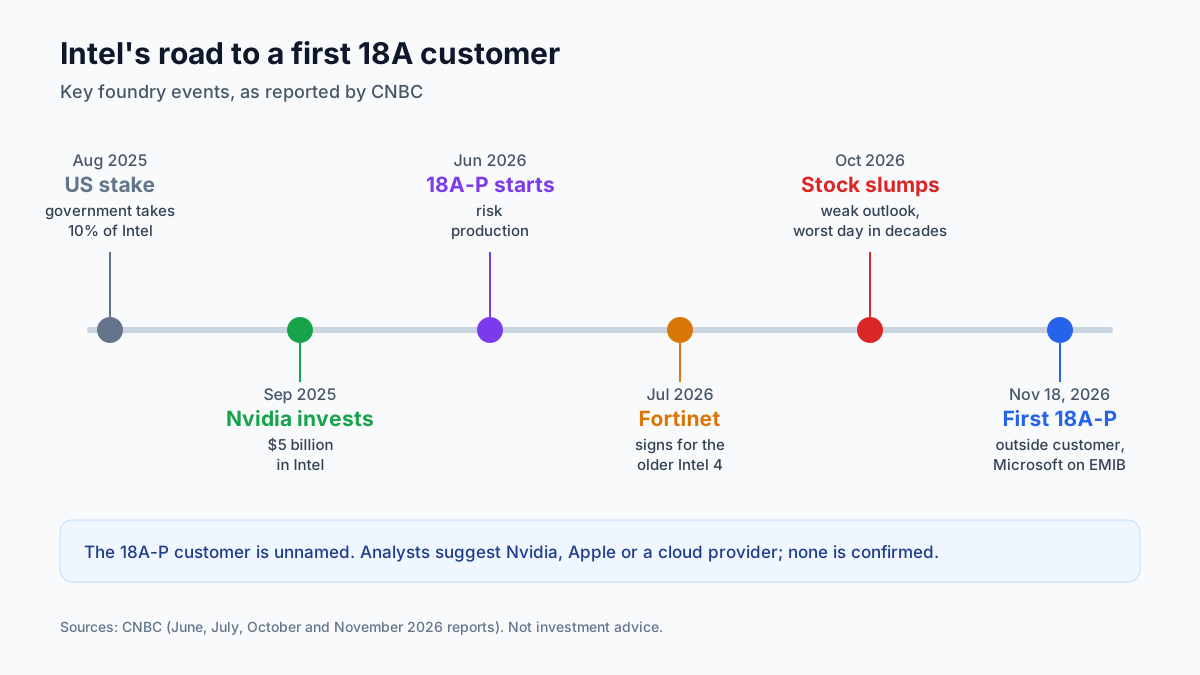
The US government took a 10% stake in Intel in August 2025, and Nvidia followed with a $5 billion investment. In July 2026, Fortinet signed on to make a security chip with Intel, but on the older Intel 4 process, as CNBC reported then.
Then came a hard October. Intel said fourth-quarter revenue would fall at least $1 billion short of estimates, blaming a PC slump and supply problems, and its stock had its worst day in decades. Against that backdrop, a first outside 18A customer is a welcome turn.
What Intel 18A Still Has to Prove
One client is a start, not a business. To compete with TSMC, Intel needs to show several things:
- Steady yields at high volume, published and repeatable
- More clients, ideally ones who name themselves
- On-time delivery of the first customer's chips
- Fair pricing that wins orders without hurting margins
- Trust, since clients must share designs with a firm that also makes rival chips
The last point is often missed. Intel designs its own chips, so some clients worry about sharing their designs. Intel has worked to separate its foundry business for exactly this reason.
What It Means for Teams That Buy AI Compute
Most data and AI teams will never buy a chip from Intel directly. But chip supply shapes what cloud and AI services cost. Here's how to read the news:
| If you... | What to watch |
|---|---|
| Rent GPUs or AI capacity | Whether more chip supply eases prices in 2027 and later |
| Buy servers | Intel's server chip supply, which Tan says can't meet demand |
| Build on one cloud | Whether your cloud's own chips move to Intel |
| Plan multi-year AI budgets | Supply risk if most chips still come from one foundry |
The short version: nothing changes this quarter. But if Intel's foundry grows, AI compute could get cheaper and less risky to rely on over the next few years. Tan himself said in late October that Intel can't currently meet demand for its server chips.
Worked Example: Why One Customer Isn't Enough
Here's our own simple math, to show why analysts want more than one client.
A leading-edge fab can cost $20 billion or more to build. Say a fab needs to run near 80% of capacity to cover its costs. If one client fills 20% of it, the fab still needs three or four more clients of the same size to reach that level.
These are made-up numbers, not Intel's. But they show the point: one unnamed client proves the process is ready for outsiders. It doesn't yet pay for the fabs Intel has built.
Risks and Open Questions
There's still a lot we don't know:
- The client: who it is and how many chips it will order
- Yields: whether the reported 70% figure holds and keeps rising
- Timing: when the first customer chips reach volume production
- Microsoft's chips: which ones will use EMIB, and when
- Intel's finances: whether foundry growth can offset weak PC sales
What to Watch Next
A few signals will show whether this is a turning point:
- A named client, announced by Intel or by the client itself
- Yield updates in Intel's next earnings report
- More 18A-P deals, especially from cloud providers
- The 14A process, Intel's next step after 18A, and whether customers commit early
- TSMC's response, in pricing or new capacity
Intel 18A: Our Take
Intel 18A's first outside customer is real progress after years of setbacks. Paired with Microsoft's EMIB deal, it suggests big buyers are willing to give Intel a chance, mainly because they need more supply than TSMC alone can give.
But it's one unnamed customer, and some of the numbers around it aren't confirmed. The next six to twelve months will show whether this is the start of a real foundry business or a single bright spot.
For teams that buy AI compute, there's nothing to change today. The long-term signal is good: more places to make advanced chips should mean steadier supply and better prices over time.
How Van Data Team Helps
We help teams plan AI infrastructure with supply and cost in mind:
- Cost reviews for GPUs, cloud AI and inference, through our cloud cost optimization service.
- AI agents that can switch models and providers as prices change, through AI agent development.
- Data pipelines that stay portable between clouds, via data pipeline development.
- Dashboards that track AI spend by team and workload, through agentic BI reporting.
This article is based on reporting by CNBC and Seeking Alpha, plus other coverage, as of November 20, 2026. It is not investment advice. Planning your AI compute budget? Get in touch and we'll help you size it.
AI Model Brief
The AI models worth knowing, once a week
What shipped, how it scores on independent benchmarks, what it costs per million tokens and what was deprecated, from the data behind our AI model benchmarks.
We use your address only to send the brief. See our privacy policy.
See this week’s brief
Founder of Van Data Team. Builds Vanaxity, the AI agent system for SEO, GEO, and AEO, and leads data engineering delivery for B2B teams.
About the authorArticle FAQ
Questions readers usually ask next.
These short answers clarify the practical follow-up questions that often come after the main article.
Need a similar system?
If this article maps to a workflow your team already operates, the next step is usually a scoped review of the system, constraints, and rollout path.
Consultation
Scope your next AI workflow.
Share the system and blockers. We will map fit, gaps, and the next step.