Google TPU 8tx and TPU 8i Max: What Data Teams Need to Know
Google's TPU 8tx brings confidential AI to its chips, and TPU 8i Max targets long context. What's known, what's missing and how data teams should prepare.
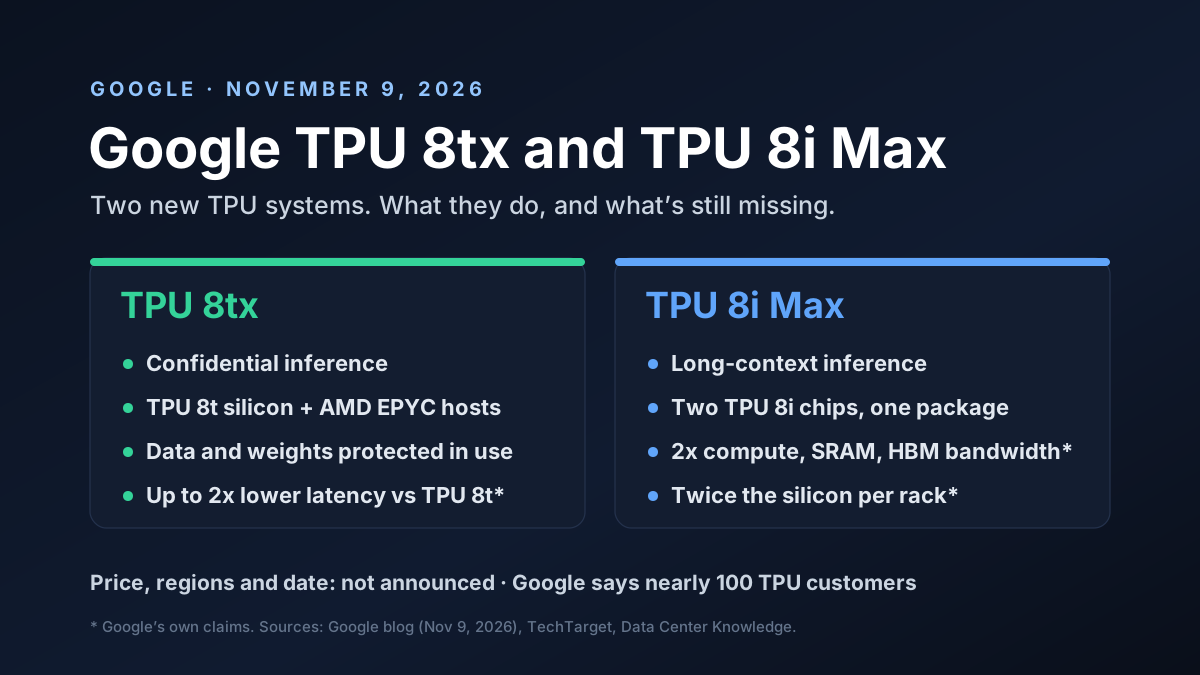
Google now has four new TPU systems in a year. On November 9, 2026, it added TPU 8tx, built to keep data and model weights private while they run, and TPU 8i Max, built for AI agents that need huge context, to the TPU 8t and TPU 8i it showed in April.
The news landed on a rough day for Nvidia, and that made it louder. But neither chip has a price or a date yet. This guide covers what each one does and which specs are public. It also covers what's missing and how data teams can prepare without betting on a launch date.
Disclosure and scope: Van Data Team builds data and AI systems for clients on Google Cloud, AWS, Azure and Nvidia hardware. We have no business ties to Google's TPU team. This isn't investment advice. We drafted this with help from Anthropic's Claude and checked each claim against the sources linked here.
Most specs below are Google's own claims. Where outlets disagree, we say so, and we label our own math.
Key Takeaways
- Two new systems: Google added TPU 8tx for confidential inference and TPU 8i Max for long context.
- TPU 8tx: TPU 8t silicon with 5th Generation AMD EPYC hosts, with data kept protected even while in use.
- TPU 8i Max: two TPU 8i chips in one package, with double the compute, SRAM and memory bandwidth.
- No date or price: Google hasn't announced either, and the 2027 timing in some reports is unconfirmed.
- Customers: Google says nearly 100 customers use its TPUs.
- For data teams: keep code portable now, and test before you plan around a chip you can't buy.
TPU 8tx and TPU 8i Max at a Glance
| Item | TPU 8tx | TPU 8i Max |
|---|---|---|
| Built for | Confidential inference on sensitive data | Long-context agents and dense racks |
| Based on | TPU 8t silicon | Two TPU 8i chips in one package |
| Host CPU | 5th Generation AMD EPYC | Not stated |
| Headline claim | Up to 2x lower latency than TPU 8t | Double the compute, SRAM and HBM bandwidth of TPU 8i |
| Also good for | Small-scale training | Coding agents and other long tasks |
| Price and date | Not announced | Not announced |
What Google Announced on November 9
Amin Vahdat, Google's chief technologist for AI and infrastructure, shared the news on Google's blog. He called them the third and fourth systems in the eighth TPU generation, and said the four together cover every stage of building and running AI agents. That's a big claim. It's also a clear sign of where Google wants AI inference to run.
Google also said it now lets some customers put TPUs straight into their own data centers. That's new for a chip Google once kept inside its own cloud. It also changes the talk for buyers, since a team that needs hardware on its own site no longer has to pick Nvidia GPUs by default. Oracle has also said it will offer TPUs to its cloud customers, Data Center Knowledge reported.
The market noticed. Alphabet shares rose more than 3% in early trading, Anadolu reported. It was the same day Nvidia faced a board probe of its CEO, which we covered in our Jensen Huang investigation guide.
What TPU 8tx Does: Confidential AI in Hardware
Most data is encrypted when it's stored and when it moves. But it has to be unlocked in memory while a chip works on it. That's the gap TPU 8tx targets.
Google says the chip builds security into the hardware, so data and model weights stay protected and isolated even while in use. It pairs the TPU 8t chip with 5th Generation AMD EPYC CPU hosts. Google also claims up to 2x lower latency than TPU 8t, with a near-zero speed penalty for the security.
The idea is to do the whole job in one safe place. On a single system, without moving private data anywhere else, a team could:
- Fine-tune a model on that data
- Distill a smaller model from it
- Run reinforcement learning
TechTarget says Google built the chip for sensitive government work and regulated firms.
Analyst Patrick Moorhead of Moor Insights & Strategy gave a simple example to TechTarget. A bank or a government agency could tune and run models on one confidential system. He also noted that about two-thirds of AI compute now goes to inference.
What TPU 8i Max Does: Bigger Context, Denser Racks
TPU 8i Max takes two TPU 8i chips and puts them on one package. Google says that doubles the compute, the on-chip SRAM and the memory bandwidth of TPU 8i. It also fits twice the silicon in the same rack space.
Workloads that could gain the most:
- Agents that read a whole codebase
- Long video or audio analysis
- Research tools that hold many papers at once
- Chat products with long histories
Why does that matter? Long context eats memory. When an agent works across a whole codebase or hours of video, it has to keep a lot in reach at once. More fast memory per package means less waiting.
Google's Mark Lohmeyer described it as adding more lanes to the highway. It's an inference chip, not a training chip, and it sits next to TPU 8i rather than replacing it. For data teams, the practical gain is fewer chips per long job. That can mean fewer moving parts, though only tests will show the real cost per request.
TPU 8tx Specs: What's Known and What's Missing
Google shared detailed specs for TPU 8t and TPU 8i in its April technical deep dive. For the new systems, the numbers are thinner:
| Spec | TPU 8t | TPU 8i | TPU 8i Max |
|---|---|---|---|
| HBM capacity | 216 GB | 288 GB | Not confirmed by Google |
| HBM bandwidth | 6,528 GB/s | 8,601 GB/s | About 17.2 TB/s |
| On-chip SRAM | 128 MB | 384 MB | 768 MB |
| Peak FP4 compute | 12.6 PFLOPs | 10.1 PFLOPs | About double TPU 8i |
| Network | 3D torus | Boardfly | Not stated |
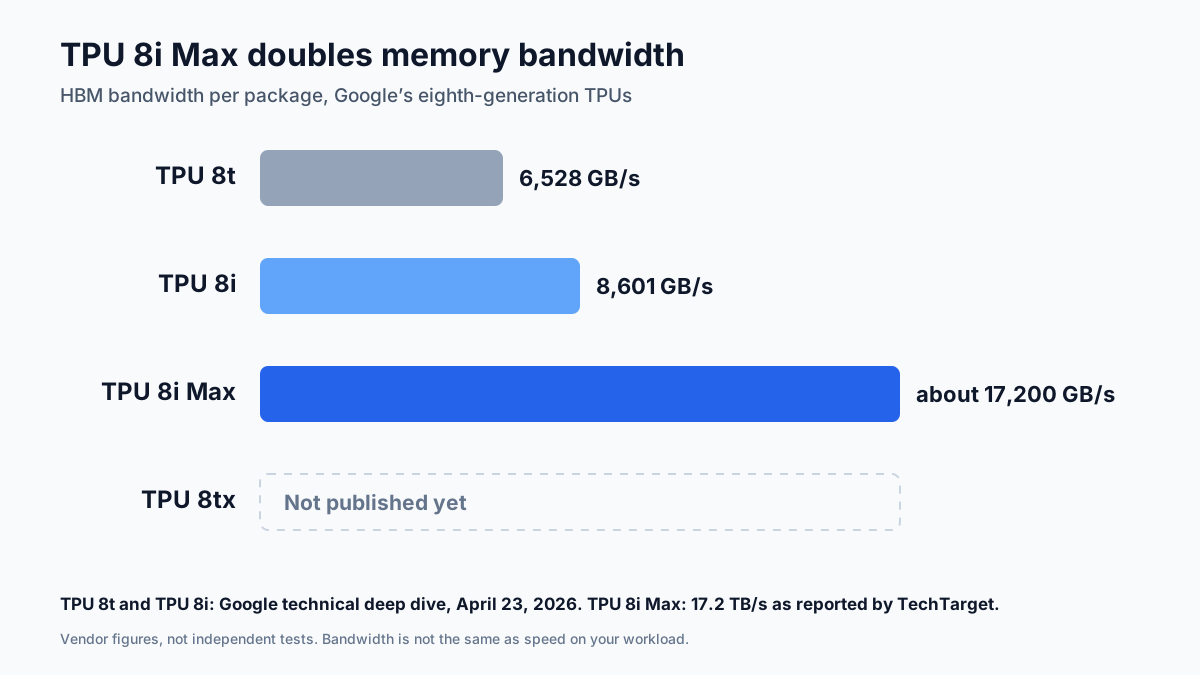
Two gaps stand out. First, Google hasn't published a full spec sheet for TPU 8tx, so its memory and bandwidth aren't public. Second, the memory size of TPU 8i Max is unclear. Data Center Knowledge quoted Lohmeyer giving 384 GB, but Google's own post lists no figure.
So treat the table as a sketch. Wait for the official spec sheet before you size a workload.
Four TPU Systems in One Year
Here's how the eighth generation now fits together:
| System | Announced | Main job | Key public figure |
|---|---|---|---|
| TPU 8t | April 2026 | Large-scale training | Up to 2.7x better performance per dollar than Ironwood |
| TPU 8i | April 2026 | Serving and reasoning | Up to 80% better performance per dollar than Ironwood |
| TPU 8tx | November 9, 2026 | Confidential inference | Up to 2x lower latency than TPU 8t |
| TPU 8i Max | November 9, 2026 | Long-context inference | Double TPU 8i compute, SRAM and HBM bandwidth |
The split is the story. Google no longer sells one chip for everything. It has one system for training, one for fast serving, one for private data and one for long context. That's closer to how data teams already split their own work.
TechTarget reported that TPU 8t and TPU 8i were still due to go online by the end of this year. So even the April chips aren't fully out yet. More choice also means more homework. Each system will likely come with its own price, regions and quotas, so plan time to compare them.
Who Should Care About TPU 8tx
Not every team needs confidential computing. It matters most where the data can't be seen by anyone, including the cloud provider:
| Team type | Why TPU 8tx could matter | What to check first |
|---|---|---|
| Banks and insurers | Model work on customer data that can't leave a safe zone | Whether your regulator accepts hardware isolation |
| Healthcare | Patient data used for tuning and inference | Data residency and audit logs |
| Government | Sensitive work that today needs on-site hardware | Whether you can host the system yourself |
| AI labs | Model weights kept private while they run | Speed cost of the security layer |
Three signs it belongs on your roadmap:
- Your security team has blocked an AI project over data exposure
- You run AI on your own servers only because of rules on where data sits
- Your model weights are a core asset you can't risk leaking
If none of these fit you, TPU 8tx is a chip to watch, not one to plan for. Your bigger questions are price and speed, and those aren't public.
TPU 8tx vs Confidential GPUs
TPU 8tx isn't the first chip to protect data in use. Nvidia GPUs, starting with the H100, offer a confidential computing mode too. Google Cloud already runs confidential VMs on AMD processors.
What's different is the pitch. Google says the security sits in the TPU system itself, with almost no speed cost. IDC's Dave McCarthy told Data Center Knowledge that Nvidia is still shaping its own approach in this area. Neither side has shared public test results that compare the two.
So don't pick on the label. Ask each vendor for the same three things:
- Proof: how you can check that the hardware is what it claims to be
- Speed: real latency and throughput with protection on and off
- Scope: what stays protected, from model weights to logs and caches
Can Your Code Run on TPUs?
This is the question that decides most moves. TPUs have long worked best with JAX. Most teams, though, write PyTorch and lean on Nvidia's CUDA tools.
Google is working on that gap with two open-source projects, Interesting Engineering reported:
- TorchTPU: native PyTorch support, so existing PyTorch code and Hugging Face models run without a rewrite, Google says
- TPU Sync: cuts time to first token by more than 90% in some setups, per Google
Before any test, check three things in your own stack:
- Which framework each model uses, whether PyTorch, JAX or something else
- Whether you rely on custom CUDA kernels or Triton code
- How you serve models today, and whether that tool supports TPUs
Those are vendor claims. Custom CUDA kernels won't move for free. Test your own models before you believe any number, because every stack has odd corners that only show up under real traffic.
How to Prepare for TPU 8tx Now
You can't buy TPU 8tx yet. But you can be ready the day it ships. Start with three steps:
- Sort your workloads by data sensitivity and context length
- Find the hard ties, such as custom CUDA kernels, engine files built for one GPU or tools that only read Nvidia metrics
- Test one model on today's TPUs
Then handle the paperwork:
- Ask your security team whether hardware isolation would let new data into AI work
- Ask Google for dates, regions, prices and test results under your own load
- Write it down, with an owner and a date to review it
Worked Example: Is a Second Accelerator Worth Testing?
Here's a simple model, using our own math and made-up numbers:
- Inference spend: $80,000 a month on GPUs
- Test cost: two engineers for three weeks, about $30,000
- Possible saving: if a TPU handles 30% of that work at 20% lower cost, that's $4,800 a month
At that rate, the test pays for itself in about six months, but if the saving is only 10%, payback takes more than a year. And if the model won't run without big changes? Then the saving may never come.
Run the same sum with your own numbers. Swap in your real spend, your team's day rate and a saving you've measured, not one from a slide.
That's why the test matters more than the launch. The answer depends on your models and your traffic, not on Google's slides.
What This Means for AI Inference Budgets
Training gets the headlines, but AI inference pays most of the bills now. That shift is why Google keeps splitting its chips by job. Here's what it means for budgets:
- Inference is the big line item, at about two-thirds of AI compute, Moorhead says
- Special chips cut cost per task only when the task fits the chip
- Long context is the priciest kind of inference, because memory, not math, becomes the limit
- Confidential mode can open data you couldn't use before, which adds value but also review work
So the question isn't which chip is fastest. It's which mix of chips gives you the lowest cost for each kind of request. Most teams will end up with more than one, and that's fine if the code can move.
Risks and Open Questions
There's a lot we still don't know. These are the biggest gaps:
- Timing: no official date, and the 2027 timing in some reports is unconfirmed
- Price: no list price for either system
- Regions: no word on where they'll run
- Supply: big labs may claim much of the first output
Software is the other risk. A new chip needs drivers, compilers and tools that work on day one. Google has improved its PyTorch support, but early users of any new system tend to find the rough edges first.
There's also lock-in to think about. Moving work from one vendor to another can trade one kind of dependence for a new one. The goal is a choice, not a swap.
What to Watch Next
A few things will tell us whether these chips matter for most teams:
- Spec sheets for TPU 8tx and TPU 8i Max, with memory size and bandwidth
- Pricing and regions on Google Cloud
- Independent tests of the security layer's speed cost
- Rollout of TPU 8t and TPU 8i, still due by the end of 2026
- Customer stories from banks, health firms or governments running TPU 8tx
TPU 8tx: Our Take
TPU 8tx is the more interesting of the two. Confidential computing has been a niche because it was slow, awkward or both. If Google's near-zero speed cost holds up, regulated teams could use AI on data they've had to keep away from it.
TPU 8i Max is a solid step for long-context agents, but it's an upgrade, not a new idea. For most teams, the real news is that Google now has four TPU systems and is willing to put them in customers' own buildings. That gives buyers a stronger hand, whatever they choose.
If you run a regulated business, set a reminder for when the spec sheet lands. If you don't, keep doing what works and look again next year.
How Van Data Team Helps
We help data and AI teams keep their platforms flexible and their costs in check:
- GPU and TPU spend reviews by vendor, chip and workload, through our cloud cost optimization service.
- Portable AI systems on open frameworks, via AI agent development.
- Pipelines that can move between clouds, via data pipeline development.
- Cost and risk dashboards for AI workloads, through agentic BI reporting.
Thinking about a TPU test, or about running AI on sensitive data? Get in touch and we'll help you scope a trial you can measure.
AI Model Brief
The AI models worth knowing, once a week
What shipped, how it scores on independent benchmarks, what it costs per million tokens and what was deprecated, from the data behind our AI model benchmarks.
We use your address only to send the brief. See our privacy policy.
See this week’s brief
Founder of Van Data Team. Builds Vanaxity, the AI agent system for SEO, GEO, and AEO, and leads data engineering delivery for B2B teams.
About the authorArticle FAQ
Questions readers usually ask next.
These short answers clarify the practical follow-up questions that often come after the main article.
Need a similar system?
If this article maps to a workflow your team already operates, the next step is usually a scoped review of the system, constraints, and rollout path.
Consultation
Scope your next AI workflow.
Share the system and blockers. We will map fit, gaps, and the next step.