September 22, 2026
Grok 4.7 vs Fable 5.1 vs GPT-6 Astra: Real Cost per Task
Grok 4.7 vs Fable 5.1 vs GPT-6 Astra on independent tests: who scores highest, who's cheapest per task, and which to use for coding, research and agents.
Article focus
Grok 4.7 is five to eight times cheaper per token than Fable 5.1 and GPT-6 Astra. On independent tests, it scores lower and uses far more tokens, so it isn't cheaper per task. Here's the full comparison, test by test, and which model fits which job.
Section guide
Grok 4.7 vs Fable 5.1 vs GPT-6 Astra comes down to one gap: price per token versus cost per task. Grok 4.7 is five to eight times cheaper per token, but on independent tests, Fable 5.1 and GPT-6 Astra both score 53 against its 46. Grok also uses about three times as many tokens per task as Astra. So Astra, not Grok, delivers the most score per dollar.
Key Takeaways
- On the independent Artificial Analysis Intelligence Index, Fable 5.1 and GPT-6 Astra tie at 53 at their top settings. Grok 4.7 scores 46.
- Grok 4.7 lists at $2 input and $6 output per million tokens. Fable 5.1 and GPT-6 Astra both list at $10 and $50.
- Per task, the picture flips. At the high setting, Astra costs $1.73 per task, Grok 4.7 $2.73 and Fable 5.1 $3.91.
- Fable 5.1 leads knowledge-work tasks, long context and hard questions. Astra leads terminal work, automation and research physics. Grok 4.7 wins none of the ten tests outright.
- Grok 4.7 still makes sense for input-heavy, low-reasoning work, where its low per-token price does carry through.
Grok 4.7 vs Fable 5.1 vs GPT-6 Astra: Which Scores Highest?
Fable 5.1 and GPT-6 Astra, tied. Grok 4.7 is a clear step behind.
Reported fact: Anthropic released Claude Fable 5.1 on September 1, 2026. OpenAI released GPT-6 Astra on September 3, with a staged rollout. xAI released Grok 4.7 on September 21. We covered each launch separately, including Fable 5.1, GPT-6 Astra and Grok 4.7.
Here's the side-by-side at a glance, using each model's top setting. Prices come from each vendor. Scores, speed and cost per task come from Artificial Analysis, checked on September 22, 2026.
| Feature | Grok 4.7 (xhigh) | Fable 5.1 (max) | GPT-6 Astra (max) |
|---|---|---|---|
| Intelligence Index | 46 | 53 | 53 |
| Price per million tokens (input / output) | $2 / $6 | $10 / $50 | $10 / $50 |
| Cached input per million tokens | $0.50 | $0.25 | $1.00 |
| Cost per task | $3.74 | $7.63 | $3.26 |
| Output tokens per task | About 81,000 | About 78,000 | About 27,000 |
| Output speed | About 42 tokens/s | About 67 tokens/s | About 65 tokens/s |
| Context window | 500,000 tokens | 1 million tokens | 1 million tokens |
A note if you've read our earlier comparisons. Artificial Analysis has updated its index since early September and is now on version 4.3.2.
On an earlier version, Fable 5.1 led GPT-6 Astra 66 to 61, as we reported in our GPT-6 Astra vs Fable 5.1 breakdown. On the current version, they tie at 53. Scores from different index versions can't be compared directly.
What Do Independent Benchmarks Show, Test by Test?
Each model has clear strengths. The composite score hides them, so it's worth looking at the ten tests behind it.
Here's Artificial Analysis's breakdown, from its Grok 4.7 vs GPT-6 Astra and GPT-6 Astra vs Fable 5.1 comparisons, with each model at its top setting. Test descriptions follow its methodology page. The first two rows are ratings, where higher is better. The rest are scores or percentages.
| Test (Artificial Analysis) | What it measures | Grok 4.7 | Fable 5.1 | GPT-6 Astra |
|---|---|---|---|---|
| GDPval-AA v2.1 | Agent tasks from 44 occupations | 1695 | 1735 | 1542 |
| AA-Briefcase v1.1 | Multi-week knowledge-work projects | 1657 | 1678 | 1569 |
| AutomationBench-AA | Workflows across business apps | 66% | 59% | 68% |
| Terminal-Bench 4.0 | Terminal tasks: coding, admin, data | 26% | 52% | 59% |
| SciCode | Scientific Python coding | 57% | 63% | 56% |
| Humanity's Last Exam | Hard questions across many fields | 43% | 59% | 55% |
| CritPt | Research-level physics | 18% | 30% | 32% |
| GDP.pdf | Reasoning over long professional documents | 20% | 26% | 31% |
| AA-LCR v1.1 | Reasoning across ~100,000-token documents | 77% | 85% | 81% |
| AA-Omniscience | Factual reliability, penalizing wrong guesses | 32 | 43 | 43 |
Here's how that splits:
- Fable 5.1 leads on knowledge-work agent tasks, scientific coding, hard questions and multi-document long context.
- GPT-6 Astra leads on terminal work, business app automation, research physics and long professional documents.
- Grok 4.7 wins no test outright. But it beats Astra on both knowledge-work tests and on SciCode, and comes a close second on automation.
The biggest gap is Terminal-Bench 4.0. Astra scores more than twice what Grok 4.7 does. If your agents live in a terminal, that row matters more than the composite.
Grok 4.7 vs Fable 5.1 vs GPT-6 Astra: Which Is Cheapest per Task?
GPT-6 Astra, at almost every setting. That's the surprise in this comparison.
Cost per task is what you actually pay for a finished job, including every thinking and output token. Here's how each model's score and cost per task change across settings on Artificial Analysis's index:
| Model and setting | Intelligence Index | Cost per task |
|---|---|---|
| GPT-6 Astra (medium) | 50 | $1.54 |
| GPT-6 Astra (high) | 51 | $1.73 |
| GPT-6 Astra (xhigh) | 52 | $2.31 |
| GPT-6 Astra (max) | 53 | $3.26 |
| Grok 4.7 (high) | 46 | $2.73 |
| Grok 4.7 (xhigh) | 46 | $3.74 |
| Fable 5.1 (medium) | 49 | $2.98 |
| Fable 5.1 (high) | 51 | $3.91 |
| Fable 5.1 (xhigh) | 53 | $5.98 |
| Fable 5.1 (max) | 53 | $7.63 |
Three things stand out:
- Astra gives the most score per dollar. At medium, it scores 50 for $1.54. Grok 4.7's best score is 46, at $2.73.
- Fable 5.1 is the most expensive at the top. Reaching 53 costs $5.98 at xhigh, against $3.26 for Astra at max.
- Grok 4.7's xhigh setting buys nothing here. It scores 46 at both high and xhigh, but xhigh costs 37% more.
To be fair to Fable 5.1, its cheaper cache helps in long agent loops that re-read the same context. Artificial Analysis's tasks may not reflect that fully. Our Jev comparison walks through why cache pricing matters for agents.
Why Doesn't Grok's Low Price per Token Win?
Because it writes a lot more. Artificial Analysis counts about 81,000 output tokens per task for Grok 4.7 at xhigh, of which 59,000 are reasoning. GPT-6 Astra at max uses about 27,000, with 17,000 reasoning.
Output tokens are also where most of the cost sits on reasoning-heavy work. Grok's output price is about eight times lower than Astra's. But it produces three times as many output tokens, and its input tokens add up on long agent tasks too. The per-token discount mostly disappears.
That doesn't make Grok 4.7 expensive for every job. It depends on the shape of your workload:
- Input-heavy, low-reasoning work. Say you send a 100,000-token document and get 1,000 tokens back at low effort. Grok 4.7 costs about $0.21. Fable 5.1 or Astra costs about $1.05 at list price, before caching.
- Reasoning-heavy agent work. Long multi-step tasks, where the model thinks a lot. Here Grok's extra tokens can make it cost more than Astra per finished task.
- Somewhere in between. Most real workloads, which is why measuring beats guessing.
We made the same point in our Grok 4.7 analysis: same price per token doesn't mean same cost per task.
Which Model Is Fastest?
In the Grok 4.7 vs Fable 5.1 vs GPT-6 Astra speed race, Fable 5.1 and Astra lead at the top settings. At the high setting, it's roughly a tie.
Artificial Analysis measured output speed at about 67 tokens per second for Fable 5.1 at max, 65 for Astra at max, and 42 for Grok 4.7 at xhigh. At the high setting, all three sit between 54 and 56 tokens per second.
That matters because xAI's launch post calls Grok 4.7 "twice as fast, at half the price of comparable models." Independent measurements don't support that yet, at least not on output speed per token. Grok 4.7 at high also runs a little slower than Grok 4.6 at high, which Artificial Analysis measures at about 60 tokens per second.
Remember that tokens per second isn't time per task. A model that writes three times as many tokens will take longer to finish, even at the same speed. For agents, measure wall-clock time per completed task.
How Do Vendor Claims Compare With Independent Tests?
Each vendor's own numbers look better than the independent ones. The gap is largest for Grok 4.7's terminal results.
- xAI: its launch post reports Grok 4.7 at 38.0% on Terminal-Bench 4.0. Artificial Analysis's run of Terminal-Bench 4.0 shows 26%. Different harnesses and settings can explain some of that, but the gap is wide.
- OpenAI: its launch table showed GPT-6 Astra leading Fable 5.1 on most rows. Independent tests show a split, with Fable 5.1 ahead on several.
- Anthropic: Fable 5.1 does lead many independent tests. It also has the highest cost per task at its top settings, a point that doesn't appear in any launch post.
This is normal. Vendors choose tests, settings and harnesses that suit their model. That's why we weight independent results more heavily, and why your own tests should count most of all.
Grok 4.7 vs Fable 5.1 vs GPT-6 Astra: Which Should You Use for Which Job?
Match the model to the work. Here's a starting map based on the independent results:
- Command-line and computer-use agents: GPT-6 Astra. It leads Terminal-Bench 4.0 and automation tests by a clear margin.
- Knowledge-work agent tasks: Fable 5.1, with Grok 4.7 a strong, cheaper second on these specific tests.
- Long documents: a split. Fable 5.1 leads reasoning across several long documents, while Astra leads tasks on long professional PDFs. Both have a 1 million-token window.
- Research math and science: GPT-6 Astra for physics and math, Fable 5.1 for scientific coding.
- Best value across mixed work: GPT-6 Astra at medium or high, which gives the most score per dollar here.
- Input-heavy, low-reasoning tasks at scale: Grok 4.7, where its $2 input price carries through.
- Long agent loops that re-read context: Fable 5.1 or Grok 4.7 for their cheaper cache, but test the total cost.
Most teams will end up using more than one. A router can send each request to the model that fits it best, and keep a fallback when one vendor has a bad day.
What About Context, Caching and Limits?
These details can change your costs more than the headline price.
- Context window. Fable 5.1 and GPT-6 Astra both handle about 1 million tokens. Grok 4.7 handles 500,000.
- Long-prompt pricing. Grok 4.7 doubles its rates once a prompt passes 200,000 tokens, for the whole request, per xAI's pricing. Check each vendor's current long-context terms before you plan big prompts.
- Cache reads. Fable 5.1 charges $0.25 per million cached tokens, Grok 4.7 $0.50 and Astra $1.00. For agents that re-read the same files every step, this adds up fast.
- Fast modes. All three offer faster serving at a higher price. Grok 4.7's fast variant is limited to Cursor and Grok Build for now.
How Should You Test Grok 4.7 vs Fable 5.1 vs GPT-6 Astra?
On your own tasks, with cost per finished task as the main number. Here's a short plan:
- Pick 50 to 200 real tasks from your work, with known good answers.
- Run each model at two settings, such as medium and high, since the best value often isn't the top setting.
- Record four numbers per task: success, output tokens, cost and wall-clock time.
- Divide cost by successful tasks, so failures count against the model that caused them.
- Look at the failures. Note which model gives up early, loops, or answers confidently and wrongly.
Our guide to AI agent evaluation covers how to build and maintain a test set like this.
How Van Data Team Helps Teams Pick Between Grok 4.7, Fable 5.1 and GPT-6 Astra
We help teams choose models with their own data, not vendor charts. That means building task sets from real work, running models side by side at several settings, and measuring success rate, tokens, cost and time per finished task.
In the Grok 4.7 vs Fable 5.1 vs GPT-6 Astra choice, the answer is often a mix, routed by job. If you want a model stack that stays accurate and affordable as new releases land, our work on AI agent evaluation and AI agent development cost is a good place to start.
Article FAQ
Questions readers usually ask next.
These short answers clarify the practical follow-up questions that often come after the main article.
Need a similar system?
If this article maps to a workflow your team already operates, the next step is usually a scoped review of the system, constraints, and rollout path.
Book your free workflow review here.
Related articles
View all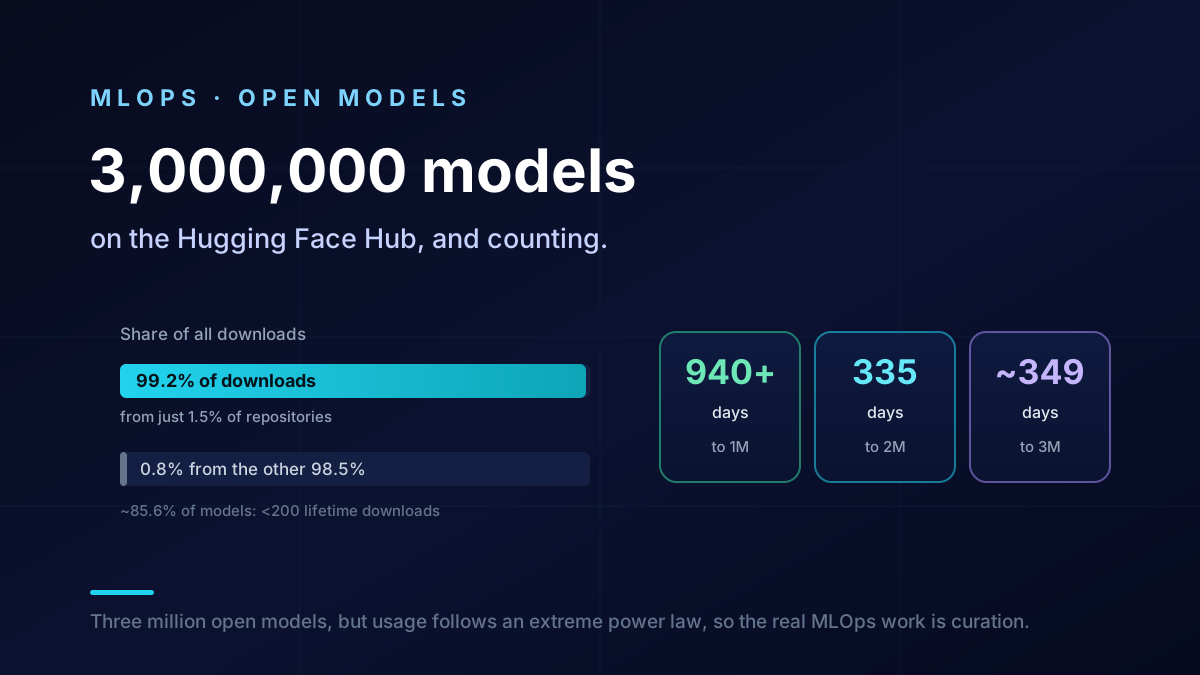
Hugging Face Hub Crosses 3 Million Models
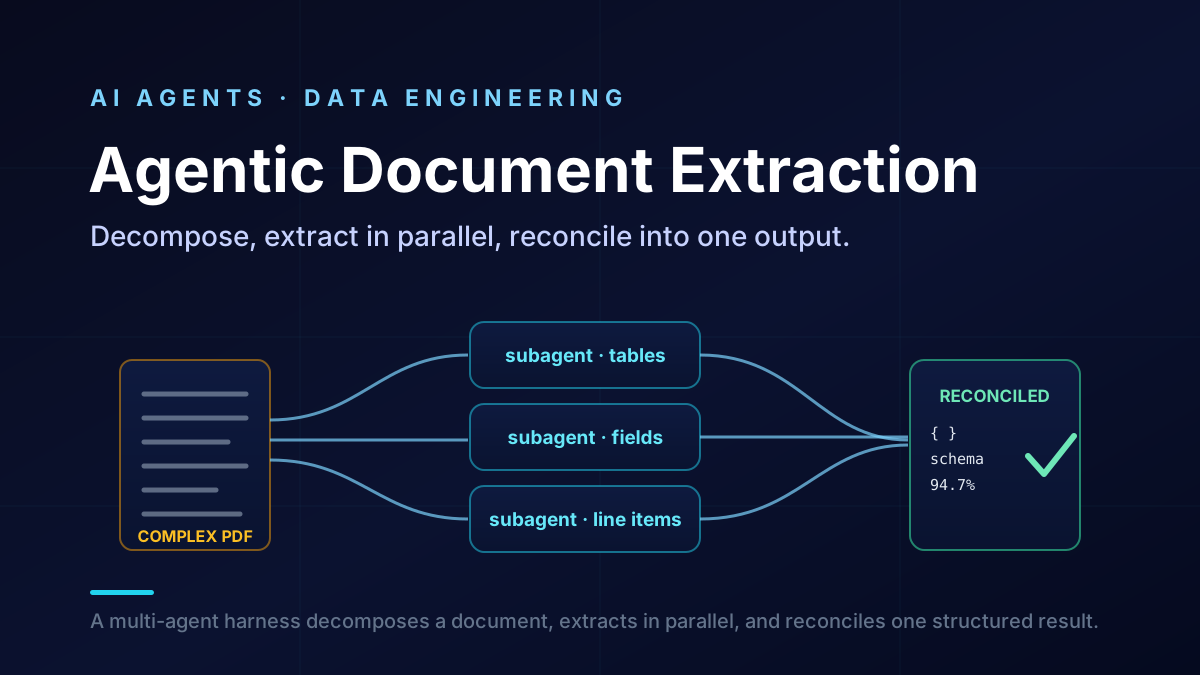
Agentic Document Extraction and Databricks Precision Mode
WeatherNext: Evaluating AI Cyclone Forecasting