iPhone Duo vs Galaxy Z Fold 8 vs Xiaomi 18 Fold: Daily Use
iPhone Duo vs Galaxy Z Fold 8 vs Xiaomi 18 Fold in daily use: weight, screens, crease, apps, cameras and battery, from early reviews. Which one fits you?
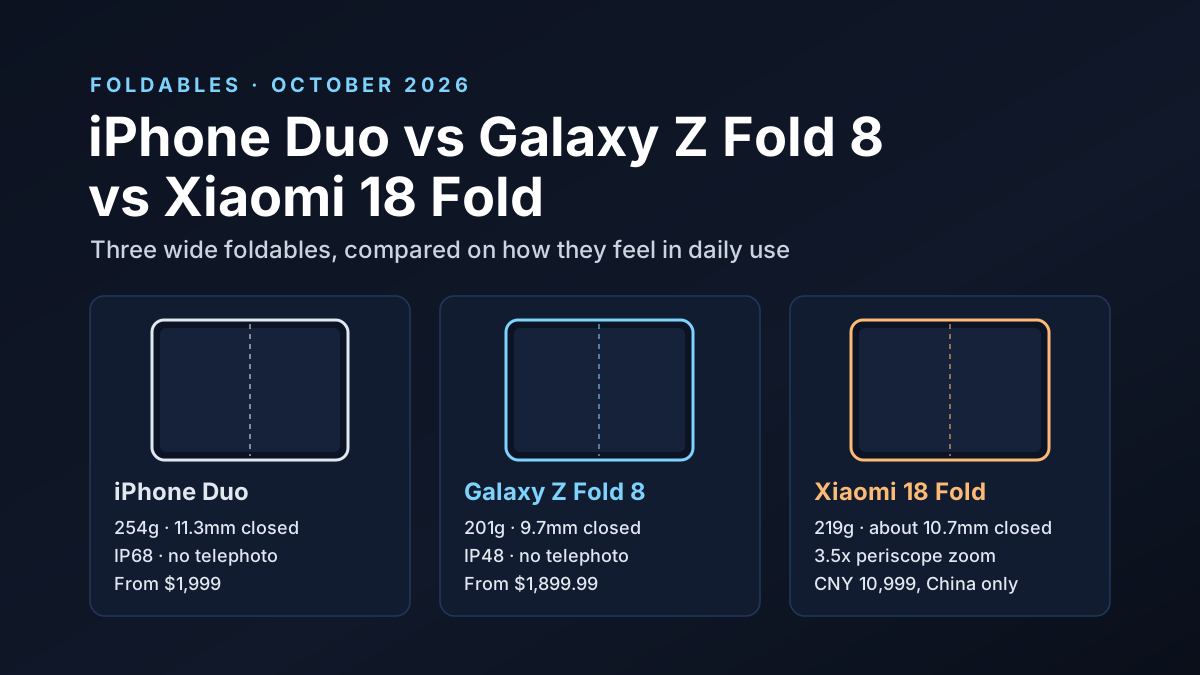
Foldables just got interesting again. In three months, Samsung, Xiaomi and Apple each launched a wide, book-style folding phone. The Galaxy Z Fold 8 arrived in August, the Xiaomi 18 Fold in September and the iPhone Duo in October.
On paper they look alike. In the hand, they don't. This guide compares the iPhone Duo vs Galaxy Z Fold 8 vs Xiaomi 18 Fold on the things you notice every day: weight, typing, reading, apps, photos, battery and how worried you should be about the hinge.
How we wrote this: We haven't run our own lab tests on these phones. This comparison brings together official specs and early hands-on reviews, and we name the source for each test result. Van Data Team has no business ties to Apple, Samsung or Xiaomi, and none of these companies paid for, reviewed or saw this article before we published it. We researched and drafted it with help from Claude, an AI model by Anthropic.
Key Takeaways
- Lightest and slimmest: the Galaxy Z Fold 8, at 201g and 9.7mm closed. The iPhone Duo is the heaviest at 254g and 11.3mm closed.
- Longest battery: the Xiaomi 18 Fold has the biggest cell at 6,000mAh. Among the two you can buy globally, the iPhone Duo beat the Fold 8 by more than three hours in Tom's Guide testing.
- Best camera: the Xiaomi 18 Fold, the only one with an optical telephoto. The Duo and the Fold 8 skip zoom lenses entirely, so anything far away, like a stage or a sports field, ends up as a soft digital crop on both of them.
- Toughest on paper: the iPhone Duo, with IP68. The Fold 8 is IP48, which covers water but only larger dust particles, and Xiaomi's IP58 and IP59 listings come from Chinese specs that Xiaomi didn't repeat at IFA.
- Best multitasking: Samsung and Xiaomi. The Duo has Split View for two apps, but some apps still show black bars.
- The real choice: for most people, it's the ecosystem. iPhone users should look at the Duo, Android users at the Fold 8, and the Xiaomi only if you can buy and service it where you live.
iPhone Duo vs Galaxy Z Fold 8 vs Xiaomi 18 Fold at a Glance
| Spec | iPhone Duo | Galaxy Z Fold 8 | Xiaomi 18 Fold |
|---|---|---|---|
| Launch | On sale October 23, 2026 | On sale August 2026 | On sale in China September 10, 2026 |
| Starting price | $1,999 (256GB) | $1,899.99 (256GB) | CNY 10,999 (12GB, 256GB); no US price |
| Inner screen | 7.6 inches | 7.6 inches, 4:3 | 7.58 inches, 2364 x 1672 |
| Cover screen | 5.4 inches | 5.5 inches | 5.38 inches |
| Weight | 254g | 201g | 219g |
| Thickness, closed / open | 11.3mm / 5.2mm | 9.7mm / 4.5mm | About 10.7mm / 5.0mm |
| Chip | Apple A20 Pro | Snapdragon 8 Elite Gen 5 for Galaxy | Xiaomi XRING O3 |
| Battery | 4,883mAh, two cells (reported) | 4,800mAh | 6,000mAh silicon-carbon |
| Charging | 50% in about 20 min with a 60W adapter; MagSafe and Qi2 | 45W wired, 20W wireless | 67W wired, 50W wireless |
| Rear cameras | 48MP main, 48MP ultra wide | 50MP main, 50MP ultra wide | 200MP main, 50MP 3.5x periscope, 50MP ultra wide |
| Water and dust | IP68 | IP48 | IP58/IP59 on Chinese listings |
| Software | iOS 27.1 | Android with One UI | Android 17 with HyperOS 4 |
Sources: Apple, Droid Life, Samsung support, Digital Trends and 9to5Mac. Apple doesn't publish battery capacity; the Duo figure comes from early reviews.
How We Compared Them
Spec sheets don't tell you how a phone feels at 11 p.m. on the sofa. So we sorted the reviews by the moments that make up a normal day:
- Carrying it in a pocket or bag.
- Using it closed for quick replies and maps.
- Opening it to read, watch or work.
- Taking photos of people and faraway things.
- Getting home with some battery left.
For each moment, we note what reviewers liked, what bothered them and where the three phones differ. Where reviewers disagree, we say so.
Three Wide Foldables, Three Philosophies
All three phones share a new shape. Older book-style foldables had a tall, narrow cover screen that felt like a TV remote. These three are wider, closer to a passport, so the outside screen feels like a normal phone.
The thinking behind each one is different, though:
- Apple built the iPhone Duo around polish and toughness. It's heavy, but it has IP68, a hinge with more than 100 parts and an inner screen with a coating that hides the crease.
- Samsung built the Galaxy Z Fold 8 around lightness. At 201g, it's the lightest Fold so far, and it's only 4.5mm thick when open.
- Xiaomi built the 18 Fold around hardware. It has the biggest battery, the fastest charging and the only zoom camera of the three.
Each choice has a cost. You'll see those costs in the sections below.
iPhone Duo vs Galaxy Z Fold 8: Carrying Them All Day
Weight is the first thing you notice, and it's the iPhone Duo's biggest weakness. At 254g, it weighs 5g more than the iPhone 18 Pro Max. The Galaxy Z Fold 8 weighs 201g. That 53g gap is about the weight of a large egg, and you feel it in a jacket pocket.
Closed, the Duo is 11.3mm thick. The Fold 8 is 9.7mm and the Xiaomi about 10.7mm. 9to5Mac still found the Duo easy to pocket because it's short, at 117.8mm by 84.1mm folded. Long one-handed sessions strained the reviewer's wrist, though. Not ideal.
The Xiaomi 18 Fold sits in the middle at 219g. Digital Trends said it feels solid and planted, with a matte glass back.
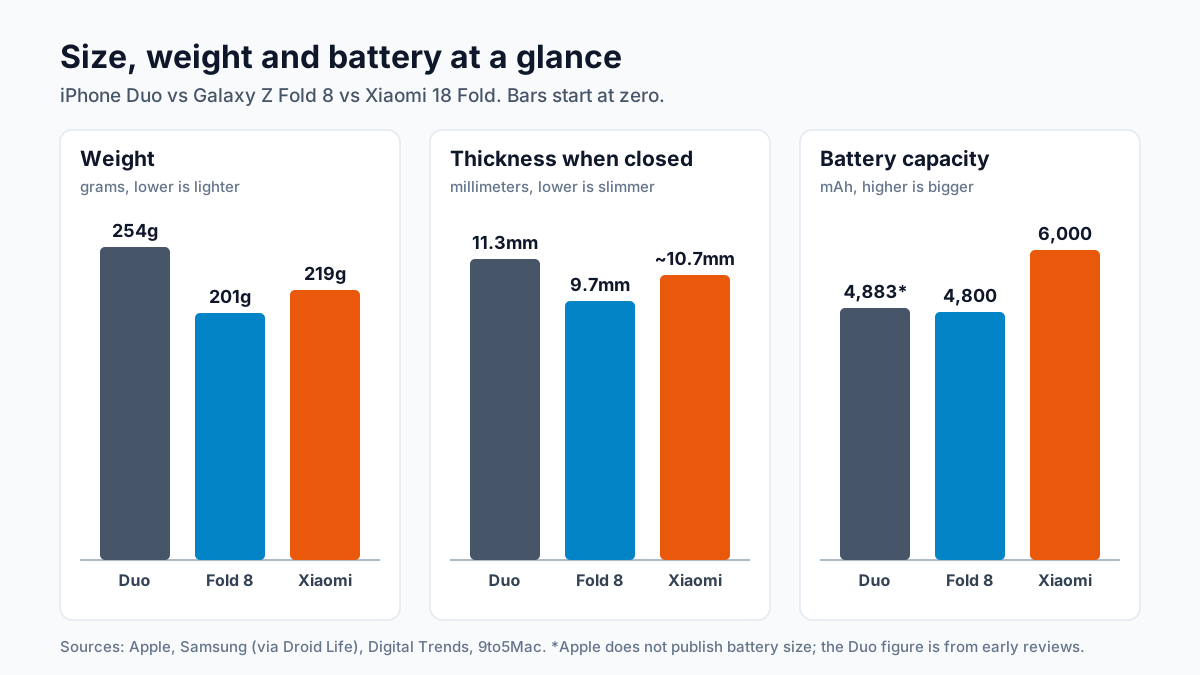
Daily-use verdict: if you carry your phone in a small pocket or use it one-handed on a commute, the Fold 8 is the easiest to live with. The Duo asks you to accept extra weight in exchange for its other strengths.
The Cover Screen: Using It Closed
Most of the time, you'll use a foldable closed. So the outside screen matters more than the big one, even though the big one gets all the attention in launch videos and adverts.
All three now have wide cover screens of about 5.4 inches. That's the big change from older Folds. On the Duo, the cover screen has about 90% of the screen area of an iPhone 18 Pro, and its shape is about 1.4 to 1.
Here's what reviewers found when typing and browsing with the phones closed:
- iPhone Duo: 9to5Mac found typing comfortable, with the keyboard taking just under half the screen. Right-handed reach was good. Left-handed use was harder, especially reaching the top-right corner.
- Xiaomi 18 Fold: Digital Trends found it wide enough for one-handed use, and typing felt more natural than expected. Its curved right edge takes away a little space.
- Galaxy Z Fold 8: it has the largest cover screen, at 5.5 inches, on a body that's a little taller and narrower than the other two.
The weak spot is the web. Websites aren't built for a short, wide screen. Cookie and newsletter banners can fill most of the view on the Duo's cover screen.
Opening Up: Inner Screens and the Crease
Each phone opens to a screen of about 7.6 inches. The crease is where they differ most.
Apple's press release called the inner screen crease-free, and so did our launch post. Reviewers found that's not quite true.
The Duo uses a nano-texture coating that scatters light, so the crease is hard to see in normal use. It shows in bright light over dark content. You can feel it when you scroll. That coating also cuts glare, but it holds on to fingerprints.
The Xiaomi's crease gets similar notes. Digital Trends could feel a slight dip but said it was hard to see most of the time.
Still, progress is real. All three are a long way ahead of foldables from a few years ago, when the fold line was the first thing people saw.
Opening the Duo takes two hands, and the 9to5Mac reviewer stopped noticing that after a day or so. Its hinge holds steady at partial angles. So you can stand it up for video calls or use it as a bedside clock without a stand.
iPhone Duo vs Galaxy Z Fold 8 for Video and Reading
Screen shape decides how much of the screen a video actually fills.
The Fold 8's inner screen is 4:3, like an iPad. What Hi-Fi? found it shrinks the black bars on most video and called the phone a brilliant portable movie machine. The Duo's inner screen has the same shape as its cover screen, and the Xiaomi's is close to it, at about 1.41 to 1 by our math from its resolution.
None of the three is 16:9, so movies will always show some bars. Digital Trends said you'll need to pinch to zoom on the Xiaomi to fill the screen.
For reading, the wide shape is a gift. Books, PDFs and long articles look like a small page. Photo galleries look great too. GSMArena praised the Fold 8's inner panel for photos, books and multitasking, but found the camera viewfinder awkward in that shape.
Apps and Multitasking
Here the Duo is behind, and it's the newest player. Expect growing pains.
Apple added Split View, so you can run two apps side by side on an iPhone for the first time. You can also open two windows of the same app, swap apps fast and save app pairs. But 9to5Mac found real limits:
- No drag-and-drop into Split View, and no Slide Over.
- Old apps letterbox: apps built with the iOS 26 SDK or earlier show black bars in landscape and a floating window in portrait, which looks a lot like an iPhone app running on an iPad.
- Partly updated apps: apps built with the iOS 27 SDK fill most of the screen but leave a strip on the right.
- Fully updated apps: only apps built with the iOS 27.1 SDK use both screens fully.
- Safari sometimes serves the phone version of a site on the big screen.
Samsung has refined its foldable software over eight generations. The Fold 8 runs several apps side by side and supports DeX, its desktop mode, according to TheSmartLocal. Xiaomi's HyperOS 4 goes further, with up to four live app panes, per Gadget Flow.
Apps will improve. Apple has strong pull with developers, and big apps such as Netflix, Zoom and Slack were ready at launch. But if you multitask hard today, Android is ahead.
iPhone Duo vs Galaxy Z Fold 8: Cameras
This is the round where neither Apple nor Samsung wins. The Xiaomi does.
| Camera | iPhone Duo | Galaxy Z Fold 8 | Xiaomi 18 Fold |
|---|---|---|---|
| Main | 48MP | 50MP | 200MP |
| Ultra wide | 48MP | 50MP | 50MP |
| Telephoto | None (2x crop) | None | 50MP periscope, 3.5x optical |
9to5Mac rated the Duo's main camera about level with the iPhone Air's, a notch below the 18 Pro. Mark Ellis Reviews flagged the Fold 8's missing optical zoom as a con. Digital Trends called the Xiaomi's cameras unusually serious for a foldable.
Each phone has one clever trick. The Duo lets you take selfies with the main camera, using the outer screen as a viewfinder, and its Duo Preview and Smart Take modes help with group shots. Samsung's Folds have offered rear-camera selfies for years, but Apple's version is polished.
Daily-use verdict: if photos of your kids at a football match or a band on a far stage matter to you, zoom matters, and only the Xiaomi has it.
iPhone Duo vs Galaxy Z Fold 8: Battery Life
Battery life is the most mixed result. Every outlet tests differently.
| Test | Result |
|---|---|
| Tom's Guide web test, iPhone Duo | 13 hours 20 minutes |
| Tom's Guide web test, Galaxy Z Fold 8 | More than three hours less than the Duo |
| Tom's Guide web test, iPhone 18 Pro Max (for scale) | 17.5 hours |
| 9to5Mac daily use, iPhone Duo | Ended days at about 20%, with heavy inner-screen use |
| Gizmodo, iPhone Duo | 5.5 to 7.5 hours of screen-on time |
| Digital Trends daily use, Xiaomi 18 Fold | About a day and a half |
The Fold 8 has a 4,800mAh battery, and reviewers were split. Mark Ellis praised its battery life, while GSMArena found it runs hot and slows down under long, heavy loads.
The Xiaomi has the biggest battery by a wide margin. It's a 6,000mAh silicon-carbon cell, and it charges fastest, at 67W wired and 50W wireless.
Charging on the Duo is quick if you own the right brick. It reaches 50% in about 20 minutes with a 60W or higher adapter, or in about 30 minutes on a MagSafe or Qi2 charger with a 35W adapter. One small annoyance: MagSafe wallets and battery packs hang off the short bottom edge.
iPhone Duo vs Galaxy Z Fold 8: Durability and Repairs
Foldables break in ways normal phones don't, so this round deserves care.
On paper, the Duo is the toughest. It has an IP68 rating, a titanium body, Ceramic Shield on both sides and a hinge with more than 100 parts. The Fold 8 is IP48, which means good water resistance but protection only against dust particles larger than 1mm. Xiaomi's Chinese listings show IP58 and IP59, but Engadget said Xiaomi didn't share a rating at its IFA hands-on.
The Duo has had a rough first week, though. Some owners reported inner screens cracking along the hinge line, often after feeling resistance or hearing a pop when opening. Apple says it affects a small number of units and that affected owners can get a replacement through AppleCare, even without AppleCare+. The cause hasn't been made public yet, and Apple says its own review unit was fine and that one test unit had passed more than 55,000 folds.
What we'd do: buy any foldable with an extended warranty or care plan. Seriously. Repairs to inner screens are costly on every brand. With the Xiaomi, check who will fix it where you live before you buy.
Performance and Heat
All three are fast. The differences show up under long loads, not in daily taps.
- iPhone Duo: Apple says the A20 Pro gives up to 35% better sustained performance than the iPhone 17 Pro, helped by a vapor chamber. 9to5Mac found it performs about like the 18 Pro but runs a little warmer, with no slowdown. Its speakers sound thinner and quieter.
- Galaxy Z Fold 8: it packs a Snapdragon 8 Elite Gen 5 into a 4.5mm body. Gizmodo found it snappy. GSMArena found heavy throttling and heat under sustained load.
- Xiaomi 18 Fold: the XRING O3 is Xiaomi's own 3nm chip. Digital Trends found it fast and smooth in daily use.
For long gaming sessions, that thin Samsung body is the weak point, because a 4.5mm frame has less room to spread heat than the thicker Apple and Xiaomi phones.
Ecosystem: The Choice You're Really Making
For most buyers, this matters more than any spec.
- Apple users: the Duo slots straight in with your Mac and Apple Watch. Touch ID sits in the side button, and Apple Watch unlock helps a lot. The 9to5Mac reviewer missed Face ID's Attention Aware features, such as notifications that expand when you glance at them, which a fingerprint sensor in the side button simply can't offer. Apple Pencil support with the USB-C Pencil is coming later this year.
- Android users: the Fold 8 is the natural pick. You get Galaxy AI, DeX and, per Gadget Flow, Samsung's seven-year update policy. One loss: the S Pen no longer works on the Fold series, a change that began with the Fold 7.
- Xiaomi buyers: the 18 Fold runs HyperOS 4 on Android 17, set up for Chinese apps and services. That's fine inside China. Elsewhere, expect more setup work and less certainty about updates.
Switching is expensive. Moving from iPhone to Android, or the other way, means new apps, new habits and sometimes lost data, so most people should start from the ecosystem they already have.
Price and Where You Can Buy Them
The prices are close at the top, and availability is not.
- iPhone Duo: from $1,999 for 256GB, up to 2TB. On sale in more than 70 countries from October 23, with 28 more from October 30. It's eSIM-only worldwide.
- Galaxy Z Fold 8: from $1,899.99 for 256GB, $100 less than the Duo. Sold widely through Samsung and carriers.
- Xiaomi 18 Fold: from CNY 10,999 in China, up to CNY 15,999 for a special 1TB edition. There's no official sale outside China yet.
Demand looks strong. Xiaomi says first-sale demand was 310% higher than for its previous large foldable, and one industry watcher reported about 36,000 units sold on the first day, though that figure is unofficial. Outside China, buying one means importing it.
iPhone Duo vs Galaxy Z Fold 8: Which Should You Buy?
Here's the short version, by type of buyer.
Pick the iPhone Duo if you already live in Apple's world, you want the strongest water and dust rating, and you can accept the weight. Gadget Flow calls it the safest pick for existing iOS users. Wait a few weeks if the cracking reports worry you, and watch for updates from Apple.
Pick the Galaxy Z Fold 8 if you want the lightest, slimmest foldable, you use Android or you watch a lot of video. It's also $100 cheaper. Skip it if you need a zoom lens or play long gaming sessions.
Look at the Xiaomi 18 Fold if you live in China, or you're happy to import and live without a local warranty. It has the best camera and the biggest battery of the three.
When the Xiaomi 18 Fold Makes Sense
The Xiaomi is the most interesting phone here and the hardest to recommend. That's not about quality. Reviewers like it a lot. Digital Trends called it the best passport-style foldable right now, with the sad quirk that it's sold only in China.
It makes sense for three groups:
- Buyers in China, who get full support, local apps and a warranty.
- Camera lovers who'll accept import risk for the only zoom lens here.
- Battery-first users, who want the 6,000mAh cell and 67W charging.
For everyone else, the Fold 8 is the safer Android choice.
What About the Galaxy Z Fold 8 Ultra?
Samsung also sells a Galaxy Z Fold 8 Ultra for $2,099. It's the bigger model, with an 8-inch inner screen, a 6.5-inch cover screen and a 5,000mAh battery.
It fixes the Fold 8's biggest gap. It has a 200MP main camera and a 10MP 3x telephoto. The trade-off is weight, at 215g, and a taller, narrower shape when closed. If you want a Samsung phone and you care about zoom more than weight or pocket size, the Ultra is the one to try in a shop before you decide.
A Week-One Checklist for Any Foldable
New foldables need a little care at first. These steps help no matter which one you buy:
- Leave factory layers alone. If the inner screen has a fitted protective layer, don't peel it off. Check the maker's care guide.
- Open it gently. If the hinge feels stiff or you hear a pop, stop and contact support.
- Keep it clean. Grit in the hinge or between the screens can scratch the soft inner panel.
- Check app support. Open the 10 apps you use most on the big screen. Note the letterboxers.
- Set up your care plan. Inner-screen repairs cost far more than on a normal phone, and with the Xiaomi you also need to know who can repair an imported unit at all.
- Track your battery. Note your screen-on time for a week, then compare it with the reviews.
What Foldables Mean for App Teams
There's a lesson here for product teams, too. A wide foldable is two screen sizes in one, and users jump between them all day, sometimes dozens of times, which means every screen in your app has to work in both shapes. The iPhone Duo shows how fast a new screen can expose old app layouts.
If you run an app, check your analytics. Measure first.
How many sessions come from foldables, and from which screen state? Do people who open the big screen stay longer or buy more? Those numbers tell you whether redesigning for foldables is worth it now or later.
Phones are also becoming small AI computers, a trend we covered in our look at on-device AI chips, and a bigger screen gives those AI features more room to show their results right next to the app you're using.
iPhone Duo vs Galaxy Z Fold 8: Our Take
The iPhone Duo vs Galaxy Z Fold 8 race is closer than many expected. Apple didn't reinvent the foldable. It made a polished, tough and heavy version, and its software still has gaps.
Samsung's eighth try is light and refined, and it's $100 cheaper. Xiaomi built the best hardware of the three but sells it in only one country.
So the right answer depends on your ecosystem first and your habits second:
| If you... | Pick |
|---|---|
| Carry your phone all day | Galaxy Z Fold 8 |
| Live in Apple's world | iPhone Duo, with a care plan |
| Want the best camera | Xiaomi 18 Fold, if you can buy it locally |
| Aren't sure yet | Wait a year |
These are first-generation shapes for all three brands, and next year's models will fix many of the small annoyances that early reviewers found in daily use.
How Van Data Team Helps Teams Read Their Users
We build data platforms and analytics that show how people really use a product, across devices, screen sizes and app versions. That's how you decide whether a new device class, like foldables, deserves design time.
If you're unsure which devices and screens matter for your app, get in touch. For Apple's launch details, see our earlier piece on the iPhone Duo release.
Sources: Apple newsroom, 9to5Mac review, Tom's Guide comparison, Apple's response on cracks via 9to5Mac, Droid Life on Fold 8 specs, Samsung support, GSMArena review, What Hi-Fi?, Digital Trends on the Xiaomi 18 Fold, Gizmochina on Xiaomi sales, Gadget Flow.
AI Model Brief
The AI models worth knowing, once a week
What shipped, how it scores on independent benchmarks, what it costs per million tokens and what was deprecated, from the data behind our AI model benchmarks.
We use your address only to send the brief. See our privacy policy.
See this week’s brief
Founder of Van Data Team. Builds Vanaxity, the AI agent system for SEO, GEO, and AEO, and leads data engineering delivery for B2B teams.
About the authorArticle FAQ
Questions readers usually ask next.
These short answers clarify the practical follow-up questions that often come after the main article.
Need a similar system?
If this article maps to a workflow your team already operates, the next step is usually a scoped review of the system, constraints, and rollout path.
Consultation
Scope your next AI workflow.
Share the system and blockers. We will map fit, gaps, and the next step.