AI Capex: What Big Tech's $167B Quarter Means for AI Buyers
Alphabet, Microsoft and Amazon spent about $167B on AI capex in one quarter, and Alphabet lost about $500B in a day. What it means for cloud and AI buyers.
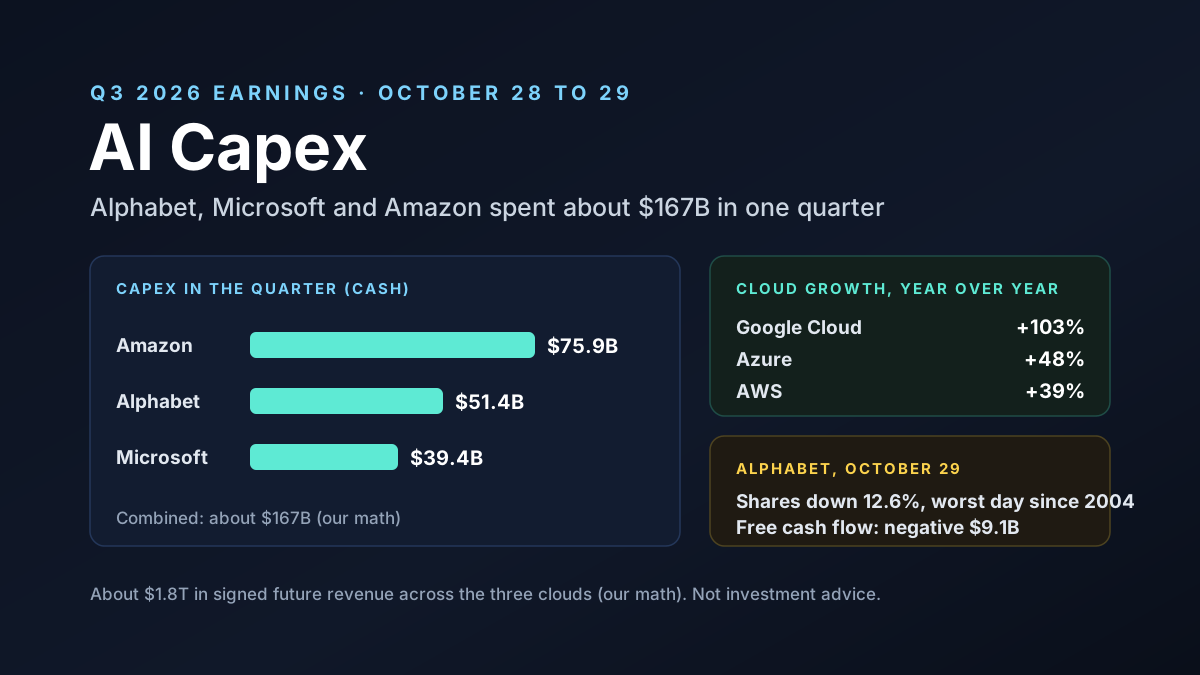
AI capex just had its biggest test yet. Alphabet and Microsoft reported results on October 28, 2026, and Amazon followed on October 29. All three clouds grew fast, but the spending stole the show.
By our count, the three companies spent about $167 billion on capital projects in a single quarter, most of it for AI. Alphabet's free cash flow turned negative again, and its shares had their worst day since 2004. That's rare. Here's what the numbers say, and what they mean for companies that buy cloud and AI services.
Disclosure: Van Data Team builds data and AI systems on Google Cloud, Microsoft Azure and AWS. This article was researched with Claude, made by Anthropic, which buys large amounts of cloud capacity from Amazon and Google. This is not investment advice. We don't recommend buying or selling any stock.
Key Takeaways
- Alphabet, Microsoft and Amazon spent about $167 billion on capex in the third quarter of 2026, by our count of their reported cash figures.
- Their clouds grew fast: Google Cloud up 103%, Azure up 48% and AWS up 39%.
- Alphabet's free cash flow was negative $9.1 billion, its second negative quarter in a row. Its shares fell 12.6% on October 29, its worst day since its 2004 listing.
- The three clouds report about $1.8 trillion in contracted future revenue between them, by our count. Much of that capacity is already spoken for.
- For AI buyers, expect tight capacity for the newest chips, fewer deep discounts and more pressure to sign long commitments.
AI Capex at a Glance
| Q3 2026 | Alphabet | Microsoft | Amazon |
|---|---|---|---|
| Reported | October 28 | October 28 | October 29 |
| Total revenue | $127.6B, up 25% | $92.3B, up 19% | $201.9B, up 12% |
| Cloud growth | Google Cloud up 103%, to $30.7B | Azure up 48% | AWS up 39%, to $46.0B |
| Capex in the quarter | $51.4B | $39.4B cash; $45.2B with finance leases | $75.9B cash capex; $77.3B gross |
| Free cash flow | Negative $9.1B | $18.6B, down 27% | Negative $42.4B over 12 months |
| Contracted future revenue | $561B Google Cloud backlog | $677B commercial RPO | $578B AWS backlog |
| Next year's spending | "Increase significantly" in 2027 | About $170B in calendar 2027 | "Meaningfully more" in 2027 |
What Happened to Alphabet's Stock
Alphabet's Class A shares closed at $283.82 on October 29, down 12.6%. It was the company's worst day since it listed in 2004, beating a fall of about 11.6% in March 2020.
Estimates of the value lost range from about $480 billion to $500 billion, depending on the share count and timing used. Either way, it's one of the biggest one-day losses for any US-listed company. Only Nvidia's drop of about $593 billion in January 2025 was clearly larger.
The cause wasn't only spending. Search revenue grew 12%, below the roughly 15% analysts expected, and earnings per share missed too. But the cash numbers drew the most attention.
Why AI Capex Spooked Investors
The simple version: Alphabet spent more than it brought in. It spent $51.4 billion on capex in the quarter, while its operations brought in about $42.3 billion in cash. That left free cash flow at negative $9.1 billion, the second negative quarter in a row.
Then came the outlook. Alphabet kept its 2026 capex plan at $195 billion to $205 billion. Its finance chief, Anat Ashkenazi, said capex will "increase significantly in 2027," with details on the next call.
Investors had cheered AI spending for three years. Patience is thinning. Now some want proof that it pays off before the bill doubles again. We covered a similar reaction to Meta's spending in our look at AI bubble fears.
Alphabet: Cloud Doubles, Cash Turns Negative
The irony is that Alphabet's AI business is booming. Demand looks huge. Google Cloud revenue more than doubled, up 103% to $30.7 billion. Its operating margin rose to 36.2%, up from 23.7% a year earlier.
Usage is surging too:
- Model APIs: nearly 32 billion tokens per minute, more than four times a year ago.
- Gemini app: one billion users.
- Cloud backlog: about $561 billion of signed contracts not yet delivered.
Google expects to turn just over 55% of that backlog into revenue within two years. So demand isn't the problem. The question is how long it takes to earn back the spending, especially when most of it goes to servers that will need replacing within a few years.
Microsoft: Azure Grows 48%, OpenAI Is 11% of Revenue
Microsoft had a calmer day, and its shares edged higher. Revenue rose 19% to $92.3 billion, and Azure grew 48%, faster than Microsoft's own forecast.
It spent $39.4 billion in cash on property and equipment. Counting finance leases, which are mostly data centers it rents from others and books like purchases, the total was $45.2 billion, up about 30% from a year earlier. Microsoft said some capacity from outside partners arrived late, which kept spending below expectations. Free cash flow stayed positive at $18.6 billion, though it fell 27%.
The surprise was in Microsoft's quarterly filing. Deals with OpenAI brought in about $10 billion of revenue in the quarter, close to 11% of the total. OpenAI also owed Microsoft $7.2 billion at quarter end, up from $6 billion in June. Microsoft's commercial remaining performance obligation, the value of contracts not yet delivered, reached $677 billion, up 73% from a year earlier.
Looking ahead, Microsoft expects more than $50 billion of capex and finance leases next quarter, and about $170 billion for calendar 2027. It points to capacity shortages as the reason.
Amazon: AWS Speeds Up, Spending Speeds Up More
AWS grew 39% to about $46 billion, its fastest growth in nearly five years. AWS operating income was $17.8 billion. Amazon projects AWS growth above 40% in both 2027 and 2028.
Spending grew far faster:
- Cash capex: $75.9 billion in the quarter, or $77.3 billion in gross purchases of property and equipment.
- Free cash flow: negative $42.4 billion over the last 12 months.
- 2026 plan: about $220 billion of cash capex.
- 2027 plan: "meaningfully more" than in 2026.
AWS's backlog reached $578 billion, more than double a year earlier, which shows that customers are signing up for capacity years before it even exists. Amazon's shares fell more than 7% after hours.
Adding It Up: $167 Billion in One Quarter
Here's our own math. Add Alphabet's $51.4 billion, Microsoft's $39.4 billion and Amazon's $75.9 billion, and you get about $167 billion in one quarter. Using Microsoft's figure with leases and Amazon's gross figure, it's about $174 billion.
And all three companies plan to spend more in 2027.
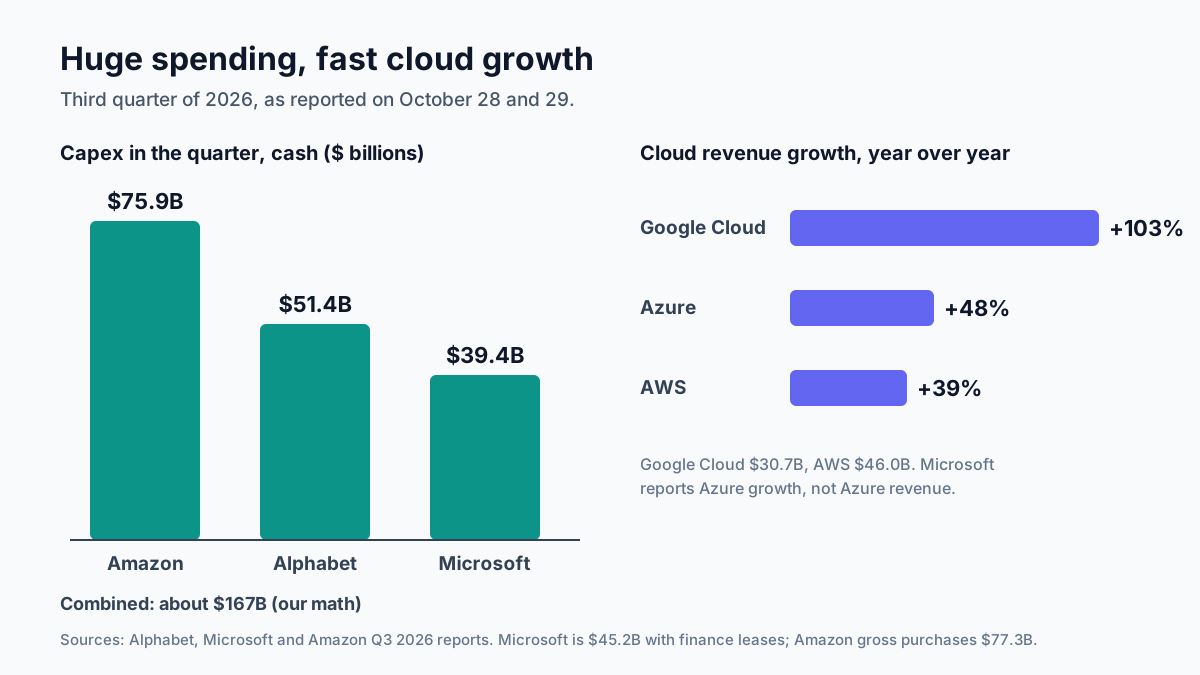
The definitions differ a little. Microsoft reports cash spent on property and equipment, Amazon reports cash capex net of some offsets and Alphabet reports purchases of property and equipment. So treat $167 billion as a close estimate, not an exact sum.
What Is AI Capex, and Where Does the Money Go?
AI capex is spending on the physical base of AI: chips, servers, networking, data center buildings and power. Companies record it as an asset and spread the cost over several years through depreciation.
The mix matters. Alphabet said about 65% of its quarter's capex went to servers and networking, and about 35% to data centers. Servers wear out and go out of date in a few years, much faster than buildings. So a large share of this spending has to earn its return quickly.
That's why cash flow matters so much right now. When a company spends more than it earns, it has to borrow, cut back elsewhere or prove that revenue will catch up soon.
The $1.8 Trillion Backlog
The other side of the story is demand. Add Microsoft's $677 billion, AWS's $578 billion and Google Cloud's $561 billion, and the three report about $1.8 trillion in signed future revenue, by our count.
| Company | Contracted future revenue | What it covers |
|---|---|---|
| Microsoft | $677B, up 73% in a year | All commercial contracts, not just Azure |
| Amazon | $578B, more than double a year ago | AWS |
| Alphabet | $561B, just over 55% due within two years | Google Cloud |
These aren't measured the same way. Microsoft's figure covers all its commercial contracts, not just the cloud. And they include some very large contracts with AI labs such as OpenAI and Anthropic.
Still, the message is clear. Much of the capacity being built is already sold. That's good news for the clouds, and a warning for smaller buyers who will need capacity later, since they'll be in line behind the biggest contracts.
What AI Capex Means for Companies Buying AI
Most companies don't own data centers. They rent AI through the cloud or through model APIs. So the real question is what this spending does to price, supply and risk for buyers.
Here's the short version:
- Capacity for the newest chips stays tight. Big signed contracts, like the multi-year deals AI labs have struck, get served first, and everyone else waits for whatever capacity is still left over.
- Discounts get harder to win. Providers need a return on huge spending.
- Long commitments get pushed harder. Clouds want steady, predictable use for the new data centers they're building, because idle servers lose value every single month that they sit unused in a rack.
- Your vendors depend on a few giant customers. That adds risk you can't see in your own contract.
The next few sections take these one at a time, with the numbers from this quarter's reports and the steps you can take right now.
AI Capex and Cloud Prices: Will They Go Up?
Not across the board. Price per token has kept falling as chips improve, and competition is fierce. Google's new Gemini 4 Carbon, for example, launched at $2 per million input tokens, the same price as Gemini 4 Argon, even though it scores higher on the main independent index.
But watch the fine print. Many models launch at an introductory price that doubles later; Carbon goes to $4. Committed-use discounts may shrink. And the newest hardware often costs more for the first year or two.
So plan for unit prices that stay flat or fall slowly, while total bills rise as usage grows. Our guide to token efficiency explains why tokens per task matter more than the price list.
AI Capex Hasn't Fixed the Capacity Crunch
All this spending exists because demand is still bigger than supply. Microsoft tied its 2027 spending plan to capacity shortages. It also said some partner capacity arrived late this quarter.
For buyers, that means real limits. You may face quotas on the newest GPUs, waiting lists in popular regions or slower access to new models. Teams that plan ahead will get served first.
If you rent GPUs from smaller providers to get around these limits, read our piece on the neocloud shakeout first, since those providers face their own funding squeeze.
The OpenAI Concentration Risk
Microsoft's filing shows how much the cloud business now leans on AI labs. About 11% of Microsoft's revenue came from OpenAI in one quarter. OpenAI also owed Microsoft $7.2 billion at quarter end.
That's not a problem for your contract today. But it shows that cloud plans depend on a few giant buyers. If one of them slows down, switches provider or pays late, clouds may change prices, regions or priorities.
The practical lesson is to avoid being trapped. Keep your workloads able to move between clouds and between models. Our guide to multi-cloud FinOps covers how to track spending across providers.
A Worked Example: Commit or Pay as You Go?
Here's a made-up example with round numbers to show the trade-off between locking in a discount and keeping the freedom to spend less later on. It isn't a real offer from any cloud.
A company spends $20,000 a month on AI services at on-demand prices. Its cloud offers a one-year deal: commit to $16,000 a month and get the same usage, a 20% saving.
| What happens to usage | On-demand cost per year | Committed cost per year | Result (our math) |
|---|---|---|---|
| Usage stays the same | $240,000 | $192,000 | Commitment saves $48,000 |
| Usage falls 20% | $192,000 | $192,000 | Break-even |
| Usage falls 40% | $144,000 | $192,000 | Commitment costs $48,000 more |
The lesson: a commitment only pays if your usage stays above the break-even point. With AI, usage can swing fast. A cheaper model, a better prompt or a failed project can cut it in half. So commit to the part of your usage you're sure of, and keep the rest flexible.
How to Protect Your AI Budget
You can't control what big tech spends. But you can control how exposed your projects are.
- Forecast usage by workload. Know which jobs drive your bill, how fast each one is growing and what would happen to the total if your busiest workload doubled next quarter.
- Track cost per task. It's the number that tells you whether a model switch saves money.
- Commit only your floor. Lock in the usage you're sure of, and pay as you go for the rest.
- Ask for exit terms. Get the right to move unused commitment to other services, regions or newer models, so a change in plans doesn't leave you paying for capacity you can't use.
- Stay portable. Use open formats, standard containers and a model layer you can swap.
- Use smaller models where they work. Not every task needs the newest, scarcest model.
Our guide to cloud cost guardrails shows how to set budgets and alerts that catch surprises early.
Questions to Ask Your Cloud Provider
Before you sign anything long, ask these:
- Is capacity for the chips we need guaranteed, or best effort?
- What happens to the price when an introductory rate ends?
- Can unused commitment move to other services, regions or models, and if it can, is there a fee or a deadline for making that switch?
- What notice do we get before quotas or prices change?
- Which regions have spare capacity today, and which are full?
Clear written answers are worth more than a bigger discount.
Is the AI Capex Boom a Bubble?
There are two honest sides to this debate, and we don't take a view on any stock, since this article is about buying cloud services, not shares.
The case for worry:
- At Alphabet and Amazon, spending now outruns the cash their businesses bring in.
- Free cash flow has turned negative at Alphabet and Amazon.
- Most of the money goes to servers that age quickly, so idle capacity loses value fast if AI demand slows.
The case for calm:
- Cloud revenue is growing fast, and margins are high.
- About $1.8 trillion of future revenue is already signed.
- Microsoft still makes positive free cash flow, and Google says its token volume quadrupled in a year.
For AI buyers, it matters less. Boom or slowdown, the same habits protect you: measure your usage, keep options open and avoid long bets you can't exit.
What to Watch Next
- Alphabet's Q4 call, where it promised details on 2027 spending.
- Capacity news, such as quotas, waitlists or new regions from the big three.
- Launch prices ending, as introductory model prices step up.
- Large AI lab contracts, since a few very large customers, including OpenAI and Anthropic, drive much of the backlog and can shift demand between clouds quickly.
- Free cash flow at Amazon and Alphabet, to see whether spending starts to pay back.
AI Capex: Our Take
This was the quarter when AI capex stopped being just a growth story and became a cash story. The clouds are growing fast and their order books are huge. But spending is rising fast too, and investors want proof that it pays.
For most companies, nothing here changes what you should build. It changes how you should buy. Expect tight capacity and tougher discounts, commit only to usage you're sure of and keep your workloads portable. That approach works whether the boom keeps going or cools off.
How Van Data Team Helps Teams Plan AI Spending
We help companies plan and control AI and cloud costs with clear numbers, not guesses. That includes usage forecasts by workload, cost-per-task tracking, commitment planning and portable designs that let you move between clouds and models.
If your AI bill is growing faster than your plan, start with our guide to multi-cloud FinOps, then get in touch for a quick review.
Sources: Alphabet Q3 2026 earnings call coverage, CNBC on Alphabet's results, CNBC on Alphabet's worst day, TechCrunch on Microsoft's OpenAI revenue, Microsoft's Q1 FY2027 call transcript, Amazon's Q3 2026 results and AI Weekly on AWS.

Founder of Van Data Team. Builds Vanaxity, the AI agent system for SEO, GEO, and AEO, and leads data engineering delivery for B2B teams.
About the authorArticle FAQ
Questions readers usually ask next.
These short answers clarify the practical follow-up questions that often come after the main article.
Need a similar system?
If this article maps to a workflow your team already operates, the next step is usually a scoped review of the system, constraints, and rollout path.
Consultation
Scope your next AI workflow.
Share the system and blockers. We will map fit, gaps, and the next step.