Tesla Roadster Flying Car: What's Real and What's a Stunt
The new Tesla Roadster uses cold-gas thrusters to jump, flip and hover. What Tesla showed, what's still unproven, and how to judge a tech demo like this one.
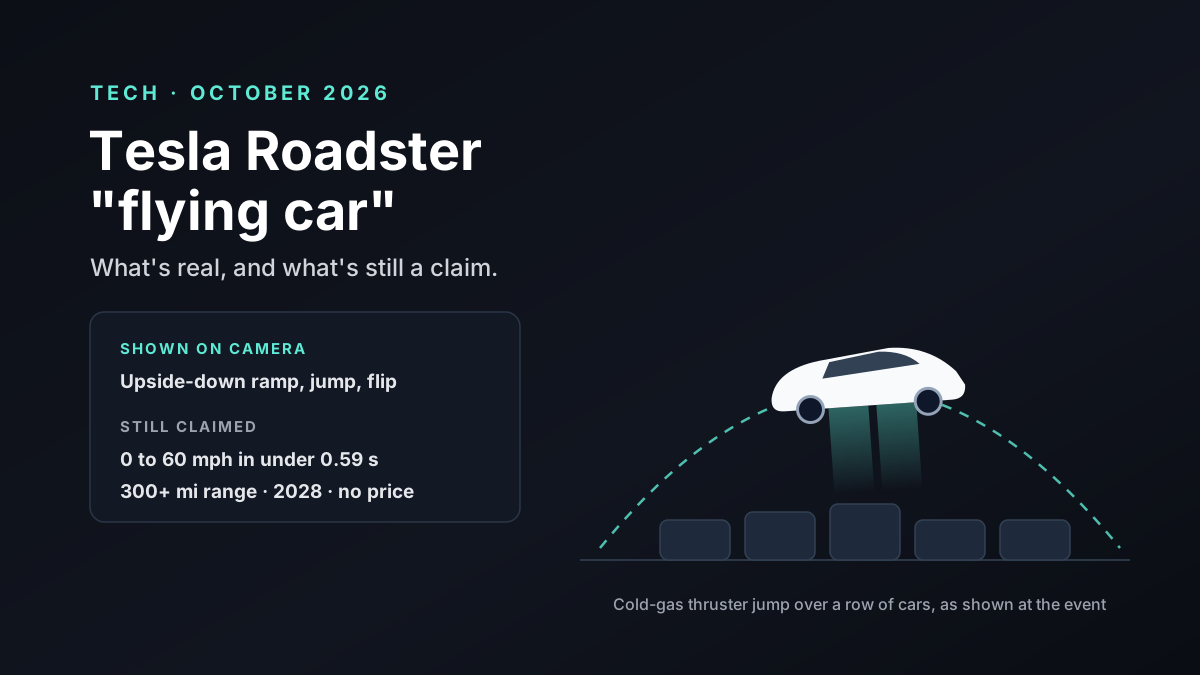
The new Tesla Roadster can't fly like a plane, but it can jump, flip and land using cold-gas thrusters built with SpaceX. That's what Tesla showed at a long-delayed event near Waco, Texas, on October 15, 2026. Elon Musk called it the world's first flying car. The stunts were real on camera, but the specs, price and road rules are still mostly claims.
Key Takeaways
- Tesla showed the next-generation Roadster on October 15, 2026, nearly nine years after the first reveal in 2017.
- A demo car drove up a curved ramp upside down, using fans for grip, then used cold-gas thrusters to flip, jump a row of Teslas and land.
- Tesla offers three trims: Performance, Thrust and Rocket. Only Rocket has thrusters for upward movement, and Tesla says it isn't approved for public roads.
- Tesla claims 0 to 60 mph in under 0.59 seconds for Rocket, but no one outside Tesla has tested it.
- There's still no price. Reservations take $50,000 for Performance and $250,000 for Thrust, and production is set for 2028.
The Tesla Roadster at a Glance
| Trim | Seats | What it adds | Claimed 0 to 60 mph | Reservation |
|---|---|---|---|---|
| Performance | 2 | Active aero and a fan "suction system" for grip | Under 1.6 seconds | $50,000 |
| Thrust | 2 | Rear cold-gas thrusters | Under 0.9 seconds | $250,000 |
| Rocket | 1 | Thrusters around the car for lift and rotation | Under 0.59 seconds | Invite only |
Tesla lists over 300 miles of range for all trims and a top speed above 230 mph for Rocket, according to Electrek's summary of the specs Tesla posted after the event. Tesla treats Thrust and Rocket as add-ons to the Performance car.
What Tesla Showed at the Event
The event took place at a SpaceX test site in Texas, near Waco. According to The Guardian, the demo Roadster was controlled remotely "to make sure we don't kill anyone," in Musk's words.
The stunts went like this:
- The ramp: the car drove up a curved ramp until it was upside down, held on by fans that pull air from under the car.
- The flip: at the top, thrusters pushed it off the ramp, spun it and set it down on the pavement.
- The jump: in another run, it used thrusters to leap over a Cybercab, a Cybertruck, a Tesla Semi, a Model Y and a Model 3.
- The launch: Tesla then showed a 0 to 60 mph run, which it timed at about one second.
TechCrunch reports that Tesla vehicle engineering chief Lars Moravy said the car uses 10 thrusters fed by 600 liters of compressed air, which can be refilled. Musk credited joint work between Tesla and SpaceX engineers.
How the Tesla Roadster's Thrusters Work
They aren't rocket engines in the usual sense. Cold-gas thrusters release compressed gas through nozzles to push the car, with no burning fuel. SpaceX uses the same basic idea to steer spacecraft.
The gas sits in carbon fiber overwrapped pressure vessels, light tanks wrapped in carbon fiber that can hold very high pressure. Tesla says it packed them into "every usable void" in the car. More gas means more thrust time, so the one-seat Rocket trim gives up a seat for bigger tanks.
Why cold gas instead of a real rocket? It's simpler and safer. There's no flame, no fuel to burn and nothing to replace after each run, just tanks to refill.
The trade-off is power per kilogram: cold gas gives far less push for its weight than burning fuel does, which is why the thrust only lasts for short bursts. Electrek reports that four rear ports on the top trim produce about 80 kilonewtons of force, which is a lot for a car, but only for seconds at a time.
The second trick is the fan system. Fans pull air out from under the car while skirts seal the gap to the ground, so outside air pressure pushes the car down. That's how it stayed on the ramp upside down.
The idea isn't new. Race cars have used fans for grip, and McMurtry's Spéirling showed it on a modern electric car.
Can the Tesla Roadster Really Fly?
Not in the sense most people mean. Nothing at the event showed sustained flight. What it showed were short hops, flips and controlled landings, powered by a tank of gas that runs out quickly.
That's still impressive engineering. Pointing thrust in the right direction fast enough to flip a car and land it takes serious control software. Tesla says the thrusters needed new hardware and controls to work in open air, not in space.
But calling it a flying car stretches the term. A flying car usually means a vehicle that can take off, travel and land under its own power, like the small electric aircraft other companies are testing. The Roadster is closer to a car that can jump.
What's Confirmed and What's Unproven
Here's how we'd sort the claims. Confirmed means it was shown on camera at the event. Claimed means Tesla said it, but nobody has checked it.
| Claim | Status | Notes |
|---|---|---|
| Drives upside down on a ramp | Shown on camera | Fan grip, as on earlier fan cars |
| Jumps and flips using thrusters | Shown on camera | Remote-controlled, per The Guardian |
| 0 to 60 mph in under 0.59 seconds | Claimed | Demo runs showed about 1.0 and 0.81 seconds |
| Over 300 miles of range | Claimed | Down from 620 miles promised in 2017 |
| Over 230 mph top speed | Claimed | Rocket trim only |
| About 4,700 kg of downforce | Claimed | Electrek calls this surprisingly high for the car's weight |
| Production in 2028 | Target | Earlier dates slipped from 2020 onward |
The 0 to 60 figure needs a closer look. Electrek's technical review notes that the thrusters seemed to start before the car moved, and that the run may not have used the standard one-foot rollout most car tests use. Neither point means the number is wrong. But it does mean the figure can't be compared with normal car tests yet.
Is the Flying Roadster Legal?
Tesla itself says the Rocket trim isn't approved for public roads. The Guardian quotes Musk saying he wasn't sure it was "necessarily legal in all jurisdictions."
We found no report of an aviation or road-safety approval for the thruster features. That's not surprising. Rules lag. A car that briefly lifts off with gas thrusters doesn't fit neatly into existing rules for cars or for aircraft, and regulators usually take years to write new categories for vehicles that sit between the two. Electrek also notes the thruster plumes can reach tens of meters, which raises obvious safety questions on a public road.
Our read is that the Performance trim is the one that might reach normal roads as a fast electric sports car. The thruster trims look aimed at tracks, private events and showpieces, at least for now.
How the Tesla Roadster Changed Since 2017
The car has changed a lot since it was first shown in November 2017. Some numbers went up, others came down.
| Spec | Promised in 2017 | Claimed in 2026 |
|---|---|---|
| Range | 620 miles | Over 300 miles |
| 0 to 60 mph | 1.9 seconds | Under 1.6 seconds (Performance) |
| Top speed | Over 250 mph | Over 230 mph (Rocket) |
| Seats | Four (2+2) | Two at most |
| Production | 2020 | 2028 |
| Base price | $200,000 | Not announced |
Range roughly halved, and the back seats are gone. In return, Tesla added fans and thrusters that weren't part of the original design, though Musk first floated a thruster package in 2018.
Who Is the Tesla Roadster For?
Not most drivers. With deposits of $50,000 to $250,000 and no price yet, the Roadster is a halo car, built to show what Tesla can do rather than to sell in large numbers. Here's who we think it's really aimed at:
- Collectors and early buyers, including the people who reserved in 2017 and have waited since.
- Track-day drivers, who can use the fan grip and rear thrusters where road rules don't apply.
- Events and shows, where the one-seat Rocket trim's jumps and flips are the point.
- Tesla's own brand, since a car that drives upside down gets attention no ad can buy.
Musk also framed it as an ending. TechCrunch quotes him calling it the best of "the last of the human-driven cars," at a time when Tesla is pushing hard on self-driving taxis. That makes the Roadster a bit of a farewell to the steering wheel, even though it uses a yoke and steer-by-wire controls.
Why the Delays Matter
The Roadster has the longest delay record of any Tesla. Production was first promised for 2020. The reveal then moved many times, including several dates in 2026 alone, before an October 1 event was postponed for bad weather.
Delays aren't unusual for hard engineering, and the Roadster had to absorb a whole new set of ideas, from fan grip to thrusters, that weren't in the 2017 plan, but they still matter for buyers. In 2017, Tesla took $50,000 deposits, and 1,000 Founders Series buyers paid $250,000.
Many of those buyers have now waited nearly nine years. TechCrunch notes that critics, including OpenAI chief executive Sam Altman, have complained about the wait.
Musk was frank. TechCrunch quotes him saying the Roadster is "not sure it moves the needle massively" on revenue. Analyst Gene Munster went further and called the reveal an engineering flex with no real commercial value beyond showing up rival carmakers, according to Stocktwits.
What Buyers Should Know Before Reserving
If you're thinking about a reservation, read the terms closely. Based on Tesla's reservation page as reported by Electrek and TechCrunch:
- A reservation isn't an order. It holds a place in line, and there's still no price for any trim.
- The money comes fast. Performance takes $5,000 up front, which Tesla calls fully refundable, and $45,000 within 10 days, or the reservation is cancelled.
- The thruster trims cost more to reserve. Thrust takes $250,000, the same amount 2017 Founders Series buyers paid, while Rocket is invite only and Tesla hasn't said how buyers will be chosen or what it will cost.
- The timeline is long. Production is planned for 2028, and the car's dates have slipped many times.
- The specs can still change. Range, seats and top speed have all moved since 2017.
Before you pay, check what's refundable after the first 10 days, what happens if the price is higher than you expect, and whether a thruster trim can be insured or registered where you live.
What the Tesla Roadster Says About Tesla and SpaceX
The most interesting part may not be the car. It's how openly Tesla mixed its work with SpaceX's. The thrusters, the gas tanks and the control software all borrow ideas from rockets.
For years, Musk's companies have shared people and ideas. The Roadster turns that into a product feature. Whether that's a one-off stunt or a sign of deeper ties between the two firms, it shows how much engineering talent and tooling moves between them.
Questions Tesla Still Hasn't Answered
The event left a lot out. These are the open questions we'd want answered before taking any of the flight claims at face value:
- How long does the gas last? Tesla hasn't said how many jumps or seconds of thrust one tank gives, and Electrek points out that the demo seemed to use different cars for different stunts, which may hint at limited gas per run.
- How long does a refill take? And how much energy does it take to compress 600 liters of gas back to full pressure, at a track or at home, between runs?
- How safe are the tanks in a crash? High-pressure carbon fiber tanks need careful testing.
- Who can drive the Rocket trim? The demo car was remote-controlled, so it's unclear how a person would handle it.
- How fast is it in normal tests? An independent 0 to 60 run with standard rules, done by a car magazine or testing firm with its own timing gear, would settle the question quickly.
- What will it cost? Without a price, it's hard to judge value against other fast electric cars.
None of these is a reason to dismiss the car. They're the normal questions any big launch should face, and Tesla may answer some of them before 2028.
How to Judge a Tech Demo Like This One
We spend a lot of time helping teams judge AI products, and big launch demos raise the same questions every time. The Roadster event is a useful case. Here's the checklist we'd use for any demo, whether it's a car, a chip or an AI agent:
- What was shown live, and what was a video? Recorded runs can be picked from many takes.
- Who was in control? A remote-controlled car, like a hand-picked AI prompt, tells you less about everyday use.
- How was it measured? The 0 to 60 question is a good example, because a small change in how a run is started or timed can shave tenths of a second off the result, so ask for the method, not just the number.
- What isn't on stage? Price, refill time, safety approvals and real-world limits are often missing from launch events, because a stage is built to show the best moment, not the average day of use.
- Who has tested it outside the company? Until someone does, every number is a claim.
- How old is the promise? A long gap between first claim and delivery is a reason for caution.
We use the same approach when we test AI tools for clients. Our guide to AI agent evaluation shows how to turn a polished demo into a test on your own data. And our look at MAI-Base-2 shows how to read a company's own estimates. Same idea.
Tesla Roadster: Our Take
The new Tesla Roadster is real, and the demo was a genuine piece of engineering. Gripping a ramp upside down with fans and flipping a car with cold-gas thrusters is hard to do and harder to do safely.
But it's not a flying car in the usual sense, and most of the headline numbers are still Tesla's own. There's no price, the thruster trims aren't cleared for public roads, and production is two years away after nearly a decade of delays.
Watch for independent tests, a real price and road approval. Until then, enjoy the video, and treat the specs as promises.
How Van Data Team Helps Teams Cut Through Demos
We help companies test technology claims against their own needs, especially AI tools and platforms. That means turning a vendor demo into a fair test on real data, measuring the results the same way each time and writing down what's proven and what isn't.
If you're weighing a new AI product after a slick demo, our AI governance guide is a good place to start.
Founder of Van Data Team. Builds Vanaxity, the AI agent system for SEO, GEO, and AEO, and leads data engineering delivery for B2B teams.
About the authorArticle FAQ
Questions readers usually ask next.
These short answers clarify the practical follow-up questions that often come after the main article.
Need a similar system?
If this article maps to a workflow your team already operates, the next step is usually a scoped review of the system, constraints, and rollout path.
Consultation
Scope your next AI workflow.
Share the system and blockers. We will map fit, gaps, and the next step.