MAI-Base-2: What Microsoft's 2.8T-Parameter Model Means
MAI-Base-2 is Microsoft's new 2.8T-parameter base model, trained without distillation. What's confirmed, what the efficiency claims mean and why it matters.
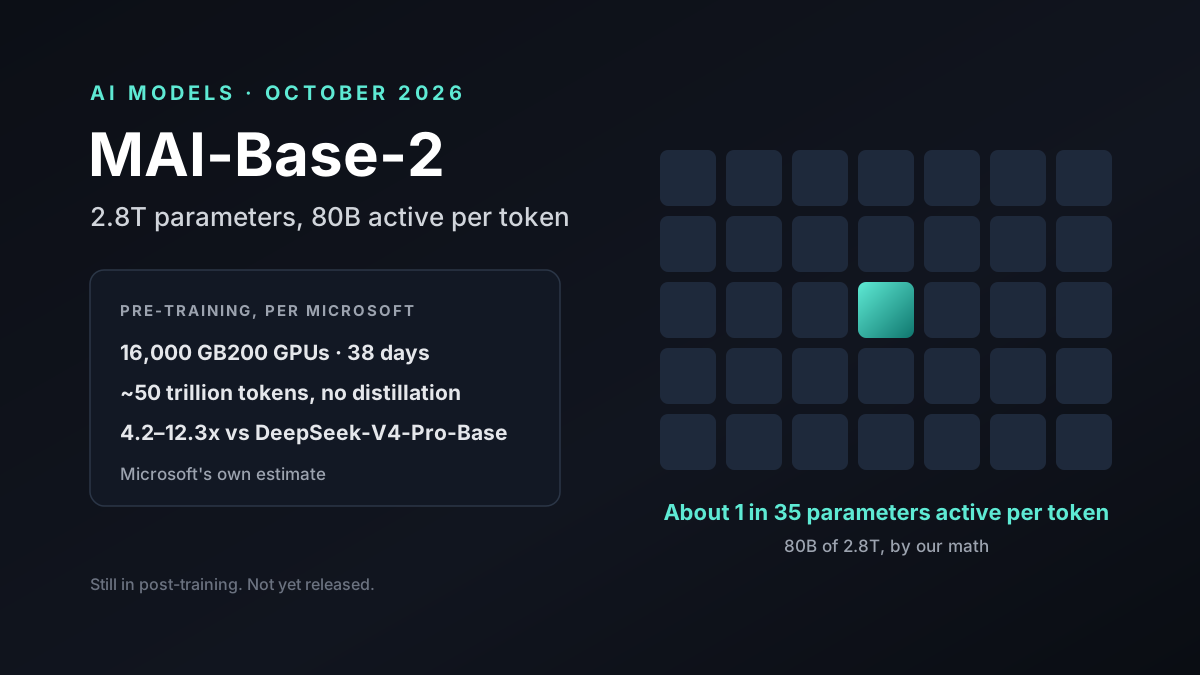
MAI-Base-2 is Microsoft's newest foundation model, and the company says it has finished pre-training it. It's a mixture-of-experts model with 2.8 trillion total parameters and 80 billion active for each token. Microsoft says it beats every open-weight model it tested and needs 4 to 12 times less compute than DeepSeek-V4-Pro-Base to reach the same quality. It isn't out yet, though, and the strongest claims come from Microsoft's own tests.
Key Takeaways
- Microsoft AI finished pre-training MAI-Base-2, a 2.8 trillion parameter model with 80 billion active parameters, on October 15, 2026.
- It trained on 16,000 GB200 GPUs for 38 days, using about 50 trillion tokens of data with a March 2026 knowledge cutoff.
- Microsoft says it beats every open-weight model it tested and is 4.2 to 12.3 times more compute-efficient than DeepSeek-V4-Pro-Base, based on its own estimates.
- Mustafa Suleyman told staff it also beat OpenAI's comparable base model with about a quarter of the compute, according to Business Insider. That claim isn't public.
- It's still in post-training. Microsoft plans to license the weights through Foundry, with no date or terms yet.
MAI-Base-2 at a Glance
| Detail | MAI-Base-2 |
|---|---|
| Type | Mixture-of-experts base model, with experts in every layer |
| Size | 2.8 trillion total parameters, 80 billion active per token |
| Training hardware | 16,000 Nvidia GB200 GPUs |
| Training time | 38 days, in August and September 2026 |
| Training data | About 50 trillion tokens, with no distillation from other models |
| Images | Trained with vision from the start, 18% of the data mix |
| Knowledge cutoff | March 2026 |
| Status | In post-training, not released |
| Planned access | Weights licensed to trusted partners through Foundry |
A base model is the raw result of pre-training. It has learned to predict text, but it hasn't yet been taught to follow instructions, reason step by step or chat safely. That comes in post-training, which is the stage MAI-Base-2 is in now.
What Microsoft Announced About MAI-Base-2
The details come from a technical post on Microsoft AI's site, Frontier Pre-training at Microsoft AI, published on October 15, 2026, and a Reuters summary of it. The main points:
- Scale: 2.8 trillion total parameters, of which 80 billion are used for each token. That makes it larger and sparser than MAI-Base-1.
- Data: a 50 trillion token training mix. The pool of unique training tokens grew about 36% from MAI-Base-1.
- Vision: unlike its predecessor, it learned images and text together from the start, with no separate image encoder. Image and text data made up 18% of the mix, covering charts, captions, spatial reasoning and medical images.
- No distillation: Microsoft says the training data is "organic" and that it didn't learn from other companies' models.
- Training efficiency: an average of 21% model FLOPs utilization, a measure of how much of the GPUs' peak speed was put to work, and 89% goodput, the share of time spent on useful training.
Microsoft also said work on MAI-Base-3 has already started.
How Big Is MAI-Base-2?
Very big on paper, but smaller in practice than the headline suggests. In a mixture-of-experts model, each token only passes through a few of the model's "experts." So while MAI-Base-2 has 2.8 trillion parameters in total, only 80 billion do the work for any one token.
That matters for cost. The active parameter count drives how much compute each answer takes, while the total count drives how much memory you need to hold the model. A 2.8 trillion parameter model still needs a lot of GPUs just to load, which is why licensing the weights is mostly a story for large companies, not small teams.
It's also a big step up from Microsoft's last model. MAI-Base-1, which Microsoft introduced in June 2026, was reported at about 1 trillion total and 35 billion active parameters. Microsoft built MAI-Thinking-1, its first in-house reasoning model, on top of it.
| Detail | MAI-Base-1 | MAI-Base-2 |
|---|---|---|
| Total parameters | About 1 trillion (reported) | 2.8 trillion |
| Active parameters | About 35 billion (reported) | 80 billion |
| Training GPUs | 8,192 (reported) | 16,000 GB200 |
| Vision | Not trained natively with images | Trained with images from the start |
| Unique training tokens | Baseline | About 36% more |
Microsoft also says its training recipe got 6.3 to 12.7 times more compute-efficient between the two models, by its own estimate. That's a big jump in about four months. If even part of it holds up, Microsoft's lab is improving its methods quickly, not just buying more GPUs.
Mixture-of-Experts in Plain Terms
A mixture-of-experts model splits its layers into many smaller blocks, called experts. For each token, a small router picks a few experts to use and skips the rest. It's a bit like a large firm where each question goes to the two or three people who know the topic, not to everyone in the building.
The upside is cost. You get the knowledge of a very large model, but each token only pays for the active part. That's how a 2.8 trillion parameter model can run with the compute of an 80 billion parameter one.
The downside is memory and complexity. All the experts still have to sit in GPU memory, so serving a model this size takes many GPUs working together. The router also has to spread work evenly, or some experts get overloaded while others sit idle. Most frontier labs now use this design, including DeepSeek, Kimi and Qwen, so MAI-Base-2 is following the field here, not breaking from it.
How Much Compute Did It Take?
Microsoft gave enough detail for a rough estimate.
Our math:
- 16,000 GPUs for 38 days is about 608,000 GPU-days, or about 14.6 million GPU-hours.
- At 21% of a 2.5 petaflop peak per GPU, that works out to roughly 2.8 times 10 to the 25 floating-point operations.
- A common rule of thumb, six times active parameters times training tokens, gives about 2.4 times 10 to the 25 for 80 billion active parameters and 50 trillion tokens. The two estimates line up.
If you assume a cloud price of $3 to $6 per GPU-hour, 14.6 million GPU-hours would cost about $44 million to $88 million for the final run alone. That's an illustration, not Microsoft's number. It owns its hardware, and the full cost of research, failed runs, data and staff is far higher.
The headline is that Microsoft trained a frontier-scale base model in about five weeks. That speed is part of what it's selling.
Is MAI-Base-2 Better Than Open-Weight Models?
Microsoft says yes, on its own tests. Here's what it compared and how.
| Model compared | Checkpoint Microsoft used | Microsoft's result |
|---|---|---|
| DeepSeek-V4-Pro-Base | Base model | MAI-Base-2 lower bits-per-byte; 4.2x to 12.3x less compute to match |
| Kimi K3 | Post-trained only | MAI-Base-2 lower bits-per-byte |
| Qwen3.8-2.4T-A95B | Post-trained only | MAI-Base-2 lower bits-per-byte |
| MiMo-V2.6-Pro-RL | Post-trained only | MAI-Base-2 lower bits-per-byte |
The test was bits-per-byte on held-out data, which measures how well a model predicts text it hasn't seen. Lower is better. Microsoft used held-out text, code from its own codebase, and STEM, math and question sets it paid vendors to write. It says it checked all of them for overlap with its training data.
If you've followed the open-weight race in our Qwen vs DeepSeek vs Kimi comparison, these are the same families Microsoft says it now beats. But read the result for what it is.
How to Read the Efficiency Claims
Three caveats matter, and Microsoft states two of them itself.
- It's an estimate. The 4.2 to 12.3 times figure comes from fitting a scaling curve of quality against compute, then estimating how much compute Microsoft's recipe would need to match DeepSeek. It wasn't measured head to head.
- Some rivals weren't base models. For Kimi K3, Qwen3.8 and MiMo, only post-trained versions were available, and Microsoft itself notes that post-training can shift these scores in either direction, so it isn't a like-for-like test.
- Prediction isn't the same as usefulness. Bits-per-byte shows how well a model predicts text. It's a good sign of a strong base, but it doesn't tell you how well the finished model will code, follow instructions or handle your documents.
There's also no outside check yet. The test sets are Microsoft's, and no independent lab has run the model.
None of this means the claims are wrong. Bits-per-byte on clean, held-out data is a respected way to compare base models. It just means the real test comes when a post-trained version is released and others can try it.
The OpenAI Comparison Behind the Headlines
The claim that got the most attention wasn't in Microsoft's technical post. According to Business Insider, as summarized by Startup Fortune, Microsoft AI chief executive Mustafa Suleyman told staff at a town hall that the model beat the OpenAI base model behind GPT-5.6 while using about a quarter of the training compute.
The reports say the comparison used technical information Microsoft holds about OpenAI's models, through the two companies' long partnership. It hasn't been published, so outsiders can't check it.
That's an unusual thing for a partner to say. Microsoft remains one of OpenAI's largest investors and a major partner. But the relationship has been changing. Microsoft introduced seven of its own MAI models at its Build conference in June 2026, and an April 2026 change to the two companies' deal removed the clause tied to OpenAI reaching AGI.
For buyers, the point isn't who wins the rivalry. It's that Microsoft is building a second source of frontier models inside its own platform, next to the OpenAI models it already sells, such as the GPT-5.6 models in Microsoft 365 Copilot.
What Licensing the Weights Through Foundry Could Mean
Microsoft says that because it trained on its own data and didn't distill other models, it can license MAI-Base-2's weights to trusted partners through Foundry, its platform for building AI apps. That's a notable step. Most frontier labs keep their weights private and only sell access through an API.
If it happens, licensed weights could let a company:
- Run the model where its data lives, such as a private cloud or a regulated region, rather than sending data out.
- Fine-tune the base model deeply on its own data, not just adjust a finished chat model.
- Control versions and retirement, so a model doesn't change or disappear under a working system.
There are open questions, though. Microsoft hasn't said who counts as a trusted partner, what it will cost, what limits come with the license, or when it will start. A 2.8 trillion parameter model also needs serious hardware to run, so this is likely to suit large firms and governments first.
Why Microsoft Is Building Its Own Models
For years, Microsoft's AI strategy leaned on OpenAI. It invested heavily, hosted OpenAI's models on Azure and built them into Copilot. That's still true, but Microsoft is now building a second track of its own.
At its Build conference in June 2026, Microsoft introduced seven in-house MAI models, including MAI-Thinking-1, which it offered in private preview through Foundry. Suleyman has said the goal is to reach the top tier soon. "Certainly by 2027, the objective is to really get to state-of-the-art," he told eWeek.
There are plain business reasons for this. A company that sells AI to millions of customers doesn't want its core product to depend on one outside lab. Owning a model means Microsoft can set its own prices, choose its own release dates and decide what to license. MAI-Base-2 is the clearest sign yet that this second track is getting close to frontier scale.
What MAI-Base-2 Means for Teams Building on AI
Here's how we read it for companies building with AI today. These are our views.
- More choice inside Microsoft. Teams on Azure and Foundry may soon pick between OpenAI models, Microsoft's own MAI models and others on the same platform, which gives buyers more room to bargain on price and a fallback if one model has a bad week.
- Weights may become a real option. If licensing works, banks, hospitals and public agencies could get frontier-class models they run and control themselves, which is something most API-only labs don't offer. Start listing which workloads would benefit.
- Don't plan on it yet. There's no release date, no post-trained results and no price. Keep current projects on models you can test today.
- Keep your stack portable. With new models arriving every few weeks, a routing layer and your own test set matter more than any single model. Our model portability lesson covers how to set that up.
How to Prepare for MAI-Base-2
You don't need to do anything today, but a little groundwork will make testing faster when the model arrives.
- Build a test set now. Collect 100 to 300 real tasks with known good answers, so you can score any new model in a day.
- Track cost per finished task. Price per token tells you little when models think and write at different lengths.
- List your data limits. Note which workloads can't leave your own cloud or region. Those are the first candidates for licensed weights.
- Watch for the post-trained model. The first public results on coding, reasoning and documents will show whether the pre-training gains carry through.
- Review contracts. If you buy through Microsoft, ask how MAI models will be priced and supported next to the OpenAI models you use today.
What to Watch Next
- Post-training results: benchmark scores for the finished model on public tests.
- Independent checks: whether outside labs can reproduce Microsoft's quality and efficiency claims.
- Foundry terms: who can license the weights, at what price and with what limits.
- MAI-Base-3: already started.
- OpenAI's response: whether OpenAI disputes the reported comparison or releases its own numbers.
MAI-Base-2: Our Take
MAI-Base-2 is a serious model. A 2.8 trillion parameter base, trained in five weeks on organic data, with strong results on clean held-out tests, puts Microsoft among the labs that can train frontier models on their own.
The biggest claims are still Microsoft's alone, though. The efficiency figures are estimates, some rivals were tested as finished models, and the OpenAI comparison came from a staff meeting, not a paper. Until a post-trained version ships and others test it, treat MAI-Base-2 as a strong signal, not a proven product.
For most teams, the practical takeaway is about choice. Microsoft is building a second source of frontier models on its own platform, and possibly a way to license weights. Both are worth planning for, without betting today's projects on them. We'll update this post when Microsoft publishes post-training results or Foundry terms.
How Van Data Team Helps Teams Choose Models
We help companies test and switch between AI models without rewriting their systems. That means building a test set from your real work, scoring new models side by side, tracking cost per task, and setting up routing so you can move when a better option arrives.
If you're planning for new models like MAI-Base-2, our AI governance guide is a good place to start.

Founder, Van Data Team - builds Vanaxity, the AI agent system for SEO, GEO, and AEO, and leads data engineering delivery for B2B teams.
About the authorArticle FAQ
Questions readers usually ask next.
These short answers clarify the practical follow-up questions that often come after the main article.
Need a similar system?
If this article maps to a workflow your team already operates, the next step is usually a scoped review of the system, constraints, and rollout path.
Book your free workflow review here.
Consultation
Scope your next AI workflow.
Share the system and blockers. We will map fit, gaps, and the next step.