August 6, 2026
Qwen vs DeepSeek vs Kimi for Agents and Coding
Qwen Vs DeepSeek Vs Kimi guide for production teams: compare workflow fit, risk, cost, review burden, and deployment guardrails before shipping safely.
Article focus
High-volume API coding teams: Choose DeepSeek-V4-Flash as the first candidate to test when cost or latency is the primary bottleneck. Its smallest stated active footprint makes it the strongest throughput and latency hypothesis.
Section guide
Verdict
There is no universal winner, but each model has a clear first-test persona:
- High-volume API coding teams: Choose DeepSeek-V4-Flash as the first candidate to test when cost or latency is the primary bottleneck. Its smallest stated active footprint makes it the strongest throughput and latency hypothesis.
- Managed multimodal teams: Choose Qwen 3.8-Max first when native vision and managed Alibaba deployment matter most.
- Self-hosting and deployment-control teams: Choose Kimi K3 first when currently available open weights justify the added infrastructure and operational burden.
- Mixed-workload teams: Choose the candidate that clears quality, safety, latency, observability, and governance gates at the lowest cost per accepted outcome.
Qwen vs DeepSeek vs Kimi has no universal winner for agent and coding work. Engineering and ML-platform teams should choose by cost per accepted outcome, latency, deployment control, and results from a shared evaluation harness. Benchmark headlines alone can lead to slow, costly deployments that stall in production. This guide gives you a side-by-side comparison and a practical bake-off scorecard.
How to use this guide: Match your primary workload constraint to the verdict, use the comparison tables to shortlist a first candidate, and run the shared scorecard before selecting a production default.
At Van Data Team, we start with the workflow: repository tasks, tool permissions, review gates, latency budgets, and failure recovery. Our approach to production AI agent workflows puts each candidate behind a common adapter. We then compare real outcomes before granting the model broader access.
Key Takeaways
The right model is the one that clears your hard production gates at the lowest cost per accepted outcome.
- DeepSeek has the smallest stated active footprint, making it a strong cost and latency candidate to test.
- Qwen combines managed access with native vision, while its announced open weights are not yet available.
- Kimi offers native vision and currently available open weights, but self-hosting shifts cost into infrastructure and operations.
- Published benchmark results use incompatible versions, task types, and vendor harnesses.
- Quality, safety, latency, observability, governance, and human review should be hard gates, not weighted preferences.
Qwen vs DeepSeek vs Kimi at a glance
The candidates share a long-context ceiling, but their architecture, deployment options, and evidence differ sharply. The source set includes TechNode's Qwen launch coverage, MarkTechPost's DeepSeek update, and Kie.ai's Kimi coverage.
These are reported facts about what each vendor shipped or announced. They narrow the candidate set, but they do not rank it.
The supplied DeepSeek coverage calls the change a "zero migration cost" update:
"Zero migration cost."
That removes API migration work. It does not remove regression risk. A silent upgrade makes automated holdout tests, version records, and rollback plans more important.
The architecture gap changes serving economics
Active parameters strongly affect compute per token, while total parameters still affect memory, storage, loading, and expert placement.
A Mixture-of-Experts model, or MoE model, routes each token through part of a larger network. TechNode reports 95 billion active parameters from a 2.4-trillion-parameter model. MarkTechPost reports 13 billion active from 284 billion total.
That gap makes DeepSeek the obvious throughput and latency hypothesis to test. It does not prove lower latency or price. Batching, quantization, expert routing, interconnect traffic, and provider utilization can change the result.
Kie.ai's Kimi coverage reports an active-expert count rather than an active-parameter count. Those measures are not interchangeable without the size and design of each expert. Do not invent a conversion.
For self-hosting, the full weight set still has to be stored and distributed. Sparse activation can reduce per-token compute while leaving a difficult memory and placement problem. Apply the same workload-driven cloud cost discipline used for any large data platform: measure utilization, idle capacity, operational labor, and failed work.
Benchmark headlines cannot select the model
The published results cannot establish an overall winner because the benchmark versions, task types, and harnesses differ.
MarkTechPost reports 82.7 on TerminalBench 2.1. Kie.ai reports 88.3 on Terminal-Bench 2.0. These scores are not directly comparable. Qwen's text and vision arena positions measure another signal entirely.
Prompts, tools, permissions, retries, timeouts, environments, and scoring rules can all move a result. The design of SWE-bench reinforces the broader point: benchmark definitions and execution harnesses are part of the test.
Consider a repository-maintenance agent. It must inspect unfamiliar code, edit files, run tests, recover from terminal errors, and explain unresolved failures. A public coding score does not tell you whether the model respects your file permissions or stops after a risky tool error.
Run each candidate with the same prompt, tool schema, environment, retry policy, and acceptance criteria. Keep a holdout set hidden from prompt tuning. Rerun that set whenever an adapter, system prompt, or provider model changes.
API access and self-hosting are different bets
API access minimizes infrastructure work, while self-hosting offers more deployment control at a much higher operational burden.
Kimi has open weights available. Qwen has announced that weights will follow, but they are not yet available in the supplied evidence. DeepSeek remains an API-first public beta here.
Self-hosting Kimi's 2.8-trillion-parameter weight set shifts spending from API tokens into hardware, utilization, serving engineering, monitoring, and upgrades. Open weights do not automatically mean lower cost. They also do not automatically mean open source.
Review the license, model lineage, derivative restrictions, data handling, and redistribution terms before deployment. Production plans also need version pinning, capacity tests, rollback behavior, and an owner for security updates.
API evaluation needs similar discipline. List price excludes retries, excessive context, failed tool calls, review time, and provider changes. Compare total cost per accepted outcome, not price per token alone.
Put every candidate in the same agent stack
Each model should enter the same workflow through a swappable provider adapter, with orchestration and tools held constant.
The orchestrator may be LangGraph, LangChain, or CrewAI. The model should see the same state, prompts, and permissions in each run. If the workflow uses native function calling or MCP, normalize tool schemas, error responses, and timeouts.
Use Plan-and-Execute only when the workflow already benefits from explicit planning. Adding a planning layer solely for evaluation changes the task and adds token use.
Capture cost, end-to-end latency, token budget, tool calls, retries, evaluation results, and human escalations. Observability must cover the whole loop, not just the final answer. The AI agent ops playbook explains why traces and escalation paths belong in the initial design.
Keep human approval before external writes, production changes, or broader tool permissions. Expand autonomy only after tool recovery and escalation behavior pass review. Our guide to AI agents with human review covers that control point in more depth.
Run a workload-level model bake-off
The following illustration summarizes one harness, three models, one decision rule:
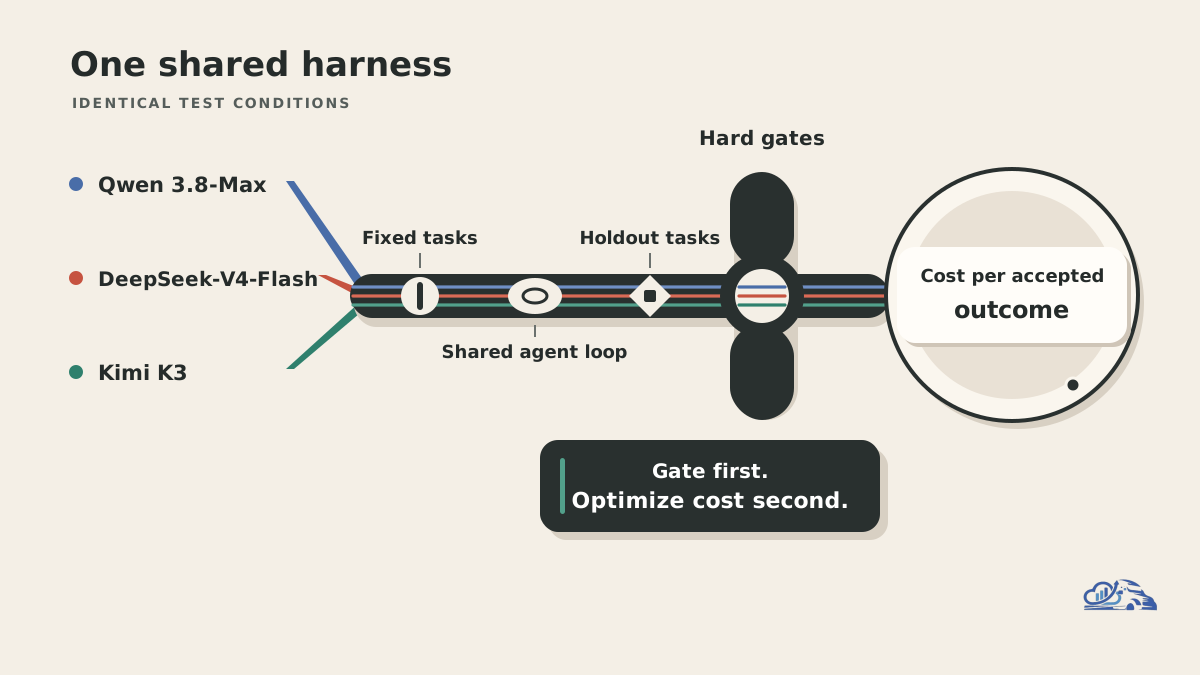
A useful bake-off measures complete work on representative tasks, not isolated model responses.
Build the task set from real operating pressure. Include repository maintenance, screenshot-guided frontend work, long runbooks, ambiguous requests, broken tools, and policy-sensitive actions. Use blind human acceptance when deterministic tests cannot judge the result.
Freeze the provider adapter, orchestration, prompts, tool definitions, permissions, retry rules, and infrastructure assumptions. Separate tuning tasks from the holdout set. Record why each rejected output failed.
Model-selection scorecard
| Criterion | Measurement | Decision use | Qwen 3.8-Max | DeepSeek-V4-Flash | Kimi K3 |
|---|---|---|---|---|---|
| Accepted outcome quality | Deterministic checks or blind human acceptance on fixed tasks and holdouts | Hard gate | Record | Record | Record |
| Cost per accepted outcome | API spend or amortized infrastructure and operations divided by accepted outputs | Primary economic test | Record | Record | Record |
| End-to-end latency | Median and tail completion time for the complete loop | Workload gate | Record | Record | Record |
| Token budget | Prompt, retrieved context, tool-return, retry, and output tokens | Detect waste | Record | Record | Record |
| Tool reliability | Valid calls, argument errors, recovery, and task completion | Hard gate | Record | Record | Record |
| Observability | Complete traces for decisions, tools, costs, failures, and escalation | Hard gate | Record | Record | Record |
| Human review load | Review time, rejection causes, and escalation frequency | Operating-cost input | Record | Record | Record |
| Deployment fit | Data control, versioning, rollback, license, and lineage | Governance gate | Record | Record | Record |
Eliminate any candidate that fails quality, safety, latency, observability, or governance. Among the remaining options, prefer the lowest cost per accepted outcome. A weighted average should never hide a failed hard requirement.
Van Data Team can turn this into a scoped model-selection sprint with a workflow map, evaluation set, adapter design, observability specification, risk gates, cost model, and delivery plan. See how we scope production AI agent delivery.
When to test each model first
Test DeepSeek first for high-volume API work, Qwen first for managed multimodal workflows, and Kimi first when current open-weight control matters.
| Model | Best initial fit | Strength to verify | Limitation and freshness note |
|---|---|---|---|
| Qwen 3.8-Max | Vision-based agents, managed Alibaba deployment, or preparation for a future open-weight path | Multimodal quality, managed integration, long-context behavior | Weights remain announced rather than available. Coding evidence is not from the same harness. Facts reflect the August 3, 2026 release. |
| DeepSeek-V4-Flash | High-throughput coding queues and cost-sensitive API agents | Throughput, latency, Codex integration, and tool recovery | Public beta, incomplete pricing evidence, and silent-update drift. Facts reflect the July 31, 2026 update. |
| Kimi K3 | Self-hosting, native vision, web development, or strict deployment control | Multimodal work, open-weight operations, and frontend task quality | Large total weight footprint, license review, and operational load. Facts reflect the July 16 launch and July 27, 2026 weight release. |
These are starting recommendations, not final selections. If different models win different task classes, route by workload. A coding queue and a screenshot-driven frontend agent do not need the same default model.
Common selection mistakes
Most failed comparisons mix incompatible evidence or ignore the full operating loop.
- Sorting different benchmark versions into a single leaderboard
- Treating a context limit as proof of reliable long-context reasoning
- Equating total parameters with per-token compute
- Converting Kimi's active-expert count into an unsupported parameter estimate
- Comparing list prices without retries, failures, and review
- Assuming open weights are automatically cheaper or open source
- Changing prompts, tools, or permissions between candidates
- Ignoring silent upgrades and evaluation drift
- Expanding autonomy before recovery and escalation pass review
Operational Budget
Before rollout, set an operational budget per workflow, not per million tokens. In Qwen vs DeepSeek vs Kimi, published token rates are only inputs. A cheap model that loops, times out, or needs repair may cost more than a pricier model that succeeds on its first attempt.
Use the same scorecard for every candidate:
- Accepted-output cost: model, GPU, storage, tool, and retry costs divided by approved results.
- Latency and tokens: median and tail latency, input and output tokens, cache use, and total agent-loop consumption.
- Reliability: retry rate, tool-call failures, recovery time, and workflows requiring a full restart.
- Human effort and quality: reviewer minutes, correction severity, task-evaluation pass rate, and holdout performance.
Convert reviewer time into a labor cost. For self-hosted weights, include GPU capacity, idle time, serving software, monitoring, upgrades, and incident response. Keep safety, correctness, and governance as hard gates; a low-cost result that fails review isn’t accepted.
Van Data Team recommends ranking models by cost per approved workflow result after those gates. That metric captures the full operating burden and exposes false savings hidden by attractive token pricing.
Tooling And Landscape Fit
The model and the agent framework solve different problems. Native function calling fits short, predictable tool flows. LangGraph fits stateful loops, retries, checkpoints, and human approval. LangChain offers broad adapters, while CrewAI suits role-based multi-agent workflows. MCP can standardize tool access across all three models. Plan-and-Execute adds structure, but often increases latency and token use.
For Qwen vs DeepSeek vs Kimi, keep the orchestration layer fixed during evaluation. DeepSeek’s smaller active footprint makes it a practical candidate for frequent, latency-sensitive tool calls. Qwen and Kimi deserve extra testing when vision is part of the workflow. Kimi’s available weights also fit teams that need self-hosting, while managed APIs reduce infrastructure work.
Apply the same runtime controls to every candidate:
- Set cost, latency, and token-budget ceilings per task.
- Record prompts, tool calls, retries, state changes, and human overrides for observability.
- Evaluate completion quality, tool accuracy, recovery behavior, and cost per accepted outcome.
- Require human review before write access, external messages, deployments, or wider autonomy.
Framework choice won’t rescue a weak model-task fit. Likewise, a strong model can fail inside an opaque agent loop. Choose the orchestration pattern first, then test each model under the same controls and production-like failures.
Conclusion: choose the workflow, then the model
The Qwen vs DeepSeek vs Kimi decision should end with measured production fit, not a borrowed leaderboard. DeepSeek deserves an early cost and throughput test. Qwen deserves priority when managed native vision matters. Kimi is the clearest current candidate when open-weight control justifies the operational burden.
Run a controlled bake-off, enforce hard gates, and compare cost per accepted outcome. That workflow-first discipline gives engineering teams a decision they can defend, monitor, and revisit as models change.
Article FAQ
Questions readers usually ask next.
These short answers clarify the practical follow-up questions that often come after the main article.
Need a similar system?
If this article maps to a workflow your team already operates, the next step is usually a scoped review of the system, constraints, and rollout path.
Free model review
Choose Your Frontier MoE Model
Compare Qwen 3.8-Max, DeepSeek-V4-Flash, and Kimi K3 for your agent and coding workload, then leave with a tested selection plan.
- A workload-specific three-model scorecard
- A fair bake-off harness plan
- Cost-per-accepted-outcome estimates
- Deployment and governance next steps
Related articles
View all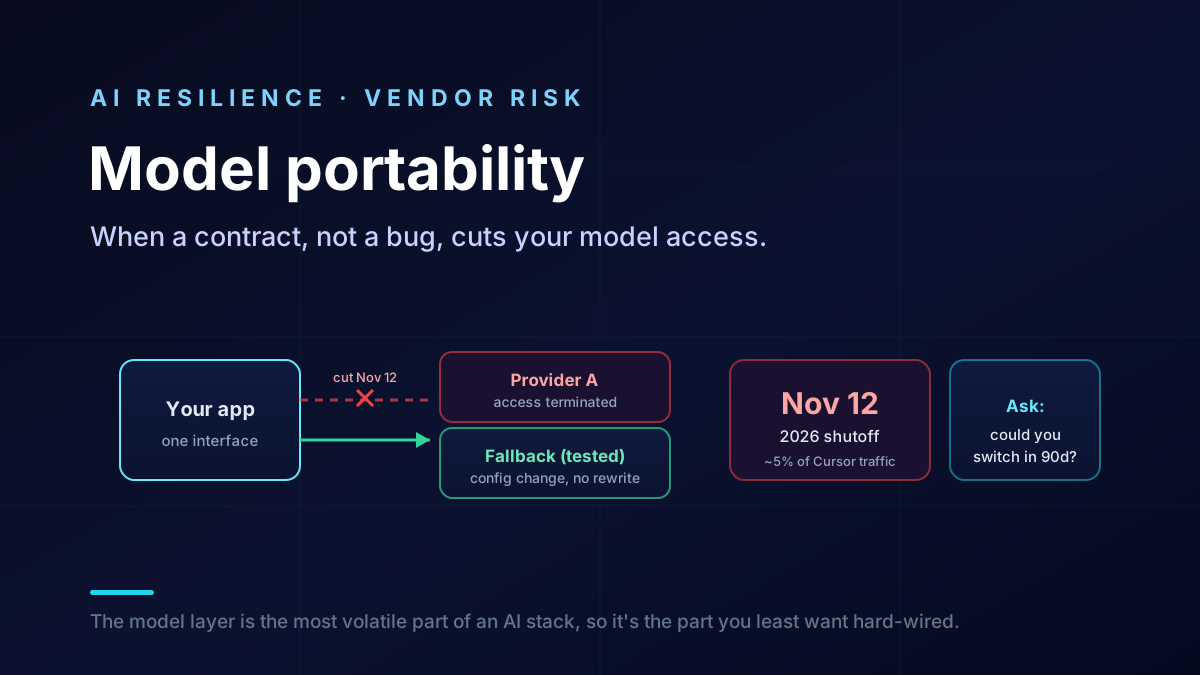
Model Portability: The Cursor-OpenAI Cutoff Lesson
Defensive AI Agents and the Defender's Window
AI Agent Evaluation Security After Anthropic's Incident