Gemini 3.6 Flash vs Claude Opus 5: Route by Tier
Gemini 3.6 Flash is cheaper and takes voice and video; Claude Opus 5 leads on hard reasoning and agentic coding. How to split the work between the two.
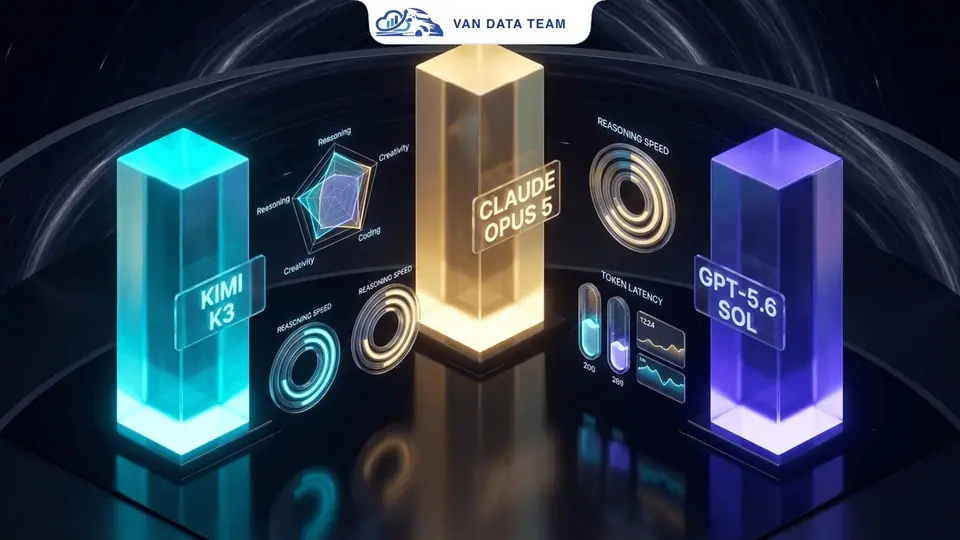
Gemini 3.6 Flash vs Claude Opus 5 is a different-tier comparison, not a contest for one universal winner. Flash is the cheaper, efficiency-oriented, multimodal model for high-volume work; Opus is the frontier tier for difficult reasoning, agentic coding, and complex knowledge work. According to DocsBot's model comparison, Google released Gemini 3.6 Flash on July 21, 2026, and Anthropic released Claude Opus 5 on July 24, 2026. Both are current, shipping models, and the Claude Opus 5 launch announcement identifies its API model as claude-opus-5.
For engineering, platform, and MLOps teams, the buyer problem is deciding which model should handle each step, how outputs will be validated, and when escalation is worth the added spend. At Van Data Team, we start by mapping task classes, evidence, tools, failure modes, and approval boundaries. We then turn that map into production AI agent workflows with routing, observability, review gates, and recovery paths. This guide separates reported facts from Van Data Team analysis and provides a decision table, escalation policy, and evaluation plan teams can use immediately.
Key Takeaways
The practical conclusion is to route by task class and validate before accepting any model output.
- Test Gemini 3.6 Flash for routine, high-volume, latency-sensitive, long-input, voice, and video workflows.
- Use Claude Opus 5 for novel reasoning, complex agentic coding, multi-step planning, and demanding knowledge work.
- Compare input context, output capacity, modality, latency, and reasoning quality as separate dimensions.
- Measure cost per accepted outcome, including retries and review, instead of optimizing token price alone.
- A mixed-model system will fit many production workflows better than either model used everywhere.
Gemini 3.6 Flash vs Claude Opus 5 is a tiering decision
The reported specifications place Gemini 3.6 Flash in an efficiency-oriented operating envelope and Claude Opus 5 in a frontier-reasoning envelope.
The facts in this table come from the comparison source. The task-fit implications are Van Data Team analysis.
| Dimension | Gemini 3.6 Flash | Claude Opus 5 | Production implication |
|---|---|---|---|
| Token pricing | $1.50 input and $7.50 output per 1M tokens | $5.00 input and $25.00 output per 1M tokens | Opus is roughly 3.3x more expensive before retries and review are counted. |
| Input and output limits | 1,048,576-token input; 65,536-token maximum output | 1,000,000-token input; up to 128,000 output tokens | Flash has the marginally larger input window; Opus has the larger output ceiling. |
| Speed and media | Google DeepMind lists audio and video among Flash inputs; no controlled head-to-head speed result is supplied | DocsBot reports no voice or video processing for Opus; no controlled head-to-head speed result is supplied | Flash is the direct intake tier for media-heavy workflows; test latency directly. |
| Training data | Around March 2026 | May 31, 2026 | Opus has more recent training data, but both still need retrieval for current operational facts. |
| Best-fit tier | Efficient throughput | Frontier reasoning | Select by task class rather than vendor preference. |
Gemini 3.6 Flash is strongest when the workflow needs inexpensive throughput, media intake, or broad document ingestion without frontier-level reasoning. Google DeepMind uses the same operational framing in its Gemini 3.6 Flash model card:
"Gemini 3.6 Flash is our workhorse model that delivers better coding, knowledge work, and multimodal performance"
Its limitation is task complexity. A large context window can hold more material, but it does not guarantee stronger synthesis, better retrieval, or fewer reasoning errors.
Claude Opus 5 is strongest when ambiguity, planning depth, repository-wide reasoning, or consequential knowledge work justifies a higher inference price. Its limitations are equally concrete: higher unit cost and, in the cited comparison, no native voice or video input. It should not be the automatic choice for routine extraction simply because it is the flagship.
Source and specification freshness should be operational metadata. Store the provider, model ID, price schedule, context limits, prompt version, and evaluation date in the routing registry, then re-run evaluations after any model, prompt, tool, or retrieval change.
Reported performance separates throughput from hard reasoning
Claude Opus 5 leads on the published hard-task results, while Gemini 3.6 Flash retains the efficiency advantages that matter for routine production volume.
| Evaluation | Gemini 3.6 Flash | Claude Opus 5 | What it supports |
|---|---|---|---|
| ARC-AGI-3 | No published head-to-head result | 30.2% | Route unfamiliar, adaptive reasoning toward Opus. |
| Frontier-Bench v0.1 | No published head-to-head result | 43.3% | Prefer Opus for difficult terminal coding and long-horizon software tasks. |
| GDPval-AA v2 | About 1421 | 1861 | Opus has the concrete advantage on difficult knowledge work. |
These are reported facts, not a universal deployment scorecard. The ARC-AGI-3 and Frontier-Bench results establish Opus's hard-task capability without supplying symmetric Flash scores. The GDPval-AA result provides the clearest direct knowledge-work comparison.
Production acceptance still depends on the prompt, retrieved evidence, tool contracts, validators, latency target, and review burden. A public benchmark can identify a promising tier. It cannot decide whether a generated migration is safe to merge or whether an analytical answer meets an internal evidence standard.
When to choose or test each model
Choose or test Gemini 3.6 Flash when throughput, response time, media support, or input scale matters more than frontier reasoning. Strong fits include classification, extraction, transcription, routine summarization, first-pass triage, and large-corpus retrieval or compression.
Choose Claude Opus 5 when the task starts with material ambiguity or requires novel reasoning, complex planning, agentic terminal coding, cross-document judgment, or a long analytical artifact. Route these tasks directly to Opus instead of paying for a predictable Flash failure first.
Test both models when the work sits between tiers. Use the same prompt, evidence bundle, tools, output contract, and acceptance rubric. Segment results by task class; an aggregate winner will hide the routing policy the test is meant to discover.
Route each task to the appropriate model tier
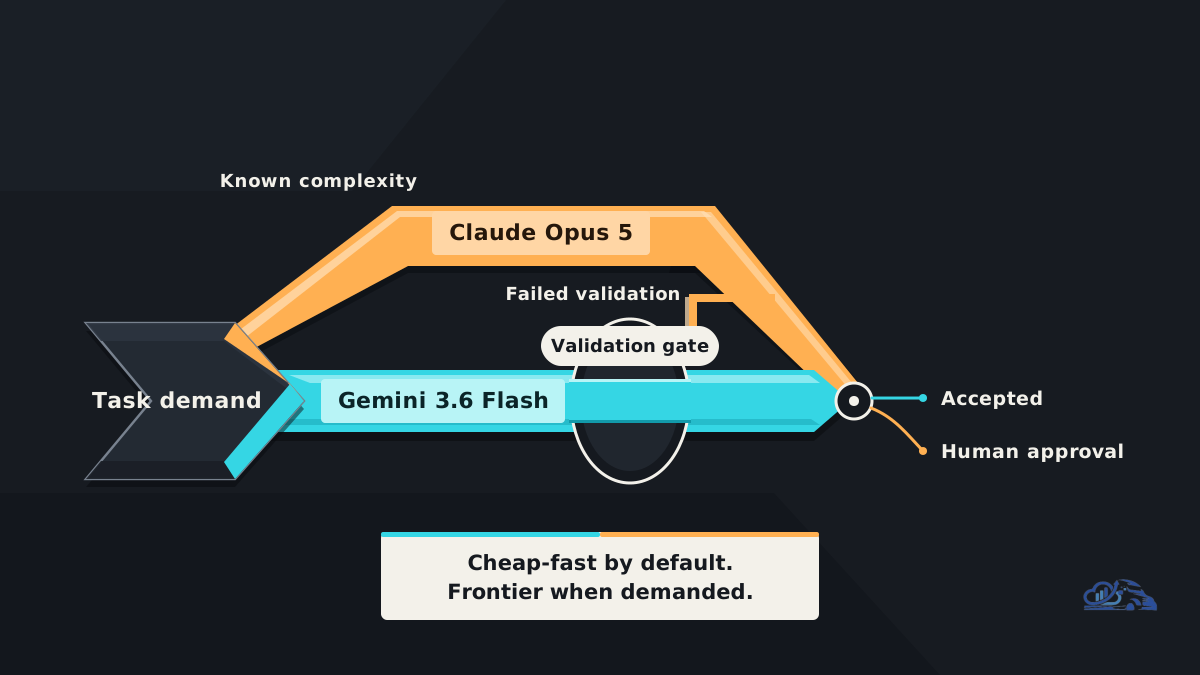
A production router should start with known task demands, then use validation and risk signals to accept, escalate, or require human review.
Qualified verdict by use case
| Task class | Default route | Escalate or reroute when | Required controls |
|---|---|---|---|
| Classification and extraction | Gemini 3.6 Flash | Schema failure, conflicting evidence, or material ambiguity | Schema and business-rule validation |
| Voice or video intake | Gemini 3.6 Flash | The extracted evidence requires difficult synthesis or action | Provenance and sensitive-data filtering |
| Summarization and first-pass triage | Gemini 3.6 Flash | Required evidence is missing or conflicts remain unresolved | Grounding and required-field checks |
| Large-corpus retrieval | Gemini 3.6 Flash | Cross-document reasoning becomes the main task | Retrieval logs, citations, freshness, and lineage |
| Novel reasoning and planning | Claude Opus 5 | Route directly; do not wait for a known tier mismatch | Plan checks, tool boundaries, and risk review |
| Agentic terminal coding | Claude Opus 5 | Keep complex repository work on the frontier tier | Tests, linting, security checks, diff review, and rollback |
| Complex knowledge synthesis | Claude Opus 5 | Use Flash only for cleanly separable extraction stages | Evidence bundle and rubric-based review |
| Mixed production agent | Flash for routine stages; Opus for escalation | Validation failure, high reasoning demand, or elevated risk | Shared traces, retry ceiling, and human escalation |
Role-based examples make the handoff concrete:
- In support operations, Flash classifies requests and extracts account facts. An incident spanning products escalates to Opus for causal analysis and a response plan.
- In software engineering, Opus receives repository context and develops a migration or debugging plan. Tests, security checks, diff review, approval, and rollback remain outside the model.
- In a video incident review, Flash converts media into a sourced event timeline. Opus receives that timeline when the team needs multi-step root-cause analysis. The same split works in agentic BI and reporting: routine evidence preparation first, judgment-heavy interpretation second.
Build escalation around validation and accepted outcomes
A reliable escalation policy treats model output as a proposal that must pass explicit checks before it can change production state.
- Start with Flash for routine, reversible, high-volume, or multimodal work with dependable validators; test it against the workflow's latency target.
- Route directly to Opus for known novel reasoning, complex coding, multi-step planning, or difficult knowledge synthesis.
- Escalate when schema, grounding, citation, business-rule, tool-argument, security, or automated-test validation fails.
- Require human approval for customer communication, production changes, security actions, financial decisions, and other difficult-to-reverse writes.
- Log the model, routing reason, evidence state, tool calls, validation result, retry path, review effort, and final acceptance.
The useful economic metric is cost per accepted outcome = (inference spend + retry spend + review cost) / accepted outputs. Flash can remain the better choice after failures are counted, or Opus can become cheaper when its higher acceptance rate avoids repeated retries and senior review. This workflow-level view follows the same logic as cloud cost optimization for data stacks: optimize the delivered outcome, not one invoice line.
Evaluate with representative internal tasks across extraction, media intake, coding, planning, and knowledge work. Hold prompts, retrieval, tools, and output contracts constant. Track acceptance, escalation, latency, tool-call correctness, groundedness, test success, review time, policy violations, and total cost. Re-run the suite after material changes, and keep results segmented by task class.
Van Data Team can turn this test into a scoped workflow review, routing signal map, evaluation set, guardrail matrix, and delivery plan through production AI agent delivery. The output is an implementation scope, not a generic model recommendation.
Connect routing to the agent and data stack
Model routing works only when orchestration, tool permissions, data quality, and observability are designed as one production system.
LangGraph, LangChain, CrewAI, native function calling, and Plan-and-Execute can all implement the route-validate-escalate loop. The framework matters less than explicit state, inspectable transitions, bounded retries, and durable traces. Tool and MCP interfaces should expose narrow operations with typed arguments, least-privilege permissions, idempotency where possible, and clear failure responses.
Prompt and context caching can reduce repeated input cost. Context trimming, retrieval filters, and evidence compression keep long windows from becoming dumping grounds. Agents reading Airflow, dbt, Kafka, and warehouse outputs also need freshness checks, lineage, data contracts, and pipeline SLAs. A dbt and BigQuery delivery playbook is relevant because a stronger model cannot repair stale or semantically broken source data by inference alone.
| Failure mode | Detection signal | Recovery |
|---|---|---|
| Invalid structure | Schema or contract failure | Attempt a bounded repair, then escalate with the error trace |
| Stale evidence | Freshness or lineage breach | Refresh retrieval and block consequential action |
| Unsafe tool request | Permission or policy denial | Stop and require an approved path or human review |
| Escalation loop | Repeated route or validator failure | Enforce a retry ceiling and preserve the full trace |
| High-quality but uneconomic output | Rising review-adjusted cost | Decompose the workflow or change the default tier |
Operational Budget
Reported fact: Gemini 3.6 Flash costs $1.50 per 1M input tokens and $7.50 per 1M output tokens; Claude Opus 5 costs $5.00 and $25.00 respectively, making Opus roughly 3.3x more expensive at the token meter. Unit pricing, however, is not production economics.
Van Data Team analysis: before rollout, run both models against the same representative workflows and maintain this acceptance ledger:
| Scorecard field | What to measure |
|---|---|
| Accepted-output cost | Token, tool, cache, retry, and recovery spend divided by approved results |
| Latency and token budget | End-to-end p50/p95 completion time plus input and output tokens |
| Retry and recovery | Validation failures, reruns, fallbacks, and resumable-state success |
| Human review | Reviewer minutes per approved result and rejection reason |
| Evaluation result | Task-specific pass rate, groundedness, tool accuracy, and policy compliance |
Calculate cost per approved result = total inference, retry, review, and recovery cost ÷ approved outputs. Route routine work to Flash by default, then escalate to claude-opus-5 when the task demands frontier reasoning or Flash fails a validation gate. Prompt and context caching can reduce repeated-input spend, but must remain in the ledger. A higher-priced model can be cheaper when it eliminates retries and review; Flash wins when its first-pass acceptance rate stays high.
Conclusion
Gemini 3.6 Flash vs Claude Opus 5 ends with a routing decision, not a trophy. Flash is the efficiency tier for economical throughput, long-input processing, and voice or video intake; benchmark it against the required latency target. Opus is the frontier tier for novel reasoning, agentic coding, multi-step planning, and complex knowledge work.
Start with a task inventory. Mark which tasks demand frontier reasoning, which have dependable validators, and which actions require human approval. Then run a representative evaluation, log every route and failure, and optimize cost per accepted outcome. Keep retrieval freshness, tool permissions, rollback, and pipeline SLAs inside the design because model quality cannot compensate for broken operating controls.
For a concrete next step, review Van Data Team's engagement options for a production routing scope. A useful first deliverable is a workflow map, acceptance rubric, escalation policy, evaluation plan, and implementation estimate that your engineering team can inspect before committing to a build.

Founder of Van Data Team. Builds Vanaxity, the AI agent system for SEO, GEO, and AEO, and leads data engineering delivery for B2B teams.
About the authorAI model benchmarks
Models in this article
Current pricing, context window and independent scores for each model.
Side by side
Article FAQ
Questions readers usually ask next.
These short answers clarify the practical follow-up questions that often come after the main article.
Need a similar system?
If this article maps to a workflow your team already operates, the next step is usually a scoped review of the system, constraints, and rollout path.
Consultation
Scope your next AI workflow.
Share the system and blockers. We will map fit, gaps, and the next step.