Neocloud Shakeout: What Musk's Warning Means for GPU Buyers
Musk says SpaceX closed $40B of GPU debt and predicts a neocloud shakeout. Why GPU clouds face a squeeze, and how to protect your workloads and contracts.
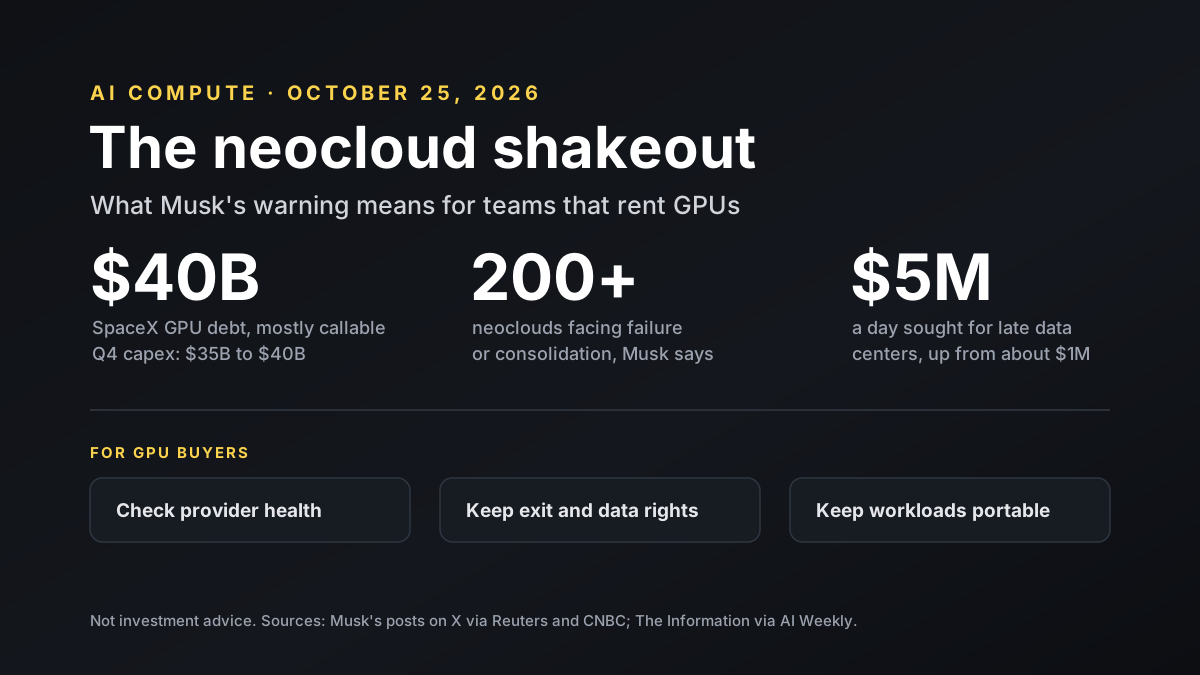
A neocloud shakeout is coming, if Elon Musk is right. On October 25, 2026, he said SpaceX had closed $40 billion of debt to buy GPUs, and that debt markets have almost shut for companies that live mainly off AI data centers. He predicted the 200-plus neoclouds, the GPU rental firms like CoreWeave and Nebius, will see heavy failures and consolidation.
Musk runs a rival AI compute business, so his warning isn't neutral. But other signs point the same way: costlier borrowing, falling neocloud stocks and growing penalties for late data centers. If your team rents GPUs, it's a good moment to check how exposed you are, and what you'd do if your provider stumbles.
Disclosure: Van Data Team builds AI systems on several clouds and GPU providers, and this article was researched with Claude. We explain what market news means for teams that rent GPUs. This isn't investment advice.
Key Takeaways
- Musk said SpaceX closed $40 billion of mostly callable debt for GPUs arriving in the first half of 2027. SpaceX expects $35 billion to $40 billion of capital spending this quarter.
- He said debt markets have nearly closed for companies without substantial revenue outside AI data centers, and predicted heavy failures and consolidation among the 200-plus neoclouds.
- Other signals back the pressure: neocloud stocks and bonds have slid, and data center tenants reportedly now demand over $5 million a day for late delivery.
- Musk competes with neoclouds, so treat his forecast as one view. Big, well-contracted providers may do fine.
- For GPU renters, the fix is practical: check provider health, tighten contract terms and keep workloads portable.
Neocloud Shakeout at a Glance
| Signal | What happened |
|---|---|
| SpaceX GPU debt | $40 billion, mostly callable, for GPUs arriving in Q1 and Q2 of 2027 |
| SpaceX Q4 capital spending | $35 billion to $40 billion expected, per its CFO |
| Musk's forecast | Heavy failures and consolidation among 200-plus neoclouds |
| Debt markets | "Almost entirely shut off" for firms reliant on AI data centers, Musk said |
| Late-delivery penalties | Over $5 million a day now sought by tenants, up from about $1 million this spring |
| On-time capacity | Goldman Sachs expects only about half of scheduled US capacity to arrive on time |
Sources: Musk's posts on X, as reported by Reuters and CNBC, plus The Information's reporting on penalties. The debt's pricing and lenders weren't disclosed.
What Musk Said About the $40 Billion
Musk made the claims in a few posts on X on Sunday, October 25. The first said SpaceX had closed $40 billion of debt for GPUs. He credited the company's investment-grade rating and its revenue from Starlink and rocket launches.
He then added detail. The money is "primarily callable debt," meaning SpaceX can repay it early, and it's for GPUs arriving in the first and second quarters of 2027. It's "not a major factor this quarter," he said.
Reuters noted it wasn't clear what "closed" meant, or whether lenders had agreed on pricing. Reuters had reported earlier in October that SpaceX was in talks with banks and asset managers to raise $40 billion for Nvidia chips.
SpaceX's AI business is growing fast. In its third quarter, revenue rose 161% to $14.58 billion, and AI revenue grew almost tenfold to $7.56 billion. Its finance chief expects $35 billion to $40 billion of capital spending in the fourth quarter.
What SpaceX Is Building With the Money
SpaceX isn't just borrowing. It's building one of the largest private AI computing operations in the world, and it wants to own as much of the chain as it can.
- Chips arriving fast: Musk has said SpaceX is bringing roughly 200,000 Nvidia GB300 chips online each month for the rest of the year, shifting mostly to Nvidia's next-generation Vera Rubin chips next year, according to Tesla North.
- Spending already high: third-quarter capital spending was $19.6 billion, most of it for its AI business.
- Its own chips: Terafab, a chip venture between SpaceX and Tesla in Austin, aims to make a first test chip around mid-2027 and reach volume production in late 2028.
- A possible merger: Musk told investors last week that combining SpaceX and Tesla would be "a good idea."
That's the opposite of the neocloud model. Instead of renting out chips bought with borrowed money, SpaceX is using strong revenue from other businesses to build capacity for its own AI products.
Musk's Neocloud Shakeout Prediction
The bigger headline was Musk's warning about everyone else. He said debt markets "have almost entirely shut off access to money" for any company without substantial revenue independent of AI data centers.
His conclusion: the 200-plus neoclouds face a wave of failures and consolidation. He used a vivid fish metaphor for it. Asked whether SpaceX would buy any of them, he replied that it wasn't buying any neoclouds, calling the idea "pointless."
That last point matters. In past shakeouts, strong players often bought weak ones cheaply. Musk is signaling SpaceX would rather build its own capacity than rescue anyone else's.
What Is a Neocloud?
A neocloud is a cloud company built mainly to rent GPUs for AI. CoreWeave, Nebius, Lambda and dozens of smaller firms fit the label. Many grew fast from 2024 to 2026 by borrowing against their chips and customer contracts, a model that works well while chip values hold up and customers keep renewing.
They differ from Amazon, Microsoft and Google in two ways. First, they focus almost entirely on AI, so their revenue rises and falls with AI demand. Second, many rely on debt to buy each new wave of chips. That makes them sensitive to lenders' mood.
We covered how one GPU cloud's listing fell apart in our post on the Firmus IPO, which also explains how to vet a GPU provider.
Why the Neocloud Shakeout Warning Lands Now
Musk's forecast arrives at a tense moment. Several signals point the same way.
- Costlier debt: investors have started betting against debt-funded US data center and neocloud companies, Reuters reports. Our look at AI bubble fears noted CoreWeave's bonds yielding around 15%.
- Falling stocks: neocloud shares have dropped sharply this month as worries about AI spending spread.
- Costly delays: The Information reports that data center tenants now demand more than $5 million a day if power and buildings arrive late. This spring, the typical ask was about $1 million.
- Late capacity: Goldman Sachs expects only about half of scheduled US data center capacity to arrive on time.
Put together, it gets harder for smaller providers to borrow, build on schedule and pay penalties when they slip. The biggest players can absorb that. Many small ones can't.
Why SpaceX Can Borrow When Others Can't
Musk's point is about who lenders trust. SpaceX has large, steady revenue from Starlink internet and rocket launches, plus an investment-grade rating. Lenders can count on that money even if AI demand cools. Neoclouds can't.
A typical neocloud has none of that. Its main asset is the GPUs, which lose value as new chips arrive. Its revenue depends on a few big AI customers. If those customers pull back, both the income and the collateral weaken at once, which is exactly the kind of double risk lenders hate to hold.
That's why lenders now ask harder questions. Borrowing is still possible for strong neoclouds with long contracts from big customers like Microsoft, OpenAI or Meta, because those contracts act like a promise of future cash. It's much harder for the long tail.
Is Musk Right About a Neocloud Shakeout?
Take the forecast seriously, but not as fact, because the person making it has a clear reason to want neoclouds to look weak. Three caveats matter.
- He's a competitor. SpaceX builds and sells its own AI compute, so a weaker neocloud market helps it.
- "200-plus" is a broad group. It includes giants with billion-dollar contracts and tiny resellers. They won't all fare the same.
- Consolidation isn't collapse. Many weak providers may be bought, merged or shrink, and their customers keep running.
Tech booms often end this way. After the dot-com crash, many fiber and hosting firms failed, but the cables and data centers stayed in use under new owners. A neocloud shakeout could follow a similar path, which may even mean cheaper GPUs later.
Who Is Most at Risk in a Neocloud Shakeout?
Not every GPU provider faces the same danger. The most exposed share a few traits:
- One big customer. If a single AI lab supplies most of the revenue, losing it can sink the business.
- Debt due soon. Providers that must refinance in the next year or two are at the mercy of today's tighter lenders.
- Capacity not yet built. Firms selling space in unfinished data centers carry delay penalties and construction risk.
- Older chip fleets. GPUs from a few generations back earn less each year as newer chips arrive.
- Small resellers. Firms that rent capacity from others and resell it have thin margins and little to fall back on.
The safest providers tend to have long contracts with several strong customers, capacity that's already running and funding that isn't due for years.
What a Neocloud Shakeout Means for GPU Renters
For teams that rent GPUs, the risk isn't the stock price. It's what happens to your service. A shakeout can play out in a few ways:
| Scenario | What it means for you |
|---|---|
| Provider is acquired | Service usually continues, but prices, terms or support may change |
| Provider raises prices | Renewals cost more; spot capacity gets scarce |
| Provider cuts capacity | New regions or GPU types are delayed or cancelled |
| Promised capacity arrives late | Your project slips with the data center |
| Provider enters bankruptcy | Access may be disrupted; prepaid credits may be hard to recover |
Most teams will face the first three, not the last. But the last one does the most damage, so plan for it anyway.
How to Check Your GPU Provider's Health
You don't need a finance team to spot warning signs. Ask your provider, or check public filings if it's listed:
- Customer mix: does one AI lab make up most of its revenue?
- Funding: when did it last raise money, and on what terms?
- Debt load: how much is due in the next two years?
- Capacity timeline: are the GPUs you're counting on already running, or still being built?
- Delivery record: has it hit its promised dates so far?
Clear answers are a good sign. Vague answers, or a refusal to share basic numbers, are a good reason to reduce how much of your critical work runs there.
Contract Terms That Protect You
Your contract decides how much a provider's trouble hurts you. Before you sign or renew, look for these terms:
- Short or flexible commitments: avoid long, large prepayments to smaller providers.
- Change of control rights: the right to exit or renegotiate if the provider is sold.
- Data export: a clear, fast way to get all your data and models out, with known egress costs.
- Service credits: make them real. Token amounts don't help.
- Delivery dates and remedies: if capacity isn't live yet, a firm date and a right to walk away if it slips.
This isn't legal advice. For large deals, have your counsel review the terms.
Keep Your Workloads Portable
The best protection doesn't depend on your provider at all. If you can move in days, a shakeout is an inconvenience, not a crisis. That's the goal.
- Store model checkpoints and training data in storage you control, not only on the provider's disks.
- Package jobs in containers, with infrastructure defined as code, so you can redeploy elsewhere.
- Test a second provider. Run a small share of work there so the move path is real.
- Avoid deep lock-in to one provider's custom tools unless the savings are large.
Our post on model portability covers how to design for this.
Delivery Delays Hit Renters Too
The penalty story isn't only a landlord problem. Many GPU deals promise capacity in data centers that aren't finished yet. If power or equipment slips, your capacity slips too.
Big tenants now negotiate daily penalties. OpenAI's deal with developer SB Energy, for example, reportedly gives it a free day of rent for each day of delay, doubling after 90 days. Smaller customers rarely get terms like that.
So ask directly: is the capacity I'm buying already live? If not, what's the delivery date, what happens to my price and my plans if you miss it, and can I walk away without losing my deposit?
What This Means for Startups and Data Teams
The impact depends on how you use GPUs.
AI startups often run on credits or discounts from smaller neoclouds. Those deals can vanish if the provider is sold or cuts back. Keep a plan B, and don't let free credits decide where your core systems live.
Data and ML teams inside larger companies usually rent capacity for training runs or inference. For them, the main risks are price changes at renewal and delays to promised capacity. Budget for both.
Teams running AI in production have the most to lose from an outage. If your product depends on a single GPU provider, a shakeout is a reason to add a second one now, while capacity is still easy to find.
Should You Sign Long GPU Deals Now?
It depends on your size and certainty. Here's a simple guide:
| Your situation | Our suggestion |
|---|---|
| Steady, predictable training or inference | Commit to the strongest providers; keep a backup |
| Early-stage or changing workloads | Stay on shorter terms and on-demand capacity |
| Offer from a small provider at a deep discount | Fine for non-critical work; avoid big prepayments |
| Capacity not yet built | Only with firm dates and exit rights |
| Critical production systems | Spread across at least two providers |
A shakeout can also bring bargains. If capacity frees up, prices may fall. Teams that stay flexible are best placed to benefit.
Neocloud Shakeout: What to Watch Next
- Neocloud funding news, including new debt deals, emergency raises or mergers.
- Bond yields for AI infrastructure companies.
- GPU rental prices, which would fall if capacity floods the market.
- Data center delays, and whether penalties keep rising.
- SpaceX's own buildout, including its Terafab chip venture with Tesla, which aims for a first test chip around mid-2027.
Neocloud Shakeout: Our Take
Musk's warning is loud and self-interested, but the pressure he describes is real. Borrowing is harder for firms that depend only on AI, delays are costlier and the market is already sorting strong providers from weak ones.
For teams that rent GPUs, the response isn't panic. It's basic supplier risk management: know your provider's health, sign terms that let you leave, keep your data and code portable and have a second option ready. Those habits pay off whether the shakeout comes or not.
How Van Data Team Helps Teams Manage GPU Risk
We help companies run AI workloads that aren't tied to a single provider. That includes portable training and inference setups, multi-provider deployments, cost tracking and contract reviews from a technical point of view.
If the neocloud news has you rethinking your GPU plans, start with our guide to cloud cost guardrails, then get in touch for a quick review.

Founder of Van Data Team. Builds Vanaxity, the AI agent system for SEO, GEO, and AEO, and leads data engineering delivery for B2B teams.
About the authorArticle FAQ
Questions readers usually ask next.
These short answers clarify the practical follow-up questions that often come after the main article.
Need a similar system?
If this article maps to a workflow your team already operates, the next step is usually a scoped review of the system, constraints, and rollout path.
Consultation
Scope your next AI workflow.
Share the system and blockers. We will map fit, gaps, and the next step.