AI Model Price War: What OpenAI's Discounts Mean for Buyers
OpenAI's discounts reportedly pulled Replit, Rippling and DataCamp away from Anthropic. What the AI model price war means and how to negotiate model deals.
The AI model price war just got personal. The Information reports that OpenAI is offering steep discounts to Anthropic's biggest customers, and that several well-known software companies have moved much of their coding work from Claude to OpenAI's models as a result. The reason they give is simple: it's cheaper.
For companies that buy AI models, this is mostly good news. Prices are falling, and vendors are willing to negotiate.
But discounts come with strings. The numbers need care, too. Here's what was reported, what it leaves out and how to make the price war work for you.
Disclosure: Van Data Team builds AI systems with models from several providers, including OpenAI and Anthropic. This article was researched with Claude, which is made by Anthropic, one of the two companies in this story. We report the figures that are unfavorable to Anthropic as they were published, alongside the data that cuts the other way. This isn't investment advice.
Key Takeaways
- The Information reports that OpenAI is using large discounts to win Anthropic's enterprise customers, especially for coding work.
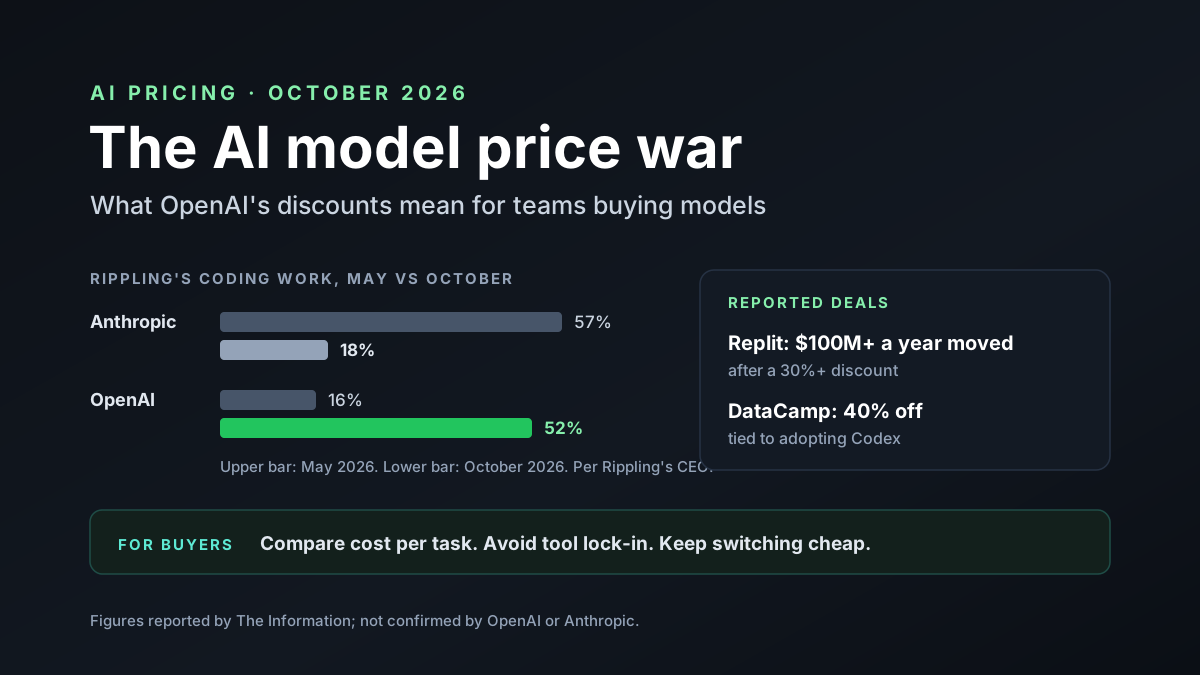
- At Rippling, OpenAI's share of coding work rose from 16% in May to 52%, while Anthropic's fell from 57% to 18%, the CEO said.
- Replit reportedly moved most of its AI spending to OpenAI in a deal worth over $100 million a year, after a discount of more than 30%.
- The deal terms are unconfirmed. Other data shows Anthropic gaining ground after its Opus 5.5 launch.
- For buyers, the lesson is to negotiate hard, compare cost per finished task and avoid discounts that lock you into one vendor's tools.
The AI Model Price War at a Glance
| Customer | What was reported | Source of the figures |
|---|---|---|
| Rippling | OpenAI share of coding work up from 16% to 52%; Anthropic down from 57% to 18% | CEO Parker Conrad |
| Replit | Most AI spend moved to OpenAI; deal over $100 million a year after a 30%+ discount | A person familiar with the deal |
| DataCamp | 40% discount tied to adopting Codex; costs down an estimated 80% to 90% | CEO Jonathan Cornelissen |
| US bank ($7B+ in assets) | ChatGPT seats doubled to 500 at no extra cost; under $7 per user | The Information's reporting |
The original report from The Information is paywalled. We rely on summaries from The Decoder, Techpresso and others.
What The Information Reported
The story is about coding, the area where Anthropic's Claude models have been most popular with businesses. According to the report, OpenAI has been offering Anthropic's large customers much better prices, and some have taken them.
Two caveats matter from the start. First, the numbers come from customer executives and people familiar with the deals, not from either AI company. Second, neither OpenAI nor Anthropic has confirmed them. Treat them as strong reporting, not audited facts.
Rippling Flipped in Five Months
The clearest example comes from Rippling, the HR software company. CEO Parker Conrad gave the numbers himself.
| Share of Rippling's coding work | May 2026 | October 2026 |
|---|---|---|
| Anthropic models | 57% | 18% |
| OpenAI models | 16% | 52% |
Conrad put the shift down to cost: OpenAI turned out cheaper. Notice what that implies. Rippling could move most of its coding work between vendors in a few months, which means its engineers' tools weren't tied to one model. That flexibility is what gave it bargaining power.
Replit's Nine-Figure Switch
Replit made the biggest move. According to a person familiar with the deal, it shifted most of its AI spending to OpenAI in a contract worth more than $100 million a year, after OpenAI offered a discount of over 30%.
The other side of that story: Anthropic had stopped a discount Replit used to get. Reports say Anthropic declined to extend it unless Replit committed to spending more.
On October 17, Replit CEO Amjad Masad said the company had stopped working with Anthropic. He cited cost, the quality of the partnership and strong results from OpenAI's newest models. The picture isn't entirely clean, though. A person familiar with the relationship disputed the split, and Replit's own documentation still listed Claude models, with OpenAI as the default for its coding agent.
DataCamp's Discount Came With a Condition
The discounts also reach smaller companies. DataCamp, an online training company with about 200 staff, was a heavy Anthropic customer. OpenAI reportedly offered it a 40% discount.
There was a catch. The discount required DataCamp to use OpenAI's Codex coding tool instead of rivals such as Claude Code or OpenCode. CEO Jonathan Cornelissen estimated that OpenAI's pricing cut his costs by 80% to 90%.
That headline number needs care. It's DataCamp's estimate of savings against its old setup, not a 90% cut in OpenAI's list prices. And the tool condition matters as much as the price, as we explain below.
Why OpenAI Can Afford the AI Model Price War
Part of this is OpenAI buying market share with its own margins. Selling below the usual price to win big accounts is a classic move in a fight for customers.
But it isn't only that. OpenAI has cut its list prices too.
Its GPT-6 Sol and Luna models, released in September, cost half as much as the models they replaced. GPT-6 Sol lists at $2 and $10 per million tokens, the same as Claude Sonnet 5.5 and a fifth of what GPT-6 Astra costs. Our review of GPT-6 Sol and Luna covers what they do well and where they fall short.
Cheaper models plus discounts on top add up fast. For coding tools that run models all day, a 30% to 40% cut is a large sum.
AI Prices Keep Falling
Discounts are only part of the story. List prices for top models have been falling with almost every release, and the drops this autumn were steep.
- GPT-6 Sol and Luna halved the prices of the GPT-5.6 models they replaced in September.
- Claude Opus 5.5 launched at $4 and $20 per million tokens, down from $5 and $25 for Opus 5.
- Claude Sonnet 5.5 kept Sonnet 5's price of $2 and $10 while scoring much higher.
- Kimi K3.1 Pro came in at $2 and $10, a third below Kimi K3.
So buyers face two forces at once: falling list prices for everyone, and private discounts for the accounts vendors want most. Both point the same way. The cost of good AI work is dropping fast.
Where Anthropic Stands in the AI Model Price War
Anthropic is heading toward a public listing, possibly in November, so the timing is awkward. Its numbers show strong growth, but also heavy spending.
- Revenue: Anthropic told investors its third-quarter revenue reached $16.8 billion, up 45% from the second quarter. That's slower than the first-to-second-quarter jump, when revenue more than doubled.
- Losses: a draft IPO filing reported by the Wall Street Journal showed a net loss of $80.7 billion in the first half of 2026. About $72 billion of that was an accounting charge tied to bonds that holders can exchange for Anthropic shares, not cash spent.
- Compute: the company has committed to large, long-term spending on computing power.
That makes a price war expensive. Matching OpenAI's discounts would cost Anthropic margin just as investors study its books. Our posts on Anthropic's Q3 revenue and its draft S-1 look at those numbers in more detail.
The Data That Cuts the Other Way
The customer stories aren't the whole picture. OpenRouter, a service that routes developer traffic across many AI models, publishes usage data, and it shows a back-and-forth race.
In the week of September 7, OpenAI models passed half of combined OpenAI and Anthropic spend on OpenRouter for the first time since early 2024. Then Anthropic released Claude Opus 5.5 on September 22. OpenRouter later said on X that Opus 5.5 had become the top model by share of spending on its platform and led a rebound for Anthropic. One newsletter says Anthropic's models were twice as popular as OpenAI's over a recent week, though we couldn't confirm that figure in OpenRouter's own data.
OpenRouter only shows one slice of the market, mostly developers and startups. Big enterprise deals like Replit's don't run through it. Still, it shows the AI model price war isn't a one-way rout, and that a strong new model can win back developers within weeks of launch, whatever the discounts.
China's Cheap Models Join the AI Model Price War
Both companies are also squeezed from below. Chinese models such as DeepSeek and Moonshot's Kimi now offer strong performance for far less money.
Kimi K3.1 Pro, released on October 23, lists at $2 and $10 per million tokens and ranks fourth on one major independent index, with open weights promised by early November. Our Kimi K3.1 Pro review covers the details. That puts a ceiling on what any US lab can charge for mid-tier work.
What the AI Model Price War Means for Buyers
For companies that buy AI models, the main message is that prices are now negotiable. Vendors want large, sticky accounts, and they'll pay for them.
That changes how you should buy:
- List prices are a starting point, not the final number, for any meaningful volume.
- Competing quotes have real value. A credible plan to move work is your strongest lever.
- Terms matter as much as rates. Discounts often come with commitments, conditions or short lives.
The companies in this story had one thing in common: they could actually move their work from one model to another without rebuilding their products, and the vendors knew it. That's what made the discounts possible.
Watch for Discounts With Strings
The DataCamp deal is a warning sign. A discount that requires you to adopt a vendor's own tool, like Codex or Claude Code, is buying more than your current spend. It's buying your future switching costs.
Before you accept a conditional discount, ask:
- What do I have to adopt or commit to in return?
- How long does the price last, and what happens at renewal?
- What would it cost to leave in a year, once my team depends on the tool?
- Is there a minimum spend? And what happens if my usage drops?
A 40% saving today can turn into a weak position next year if your workflows only run on one vendor's tool.
Also remember that switching itself has a cost. Teams need time to learn a new tool, prompts need tuning and some work gets redone. Count those costs before you count the savings.
How to Negotiate During the AI Model Price War
You don't need a nine-figure budget to get a better deal. A few steps help at any size:
- Know your usage. Track tokens, tasks and spend by model and team for at least a month.
- Run a real comparison. Test two or three models on your own tasks, so your switching threat is credible.
- Ask for committed-use discounts tied to volume you're confident about, not stretch targets.
- Keep terms short while prices are falling fast, or add price-match and review clauses.
- Protect your data. Check data retention, whether your prompts can be used for training, where your data is processed and who at the vendor can see it.
This isn't legal advice. For large contracts, involve your legal and procurement teams.
Compare Cost per Task, Not Price per Token
Price per token can mislead. It often does. A cheaper model that writes more, retries more or fails more often can cost more per finished job.
Measure what you actually pay for:
- Cost per finished task, including retries and fixes.
- Quality, such as tests passed or answers accepted without edits.
- Speed, if people are waiting on the result.
Our comparison of Claude Sonnet 5.5 and GPT-6 Luna shows how a model that's 20 times cheaper per token can still be the wrong choice for some work.
What Coding Teams Should Do This Quarter
Coding is where the fight is fiercest, so coding teams have the most to gain right now.
- Audit what you spend on coding models and tools, per developer and per task.
- Trial a second model inside your coding agent for two weeks, on real tickets.
- Set a quality bar first, such as tests passed or pull requests merged, so price doesn't win by default.
- Check seat pricing too. One bank reportedly pays under $7 per ChatGPT user, against the usual $20 or more.
- Negotiate before renewal, with test results in hand.
None of this requires switching. It just makes sure you pay a fair price for the model you keep.
Make Switching Cheap
Every lesson in this story comes back to one point: buyers who can switch get the best prices. Build for it:
- Use a model gateway so you can route work to different models without code changes.
- Keep an evaluation suite of real tasks that you can run on any model in an afternoon.
- Store prompts and settings per model, since what works for one may need tuning for another.
- Avoid deep tool lock-in. Use one vendor's coding tool only if the benefit is clear.
Our post on model portability walks through how to set this up.
Should You Switch Providers Now?
| Your situation | Our suggestion |
|---|---|
| Large, steady AI spend | Get quotes from at least two vendors before renewal |
| Coding tools tied to one model | Test alternatives first; quality differences can cost more than the discount saves |
| Offered a discount tied to a tool | Price in the cost of leaving later before you accept |
| Small or uneven usage | Stay on pay-as-you-go and route by task |
| Sensitive or regulated data | Put data terms ahead of price |
AI Model Price War: What to Watch Next
- Anthropic's response, whether it matches discounts or competes on quality.
- The IPO filing. It may reveal pricing pressure and gross margins.
- OpenRouter's weekly data on the OpenAI and Anthropic race.
- List price cuts, since discounts often turn into public price changes.
- Open-weight releases from Chinese labs that reset the floor.
AI Model Price War: Our Take
This is a normal stage for a maturing market. When two leading models are close in quality, price becomes the deciding factor for many buyers, and the vendor with more room to cut will use it. The reported switches at Rippling, Replit and DataCamp show that's already happening in coding.
But the story isn't settled. The numbers are unconfirmed, Anthropic's revenue is still growing fast and developer data shows it regaining ground. For buyers, the winner is whoever stays flexible: negotiate hard, measure cost per task and keep your systems able to switch.
How Van Data Team Helps Teams Buy AI Models
We help companies choose and run AI models without getting locked in. That includes side-by-side tests on your own tasks, cost per task tracking, model gateways that make switching easy and a technical review of vendor terms.
If the price war has you rethinking your AI spend, start with our guide to AI agent development costs, then get in touch for a quick review.

Founder of Van Data Team. Builds Vanaxity, the AI agent system for SEO, GEO, and AEO, and leads data engineering delivery for B2B teams.
About the authorArticle FAQ
Questions readers usually ask next.
These short answers clarify the practical follow-up questions that often come after the main article.
Need a similar system?
If this article maps to a workflow your team already operates, the next step is usually a scoped review of the system, constraints, and rollout path.
Consultation
Scope your next AI workflow.
Share the system and blockers. We will map fit, gaps, and the next step.