Anthropic S-1 Draft: What the $80.7B Loss Really Shows
A draft Anthropic S-1 shows $16.3B in first-half revenue and an $80.7B loss, mostly on paper. What the numbers, risks and compute deals mean for AI buyers.
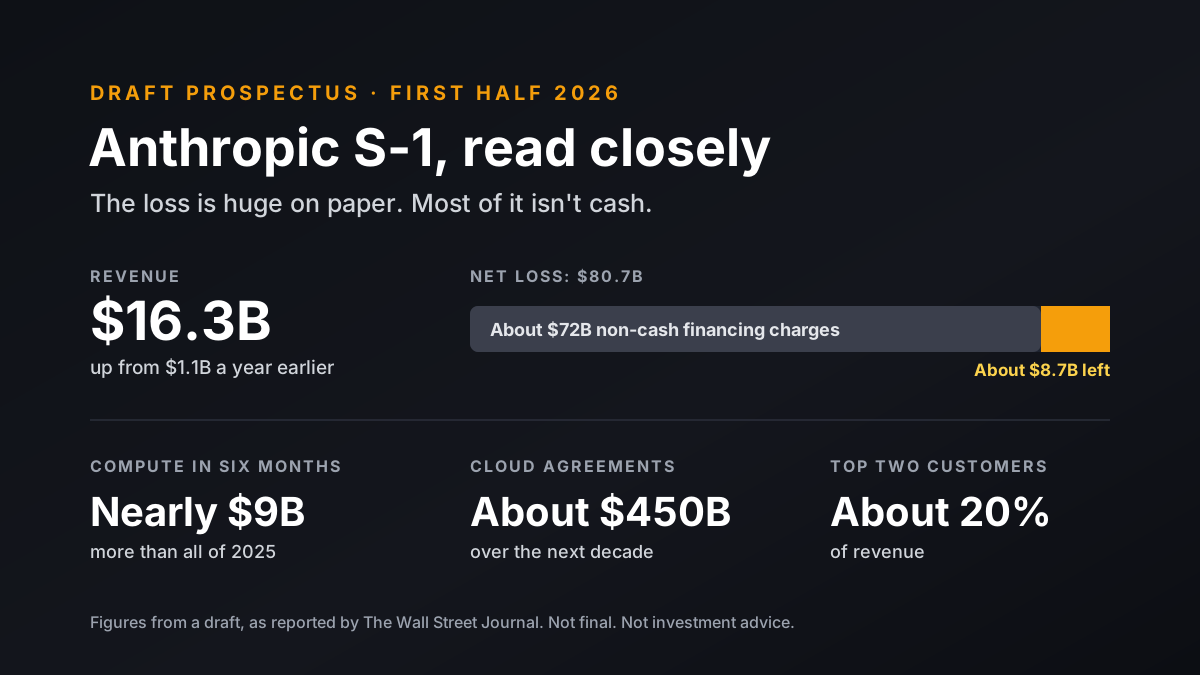
A draft Anthropic S-1 has given the clearest look yet at the company's finances. According to a report on the draft by The Wall Street Journal, Anthropic earned $16.3 billion in revenue in the first half of 2026. That's up from $1.1 billion a year earlier.
It also posted a net loss of $80.7 billion. That number sounds alarming, but most of it isn't cash. Here's what the draft shows, what the headline figures leave out and what it means for companies that rely on AI vendors.
Disclosure: Van Data Team builds with Claude and other models, and this article was researched with Claude, which Anthropic makes. We've stuck to reported figures, marked our own math and tried to give the risks and strengths equal weight. This isn't investment advice.
Key Takeaways
- The draft shows $16.3 billion in first-half 2026 revenue, about 15 times the same period of 2025, by our math.
- The $80.7 billion net loss includes about $72 billion in non-cash accounting charges. Without them, the loss is about $8.7 billion.
- Anthropic spent nearly $9 billion on computing in six months, more than in all of 2025, and has about $450 billion in long-term cloud deals.
- Two customers made up about 20% of revenue. The draft also warns that a catastrophic AI incident could cost more than its insurance covers.
- For AI buyers, the draft points to a vendor with real momentum but tight compute supply. Plan for limits.
Anthropic S-1 at a Glance
Here are the main figures from the draft, as reported by the Journal. Where we did the math ourselves, we say so.
| Item | First half of 2026 | Comparison |
|---|---|---|
| Revenue | $16.3 billion | $1.1 billion in the first half of 2025 |
| Net loss | $80.7 billion | $13 billion in the first half of 2025 |
| Non-cash financing charges | About $72 billion | Loss without them: about $8.7 billion (our math) |
| Compute and infrastructure spending | Nearly $9 billion | $7.3 billion in all of 2025 |
| Cloud computing agreements | About $450 billion over the next decade | Possible total of $750 billion with deals still in talks |
| Top two customers | About 20% of revenue | Nearly a quarter of 2025 revenue, per an earlier draft |
What the Draft Anthropic S-1 Is, and Isn't
An S-1 is the document a company files with the SEC before it sells shares to the public. It covers the business, the finances and, at length, the risks. Anthropic said on June 1, 2026 that it had submitted a draft confidentially, which lets the SEC review it before anything is made public.
So the Anthropic S-1 isn't public yet. What we know comes from news outlets that have viewed drafts. Reuters and Fortune reported on an earlier version in late September, and the Journal reported on an updated one on October 20. Anthropic declined to comment.
That matters for how you read the numbers. Drafts change, figures are rounded in news reports, and the final filing may present things differently. Treat everything here as reported, not final.
Why the $80.7 Billion Loss Looks Worse Than It Is
The headline loss is real under accounting rules, but most of it isn't money that left the company. About $72 billion came from non-cash charges tied to convertible notes and similar financing deals, according to the draft.
Here's how that works in plain terms. Some investors gave Anthropic money in exchange for notes that can turn into shares later. When the company's value rises, those future shares become worth more. Accounting rules record that increase as a cost, even though no cash is paid.
So in an odd way, part of the loss reflects how fast Anthropic's value has grown. The same thing happened in 2025. An analyst at PitchBook, writing in an analysis published by Morningstar, notes that about $34 billion of Anthropic's $42 billion loss for 2025 was a similar non-cash charge.
Strip out the $72 billion and the first-half loss is about $8.7 billion, by our math. That's still a large loss. It's just a very different story from the one the $80.7 billion headline tells, and a far more ordinary one for a fast-growing technology company.
Compute: Where Anthropic's Money Goes
The bigger story is spending on computing power. Anthropic spent nearly $9 billion on computing capacity and infrastructure in the first half of 2026. That's more than the $7.3 billion it spent in all of 2025.
By our math, that's more than half of every dollar of revenue. It shows why AI models are so expensive to run. Each new customer brings revenue, but also a bill for the chips that answer its requests.
The good news for Anthropic is that revenue grew faster than spending. Revenue rose about 15 times from a year earlier, by our math. The question for investors and buyers alike is whether that gap holds as growth slows, which it already has in percentage terms.
$450 Billion in Cloud Commitments
To secure enough computing power, Anthropic has signed long-term cloud deals it can't cancel. The draft lists about $450 billion in agreements over the next decade, according to the Journal. The three largest:
| Provider | Reported commitment |
|---|---|
| Google Cloud | $111 billion |
| Amazon Web Services | $110 billion |
| Microsoft | $31 billion |
| Total cloud agreements | About $450 billion |
Those three add up to about $252 billion, more than half the total, by our math. The draft also says Anthropic could spend as much as $750 billion on computing in the coming years, counting deals it's still negotiating.
Be careful comparing these figures with earlier reports. The September draft put total compute and infrastructure commitments at about $518 billion. That figure measured a different mix of items, so the two numbers aren't a like-for-like change.
Why does this matter? Noncancelable means the bills keep coming even if demand drops. The PitchBook analyst points out that revenue can fall within a quarter while minimum payments continue for years. That's the core trade-off: locking in supply protects growth, but it also locks in costs.
When Suppliers Become Competitors
One of the most striking details in the draft is about Anthropic's relationship with the big cloud providers. The company said it has sought more computing capacity than those providers were willing to supply, according to the Journal.
That's an unusual position. Google, Amazon and Microsoft are Anthropic's biggest suppliers, and Google and Amazon are also major investors. But all three also sell AI models of their own or from rivals. That creates tension.
Anthropic's answer is to look beyond the big clouds. The draft says it's pursuing data centers built by third parties to get around supply limits. That spreads risk, but newer operators have shorter track records.
For companies that buy AI, this is a useful signal. If even the largest model makers struggle to get enough chips, capacity limits and rate caps are likely to remain part of the picture for a while.
Customer Concentration in the Anthropic S-1
About 20% of Anthropic's first-half revenue came from just two customers, the draft shows. By our math, that's roughly $3.3 billion. The customers aren't named.
The draft also says a limited group of customers is expected to provide a large share of revenue for the foreseeable future. In the earlier draft, two customers made up nearly a quarter of 2025 revenue, so the share has eased a little as the business grew.
Concentration cuts both ways. Large customers bring scale and steady demand. But losing one, or seeing one shift spending to a rival model, would hit revenue hard. The PitchBook analyst also notes that many large customers in the earlier draft weren't on long-term contracts.
The Risk Factors Few Companies Write
Every S-1 lists risks. The Anthropic S-1 includes some that few other companies would ever write down. Among those reported:
- Alignment: according to the Journal, the draft highlights risks around model alignment, meaning whether AI systems reliably do what people intend.
- Uninsurable incidents: it warns that damages from a severe AI-related security incident could exceed the limits of its insurance coverage.
- Catastrophic risk: the earlier draft warned that advanced AI could pose "catastrophic or existential risks to humanity," as the Financial Times and others reported.
- Length: Fortune reported that risk warnings filled more than a third of that earlier draft.
You can read this two ways. Skeptics may see it as a list of reasons to worry. Others may see a company being unusually candid about what it builds. Either way, the risk section is worth reading in full once the filing is public.
Governance: Pledges, Pay and Control
The draft also covers how the company is run and who controls it. The main points reported so far:
- Pay: chief executive Dario Amodei and president Daniela Amodei each drew a base salary of about $655,000 in 2025, according to the Journal.
- Pledges: both co-founders have pledged 80% of their personal equity to charity.
- Public benefit fund: the company plans a fund equal to 5% of its shares, which could be used for donations or direct payments to specific groups.
- Voting control: based on the earlier draft, the PitchBook analyst reports that co-founders hold 50.1% of voting power through a special share class.
- Board: a separate body, the Long-Term Benefit Trust, elects four of seven directors.
The analyst argues this setup limits the influence of public shareholders. Supporters would say it's designed to keep the company's safety mission from being overruled by short-term pressure.
Strengths and Risks in the Anthropic S-1
Reading the draft fairly means holding both sides at once. Here's how the main points line up, based on what's been reported so far:
| Strengths the draft shows | Risks the draft shows |
|---|---|
| Revenue up about 15 times in a year, by our math | Growth already slowing in percentage terms |
| Most of the loss is non-cash | About $8.7 billion of loss remains, by our math |
| Long-term compute supply locked in | About $450 billion in deals that can't be cancelled |
| Customer concentration easing | Two customers still bring in about 20% of revenue |
| Unusually open about AI risks | Worst-case incidents may exceed insurance |
| Founders pledged 80% of their equity to charity | Public shareholders get limited control |
Which column matters more depends on who you are. An investor weighs them against the share price. A buyer weighs them against how much of the business runs on one vendor.
How the Anthropic S-1 Compares With the September Draft
The two drafts cover different periods, so they're best read together. Here's what each reported version showed:
| Item | September draft (full year 2025) | October draft (first half of 2026) |
|---|---|---|
| Revenue | About $4.6 billion | $16.3 billion |
| Net loss | About $42 billion | $80.7 billion |
| Non-cash financing charge | About $34 billion | About $72 billion |
| Compute spending | $7.3 billion | Nearly $9 billion |
| Top two customers | Nearly a quarter of revenue | About 20% of revenue |
Six months of 2026 brought in more than three times the revenue of all of 2025. Spending grew too, but more slowly. That's the trend the company will need to show continues.
How to Read an AI Company's S-1
Anthropic won't be the last AI company to file. OpenAI and others are expected to follow. Whether you're an investor, a buyer or just curious, a few checks help you read any of these filings:
- Split cash from non-cash. Look for charges tied to convertible notes, warrants or share-based pay. They can swamp the headline loss.
- Compare compute to revenue. If computing costs grow faster than revenue, margins are shrinking, whatever the growth rate.
- Read the commitments note. Find out how much is noncancelable and over what period.
- Check concentration. Note how much revenue comes from the top customers and from cloud marketplaces.
- Read the risk factors. They're long for a reason. Look for risks that are specific to AI, such as model behavior, misuse and liability for harm, rather than the boilerplate every company includes.
- Check who controls the board. Special share classes and trusts can limit what public shareholders can change.
But no checklist picks stocks. Whether a share is worth buying depends on price and your own situation, and a licensed adviser is the right person to ask.
What the Anthropic S-1 Means for AI Buyers
Most of our clients don't plan to buy Anthropic shares. They use Claude, alongside models from OpenAI, Google and others, inside products, internal tools and day-to-day workflows, which makes vendor health a practical concern. For them, the draft carries a few practical lessons:
- The vendor looks durable. Fast revenue growth and large funding make a sudden shutdown unlikely. That lowers one kind of risk.
- Capacity stays tight. If Anthropic can't get all the chips it wants, rate limits and slower rollouts can still affect customers. Ask about guaranteed capacity for critical work.
- Prices may shift. With compute costs above half of revenue, by our math, providers will keep adjusting pricing and model tiers. Budget with some room.
- Keep a second option. Design systems so you can switch models for important tasks without rewriting prompts, tests and integrations from scratch every time a provider changes something. Our post on Anthropic's Q3 revenue covers more vendor questions to ask.
What We Still Don't Know
The drafts leave plenty of gaps. These are the details worth watching for when the filing goes public:
- Gross margin. The drafts reported so far don't disclose it, so it's hard to judge how profitable each sale is.
- Cash on hand. The September draft showed about $20.3 billion at the end of 2025. An updated figure hasn't been reported.
- Final valuation and timing. Reports point to a target above $2 trillion and a listing after the November midterms, but neither is confirmed.
- Who the big customers are. The two largest aren't named.
We'll update this post when the final Anthropic filing becomes public.
Anthropic S-1: Our Take
The draft shows a company growing very fast, with costs to match. The $80.7 billion loss is mostly an accounting effect of that growth. The more important numbers are the nearly $9 billion compute bill and the $450 billion in deals that can't be cancelled.
Both readings have merit. Bulls will point to revenue that grew about 15 times in a year. Skeptics, like the PitchBook analyst, will argue that a $2 trillion valuation needs years of growth and better margins than the drafts show so far. We don't take a side on the shares.
For businesses that use AI, the practical message is simpler. The leading model makers are well funded but short on compute, and that shapes pricing, limits and reliability. Build with that in mind.
How Van Data Team Helps Teams Plan Around AI Vendors
We help companies choose and combine AI models without betting everything on one provider. That means comparing models on your real tasks, designing systems that can switch providers, setting up cost and usage guardrails and reviewing vendor terms on capacity and liability.
If you're planning AI spending for next year, our guides to AI governance and AI agent development costs are good places to start.

Founder of Van Data Team. Builds Vanaxity, the AI agent system for SEO, GEO, and AEO, and leads data engineering delivery for B2B teams.
About the authorArticle FAQ
Questions readers usually ask next.
These short answers clarify the practical follow-up questions that often come after the main article.
Need a similar system?
If this article maps to a workflow your team already operates, the next step is usually a scoped review of the system, constraints, and rollout path.
Consultation
Scope your next AI workflow.
Share the system and blockers. We will map fit, gaps, and the next step.