August 9, 2026
WeatherNext: Evaluating AI Cyclone Forecasting
WeatherNext shows how generative ensembles improve cyclone forecasting. Use this framework to evaluate and adopt scientific ML models with confidence.
Article focus
WeatherNext poses a hard problem for ML engineers, data scientists, and AI-for-science teams: how do you trust an AI cyclone model that beats established physics-based forecasts on track, intensity, and wind structure without relying on one headline metric?
Section guide
WeatherNext poses a hard problem for ML engineers, data scientists, and AI-for-science teams: how do you trust an AI cyclone model that beats established physics-based forecasts on track, intensity, and wind structure without relying on one headline metric? This article provides a practical evaluation and adoption framework covering task-specific benchmarks, generative-ensemble calibration, generalization, inference cost, and operational validation, using the same evidence-first review discipline Van Data Team applies to production models and pipelines.
WeatherNext gives ML engineers, data scientists, and AI-for-science platform teams a practical lesson in trusting scientific ML. Trusting a model that outperforms established physics-based systems is hard. You need task-level benchmarks, calibrated ensembles, generalization tests, and operational proof. This guide turns DeepMind's cyclone work into an evaluation and adoption framework. At Van Data Team, we apply that rigor through production AI workflows with explicit review gates, observable pipelines, and human fallback.
Key Takeaways
- Google DeepMind's Nature paper, published August 6, 2026, reports state-of-the-art cyclone forecasts across track, intensity, and wind structure.
- The reported advantage averages a day or more of lead time; its three-day forecast is about as accurate as leading systems' two-day forecast.
- The generative architecture produces about 1,000 plausible forecasts, so calibration matters as much as average accuracy.
- Open code and weights under the repository's Apache 2.0 and CC BY 4.0 licensing terms, backed by operational validation during the 2025 Atlantic hurricane season, make independent testing possible.
What WeatherNext Actually Shipped
Google DeepMind released a model family, research evidence, and reproducible software artifacts rather than a closed forecasting demo.
The Nature research introduces an operational AI model with state-of-the-art ensemble forecasts for cyclone track, intensity, and wind structure. These are separate forecasting tasks. The result isn't a claim that the model wins across all weather variables or operational decisions.
The headline metric is lead time. On average, the model's track, intensity, and wind-structure forecasts provide a day or more of advantage over leading operational models. In practical terms, its forecast three days ahead is about as accurate as what earlier systems delivered two days ahead. That extra warning window can change when forecasters investigate a risk or escalate it.
The cyclone model reaches this result at a roughly 28 x 28 km resolution. DeepMind says training used tens of terabytes of weather data plus the IBTrACS historical-storm database. This combines broad atmospheric context with specialized storm records.
The release covers WeatherNext Cyclones, WeatherNext 2, and WeatherNext 2-mini. DeepMind published code and weights through its open repository. The mini variant is small enough to run in a free Google Colab notebook, lowering the barrier to inspection and experimentation.
The Nature paper describes the operational importance directly:
"a step-change towards more reliable and timely forecasts and warnings"
That statement reflects DeepMind's reported evidence. The adoption decisions that follow are Van Data Team's analysis: benchmark the model against the exact decisions it will support, then verify its behavior under real operating pressure.
How Generative Ensembles Represent Uncertainty
The following illustration summarizes from one state to calibrated futures:
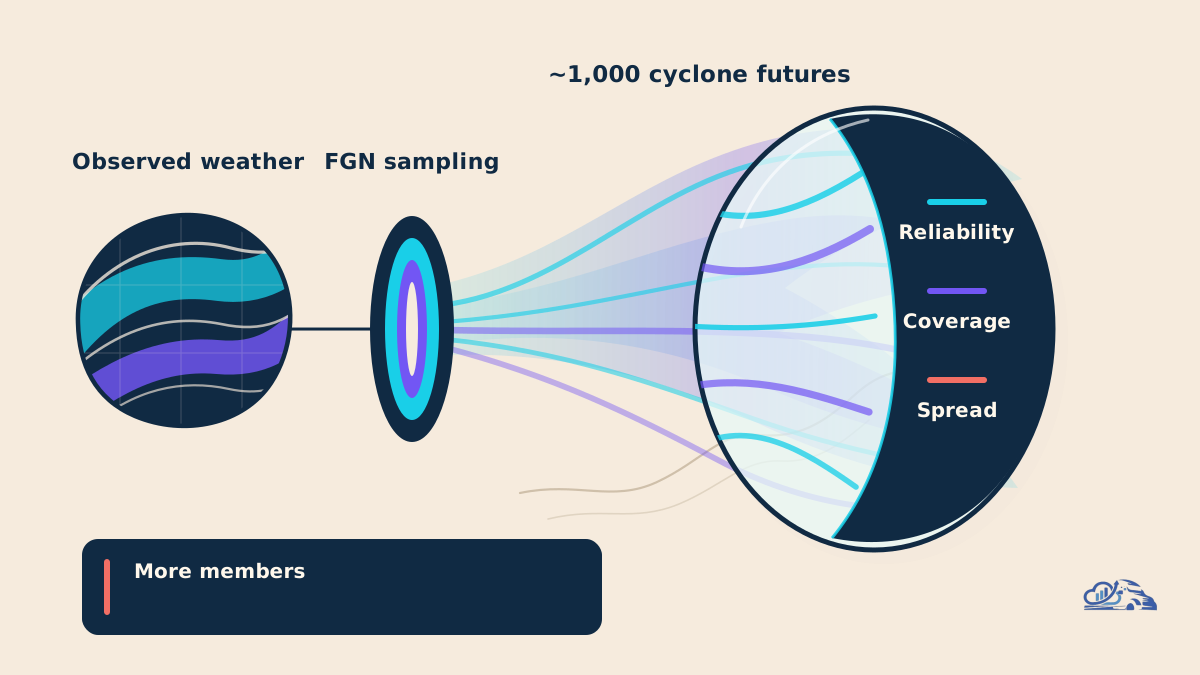
A generative ensemble is useful because it exposes plausible futures instead of hiding uncertainty behind one best guess.
Numerical weather prediction (NWP) simulates atmospheric behavior using physical equations. Forecasting centers can run NWP systems several times with changed inputs or assumptions. The resulting collection of plausible forecasts is called an ensemble.
A deterministic AI model usually returns one learned estimate. That can be accurate while giving operators little information about alternate outcomes. A single predicted track doesn't show whether nearby landfall paths are nearly as plausible.
WeatherNext uses a Functional Generative Network (FGN). An FGN is a generative architecture that produces coherent alternative forecasts from the same initial weather state. Sampling the network creates a distribution of possible cyclone paths, intensities, and wind structures.
| Evaluation dimension | Traditional NWP | Deterministic AI forecast | Generative-ensemble ML |
|---|---|---|---|
| Forecast output | Physics-based simulations, often with ensemble products | One learned best estimate | A learned distribution of plausible futures |
| Uncertainty | Derived from changed inputs and model configurations | Missing or handled outside the model | Estimated from ensemble members and tested for calibration |
| Physical checks | Conservation, stability, and domain constraints | Output plausibility and constraint checks | Member-level and distribution-level constraint checks |
| Evaluation | Accuracy by task and lead time | Accuracy by task and lead time | Accuracy, calibration, coverage, and rare-event behavior |
| Operations | High compute, established review workflows | Fast inference, external uncertainty handling | Ensemble cost, summarization, monitoring, and escalation |
Producing many members doesn't prove that uncertainty is trustworthy. A model can create a large ensemble whose members are too similar, too noisy, or systematically biased.
Teams should test reliability, coverage, sharpness, and spread. Reliability asks whether predicted likelihoods agree with observed outcomes. Coverage asks whether reality falls inside the forecast range often enough. Sharpness rewards useful concentration, but only after reliability is established. Spread measures how much members disagree.
Rare events need separate review. An ensemble that looks calibrated during routine storms may still miss rapid intensification or unusual tracks. Average error won't reveal that weakness.
Consider a coastal operations team comparing two models with similar mean-track accuracy. One model spreads members across the eventual landfall region. The other clusters tightly around the wrong coastline. Their average scores may look close, but their decision value is not. Calibration exposes the difference.
Evaluate Scientific ML on the Task That Matters
A scientific ML model should pass a predefined benchmark contract, not win a convenient aggregate score after testing begins.
At Van Data Team, we start by naming the incumbent system, operational task, evaluation window, metrics, lead times, and pass criteria. Those choices are fixed before results are examined. This prevents teams from selecting the slice where the new model looks strongest.
Track, intensity, and wind structure should remain separate scorecards. A model may improve track prediction while weakening intensity estimates during fast-changing storms. Collapsing both into one score hides the tradeoff.
Lead time also needs explicit slices. Show where skill appears, holds, and decays. The real question isn't simply whether the model is more accurate. It is whether the model gives a usable answer earlier than the current workflow.
Generalization testing should cover out-of-distribution (OOD) conditions. OOD events differ materially from routine training examples. Hold out storms, regions, seasons, and extreme cases. Review the worst failures, not only the average result. Check whether errors share a geography, storm phase, or input-quality pattern.
Measure latency and cost across the complete workflow. Include data loading, preprocessing, inference, ensemble aggregation, physical checks, storage, monitoring, and human review. A fast model call can still produce a slow or expensive decision pipeline. The same discipline used to measure infrastructure cost without slowing delivery applies here.
Reproducibility must cover more than downloaded weights. Pin the code revision, weights, runtime dependencies, preprocessing logic, data snapshots, evaluation configuration, and random seeds. Save raw predictions so another team can recompute the metrics.
Scientific ML Evaluation and Adoption Checklist
- [ ] Tasks and operational baselines are named.
- [ ] Metrics, lead times, and pass criteria are fixed before testing.
- [ ] Ensemble calibration and worst-case failures are reviewed.
- [ ] OOD and extreme-event tests are included.
- [ ] Physical-consistency checks are documented.
- [ ] End-to-end latency and inference cost are measured.
- [ ] Weights, code, data provenance, and environments are reproducible.
- [ ] Shadow-mode operational validation is complete.
- [ ] Human review, fallback, and rollback paths are defined.
The decision rule is simple: don't adopt a model from an aggregate benchmark win alone. Require task-specific evidence for every decision the model will influence.
Want a scoped adoption plan? Van Data Team can review the benchmark contract and return a provenance map, shadow-run design, monitoring plan, review gates, and delivery estimate. Start by learning how to turn the evaluation brief into an executable scope.
Why Open Weights Change Scientific Trust
Open code and weights let independent teams challenge a scientific result instead of accepting a hosted output at face value.
DeepMind's open-source repository provides the software and model artifacts needed to begin that work. Researchers can inspect inference logic, generate predictions, compare evaluation methods, and test cases that weren't emphasized in the original paper.
The accessible mini variant matters for the same reason. A research team can begin by reproducing preprocessing and scoring in a low-cost notebook environment. That expands participation beyond institutions with large compute budgets.
However, successful execution isn't successful reproduction. A notebook proves that inference runs. Reproduction means an independent team can recover the reported evaluation logic and explain any differences.
Teams should pin environments, document source-data versions, preserve transformations, and store evaluation outputs. They should also review the license, model documentation, dependencies, and artifact checksums. Changes to weights or preprocessing need the same approval trail as application code.
Accessibility also doesn't establish edge readiness. Teams still need to measure memory use, startup time, inference latency, ensemble cost, and device compatibility on the intended hardware. The smaller model makes those tests possible; it doesn't decide their outcome.
Move From Benchmarks to Operations
Operational validation is the strongest test because it exposes the model to live data, deadlines, human judgment, and failure recovery.
The U. S. National Hurricane Center used the model while forecasting Hurricane Melissa's rapid intensification and landfall during the 2025 Atlantic hurricane season. That use matters beyond a leaderboard. Forecasters saw the model beside established evidence while making time-sensitive decisions.
A team adopting scientific ML should begin with shadow deployment. The candidate model receives production inputs and produces live forecasts, but the incumbent workflow remains authoritative. Operators compare results without allowing the new model to trigger unsupported actions.
The pipeline should be explicit:
- Ingest observations and record their provenance.
- Apply versioned preprocessing.
- Run inference and preserve every ensemble output.
- Summarize the distribution for the operational task.
- Apply physical and domain-specific checks.
- Monitor freshness, latency, drift, and missing inputs.
- Escalate uncertain or conflicting cases to a human reviewer.
Suppose an ML platform team runs a candidate cyclone model beside its existing NWP feed. It scores each task and lead time, records physical-check failures, and logs every forecaster override. During routine conditions, the outputs may align. During an extreme storm, a widening disagreement becomes an escalation signal rather than an automated decision.
AI and physics should remain complementary evidence streams. NWP offers physical structure, established diagnostics, and decades of operational practice. Generative ML offers another learned view of plausible futures. Human forecasters integrate both with observations and local context.
Fallback behavior must be designed before launch. If data is stale, ensemble generation fails, or physical checks reject the output, the system should return to the approved baseline. Our operational monitoring and human escalation playbook shows how to make ownership, review, and recovery explicit.
Apply the Broader AI-for-Science Pattern
The transferable lesson is a sequence of evidence: governed data, uncertainty-aware modeling, strong benchmarks, open artifacts, operational proof, and accountable controls.
This is Van Data Team analysis, not a claim that every scientific domain will reproduce DeepMind's result. The recommended pattern is:
- Build from governed scientific data with traceable provenance.
- Represent uncertainty when the decision depends on multiple plausible outcomes.
- Compare against a strong incumbent on task-specific metrics.
- Release enough artifacts for independent reproduction.
- Validate under real conditions before granting authority.
- Govern changes through monitoring, human review, fallback, and rollback.
The same method applies to flood prediction, energy forecasting, materials modeling, and other scientific ML systems. The domain metrics will change. The evidence standard should not.
Common failure modes are also transferable. Data leakage can inflate benchmark results. An under-dispersed ensemble can look confident while missing valid outcomes. One aggregate score can hide a critical task failure. Open weights can create an appearance of transparency without reproducible preprocessing. Fast inference can be erased by slow aggregation and review.
A credible system makes those failure modes visible. Its operating record should show what data entered, which artifact ran, what checks fired, who overrode the output, and how the workflow recovered.
How Van Data Team Makes This Operational
At Van Data Team, we treat WeatherNext evaluation as an operating workflow, not a theory exercise. We first map how forecasts move from source systems into decisions. That map covers data provenance, model runs, ensemble outputs, review gates, dashboards, alerts, and fallback paths. It also shows where handoffs fail or uncertainty gets lost.
The deliverable is a scoped evaluation and adoption plan. It defines which signals to collect, including track error, intensity error, wind-structure quality, ensemble spread, calibration, latency, and inference cost. It also identifies workflow gaps, owners, and acceptance thresholds. Extreme or out-of-distribution events receive separate tests instead of being hidden inside average scores.
Automation sits behind human review where errors could affect high-impact decisions. A dashboard compares the AI model with established forecasting systems and tracks performance by lead time and storm type. A runbook explains when to escalate, rerun, fall back, or pause deployment.
This approach turns model evidence into action. Teams leave with clear benchmarks, operational controls, and a recovery path—not merely a promising research result.
Conclusion: The Method Matters More Than the Headline
The real breakthrough is not simply that an AI model beats established physics-based forecasting on selected tasks. It is the evidence chain behind the result.
WeatherNext combines governed scientific data, a generative ensemble, task-specific benchmarks, open artifacts, and operational validation. That combination makes the result useful to teams building scientific machine learning systems.
The next step is to apply the same standard to your own model. Fix the benchmark before testing. Inspect calibration and worst cases. Measure the complete operating path. Preserve human judgment and a tested fallback.
Van Data Team can turn that process into a scoped workflow review with a benchmark contract, signal map, provenance plan, validation gates, monitoring design, and implementation scope.
Article FAQ
Questions readers usually ask next.
These short answers clarify the practical follow-up questions that often come after the main article.
Need a similar system?
If this article maps to a workflow your team already operates, the next step is usually a scoped review of the system, constraints, and rollout path.
Free model review
Validate Your WeatherNext Adoption Plan
Review your WeatherNext or scientific ML use case and leave with a benchmark, calibration, and operational-validation plan.
- A task-specific benchmark map for your target outcomes
- An ensemble-calibration and uncertainty-testing plan
- An out-of-distribution and extreme-event test matrix
- A latency, inference-cost, and integration assessment
- A reproducibility and operational-validation checklist
Related articles
View all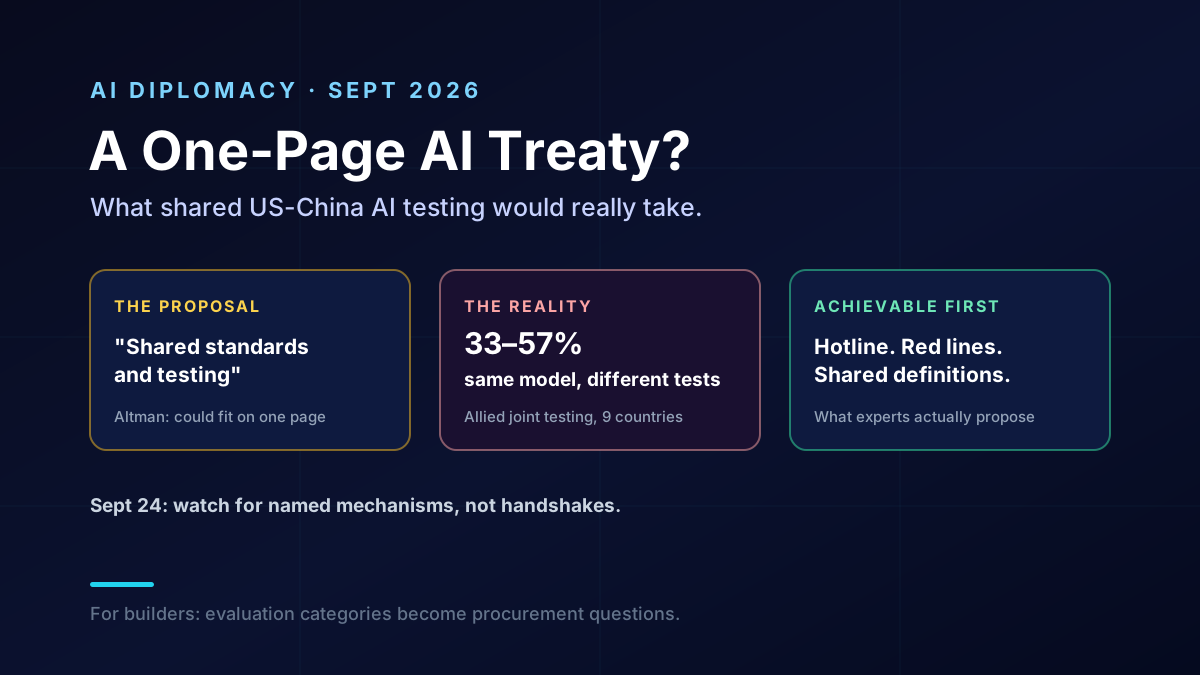
US-China AI Agreement: What Shared Testing Would Take

Kimi K3 vs Opus 5 vs GPT-5.6 Sol: which model should you use?
Gemini 3.6 Flash vs Claude Opus 5: Route by Tier