Grok for Startups: Credits, Eligibility and the Catches
Grok for Startups gives credits across Grok, Grok Build, Grok Bot and the API. Who qualifies, how credits are sized and released, and the six-month expiry.
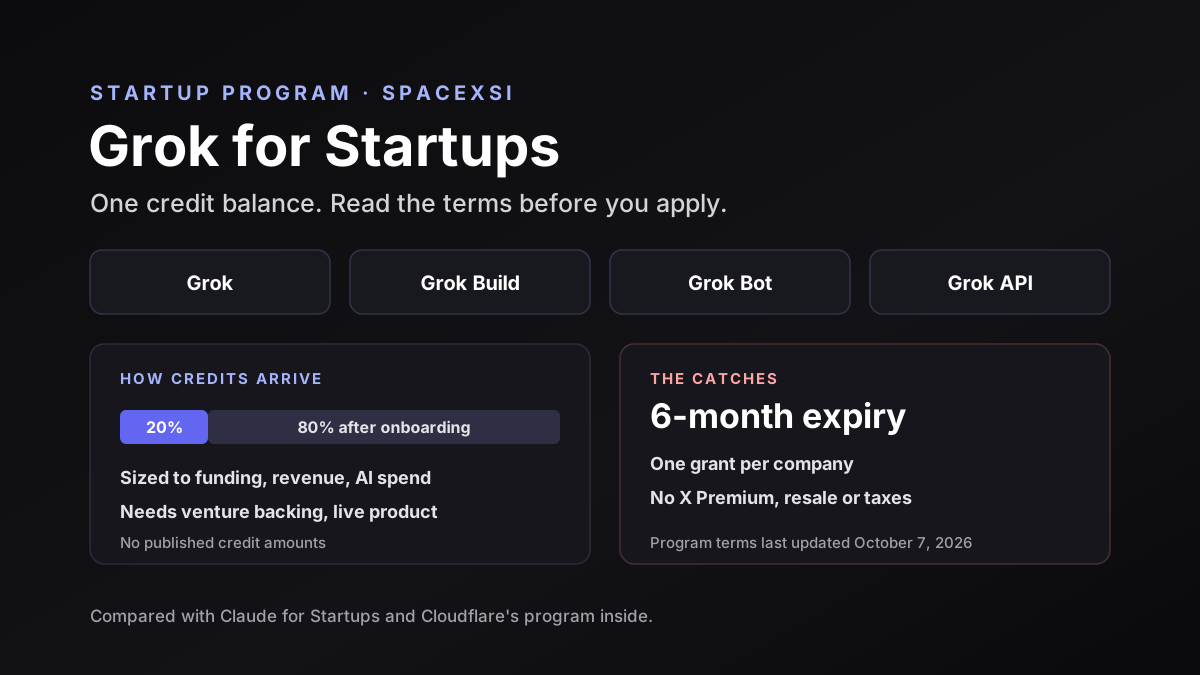
Grok for Startups is a new credits program from SpaceXSI, the company formerly known as xAI. It gives early-stage companies one credit balance across four products: the Grok assistant, the Grok Build coding agent, the Grok Bot business agent and the Grok API.
The pitch is simple. Apply, get credits sized to your company and build with Grok for free for a while. The terms add some important details, including a six-month expiry. Here's what's on offer, who qualifies and what to check before you apply.
Disclosure: Van Data Team builds with Claude, Grok and other models, and this article was researched with Claude, which is made by Anthropic, a SpaceXSI competitor. We compare the programs on their published terms only.
Key Takeaways
- Grok for Startups gives one credit balance for Grok, Grok Build, Grok Bot and the Grok API.
- You need venture backing, a live product and a company email that matches your website.
- No credit amount is published. Credits depend on funding, revenue and current AI spend.
- You get 20% of your credits when approved and the other 80% after onboarding.
- Credits expire six months after they're applied, unless your approval says otherwise. Plan your usage around that date.
Grok for Startups at a Glance
| Item | Details |
|---|---|
| Run by | SpaceXSI, formerly xAI |
| Products covered | Grok, Grok Build, Grok Bot and the Grok API |
| Who qualifies | Venture-backed startups with a live product |
| Credit amount | Not published; based on funding, revenue and AI spend |
| Release | 20% on approval, 80% after onboarding |
| Expiry | Six months after credits are applied, by default |
| Grants | One per company |
| Terms last updated | October 7, 2026 |
What Is Grok for Startups?
According to the program page, Grok for Startups offers "credits and support across Grok, Grok Build, Grok Bot, and the Grok API, all in one place." Startups apply online, and approved companies get credits on their team account plus onboarding help.
The four products cover different parts of a young company:
- Grok: the chat assistant, for research, drafts and quick answers.
- Grok Build: a coding agent that works in the background and can turn a feature request into a pull request. The program terms reference Cursor maker Anysphere's terms for some services.
- Grok Bot: a business agent for jobs like sales follow-ups, recruiting pipelines and weekly reports.
- Grok API: access to models such as Grok 4.7 for building AI into your own product.
The "one balance" design is the main difference. Instead of separate grants for chat, coding and API use, you draw everything from one pot.
What the Credits Cover
Under the program terms, credits pay for fees on the four eligible services that your team account runs up while the credits are valid. They're applied automatically before your card is charged.
The terms also list what credits can't pay for:
- Taxes, and fees from before the credits arrived or after they expire.
- Third-party products, marketplace items, professional services and hardware.
- X services, including X Premium.
- Past-due amounts, and fees under a separate committed-spend or prepaid deal.
You also can't resell usage paid for with credits or use them for other, unrelated companies. Credits are for your own business.
Who Qualifies for Grok for Startups
The program page is short on this. It says SpaceXSI checks every application for three things:
- Venture backing. Bootstrapped companies aren't the target. If you don't qualify yet, the FAQ says you can reapply once you've raised money, so a rejection today isn't a permanent answer for your company.
- A live product. Ideas and pitch decks alone aren't enough.
- A matching company email. Your email domain must match your website, and the FAQ is blunt that applications using a personal email address can't be approved at all, whatever else they show.
The terms add more factors that may count, including investors, revenue, current AI spend, traction, team size, intended use and program capacity. Companies in sanctioned countries and employees of SpaceXSI, SpaceX, Tesla, X and Anysphere, and their families, aren't eligible.
How Credits Are Sized and Released
SpaceXSI doesn't publish a credit amount. The program page says credits depend on "your funding, revenue, and current AI spend." It says it aims for "about six months of realistic usage" in one place, and six to twelve months in another.
Credits arrive in two parts:
- 20% on approval. The first tranche is ready once you're approved.
- 80% after onboarding. The rest is released automatically once you've completed the initial onboarding steps and your team is up and running.
The terms stress that any typical amounts you hear about are "informational only and are not a commitment." You're entitled only to what your approval email states. Some reports have described a monthly spend match, but that isn't on the official page, so treat it as unconfirmed.
The Six-Month Expiry Catch
This is the detail most founders will miss. Unless your approval email says otherwise, credits expire six months after they're applied to your account. Unused credits are then forfeited, with no refund and no cash value.
The two-part release makes this matter more. If your 80% tranche arrives a few weeks after the first, check whether each tranche has its own six-month clock or shares one. Your approval email should say.
In practice, that means credits work best for startups that will use them soon. If you're months away from heavy AI usage, applying today may waste part of the grant.
A Credit Planning Example for Grok for Startups
It helps to turn credits into months. Here's a simple example using Grok 4.7's API prices and our own math. It assumes prompts under 200,000 tokens and no caching:
| Monthly usage | Input tokens | Output tokens | Monthly cost | Six months |
|---|---|---|---|---|
| Light | 10 million | 2 million | $32 | $192 |
| Medium | 100 million | 20 million | $320 | $1,920 |
| Heavy | 1 billion | 200 million | $3,200 | $19,200 |
Caching changes the picture a lot. If half the medium team's input is cached at $0.50 per million, its monthly bill falls from $320 to about $245. Agents and coding tools also tend to use far more tokens than simple chat features, so track real usage in your first weeks.
The point isn't the exact numbers. It's to compare your likely six-month usage with the credits you're offered, so you know whether you'll use them up or watch them expire.
How to Apply for Grok for Startups
You apply through a form on the program page. According to the FAQ, you'll need:
- Your work email and LinkedIn profile.
- Your company website.
- Funding details and your investors.
- Revenue, current AI spend and team size.
SpaceXSI may verify what you submit, using public sources, business databases and calls to your investors. If it asks for documents, you have ten days to respond, or it may decline the application.
Be accurate. The terms require you to disclose any credits you've received from SpaceXSI before, and approval can be withdrawn if information turns out to be wrong.
VCs and accelerators can also join as program partners. If your investor is a partner, any minimum credit amount they mention still depends on SpaceXSI approving your own application.
What Happens When Credits Run Out
When credits run out or expire, you keep using the services at standard prices. Nothing switches off. But your bill starts.
The FAQ says fast-growing companies that need enterprise features, such as higher rate limits or a business associate agreement for health data, will be connected with SpaceXSI's sales team. If you'll need those features, raise them early rather than after you've built around the credits.
Grok for Startups vs Claude for Startups vs Cloudflare
Founders often stack several programs. Here's how Grok for Startups compares with two we've covered, based on each program's published details:
| Grok for Startups | Claude for Startups | Cloudflare for Startups | |
|---|---|---|---|
| What you get | One credit balance for four Grok products | Partner discounts, plus API credits via VC partners | Cloud credits in set tiers |
| Published amounts | None; sized per company | Up to $100,000 in API credits via VCs; up to $45,000 in partner discounts | $10,000, $100,000 and $350,000 tiers |
| Funding needed | Venture backing required | Open to bootstrapped and backed startups; biggest credits via VCs | Depends on tier |
| Main catch | Six-month expiry by default | Credits only on Anthropic's own API, some offers over capacity | Usage caps on some products |
Our guides to Claude for Startups and the Cloudflare startup program have the full details. The best mix depends on which models and infrastructure your product actually uses.
What You Can Build With the Credits
The credits are most useful if Grok fits your product. Three common uses stand out:
- AI features in your app, through the Grok API. Grok 4.7 costs $2 per million input tokens and $6 per million output tokens for prompts under 200,000 tokens, according to our Grok 4.7 review.
- Faster engineering, with Grok Build handling background coding tasks that your team reviews.
- Back-office automation, with Grok Bot drafting sales follow-ups, screening applicants and posting reports.
Each of these needs human review. Agents can draft and prepare, but founders should still approve emails, code merges and anything that touches customers.
Making the Credits Last
Six months goes fast. A few habits help you get real value before the expiry date:
- Measure cost per task, not per token. A model that uses more tokens can cost more overall, even at the same price. Track what each finished task costs.
- Use caching for repeated instructions and context, which is much cheaper on the API.
- Pick the smallest model that works. Save the strongest model for the hard tasks that truly need it, such as complex reasoning or long coding jobs, and route everything else to cheaper options.
- Set spending alerts, so you see when credits are running low before your card is charged.
- Plan the handover. Know what your monthly bill will be once credits end, and budget for it.
Risks to Weigh Before Building on Grok
Free credits are a good reason to try a platform, not by themselves a reason to depend on it. Before you build deeply on any single provider, consider:
- Lock-in: if your prompts, tests and tools only work with one provider, switching later is costly. Keep a way to swap models.
- Program changes: the terms say SpaceXSI may change, pause or end the program at any time, though credits already applied stay usable until they expire.
- Data and compliance: check the data terms for your use case, especially for customer or health data, where you may need an enterprise agreement.
- Fit: test Grok on your own tasks against the models you already use. Credits don't make a weaker fit worth it.
These apply to every vendor's program, not just this one, and they matter more the earlier you are, because early architecture choices tend to stick for years.
Who Should Skip Grok for Startups
The program isn't a fit for everyone. You may want to wait or look elsewhere if:
- You're bootstrapped. Venture backing is a stated requirement, so applications without it are unlikely to succeed.
- You don't have a live product yet. Build first, then apply.
- You won't use much AI soon. Six months goes fast, and unused credits are simply lost when the clock runs out, with no refund and no extension unless SpaceXSI agrees in writing.
- Your product depends on another provider's features. Credits won't help if Grok can't do what your product needs.
- You handle regulated data. Check whether you'll need an enterprise agreement, such as a BAA, before building.
Skipping now doesn't close the door. The FAQ says you can reapply once your circumstances change, such as after a funding round.
How to Stack Startup Programs Without Waste
Many founders join several programs at once: one for cloud, one or two for AI models and a few for tools. That can save a lot, but only with a plan.
- Map credits to real needs. Use each provider's credits for the work it's actually best at.
- Stagger start dates. Credits with fixed expiry dates are worth more if they don't all start in the same month.
- Keep one cost dashboard. Track every program's balance and expiry in one place.
- Avoid building around free tiers alone. Design so the product still makes sense at full price.
Our guide to AI agent development costs can help you estimate what each workload will cost once the credits end.
Questions to Ask Before You Apply
- Will we use most of the credits within six months? If not, consider waiting.
- Does Grok fit our product, or are we applying only because it's free?
- What will we pay when the credits end?
- Do we need enterprise features, such as higher rate limits or a BAA?
- Can our system switch models if pricing or quality changes?
Clear answers mean you're ready.
What the Program Says About SpaceXSI's Strategy
Credit programs are a familiar way for AI companies to win developers early. Startups that build on one platform often stay on it as they grow, and their usage grows with them.
Grok for Startups has a twist: it bundles a chat assistant, a coding agent, a business agent and an API into one offer. That suggests SpaceXSI wants startups to use Grok across the whole company, not just inside the product.
It also recruits investors. VCs and accelerators can join as partners and bring the program to their portfolios. That's the same approach Anthropic, OpenAI and the big clouds use, and it means your investors may already have a contact who can help.
Common Mistakes With AI Credits
Free credits are easy to waste. These are the mistakes we see most often with startup programs:
- Applying too early, then watching credits expire before the product needs them.
- Testing on toy tasks, so the team learns little about real costs or quality.
- Ignoring tool fees, such as search or code execution, which can add up alongside tokens.
- Forgetting the end date, then getting a surprise bill in month seven.
A short monthly review of usage, quality and remaining balance avoids most of these.
Grok for Startups: Our Take
Grok for Startups is a useful offer for venture-backed teams that already plan to use Grok. One balance across chat, coding, agents and the API is simpler than juggling several grants, and the 20/80 release rewards teams that actually start building.
The catches are worth taking seriously. There are no published amounts, and credits expire six months after they're applied. Apply when you're ready to use the credits, measure what each task costs and keep your product able to run on other models too.
How Van Data Team Helps Startups Choose AI Platforms
We help startups pick and combine AI models based on real tasks, not launch hype. That means testing models on your workloads, estimating cost per task, building model gateways that make switching easy and setting up spending alerts before credits run out.
If you're comparing startup programs, start with our guides to Claude for Startups and AI agent development costs.

Founder of Van Data Team. Builds Vanaxity, the AI agent system for SEO, GEO, and AEO, and leads data engineering delivery for B2B teams.
About the authorArticle FAQ
Questions readers usually ask next.
These short answers clarify the practical follow-up questions that often come after the main article.
Need a similar system?
If this article maps to a workflow your team already operates, the next step is usually a scoped review of the system, constraints, and rollout path.
Consultation
Scope your next AI workflow.
Share the system and blockers. We will map fit, gaps, and the next step.