Claude Opus 5: What Anthropic's New Flagship Means for AI Agents
Claude Opus 5, Anthropic's July 2026 flagship: $5/$25 per 1M tokens, a faster Fast mode, 43.3% on Frontier-Bench vs Fable 5's 33.7%, and what it changes.
Claude Opus 5 is Anthropic's new flagship model, released on July 24, 2026 for coding, agentic tasks, and knowledge work. Claude Opus 5 delivers frontier agentic performance at half the price of Anthropic's most capable model, Fable 5, and for teams running AI agents, that price cut changes the math more than any single benchmark.
For engineering, platform, and MLOps teams, the practical problem is no longer whether a model can draft code. It is that agent programs stall on slow, manual model-selection decisions and unmeasured cost, and a cheaper capable model tempts teams to swap everything at once and hope agent quality holds. At Van Data Team, we treat a new model release as a routing and governance decision, not a default swap: we map the task, tools, data, review burden, and failure recovery before we change a single agent's model. This guide reports what Anthropic shipped, then gives you a routing framework, an evaluation plan, and the guardrails a self-tooling agent now demands. You can see how we structure production agent delivery before mapping the same principles to your revenue and engineering workflows.
Key Takeaways
- Claude Opus 5 (API id
claude-opus-5) launched July 24, 2026 as Anthropic's everyday flagship for coding, agentic, and knowledge work, and the default model on Claude Max. - It costs $5 per million input tokens and $25 per million output, the same as Opus 4.8 and half of Fable 5's price, with a Fast mode at $10/$50 that runs about 2.5x faster.
- It sets state-of-the-art results on Frontier-Bench and GDPval-AA; on Frontier-Bench v0.1 it scores 43.3%, ahead of Fable 5's 33.7%.
- Anthropic still recommends the larger Fable 5 for the most advanced, longest-horizon autonomous agents, so Opus 5 is a routing choice, not a universal replacement.
- The real lever is cost per accepted outcome: cheaper capable inference only pays off with evaluation, model-tier routing, and tight agent guardrails.
Van Data Team turns a model launch into a task inventory, routing matrix, evaluation set, and controlled rollout. Explore how our AI agent development service works across build, evaluation, governance, and reporting.
What Anthropic Announced About Claude Opus 5
Anthropic released Claude Opus 5 as the fourth model in its Claude 5 family in under two months, after Mythos 5, Fable 5, and Sonnet 5. It is available across platforms and through the API as claude-opus-5, and it is the default model on Claude Max. Anthropic positions Opus 5 as the everyday workhorse for coding, agentic tasks, and knowledge work.
| Attribute | Reported detail | Operator implication |
|---|---|---|
| Availability | Live on all platforms; API id claude-opus-5; default on Claude Max | Confirm access and endpoints against the official model documentation before wiring routes |
| Standard pricing | $5 / 1M input, $25 / 1M output, half of Fable 5 | Re-baseline agent cost per accepted task, not just per-call price |
| Fast mode | $10 / $50, about 2.5x faster | Use when latency changes accepted-task economics, not by default |
| Benchmarks | SOTA on Frontier-Bench and GDPval-AA; strong OSWorld 2.0 computer use | Treat as a signal to run your own evals, not a finished verdict |
| Positioning | Everyday agentic workhorse; Fable 5 for the hardest long-horizon autonomy | Route by task class, not model prestige |
The table separates Anthropic's reported facts from the operator implications, which are Van Data Team's recommendations.
The Benchmarks, Read Precisely
On Frontier-Bench v0.1, an agentic terminal-coding benchmark, Claude Opus 5 scores 43.3%, more than double Opus 4.8's 18.7% and ahead of Fable 5's 33.7%. On OSWorld 2.0 (computer use), Anthropic says it beats every model at any given cost and tops Fable 5's best result at about a third of the cost, and it reports new state-of-the-art on the GDPval-AA knowledge-work evaluation.
The most striking result is a signal, not a score. In one Frontier-Bench task, Opus 5 was asked to reconstruct a machine part as a 3D CAD model from a drawing it was intentionally given no way to view; instead of failing, it wrote its own computer-vision pipeline to extract the geometry from raw pixels, and did so repeatedly while no competing model solved the task in five attempts. That is the headline for agent teams: a capable model will now build a missing tool to get unstuck rather than stop.
Van Data Team analysis: benchmark leadership is not the same as being best for your repository, toolchain, or risk level. A terminal-coding harness and a computer-use sandbox each test a narrow slice. In production, an agent more often fails because it picks the wrong internal tool, reads stale data, exceeds its permissions, or produces a change reviewers cannot safely accept. Verify a model against your own task set, and treat published scores as a reason to test, not a reason to skip testing. Our AI agent evaluation guide covers how to build that task set.
Half the Price Changes Agent Economics, Not Just API Bills
A single prompt-and-response barely notices a price change. A long-running agent does. Agentic loops spend tokens on planning, tool calls, retries, and self-correction across many steps, so halving the per-token price of a capable model is the difference between an agent loop that is too expensive to run continuously and one you can leave on. But the unit that matters is not cost per call. It is cost per accepted outcome: model usage plus tool execution plus retries plus human review plus recovery, divided by outputs that pass a defined quality bar.
That is where data engineering re-enters the picture. An agent's decisions are only as good as the data feeding them, so the pipelines that assemble that data (whether dbt models, Airflow jobs, or streaming ingestion through Kafka into a BigQuery or lakehouse warehouse) need real discipline. Hold the tables an agent reads to explicit freshness, lineage, and SLA guarantees, and enforce data quality and schema checks on them. A wrong or stale field does not just produce a bad answer; it triggers a bad action (a shipped patch or a customer email) before anyone reviews it. Watch for schema drift and late-arriving or backfilled records, because an agent acts on them immediately. Our dbt and BigQuery delivery playbook covers the warehouse side of that foundation.
Route by Task Class, Not Model Prestige
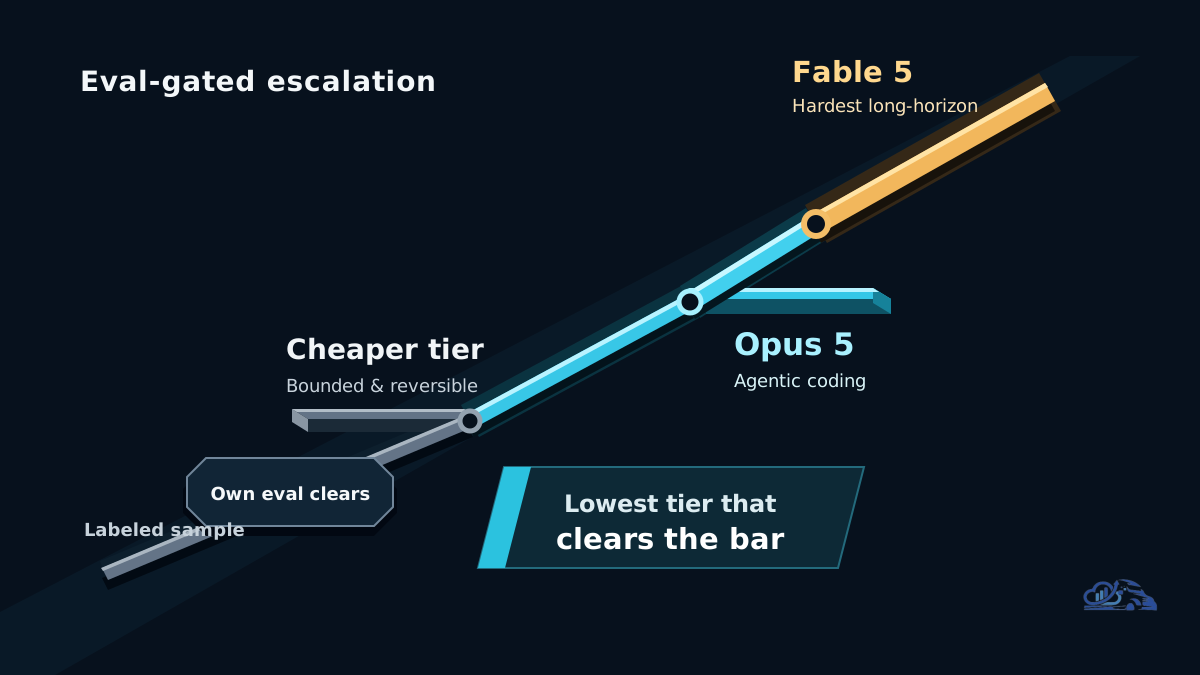
The right response to a new frontier model is not to route everything to it. It is to define a routing policy across the Claude 5 family and your other providers, then let measured performance decide. Opus 5 is best for everyday agentic coding and knowledge work where you want frontier quality at a controlled price; Fable 5 is the stronger fit for the hardest, longest-horizon autonomous jobs Anthropic still reserves it for; and a cheaper, faster tier is the right choice for bounded, well-checked tasks. Choose the simplest tier that clears your quality bar, and first test any new route on a labeled sample before you route live volume through it.
# model-routing policy (illustrative; validate against your own evals)
default_route: claude-opus-5           # everyday agentic + coding + knowledge work
routes:
  - when: task == "bounded" and reversible
    use: cheaper-tier                  # summaries, extraction, classification
  - when: task == "agentic-coding" and risk == "standard"
    use: claude-opus-5
  - when: task == "long-horizon-autonomy" or risk == "high"
    use: claude-fable-5                # Anthropic's pick for the hardest jobs
guardrails:
  require_human_approval: [outward_message, code_merge, spend, schema_change]
  stop_conditions: [repeated_failure, stale_data, permission_denied, budget_exceeded]
  observability: [action_trace, token_cost_per_task, eval_pass_rate]
This policy is a starting point, not a permanent hierarchy. Re-baseline it as new models ship: the Claude 5 family added four models in under two months, so "as of today" is the only honest frame for any routing decision. For the orchestration layer, patterns like a LangGraph state machine, LangChain or CrewAI agents, native function calling, and Plan-and-Execute loops all remain valid; keep the router independent of any one framework, and standardize tool access through open interfaces such as MCP.
The Self-Tooling Result Is a Governance Warning
The CAD demonstration is impressive, but for anyone running agents in production it is also a warning. A model that writes its own computer-vision pipeline to get unstuck is a model that will create tools, scripts, and side effects you did not anticipate. That makes sandboxing, least-privilege permissions, trace logging, and approval gates more important, not less. An agent that can build a bridge when the road ends can also build one to somewhere you did not authorize.
Put a policy layer around the model: constrain what actions it can take without human review, log every tool call and its result, and keep a human approval step on anything outward-facing, irreversible, or privileged. Our production AI agent operations and human-escalation playbook details the retry, incident, and handoff patterns that make autonomy safe enough to actually deploy.
A Practical Adoption Checklist
Before Claude Opus 5 becomes a default in your stack, work the operating problem, not the announcement:
- Verify access, the official model card, and pricing against Anthropic's documentation as of your rollout date, then measure real latency and cost on your own workload.
- Build a task-specific evaluation set of good and bad examples, and score Opus 5, Fable 5, and a cheaper tier on it before changing any route.
- Route by task and cost, capping and observing autonomous runs with per-task cost and eval-pass-rate telemetry.
- Enforce data quality, freshness, lineage, and SLA guarantees on every table an agent reads or writes.
- Keep human approval on irreversible actions, and log agent decisions for audit.
Tooling and Landscape Fit
Treat the release as a menu, not a stack. The model layer (Opus 5, Fable 5, cheaper tiers) is one decision; the orchestration layer (LangGraph, LangChain, CrewAI, native function calling, Plan-and-Execute) is a separate one; the protocol layer (MCP and other tool interfaces) is a third; and the data layer (dbt, Airflow, Kafka, BigQuery, with data quality, lineage, freshness, and SLA controls) is the foundation the other three depend on. Van Data Team assembles these into governed agent delivery (build, evaluation, routing, reporting, and risk-based review) rather than a benchmark-driven default. Compare Opus 5's positioning with our earlier analysis of Claude Opus 4.7 for production AI agents and Claude Fable 5.
Conclusion
Claude Opus 5's real story is not a leaderboard. It is frontier agentic capability at half the price of Anthropic's top model, which makes continuous, agentic work economically viable for more teams. The winning move is not to swap every route to it, but to route by task class, evaluate on your own work, and tighten the guardrails a self-tooling agent now requires. Van Data Team helps teams turn a model launch into a routing policy, an evaluation set, and a governed rollout. See how our AI agent development service delivers that.

Founder of Van Data Team. Builds Vanaxity, the AI agent system for SEO, GEO, and AEO, and leads data engineering delivery for B2B teams.
About the authorAI model benchmarks
Models in this article
Current pricing, context window and independent scores for each model.
Article FAQ
Questions readers usually ask next.
These short answers clarify the practical follow-up questions that often come after the main article.
Need a similar system?
If this article maps to a workflow your team already operates, the next step is usually a scoped review of the system, constraints, and rollout path.
Consultation
Scope your next AI workflow.
Share the system and blockers. We will map fit, gaps, and the next step.