Physical AI: Why Money Kept Flowing as Chip Stocks Crashed
Chip stocks had their worst day since 2020, yet physical AI firms Shield AI, Zipline and Agility raised billions the same day. What it means for your team.
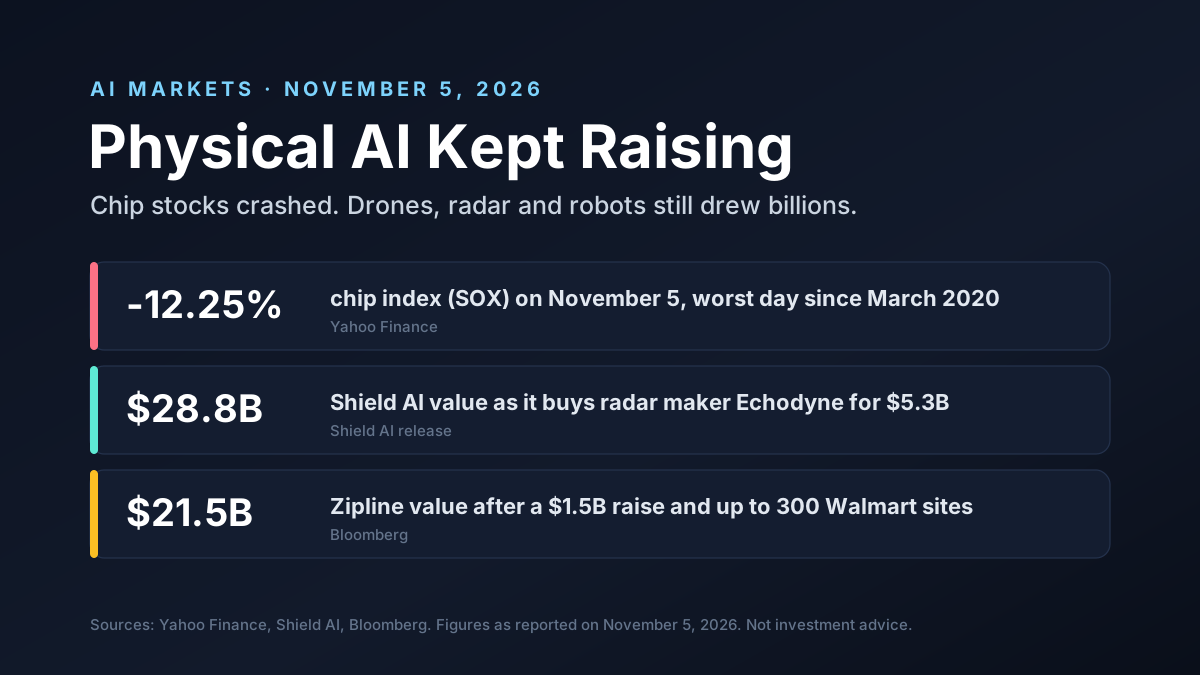
On November 5, 2026, chip stocks had their worst day in more than six years. The selloff hit Seoul and Taipei the next morning. Yet on that same Thursday, investors put billions into physical AI: AI that flies, drives, walks and watches.
Shield AI agreed to buy radar maker Echodyne for $5.3 billion. Zipline raised $1.5 billion for drone delivery. And Agility Robotics, a maker of humanoid robots, began trading on Nasdaq.
This guide covers the crash, why physical AI money kept flowing anyway and what operations and data teams should do.
Disclosure and scope: Van Data Team builds data and AI systems for clients, including data pipelines for operations teams. We drafted this article with help from Anthropic's Claude. We have no business ties to the companies named here.
Facts come from company releases and reports by Yahoo Finance, Bloomberg, Focus Taiwan and others. Market moves for Asia are morning figures, so closing numbers may differ. We label our own math. This isn't investment advice.
Key Takeaways
- The crash: the chip index fell 12.25% on November 5, its worst day since March 2020, and the Nasdaq fell 5.52%.
- Asia followed: Korea's KOSPI fell more than 8% and paused trading for 20 minutes. Taiwan's Taiex had its biggest point drop on record.
- Physical AI kept raising: Shield AI (Echodyne deal, $28.8 billion value), Zipline ($21.5 billion) and Agility Robotics (Nasdaq debut) all moved ahead the same day.
- Not all equal: Shield AI and Zipline point to real contracts. Agility had about $1.8 million in 2025 sales.
- For your team: treat physical AI as a data project first. Pick one costly task, check the vendor's paying customers and plan the data before buying robots.
Physical AI Deals at a Glance
| Company | What it does | November 5 news | Earlier value |
|---|---|---|---|
| Shield AI | Autonomy software and drones for defense | Buying Echodyne for $5.3 billion; raising $2.5 billion at a $28.8 billion value | $12.7 billion in March 2026 |
| Zipline | Drone delivery | Raised $1.5 billion at a $21.5 billion value; up to 300 new Walmart sites | $7.6 billion in January 2026 |
| Agility Robotics | Digit, a humanoid robot for warehouses | Began trading on Nasdaq as AGLT at a $2.5 billion value | Private before the merger |
What Happened to Chip Stocks on November 5
The day before had been a party. The Dow jumped more than 1,500 points on Wednesday after the midterm results. Then the mood flipped. Here's how Thursday closed, per Yahoo Finance and Fox Business:
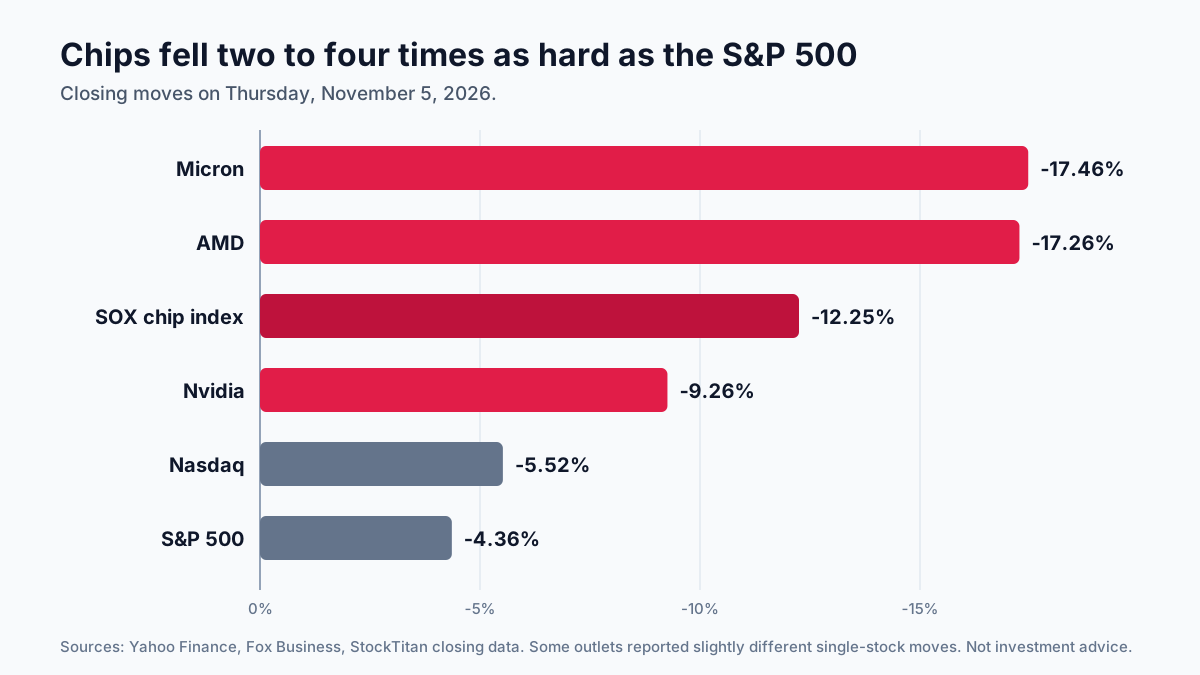
- Philadelphia Semiconductor Index (SOX): down 12.25% to 9,011, its worst day since March 2020.
- Nasdaq Composite: down 5.52%, its worst day since April 2025.
- S&P 500: down 4.36%, more than wiping out the gain from the day before the selloff began.
- Dow Jones: down 1,833 points, or 3.44%.
Chips were worst. Nvidia fell 9.26% to $181.60. AMD fell 17.26% and Micron fell 17.46%, per StockTitan's closing data, though other outlets reported slightly smaller drops. CNN put the day's loss across the stock market at about $2.5 trillion.
The timing stung. AMD had just reported record quarterly revenue of about $13.4 billion earlier that week. It didn't help, because the market was selling the whole AI build.
How the Selloff Reached Asia
Within a day, the selloff crossed the Pacific. Asian chip stocks are tied to the same AI build, since they make much of the memory and many of the chips inside AI servers.
Here's what happened on the morning of November 6:
- South Korea: the KOSPI fell more than 8% minutes after the open and briefly broke below 5,000. That set off a 20-minute trading halt, per The Asia Business Daily. Samsung fell about 10%. SK hynix, which makes much of the high-bandwidth memory that sits next to AI chips in servers, fell about 12%.
- Taiwan: the Taiex fell a record 3,737 points within minutes, about 9%, per Focus Taiwan. TSMC hit its daily limit down at NT$2,020, its biggest drop in price terms on record.
- Japan: the Nikkei fell between 5% and 7% in morning trading, depending on the report.
Some of the damage faded. By late morning the KOSPI had cut its loss to about 5%, as buyers stepped in. Closes may differ.
Why Investors Sold
Reports pointed to two triggers. The first was politics. Democrats won control of both the House and the Senate, which raised fears of a slower data center build and tighter AI rules. We covered the ballot side in our post on the data center moratorium votes.
The second was a customer pulling back. Bloomberg reported that Microsoft is tightening oversight of its deals with GPU cloud providers Nscale, Nebius and IREN, and may skip some expansion options. That's the kind of squeeze we described in our neocloud shakeout guide.
Other news piled on, including a weak Qualcomm outlook. Many of these stocks had also been sliding for weeks, as we covered in AI bubble fears.
What Is Physical AI?
Physical AI is AI that senses and acts in the real world. It runs inside machines: drones, robots, self-driving vehicles and smart sensors. A chatbot writes text. A physical AI system has to see what's around it, decide what to do and then move without hurting anyone.
So physical AI needs good sensors, fast chips on the device and a lot of real-world data, like video, radar and motion logs. It also needs safety testing a chatbot never faces.
It earns money differently too:
- A chatbot business sells usage.
- A physical AI business sells machines, flights or finished tasks, often under long contracts with a few big customers.
Shield AI Buys Echodyne for $5.3 Billion
Shield AI makes Hivemind, software that lets aircraft fly missions without a human pilot, plus its own V-BAT and X-BAT aircraft. On November 5, it agreed to buy Echodyne, a Seattle-area maker of compact radars used to detect and track drones.
Here's the deal, per Shield's release:
- Price: $5.3 billion. That's $4.8 billion at closing, plus up to $500 million if Echodyne hits agreed targets.
- New money: $2.5 billion in total, made of $1 billion in new equity at a $28.8 billion value, $1 billion from Blackstone funds and $500 million of debt led by JPMorgan.
- Timing: the deal should close in early 2027, after regulators sign off.
The logic is simple. Echodyne's chief executive, Eben Frankenberg, said "autonomous systems can only act on what they can sense." Radar is the sense. Echodyne sells in more than 40 countries and has a plant built to make about 30,000 radars a year.
The price jump stands out. In March 2026, Shield AI raised $2 billion at a $12.7 billion value, per Bloomberg, which was already more than double the value it had a year before that. Going to $28.8 billion is a gain of about 2.3 times in roughly seven months (our math).
Zipline Nearly Triples Its Value
Zipline flies small drones that drop packages at homes and stores. On November 5, it raised $1.5 billion at a $21.5 billion value, per Bloomberg. Paradigm, WCM and Layer Global led.
In January, Zipline raised over $600 million at a $7.6 billion value, per DroneLife. So its value grew about 2.8 times in roughly ten months (our math).
The Walmart news may matter more than the money. Walmart signed a new multiyear deal for up to 300 more Zipline sites. Zipline says it made more than one million deliveries in the Dallas-Fort Worth area in 2026. And 150 million autonomous miles with no safety incident.
Those are company claims, not audited figures. Still, they show real customers using the service every day. The new money goes to manufacturing, hiring and sites.
Agility Robotics Goes Public With Tiny Sales
Agility Robotics makes Digit, a humanoid robot that moves totes and boxes in warehouses. It began trading on Nasdaq on November 5 under the ticker AGLT. It got there by merging with a blank-check company, Churchill Capital Corp XI, not through a normal IPO.
The merger valued Agility at about $2.5 billion and brought in about $465 million in gross capital, below the more than $600 million it projected in June, per The Robot Report. The stock opened at $11.26, swung between $8.40 and $12.15 and closed at $11.49.
The numbers behind it are small, and worth reading before you treat a listing as proof that humanoid robots are ready for your warehouse. Merger documents show:
- 2025 revenue: about $1.78 million, up from $310,000 in 2024.
- 2025 net loss: $138.1 million.
- Cash used in 2025: about $99.8 million.
- Customer mix: more than half of 2025 revenue came from five robots bought by a single investor, as reported.
Put another way, Agility listed at roughly 1,400 times its 2025 sales (our math). That's a bet on the future. One good sign: its first paying customer, logistics firm GXO, added two more US sites last month.
Why Physical AI Money Kept Flowing
It looks odd. Why would anyone sign billion-dollar physical AI deals on the worst day for chips in six years, while traders were dumping almost anything with AI in its name? We see five reasons.
The deals were set before the crash. A $5.3 billion purchase takes months. Don't read a November 5 announcement as a vote of confidence made that morning.
Private prices move slowly. Venture funds don't reprice their bets every minute, so a private round can close at a high value while chip stocks fall 12%.
Defense money is steady. Shield AI and Echodyne sell mostly to militaries. Shield's chief executive called counter-drone work a "rapidly expanding" industry, and Echodyne holds a contract with a ceiling of $250 million from a US military task force. That demand doesn't hinge on data center permits.
They sell outcomes. Zipline sells deliveries and Shield AI sells working systems. The chip selloff was about whether AI spending will pay back. Physical AI firms can point to a delivery made or a drone caught.
Different hardware. Training still uses data centers, but day to day, physical AI runs mostly on small chips inside the machine. A slower data center build hurts it less.
Is Physical AI a Bubble Too?
Fair question. Values that double or triple in under a year should make anyone careful, especially when the public market just marked down the chips those machines depend on. Here's how we'd weigh both sides.
The case for:
- Defense budgets that keep growing.
- Real Walmart sites for Zipline.
- A GXO deal that grew.
- A million drone deliveries in one metro area.
The case against:
- Agility's sales are tiny next to its value, and much of them came from an investor.
- Humanoid robots are early.
- Pilots stall: many never reach a full rollout.
- Spending can outrun revenue. See our AI capex post.
Our read: physical AI has real demand in a few places, like defense, delivery and warehouses. Values in some corners run well ahead of the business, though, and a few of them may never catch up. If chip stocks stay down, the next private rounds will be the real test.
What Physical AI Means for Operations Teams
Most firms won't buy a radar maker. But many will meet physical AI soon. It'll arrive through a vendor, a logistics partner or a landlord. Here's where it shows up first:
- Warehouses: robots that move totes, pick items or unload trucks.
- Delivery: drones and sidewalk robots for short trips from a store or depot.
- Inspection: drones and cameras that check roofs, pipes, crops or power lines.
- Security: sensors that watch sites.
The pitch: fewer people doing boring, risky work. The catch: robots are only as good as the data they get and the systems they plug into.
Physical AI Runs on Data
This is the part buyers often miss. A physical AI pilot is a data project with a machine attached. Before a robot moves one box, it needs maps, item data, order data and links to your warehouse or fleet systems.
Then it creates data of its own: video, sensor readings, errors, battery health and task times. If nobody collects and studies those logs, you can't tell if the pilot works.
Plan for three data jobs:
- Inputs: clean item, location and order data flowing to the machines in real time. Our guide to real-time data pipelines with Kafka covers the plumbing.
- Outputs: a place to land robot logs and a few clear metrics, like tasks per hour and failures per shift.
- Decisions: reports that compare the robot with the old way, which is where agentic BI for operations teams helps.
Much of the thinking happens on the machine itself, as in our post on MIT's edge AI chip, so it keeps working when the network drops.
How to Vet a Physical AI Vendor
Many physical AI startups are young, well funded and short on track record. Ask these before you sign:
| Question | Why it matters |
|---|---|
| Who are your paying customers, outside your own investors? | Sales to investors don't prove that strangers will pay, which is why Agility's filing drew so much attention. |
| How many sites run your machines today, past the pilot stage? | Pilots stall. |
| What's the uptime, and who fixes a broken unit? | A robot that's down half the week costs more than the job it replaced. |
| Who owns the data the machines collect? | You want your own logs and video, in a format you can export and study without paying the vendor again. |
| How does it connect to our warehouse or fleet systems? | Links cost. |
| What happens if you're bought or run out of money? | Deals like Shield's show how fast owners change. |
Good answers to all six are rare. A few weak ones aren't a deal breaker, but they should shape the contract, starting with exit terms and data rights.
A Worked Example: A Warehouse Pilot
Take a hypothetical distribution center that moves totes between conveyors with four people per shift. It's thinking about a two-robot pilot.
Before any robots arrive, the team does three things:
- Picks one task: moving totes from one conveyor to another, nothing else.
- Sets a baseline: two weeks of totes per hour and errors per shift.
- Builds the data link: robot logs go to the same warehouse database as the conveyor data.
Say the pilot runs for 12 weeks at a fixed cost. If the two robots cover one person's work per shift with fewer errors, go to a second phase. If they need someone standing by, the numbers likely don't work yet (our framing, on made-up numbers).
The point is the baseline. With it, the decision doesn't rest on a vendor's demo.
What to Watch Next
| When | What to watch |
|---|---|
| Coming days | Whether chip stocks steady, and where the KOSPI and Taiex close |
| Late November | Nvidia's next quarterly results and what it says about demand |
| Next few months | How AGLT trades, and whether new physical AI rounds keep their high values |
| Early 2027 | Regulators review Shield's Echodyne deal, which is due to close |
| Ongoing | Zipline's Walmart rollout and Microsoft's moves on GPU cloud deals |
The biggest signal: the next private rounds. If physical AI firms keep raising at higher values while chip stocks stay down, the split is real.
Physical AI: Our Take
November 5 showed two markets moving in opposite ways. Public investors sold the data center side of AI hard, in New York and then in Seoul, Taipei and Tokyo before most Americans woke up. Private investors kept paying up for physical AI that flies, drives and walks.
Part of that gap is timing. Part of it is real: defense contracts, Walmart sites and paying warehouse customers are harder to wave away than a data center forecast.
For operations and data teams, the lesson is calm and practical. Physical AI is coming to warehouses, delivery and inspection. Treat it as a data project, start with one task and judge vendors by paying customers, not by their latest valuation.
How Van Data Team Helps
We help teams get ready for physical AI before the first robot shows up:
- Data pipelines that feed machines clean, real-time inputs and land their logs. See our data pipeline development service.
- Pilot metrics and reports that compare robots with the old way, through agentic BI reporting.
- Vendor reviews that check data rights, system links and exit terms.
- AI agents that plan, schedule and watch the work around the machines, via our AI agent development service.
Want a second opinion on a physical AI pilot? Get in touch and we'll help you scope the data side first.
AI Model Brief
The AI models worth knowing, once a week
What shipped, how it scores on independent benchmarks, what it costs per million tokens and what was deprecated, from the data behind our AI model benchmarks.
We use your address only to send the brief. See our privacy policy.
See this week’s brief
Founder of Van Data Team. Builds Vanaxity, the AI agent system for SEO, GEO, and AEO, and leads data engineering delivery for B2B teams.
About the authorArticle FAQ
Questions readers usually ask next.
These short answers clarify the practical follow-up questions that often come after the main article.
Need a similar system?
If this article maps to a workflow your team already operates, the next step is usually a scoped review of the system, constraints, and rollout path.
Consultation
Scope your next AI workflow.
Share the system and blockers. We will map fit, gaps, and the next step.